Paper I — Q2
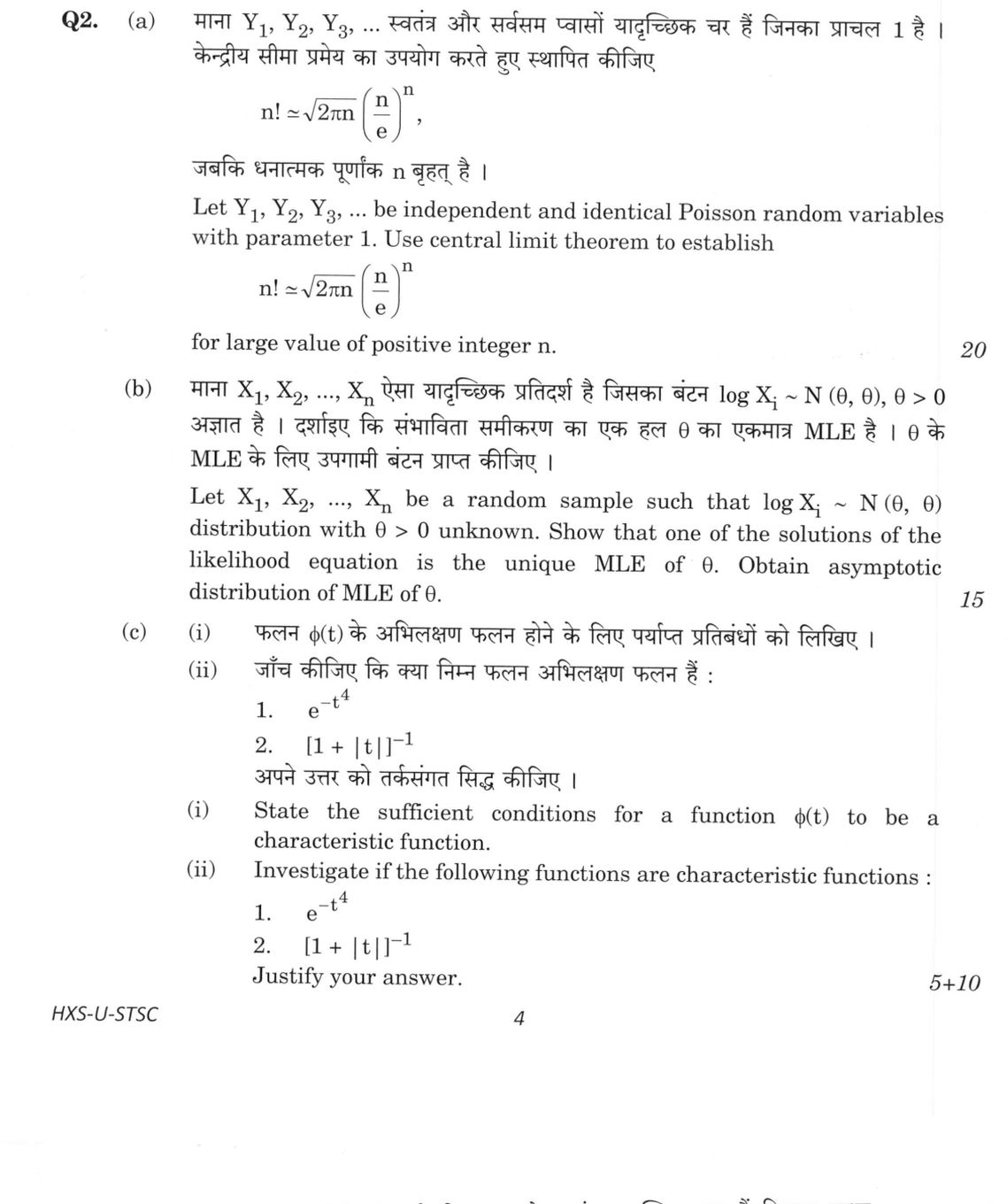
(a) Let Y₁, Y₂, Y₃, ... be independent and identical Poisson random variables with parameter 1. Use central limit theorem to…
Let Y₁, Y₂, Y₃, ... be independent and identical Poisson random variables with parameter 1. Use central limit theorem to establish n! ≃ √(2π n)(n/e)ⁿ for large value of positive integer n. 20 marks
Let X₁, X₂, ..., Xₙ be a random sample such that log Xᵢ ~ N(θ, θ) distribution with θ > 0 unknown. Show that one of the solutions of the likelihood equation is the unique MLE of θ. Obtain asymptotic distribution of MLE of θ. 15 marks
State the sufficient conditions for a function φ(t) to be a characteristic function.
Investigate if the following functions are characteristic functions : 1. e⁻ᵗ⁴ 2. [1 + |t|]⁻¹ Justify your answer. (5+10 marks)
हिंदी में प्रश्न पढ़ें
माना Y₁, Y₂, Y₃, ... स्वतंत्र और सर्वसम व्यासों यादृच्छिक चर हैं जिनका प्राचल 1 है। केन्द्रीय सीमा प्रमेय का उपयोग करते हुए स्थापित कीजिए n! ≃ √(2π n)(n/e)ⁿ, जबकि धनात्मक पूर्णांक n बहुत है। (20 अंक)
माना X₁, X₂, ..., Xₙ ऐसा यादृच्छिक प्रतिदर्श है जिसका बंटन log Xᵢ ~ N(θ, θ), θ > 0 अज्ञात है। दर्शाइए कि संभाविता समीकरण का एक हल θ का एकमात्र MLE है। θ के MLE के लिए उपगामी बंटन प्राप्त कीजिए। (15 अंक)
फलन φ(t) के अभिलक्षण फलन होने के लिए पर्याप्त प्रतिबंधों को लिखिए।
जाँच कीजिए कि क्या निम्न फलन अभिलक्षण फलन हैं : 1. e⁻ᵗ⁴ 2. [1 + |t|]⁻¹ अपने उत्तर को तर्कसंगत सिद्ध कीजिए। (5+10 अंक)
Model answer
Written by UPSC Answer Check against this question's marking rubric, to the expected length. UPSC does not publish answers for Mains — this is one way to score well, not an official key.
(a) Let Sₙ = Y₁ + Y₂ + ⋯ + Yₙ. Since Yᵢ are independent Poisson(1), Sₙ has Poisson(n) distribution. Hence P(Sₙ = n) = e⁻ⁿ nⁿ/n!.
Set Zₙ = (Sₙ − n)/√n. By the central limit theorem, Zₙ → N(0, 1). For lattice random variables, the local central limit theorem gives, for k near n, P(Sₙ = k) ≈ [1/√(2π n)] exp[−(k−n)²/(2n)]. Putting k = n, P(Sₙ = n) ≈ 1/√(2π n). Therefore e⁻ⁿ nⁿ/n! ≈ 1/√(2π n). Rearranging, n! ≈ √(2π n)(n/e)ⁿ. This is valid for large n; the relative error tends to 0.
(b) Let Zᵢ = log Xᵢ. Then Zᵢ ~ N(θ, θ). Its density is f_Z(z; θ) = [1/√(2πθ)] exp[−(z−θ)²/(2θ)]. Since x = eᶻ, the density of Xᵢ is f_X(x; θ) = [1/(x√(2πθ))] exp[−(log x−θ)²/(2θ)], x > 0. The likelihood is L(θ) = (2πθ)^(−n/2) ∏xᵢ⁻¹ exp[−(1/(2θ))Σ(log xᵢ−θ)²]. Thus the log-likelihood is l(θ) = constant − (n/2)log θ − (1/(2θ))Σ(zᵢ−θ)². Expanding the square, Σ(zᵢ−θ)² = Σzᵢ² − 2θΣzᵢ + nθ². So, absorbing constants, l(θ) = C − (n/2)log θ − S/(2θ) − nθ/2, where S = Σzᵢ². Differentiate: l′(θ) = −n/(2θ) + S/(2θ²) − n/2 = n/(2θ²)(S/n − θ − θ²). The likelihood equation l′(θ) = 0 gives θ² + θ − S/n = 0. Hence θ = [−1 ± √(1+4S/n)]/2. Since θ > 0, the only positive solution is θ̂ = [−1 + √(1+4S/n)]/2. For S > 0, which occurs with probability 1, this is positive. Also l′(θ) has the sign of A − θ − θ², where A = S/n > 0. This expression decreases strictly from A > 0 at θ = 0 to −∞ as θ → ∞. Thus l′(θ) changes sign once from positive to negative, so θ̂ is the unique global maximum. Hence θ̂ is the unique MLE.
For asymptotic distribution, the per-observation log-density is log f = −1/2 log(2πθ) − (z−θ)²/(2θ). The score is U(θ) = z²/(2θ²) − 1/(2θ) − 1/2. Then U′(θ) = −z²/θ³ + 1/(2θ²). Fisher information is I(θ) = −E[U′(θ)] = E[z²]/θ³ − 1/(2θ²). Since Z ~ N(θ, θ), E[z²] = θ + θ². Hence I(θ) = (θ+θ²)/θ³ − 1/(2θ²) = (1+2θ)/(2θ²). By asymptotic normality of the MLE, √n(θ̂ − θ) → N(0, 2θ²/(1+2θ)).
(c)(i) By Bochner’s theorem, sufficient conditions for φ(t) to be a characteristic function are:
- φ(0) = 1;
- φ is continuous at 0;
- φ is positive definite, i.e. for all n, real t₁,…,tₙ and complex a₁,…,aₙ, ΣⱼΣₖ φ(tⱼ − tₖ)aⱼ conj(aₖ) ≥ 0. These conditions are also necessary.
(c)(ii)
- Consider φ(t) = e^(−t⁴). If it were a characteristic function of X, then φ′(0) = 0 and φ″(0) = 0, since e^(−t⁴) = 1 − t⁴ + ⋯. But for a characteristic function with second derivative at 0, φ″(0) = −E[X²]. Thus E[X²] = 0, so X = 0 almost surely, giving φ(t) = 1 for all t. This contradicts e^(−t⁴) ≠ 1 for t ≠ 0. Hence e^(−t⁴) is not a characteristic function.
- Consider φ(t) = 1/(1+|t|). Let f(t) = 1/(1+t), t ≥ 0. Then f(0) = 1, f is continuous, even, decreasing, and f′(t) = −1/(1+t)² < 0, f″(t) = 2/(1+t)³ > 0. So f is convex on [0, ∞) and f(t) → 0 as t → ∞. By Polya’s criterion, an even, continuous function with these properties is a characteristic function. Therefore 1/(1+|t|) is a characteristic function.
What "Derive" is asking you to do
Reach the stated expression from a starting relation, justifying every step. The destination is printed in the question, so only the route earns marks, and the assumptions you work under are part of that route.
Structure that answers it
Assumptions and notation defined → starting relation or governing equation → each step with its justification → the required expression → limiting case or boundary check
Where marks are lost
Writing the standard result first and fitting three lines to it, which an examiner reads at a glance. Marks also go on assumptions left unstated — lossless medium, small amplitude, errors independent with zero mean — and on symbols used before they are defined, even when the question says usual notations.
How this answer will be evaluated
Approach
Framework: null. (a) derive: given > assumptions > stepwise derivation > result > check | (b) derive: given > assumptions > stepwise derivation > result > check | (c(i)) enumerate: list the items in order > one line each > no commentary | (c(ii)) justify: claim > 3-4 reasons > evidence > conclusion Full marks: Rigorous derivation with all steps shown and correct asymptotic results.
Key points expected
- Define S_n = sum of n i.i.d. Poisson(1) variables
- State S_n ~ Poisson(n) and apply CLT to standardize
- Relate P(S_n = n) to the normal density at the mean
- Equate the Poisson probability n! term with the normal density
- Write the log-likelihood function for log X_i ~ N(theta, theta)
- Differentiate to find the likelihood equation
- Identify the unique solution as the MLE
- State the asymptotic normal distribution using Fisher information
Evaluation rubric
Each sub-part is marked on its own, against the marks and word limit printed on the paper.
- (a) Derive Stirling's approximation using the Central Limit Theorem for a sum of Poisson variables. 20 marks
derive— given → assumptions → stepwise derivation → result → check
Must cover
- Define S_n = sum of n i.i.d. Poisson(1) variables
- State S_n ~ Poisson(n) and apply CLT to standardize
- Relate P(S_n = n) to the normal density at the mean
- Equate the Poisson probability n! term with the normal density
Loses marks
- Uses Stirling's formula to prove Stirling's formula
- Fails to connect the discrete probability mass to the continuous density
Earns more
- Explicitly states mean and variance of S_n
- Shows the limit as n approaches infinity
- Correctly identifies the standard deviation as sqrt(n)
Extra mark
- Mentions the error term or rate of convergence
- (b) Derive the MLE for theta and determine its asymptotic distribution for a log-normal sample. 15 marks
derive— given → assumptions → stepwise derivation → result → check
Must cover
- Write the log-likelihood function for log X_i ~ N(theta, theta)
- Differentiate to find the likelihood equation
- Identify the unique solution as the MLE
- State the asymptotic normal distribution using Fisher information
Loses marks
- Confuses the variance parameter with the mean parameter
- Fails to justify the uniqueness of the MLE
Earns more
- Calculates the Fisher information I(theta) explicitly
- Verifies the second derivative for uniqueness
Extra mark
- Provides the explicit form of the asymptotic variance
- (c(i)) List the sufficient conditions for a function to be a characteristic function. 5 marks
enumerate— list the items in order → one line each → no commentary
Must cover
- State continuity at the origin
- State positive semi-definiteness
- State normalization phi(0) = 1
Loses marks
- Lists necessary but not sufficient conditions only
- Fails to mention continuity
Earns more
- Mentions Bochner's theorem
Extra mark
- Mentions the symmetry condition phi(-t) = conjugate(phi(t))
- (c(ii)) Justify whether the given functions are characteristic functions. 10 marks
justify— claim → 3-4 reasons → evidence → conclusion
Must cover
- Test e^(-t^4) for positive semi-definiteness
- Test [1+|t|]^-1 for positive semi-definiteness
- Conclude validity for e^(-t^4)
- Conclude invalidity for [1+|t|]^-1
Loses marks
- Claims both are valid without proof
- Fails to check the positive semi-definite condition
Earns more
- Uses the property that the square of a CF is a CF
- Identifies [1+|t|]^-1 as a Laplace CF
Extra mark
- Provides a specific counter-example for the second function
Practice this exact question
Write your answer and it is marked point by point against the model answer above — what you covered, what you missed, what you got wrong.
Evaluate my answer →More from Statistics 2021 Paper I
- Q1 (a) A production unit manufacturing surgical masks is concerned about the quality of thei…
- Q2 (a) Let Y₁, Y₂, Y₃, ... be independent and identical Poisson random variables with parame…
- Q3 (a) Let X and Y be two independent random variables following exponential distribution wi…
- Q4 (a) Let X₁, X₂, ..., Xₙ be a random sample from Poisson distribution with mean λ > 0. Def…
- Q5 (a) For a simple linear regression model Y = β₀ + β₁Xᵢ + εᵢ, i = 1, ..., n (i) Derive the…