Paper I — Q3
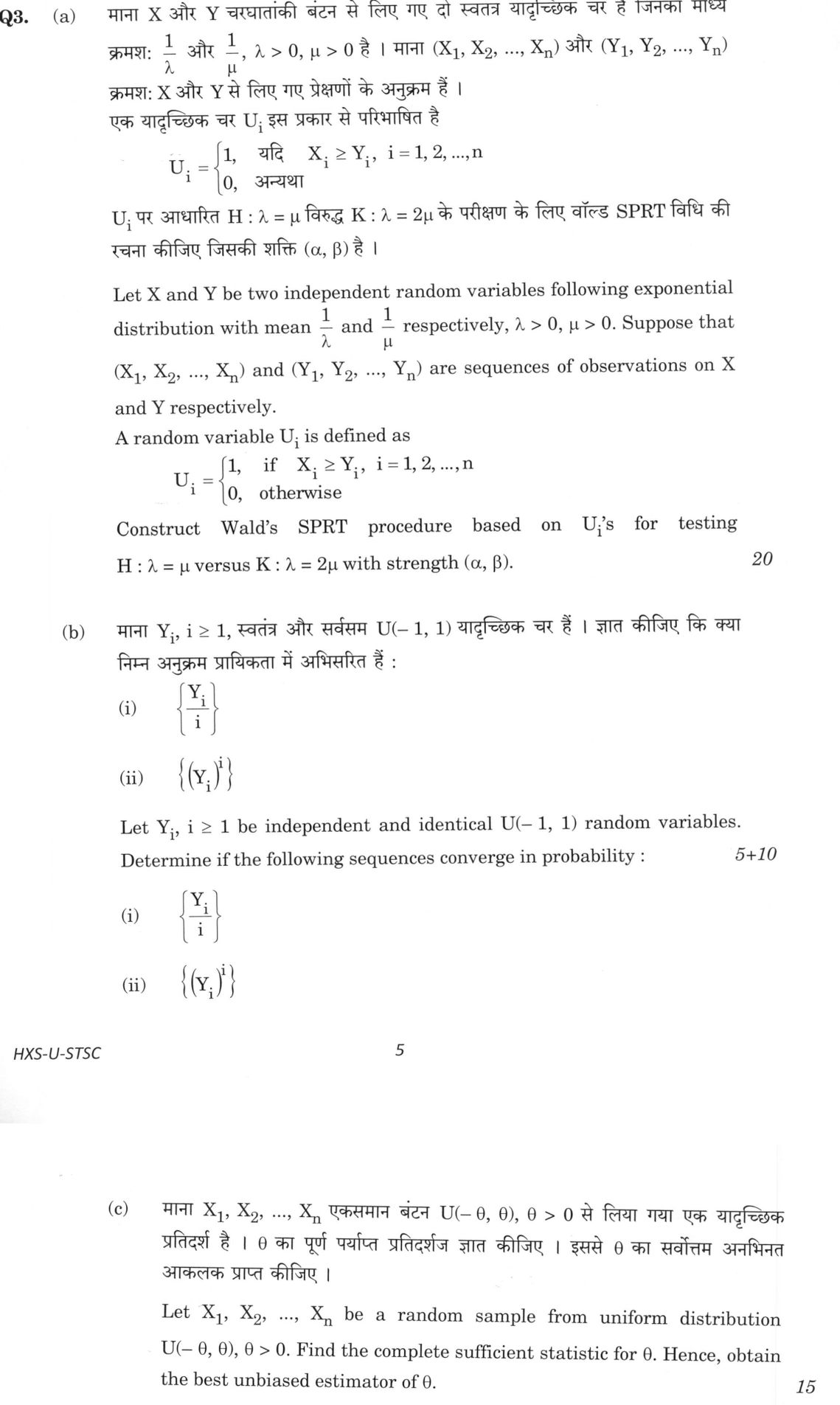
(a) Let X and Y be two independent random variables following exponential distribution with mean 1/(λ) and 1/(μ) respectively, λ…
Let X and Y be two independent random variables following exponential distribution with mean 1/(λ) and 1/(μ) respectively, λ > 0, μ > 0. Suppose that (X₁, X₂, ..., Xₙ) and (Y₁, Y₂, ..., Yₙ) are sequences of observations on X and Y respectively. A random variable Uᵢ is defined as Uᵢ = 1, & if Xᵢ ≥ Yᵢ, i = 1, 2, ..., n 0, & otherwise Construct Wald's SPRT procedure based on Uᵢ's for testing H : λ = μ versus K : λ = 2μ with strength (α, β). 20 marks
Let Yᵢ, i ≥ 1 be independent and identical U(-1, 1) random variables. Determine if the following sequences converge in probability : (i) (Yᵢ)/i (ii) (Yᵢ)ⁱ (5+10 marks)
Let X₁, X₂, ..., Xₙ be a random sample from uniform distribution U(− θ, θ), θ > 0. Find the complete sufficient statistic for θ. Hence, obtain the best unbiased estimator of θ. 15 marks
हिंदी में प्रश्न पढ़ें
माना X और Y चर्यातांकी बंटन से लिए गए दो स्वतंत्र यादृच्छिक चर हैं जिनका माध्य क्रमशः 1/(λ) और 1/(μ), λ > 0, μ > 0 है । माना (X₁, X₂, ..., Xₙ) और (Y₁, Y₂, ..., Yₙ) क्रमशः X और Y से लिए गए प्रेक्षणों के अनुक्रम हैं । एक यादृच्छिक चर Uᵢ इस प्रकार से परिभाषित है Uᵢ = 1, & यदि Xᵢ ≥ Yᵢ, i = 1, 2, ..., n 0, & अन्यथा Uᵢ पर आधारित H : λ = μ विरुद्ध K : λ = 2μ के परीक्षण के लिए वाल्ड SPRT विधि की रचना कीजिए जिसकी शक्ति (α, β) है । (20 अंक)
माना Yᵢ, i ≥ 1, स्वतंत्र और सर्वसम U(-1, 1) यादृच्छिक चर हैं । ज्ञात कीजिए कि क्या निम्न अनुक्रम प्रायिकता में अभिसरित हैं : (i) (Yᵢ)/i (ii) (Yᵢ)ⁱ (5+10 अंक)
माना X₁, X₂, ..., Xₙ एकसमान बंटन U(− θ, θ), θ > 0 से लिया गया एक यादृच्छिक प्रतिदर्श है । θ का पूर्ण पर्याप्त प्रतिदर्शज्ञात कीजिए । इससे θ का सर्वोत्तम अनभिनत आकलक प्राप्त कीजिए । (15 अंक)
Model answer
Written by UPSC Answer Check against this question's marking rubric, to the expected length. UPSC does not publish answers for Mains — this is one way to score well, not an official key.
(a) Let p = P(X ≥ Y). Since X and Y are independent exponential with rates λ and μ,
p = ∫₀∞ P(X ≥ y) μ e^(−μy) dy = ∫₀∞ e^(−λy) μ e^(−μy) dy = μ/(λ+μ).
Ties have probability zero. Under H : λ = μ, p₀ = μ/(μ+μ) = 1/2. Under K : λ = 2μ, p₁ = μ/(2μ+μ) = 1/3. Hence U₁, U₂, ..., Uₙ are iid Bernoulli(p), with p₀ = 1/2 under H and p₁ = 1/3 under K. Let Sₙ = Σ Uᵢ.
For H : p = p₀ and K : p = p₁, the likelihood ratio is
Λₙ = ∏ [p₁^Uᵢ (1−p₁)^(1−Uᵢ)] / [p₀^Uᵢ (1−p₀)^(1−Uᵢ)] = (p₁/p₀)^Sₙ ((1−p₁)/(1−p₀))^(n−Sₙ) = (2/3)^Sₙ (4/3)^(n−Sₙ).
Therefore
log Λₙ = n log(4/3) − Sₙ log 2.
Let A = log(β/(1−α)) and B = log((1−β)/α), assuming 0 < α, β < 1 and α + β < 1. Wald’s SPRT is:
- if log Λₙ ≤ A, stop and accept H;
- if log Λₙ ≥ B, stop and reject H, i.e. accept K;
- if A < log Λₙ < B, continue sampling.
Equivalently, in terms of Sₙ:
- Accept H if Sₙ ≥ [n log(4/3) − log(β/(1−α))]/log 2.
- Reject H if Sₙ ≤ [n log(4/3) − log((1−β)/α)]/log 2.
- Continue if [n log(4/3) − log((1−β)/α)]/log 2 < Sₙ < [n log(4/3) − log(β/(1−α))]/log 2.
This is the required Wald SPRT based on the Uᵢ’s.
(b) Let Yᵢ ~ U(−1, 1) independently.
(i) For ε > 0,
P(|Yᵢ/i| > ε) = P(|Yᵢ| > iε).
Since |Yᵢ| ≤ 1 almost surely, this probability is 0 whenever iε ≥ 1. Hence for i > 1/ε, it is exactly 0. Therefore
P(|Yᵢ/i| > ε) → 0 as i → ∞.
Thus {Yᵢ/i} converges in probability to 0.
(ii) For ε > 0,
P(|Yᵢⁱ| > ε) = P(|Yᵢ| > ε^(1/i)).
If ε ≥ 1, this probability is 0. If 0 < ε < 1,
P(|Yᵢ| > ε^(1/i)) = 1 − ε^(1/i) = 1 − exp((log ε)/i).
As i → ∞, exp((log ε)/i) → 1, so the probability tends to 0. Hence {Yᵢⁱ} converges in probability to 0.
(c) The joint density of X₁, X₂, ..., Xₙ is
f(x₁, ..., xₙ; θ) = (2θ)^(−n), if −θ ≤ xᵢ ≤ θ for all i, and 0 otherwise.
This is equivalent to θ ≥ maxᵢ |xᵢ|. Therefore, by the factorization theorem, T = max₁≤i≤n |Xᵢ| is sufficient for θ.
The distribution of T is
P(T ≤ t) = P(|Xᵢ| ≤ t for all i) = (t/θ)ⁿ, 0 ≤ t ≤ θ.
Hence the density of T is
f_T(t) = n tⁿ⁻¹ / θⁿ, 0 < t < θ.
To prove completeness, suppose Eθ[g(T)] = 0 for all θ > 0. Then
∫₀θ g(t) n tⁿ⁻¹ / θⁿ dt = 0,
so
∫₀θ g(t) tⁿ⁻¹ dt = 0 for all θ > 0.
Differentiating with respect to θ gives g(θ)θⁿ⁻¹ = 0 almost everywhere, hence g = 0 almost everywhere. Thus T is complete sufficient.
Now
Eθ[T] = ∫₀θ t n tⁿ⁻¹ / θⁿ dt = nθ/(n+1).
Therefore
θ̂ = (n+1)/n T = (n+1)/n max₁≤i≤n |Xᵢ|
satisfies Eθ[θ̂] = θ. Since θ̂ is unbiased and is a function of the complete sufficient statistic T, by the Lehmann–Scheffé theorem it is the best unbiased estimator of θ.
What "Construct" is asking you to do
Build the required object — a velocity diagram, a sequential test, a control chart, a geometrical figure — step by step, so the sequence is visible on the page. The steps are marked, not only the finished thing.
Structure that answers it
Data and requirement → scale or basis chosen, stated → construction steps in order → the finished construction, labelled → quantities read off, or the result it yields
Where marks are lost
A diagram drawn without a stated scale, so nothing can be scaled off it and the quantities that follow lose their support. In statistics, writing down the procedure without fixing its defining constants — stopping bounds in terms of the two error probabilities, or the control limits — leaves it unmarkable.
How this answer will be evaluated
Approach
Framework: Wald's Sequential Probability Ratio Test (SPRT). (a) calculate: given > formula > substitution > result with units > interpretation | (b) calculate: given > formula > substitution > result with units > interpretation | (c) calculate: given > formula > substitution > result with units > interpretation Full marks: Rigorous derivation with all steps shown and correct interpretation.
Key points expected
- P(U_i=1) = lambda/(lambda+mu)
- Likelihood ratio L_n = (lambda/(lambda+mu))^S * (mu/(lambda+mu))^(n-S)
- Convergence in probability definition
- M = max(|X_i|) is complete sufficient
- UMVUE = (n+1)/n * M
Evaluation rubric
Each sub-part is marked on its own, against the marks and word limit printed on the paper.
- (a) Derive the likelihood ratio for U_i and define the stopping boundaries for H vs K. 20 marks
calculate— given → formula → substitution → result with units → interpretation
Must cover
- Calculate P(U_i=1) under H and K
- Formulate the likelihood ratio L_n
- Define stopping boundaries A and B
- State the decision rule for H, K, or continue
Loses marks
- Skipping the probability calculation for U_i
- Confusing the likelihood ratio with the test statistic
Earns more
- Explicit calculation of P(X_i >= Y_i)
- Correct substitution of lambda and mu values
- Clear definition of alpha and beta roles
Extra mark
- Mention of expected sample size
- (b) Prove convergence in probability for the two given sequences. 15 marks
calculate— given → formula → substitution → result with units → interpretation
Must cover
- Apply Markov's inequality or Chebyshev's inequality
- Show limit of P(|X_n - c| > epsilon) is 0
- Handle the bounded nature of U(-1, 1) for (i)
- Analyze the exponential growth for (ii)
Loses marks
- Assuming convergence without proof
- Incorrect application of limit laws
Earns more
- Explicit use of the definition of convergence in probability
- Correct handling of the exponent in (ii)
Extra mark
- Alternative proof using almost sure convergence
- (c) Identify the complete sufficient statistic and derive the UMVUE for theta. 15 marks
calculate— given → formula → substitution → result with units → interpretation
Must cover
- Identify M = max(|X_i|) as sufficient statistic
- Prove completeness of M
- Find an unbiased estimator based on M
- Apply Lehmann-Scheffe theorem
Loses marks
- Using sum of X_i instead of max
- Failing to prove completeness
Earns more
- Correct derivation of the distribution of M
- Clear statement of the UMVUE formula
Extra mark
- Mention of the Cramer-Rao lower bound
Practice this exact question
Write your answer and it is marked point by point against the model answer above — what you covered, what you missed, what you got wrong.
Evaluate my answer →More from Statistics 2021 Paper I
- Q1 (a) A production unit manufacturing surgical masks is concerned about the quality of thei…
- Q2 (a) Let Y₁, Y₂, Y₃, ... be independent and identical Poisson random variables with parame…
- Q3 (a) Let X and Y be two independent random variables following exponential distribution wi…
- Q4 (a) Let X₁, X₂, ..., Xₙ be a random sample from Poisson distribution with mean λ > 0. Def…
- Q5 (a) For a simple linear regression model Y = β₀ + β₁Xᵢ + εᵢ, i = 1, ..., n (i) Derive the…
- Q6 (a) For a multiple linear regression model with three covariates X₁, X₂ and X₃, let rᵢⱼ d…