Paper I — Q6
(a) For a multiple linear regression model with three covariates X₁, X₂ and X₃, let rᵢⱼ denote the correlation coefficient…
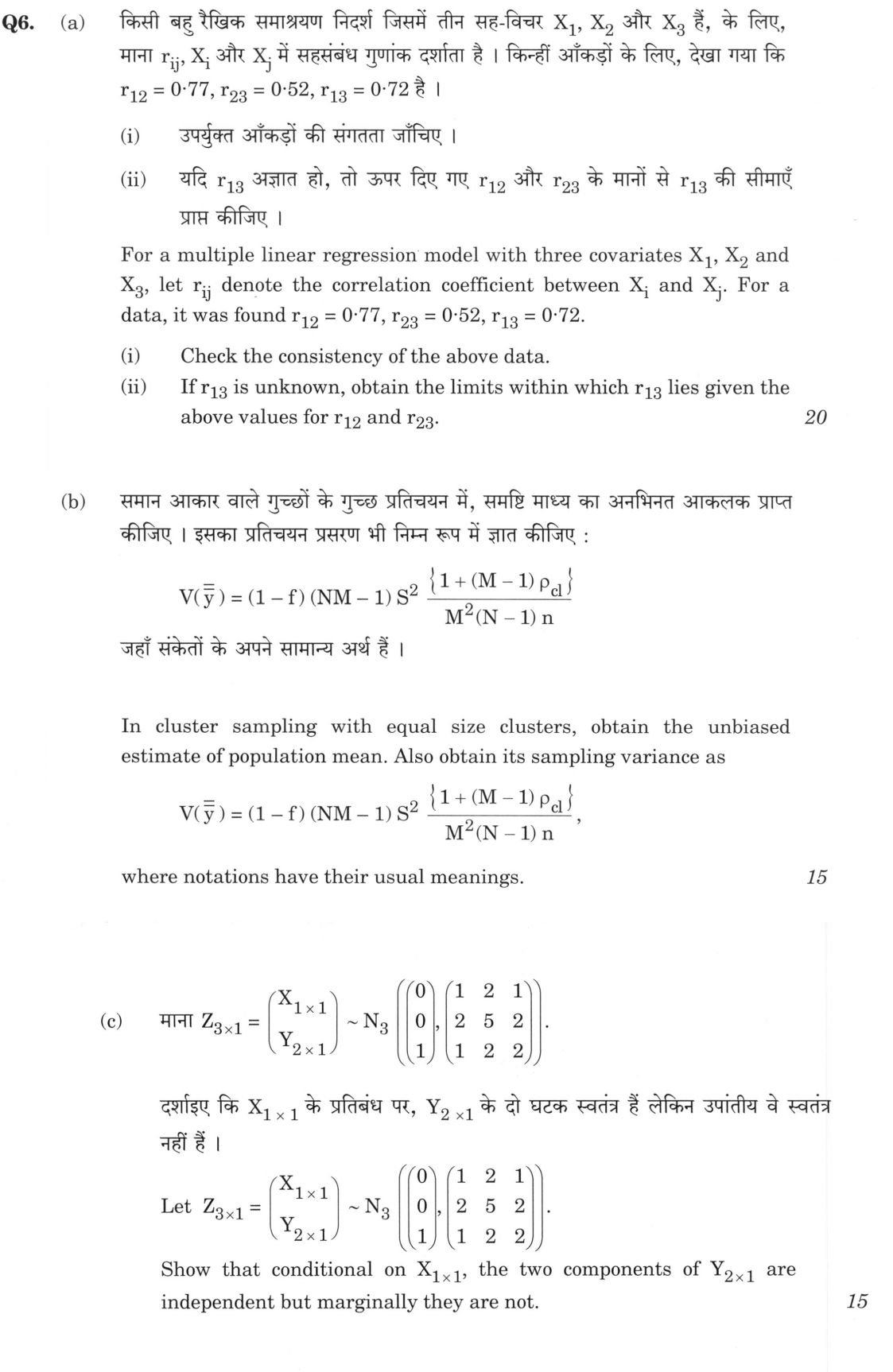
For a multiple linear regression model with three covariates X₁, X₂ and X₃, let rᵢⱼ denote the correlation coefficient between Xᵢ and Xⱼ. For a data, it was found r₁₂ = 0·77, r₂₃ = 0·52, r₁₃ = 0·72.
Check the consistency of the above data.
If r₁₃ is unknown, obtain the limits within which r₁₃ lies given the above values for r₁₂ and r₂₃. 20 marks
In cluster sampling with equal size clusters, obtain the unbiased estimate of population mean. Also obtain its sampling variance as
V(ȳ̄) = (1-f)(NM-1)S²{1+(M-1)ρcl}/[M²(N-1)n],
where notations have their usual meanings. 15 marks
Let Z₃ₓ₁ = (X₁ₓ₁, Y₂ₓ₁)ᵀ ~ N₃((0, 0, 1)ᵀ, [[1, 2, 1], [2, 5, 2], [1, 2, 2]]).
Show that conditional on X₁ₓ₁, the two components of Y₂ₓ₁ are independent but marginally they are not. 15 marks
हिंदी में प्रश्न पढ़ें
किसी बहु रैखिक समाश्रयण निदर्श जिसमें तीन सह-विचर X₁, X₂ और X₃ हैं, के लिए, माना rᵢⱼ, Xᵢ और Xⱼ में सहसंबंध गुणांक दर्शाता है। किन्हीं आँकड़ों के लिए, देखा गया कि r₁₂ = 0·77, r₂₃ = 0·52, r₁₃ = 0·72 है।
उपर्युक्त आँकड़ों की संगतता जाँचिए।
यदि r₁₃ अज्ञात हो, तो ऊपर दिए गए r₁₂ और r₂₃ के मानों से r₁₃ की सीमाएँ प्राप्त कीजिए। 20
समान आकार वाले गुच्छों के गुच्छ प्रतिचयन में, समष्टि माध्य का अनभिनत आकलक प्राप्त कीजिए। इसका प्रतिचयन प्रसरण भी निम्न रूप में ज्ञात कीजिए :
V(ȳ̄) = (1-f)(NM-1)S²{1+(M-1)ρcl}/[M²(N-1)n]
जहाँ संकेतों के अपने सामान्य अर्थ हैं। 15
माना Z₃ₓ₁ = (X₁ₓ₁, Y₂ₓ₁)ᵀ ~ N₃((0, 0, 1)ᵀ, [[1, 2, 1], [2, 5, 2], [1, 2, 2]]).
दर्शाइए कि X₁ₓ₁ के प्रतिबंध पर, Y₂ₓ₁ के दो घटक स्वतंत्र हैं लेकिन उपांतिय वे स्वतंत्र नहीं हैं। 15
Model answer
Written by UPSC Answer Check against this question's marking rubric, to the expected length. UPSC does not publish answers for Mains — this is one way to score well, not an official key.
(a)(i) For three correlations, consistency requires the correlation matrix R = [[1, r₁₂, r₁₃], [r₁₂, 1, r₂₃], [r₁₃, r₂₃, 1]] to be positive semidefinite. Since all diagonal entries are 1 and the given correlations lie in (-1, 1), it is enough to check det(R) ≥ 0.
det(R) = 1 + 2r₁₂r₂₃r₁₃ − r₁₂² − r₂₃² − r₁₃² = 1 + 2(0·77)(0·52)(0·72) − (0·77)² − (0·52)² − (0·72)² = 1 + 0·576576 − 0·5929 − 0·2704 − 0·5184 = 0·194876 = 48719/250000 > 0.
Hence R is positive definite, so the given data are consistent.
(a)(ii) Let x = r₁₃. Positive semidefiniteness requires 1 + 2(0·77)(0·52)x − (0·77)² − (0·52)² − x² ≥ 0. So x² − 2(0·77)(0·52)x + [(0·77)² + (0·52)² − 1] ≤ 0.
Solving the quadratic, x = (0·77)(0·52) ± √[(1 − (0·77)²)(1 − (0·52)²)] = 0·4004 ± √[(0·4071)(0·7296)] = 0·4004 ± √0·29702016 = 0·4004 ± 0·54499556.
Therefore −0·14459556 ≤ r₁₃ ≤ 0·94539556, or exactly 1001/2500 − √(1856376/6250000) ≤ r₁₃ ≤ 1001/2500 + √(1856376/6250000). The given value r₁₃ = 0·72 lies in this interval.
(b) Let the population have N clusters, each of equal size M, with elements yᵢⱼ, i = 1,…,N, j = 1,…,M. Let Ȳᵢ = (1/M)Σⱼ yᵢⱼ, Ȳ = (1/N)Σᵢ Ȳᵢ. A simple random sample without replacement of n clusters is selected. Define ȳ̄ = (1/n)Σᵢ∈s Ȳᵢ. Equivalently, ȳ̄ = (1/(nM))Σᵢ∈sΣⱼ yᵢⱼ. Since each cluster has inclusion probability n/N, E(ȳ̄) = (1/n)(n/N)Σᵢ Ȳᵢ = (1/N)Σᵢ Ȳᵢ = Ȳ. Thus ȳ̄ is an unbiased estimator of the population mean Ȳ.
Now let S_b² = (1/(N−1))Σᵢ(Ȳᵢ − Ȳ)² and f = n/N. Since the sample is SRSWOR of n cluster means from N clusters, V(ȳ̄) = (1−f)S_b²/n.
Write dᵢⱼ = yᵢⱼ − Ȳ. Then Ȳᵢ − Ȳ = (1/M)Σⱼ dᵢⱼ, so Σᵢ(Ȳᵢ − Ȳ)² = (1/M²)[ΣᵢΣⱼ dᵢⱼ² + ΣᵢΣⱼ≠ₖ dᵢⱼdᵢₖ].
Let S² = (1/(NM−1))ΣᵢΣⱼ dᵢⱼ² and define the intracluster correlation ρcl = [ΣᵢΣⱼ≠ₖ dᵢⱼdᵢₖ]/[(M−1)ΣᵢΣⱼ dᵢⱼ²]. Then ΣᵢΣⱼ≠ₖ dᵢⱼdᵢₖ = (M−1)(NM−1)S²ρcl. Hence Σᵢ(Ȳᵢ − Ȳ)² = (NM−1)S²[1 + (M−1)ρcl]/M².
Substituting into V(ȳ̄), V(ȳ̄) = (1−f)(NM−1)S²[1 + (M−1)ρcl]/[M²(N−1)n]. This is valid for equal-size clusters; if M = 1, the formula reduces to the usual SRSWOR result.
(c) Partition Z = (X, Y₁, Y₂)ᵀ, where X is scalar and Y = (Y₁, Y₂)ᵀ. The mean and covariance are μ = (0, 0, 1)ᵀ, Σ = [[1, 2, 1], [2, 5, 2], [1, 2, 2]].
Thus μ_X = 0, μ_Y = (0, 1)ᵀ, Σ_XX = 1, Σ_XY = (2, 1), Σ_YX = (2, 1)ᵀ, Σ_YY = [[5, 2], [2, 2]].
For a multivariate normal, Y | X = x ~ N(μ_Y + Σ_YXΣ_XX⁻¹(x − μ_X), Σ_YY − Σ_YXΣ_XX⁻¹Σ_XY). Since Σ_XX = 1, conditional mean = (0, 1)ᵀ + (2, 1)ᵀx = (2x, 1 + x)ᵀ, conditional covariance = [[5, 2], [2, 2]] − [[4, 2], [2, 1]] = [[1, 0], [0, 1]].
So conditional on X, the covariance between Y₁ and Y₂ is 0. For a bivariate normal, zero covariance implies independence. Therefore, conditional on X, Y₁ and Y₂ are independent.
Marginally, Y = (Y₁, Y₂)ᵀ ~ N((0, 1)ᵀ, [[5, 2], [2, 2]]). Here Cov(Y₁, Y₂) = 2 ≠ 0, and Corr(Y₁, Y₂) = 2/√10 = √(2/5) ≠ 0. Hence Y₁ and Y₂ are marginally dependent, not independent. Thus conditional independence holds, but marginal independence does not.
What "Derive" is asking you to do
Reach the stated expression from a starting relation, justifying every step. The destination is printed in the question, so only the route earns marks, and the assumptions you work under are part of that route.
Structure that answers it
Assumptions and notation defined → starting relation or governing equation → each step with its justification → the required expression → limiting case or boundary check
Where marks are lost
Writing the standard result first and fitting three lines to it, which an examiner reads at a glance. Marks also go on assumptions left unstated — lossless medium, small amplitude, errors independent with zero mean — and on symbols used before they are defined, even when the question says usual notations.
How this answer will be evaluated
Approach
(a(i)) calculate: given > formula > substitution > result with units > interpretation | (a(ii)) calculate: given > formula > substitution > result with units > interpretation | (b) derive: given > assumptions > stepwise derivation > result > check | (c) calculate: given > formula > substitution > result with units > interpretation Full marks: All parts fully derived with correct notation and interpretation
Key points expected
- Construct the 3x3 correlation matrix R
- Calculate the determinant of R
- Check if det(R) is non-negative
- State the consistency condition for correlation coefficients
- State the inequality for the determinant of a 3x3 correlation matrix
- Substitute the known values r12 and r23
- Solve the quadratic inequality for r13
- State the final interval for r13
Evaluation rubric
Each sub-part is marked on its own, against the marks and word limit printed on the paper.
- (a(i)) Verify if the given correlation matrix is positive semi-definite.
calculate— given → formula → substitution → result with units → interpretation
Must cover
- Construct the 3x3 correlation matrix R
- Calculate the determinant of R
- Check if det(R) is non-negative
- State the consistency condition for correlation coefficients
Loses marks
- Assuming consistency without calculation
- Arithmetic errors in determinant expansion
Earns more
- Explicitly writing the matrix with r12, r23, r13
- Showing the expansion of the determinant
Extra mark
- Mentioning the principal minors condition
- (a(ii)) Determine the range of possible values for r13 given r12 and r23.
calculate— given → formula → substitution → result with units → interpretation
Must cover
- State the inequality for the determinant of a 3x3 correlation matrix
- Substitute the known values r12 and r23
- Solve the quadratic inequality for r13
- State the final interval for r13
Loses marks
- Incorrect inequality direction
- Failing to solve the quadratic equation
Earns more
- Showing the step-by-step algebraic manipulation
- Verifying the result against the consistency condition
Extra mark
- Geometric interpretation of the correlation bounds
- (b) Derive the unbiased estimator and its variance for cluster sampling. 15 marks
derive— given → assumptions → stepwise derivation → result → check
Must cover
- Define the estimator for the population mean
- Show the estimator is unbiased
- Derive the variance formula step-by-step
- Match the final formula to the one given in the question
Loses marks
- Skipping the unbiasedness proof
- Incorrect algebraic steps in variance derivation
Earns more
- Defining all notations (N, M, n, f, S^2, rho_cl)
- Showing the expansion of the variance terms
Extra mark
- Mentioning the finite population correction factor (1-f)
- (c) Show conditional independence of Y components given X, but marginal dependence. 15 marks
calculate— given → formula → substitution → result with units → interpretation
Must cover
- Partition the mean vector and covariance matrix
- Calculate the conditional covariance matrix of Y given X
- Show the off-diagonal element of the conditional covariance is zero
- Show the marginal covariance of Y components is non-zero
Loses marks
- Incorrect matrix partitioning
- Failing to distinguish conditional vs marginal covariance
Earns more
- Correctly identifying the sub-matrices (Sigma_11, Sigma_12, etc.)
- Explicitly calculating the Schur complement
Extra mark
- Interpreting the result in terms of partial correlation
Practice this exact question
Write your answer and it is marked point by point against the model answer above — what you covered, what you missed, what you got wrong.
Evaluate my answer →More from Statistics 2021 Paper I
- Q3 (a) Let X and Y be two independent random variables following exponential distribution wi…
- Q4 (a) Let X₁, X₂, ..., Xₙ be a random sample from Poisson distribution with mean λ > 0. Def…
- Q5 (a) For a simple linear regression model Y = β₀ + β₁Xᵢ + εᵢ, i = 1, ..., n (i) Derive the…
- Q6 (a) For a multiple linear regression model with three covariates X₁, X₂ and X₃, let rᵢⱼ d…
- Q7 (a) (i) What is confounding in factorial experiments ? (ii) A 2^6factorial experiment is…
- Q8 (a) (i) In stratified sampling under optimum allocation, how will you proceed to select u…