Paper I — Q7
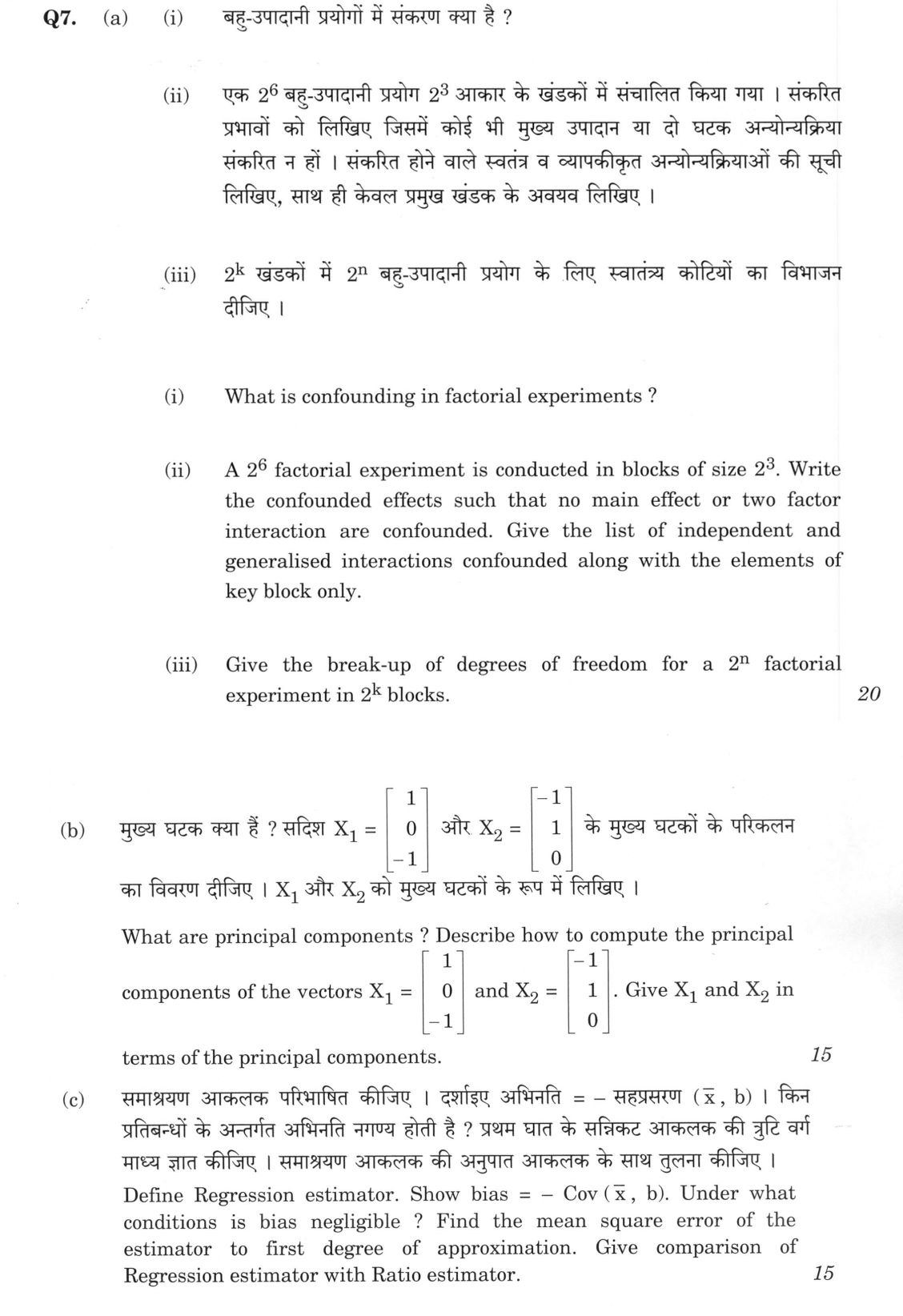
(a) (i) What is confounding in factorial experiments ? (ii) A 2^6factorial experiment is conducted in blocks of size2³. Write…
What is confounding in factorial experiments ?
A 2^6factorial experiment is conducted in blocks of size2³. Write the confounded effects such that no main effect or two factor interaction are confounded. Give the list of independent and generalised interactions confounded along with the elements of key block only.
Give the break-up of degrees of freedom for a 2^nfactorial experiment in2^k blocks.
What are principal components ? Describe how to compute the principal components of the vectors X₁ = 1 0 -1 and X₂ = -1 1 0 . Give X₁ and X₂ in terms of the principal components.
Define Regression estimator. Show bias = – Cov (x̄, b). Under what conditions is bias negligible ? Find the mean square error of the estimator to first degree of approximation. Give comparison of Regression estimator with Ratio estimator.
हिंदी में प्रश्न पढ़ें
बहु-उपादानी प्रयोगों में संकरण क्या है ?
एक 2⁶बहु-उपादानी प्रयोग2³ आकार के खंडकों में संचालित किया गया। संकीर्ण प्रभावों को लिखिए जिसमें कोई भी मुख्य उपादान या दो घटक अन्योन्यक्रिया संकीर्ण न हों। संकीर्ण होने वाले स्वतंत्र व व्यापकीकृत अन्योन्यक्रियाओं की सूची लिखिए, साथ ही केवल प्रमुख खंडक के अवयव लिखिए।
2^kखंडकों में2ⁿ बहु-उपादानी प्रयोग के लिए स्वातंत्र्य कोटियों का विभाजन दीजिए।
मुख्य घटक क्या हैं ? सदिश X₁ = 1 0 -1 और X₂ = -1 1 0 के मुख्य घटकों के परिकलन का विवरण दीजिए । X₁ और X₂ को मुख्य घटकों के रूप में लिखिए ।
समाश्रयण आकलक परिभाषित कीजिए । दर्शाइए अभिनति = – सहप्रसरण (x̄, b) । किन प्रतिबंधों के अंतर्गत अभिनति नगण्य होती है ? प्रथम घात के सन्निकट आकलक की त्रुटि वर्ग माध्य ज्ञात कीजिए । समाश्रयण आकलक की अनुपात आकलक के साथ तुलना कीजिए ।
Model answer
Written by UPSC Answer Check against this question's marking rubric, to the expected length. UPSC does not publish answers for Mains — this is one way to score well, not an official key.
(a)(i) Confounding in factorial experiments means deliberately arranging treatment combinations in blocks so that one or more treatment contrasts, usually higher-order interactions, become indistinguishable from block differences. The information on the confounded effects cannot be separated from block effects.
(a)(ii) Let the six factors be A, B, C, D, E, F. In a 2⁶ experiment in blocks of size 2³, there are 2³ = 8 blocks, so 8 − 1 = 7 treatment degrees of freedom are confounded.
Choose independent defining contrasts of order 3: ABC, ADE, BDF.
Their generalised interactions are: ABC·ADE = BCDE, ABC·BDF = ACDF, ADE·BDF = ABEF, ABC·ADE·BDF = CEF.
Thus the confounded effects are: ABC, ADE, BDF, BCDE, ACDF, ABEF, CEF. No main effect or two-factor interaction is confounded.
Taking the key block as the block containing (1), its elements are: (1), ABD, ABEF, ACDF, ACE, BCDE, BCF, DEF.
(a)(iii) For a 2ⁿ factorial in 2ᵏ blocks of size 2ⁿ⁻ᵏ, for one replication:
- Total df = 2ⁿ − 1.
- Blocks df = 2ᵏ − 1.
- Confounded treatment contrasts df = 2ᵏ − 1.
- Unconfounded treatment df = (2ⁿ − 1) − (2ᵏ − 1) = 2ⁿ − 2ᵏ.
If there are r replications:
- Replication df = r − 1.
- Blocks within replications df = r(2ᵏ − 1).
- Unconfounded treatments df = 2ⁿ − 2ᵏ.
- Error df = (r − 1)(2ⁿ − 2ᵏ).
- Total df = r2ⁿ − 1.
For r = 1, error df is zero unless higher-order interactions are assumed negligible.
(b) Principal components are uncorrelated linear combinations of the original variables chosen successively to have maximum variance, obtained from the eigenvectors of the covariance or correlation matrix.
Treat X₁ and X₂ as two variables observed on three units: X₁ = [1, 0, −1]ᵗ, X₂ = [−1, 1, 0]ᵗ.
Their means are X̄₁ = 0 and X̄₂ = 0. The sample covariance matrix, using divisor n − 1 = 2, is S = [ [1, −1/2], [−1/2, 1] ].
Eigenvalues satisfy |S − λI| = 0: (1 − λ)² − 1/4 = 0 ⇒ λ₁ = 3/2, λ₂ = 1/2.
For λ₁ = 3/2, eigenvector is (1, −1)ᵗ/√2. For λ₂ = 1/2, eigenvector is (1, 1)ᵗ/√2.
Hence the principal components are Y₁ = (X₁ − X₂)/√2, Y₂ = (X₁ + X₂)/√2.
Numerically, Y₁ = [2, −1, −1]ᵗ/√2, Y₂ = [0, 1, −1]ᵗ/√2.
Inverting, X₁ = (Y₁ + Y₂)/√2, X₂ = (Y₂ − Y₁)/√2.
(c) Let y be the study variable and x an auxiliary variable with known population mean X̄. From a simple random sample of size n, compute ȳ, x̄ and the sample regression coefficient b = sₓᵧ/sₓ². The regression estimator of the population mean Ȳ is T_reg = ȳ + b(X̄ − x̄).
For its bias, E(T_reg) = E(ȳ) + X̄ E(b) − E(b x̄). Since E(ȳ) = Ȳ, Bias(T_reg) = X̄ E(b) − E(b x̄) = −[E(b x̄) − E(b)E(x̄)] = −Cov(x̄, b).
The bias is negligible when n is large, because x̄ − X̄ and b − β are both of order n⁻¹ᐟ², so Cov(x̄, b) is of order n⁻¹, while the standard error is of order n⁻¹ᐟ². It is exactly zero if b is a preassigned constant or independent of x̄.
To first degree of approximation, T_reg − Ȳ ≈ (ȳ − Ȳ) − β(x̄ − X̄), where β = Sₓᵧ/Sₓ². Therefore MSE(T_reg) ≈ Var(ȳ) + β²Var(x̄) − 2β Cov(ȳ, x̄) = (1 − f)/n [Sᵧ² + β²Sₓ² − 2βSₓᵧ] = (1 − f)/n [Sᵧ² − Sₓᵧ²/Sₓ²] = (1 − f)/n Sᵧ²(1 − ρ²), where f = n/N and ρ is the population correlation between y and x.
For the ratio estimator T_R = ȳ X̄/x̄, MSE(T_R) ≈ (1 − f)/n [Sᵧ² + R²Sₓ² − 2R Sₓᵧ], R = Ȳ/X̄. Thus MSE(T_R) − MSE(T_reg) ≈ (1 − f)/n Sₓ²(R − β)² ≥ 0. So the regression estimator is asymptotically at least as efficient as the ratio estimator; they coincide when the regression line passes through the origin, i.e. R = β.
What "Derive" is asking you to do
Reach the stated expression from a starting relation, justifying every step. The destination is printed in the question, so only the route earns marks, and the assumptions you work under are part of that route.
Structure that answers it
Assumptions and notation defined → starting relation or governing equation → each step with its justification → the required expression → limiting case or boundary check
Where marks are lost
Writing the standard result first and fitting three lines to it, which an examiner reads at a glance. Marks also go on assumptions left unstated — lossless medium, small amplitude, errors independent with zero mean — and on symbols used before they are defined, even when the question says usual notations.
How this answer will be evaluated
Approach
Framework: UPSC Statistics Paper 1. (a(i)) define: precise definition > the distinguishing feature > one example | (a(ii)) calculate: given > formula > substitution > result with units > interpretation | (a(iii)) enumerate: list the items in order > one line each > no commentary | (b) describe: define > structure or process in order > labelled diagram > significance | (c) derive: given > assumptions > stepwise derivation > result > check Full marks: All parts fully addressed with correct derivations, clear notation, and complete comparisons.
Key points expected
- Define confounding as aliasing effects with blocks
- Mention loss of independent estimation
- State purpose: reduce experimental runs
- Identify 3 independent interactions (3-factor)
- List all 7 confounded effects (independent + generalized)
- Calculate elements of the key block
- Ensure no main or 2-factor effects are confounded
- Total df = 2^n - 1
Evaluation rubric
Each sub-part is marked on its own, against the marks and word limit printed on the paper.
- (a(i)) Definition of confounding in factorial experiments.
define— precise definition → the distinguishing feature → one example
Must cover
- Define confounding as aliasing effects with blocks
- Mention loss of independent estimation
- State purpose: reduce experimental runs
Loses marks
- Confusing confounding with blocking
- Vague definition without technical terms
Earns more
- Mention specific example of confounded effect
- (a(ii)) Confounded effects, independent/generalised interactions, and key block elements for 2^6 in 2^3 blocks.
calculate— given → formula → substitution → result with units → interpretation
Must cover
- Identify 3 independent interactions (3-factor)
- List all 7 confounded effects (independent + generalized)
- Calculate elements of the key block
- Ensure no main or 2-factor effects are confounded
Loses marks
- Confounding a main effect or 2-factor interaction
- Incorrect calculation of key block elements
Earns more
- Correct notation for interaction terms
- Clear tabulation of key block elements
- (a(iii)) Break-up of degrees of freedom for 2^n factorial in 2^k blocks.
enumerate— list the items in order → one line each → no commentary
Must cover
- Total df = 2^n - 1
- Blocks df = 2^k - 1
- Error df = 2^n - 2^k
- Treatment df = 2^n - 1
Loses marks
- Incorrect total df calculation
- Missing error df component
Earns more
- Clear tabular presentation of df
- (b) Definition of principal components, computation for given vectors, and expression of X1, X2 in terms of PCs. 15 marks
describe— define → structure or process in order → labelled diagram → significance
Must cover
- Define principal components as linear combinations
- Compute covariance matrix of X1 and X2
- Find eigenvalues and eigenvectors
- Express X1 and X2 in terms of principal components
Loses marks
- Incorrect covariance matrix calculation
- Failure to express X1, X2 in terms of PCs
Earns more
- Correct calculation of covariance matrix
- Accurate eigenvalue/eigenvector computation
- (c) Definition of regression estimator, bias derivation, conditions for negligible bias, MSE to first degree, and comparison with ratio estimator. 15 marks
derive— given → assumptions → stepwise derivation → result → check
Must cover
- Define regression estimator formula
- Derive bias = -Cov(x̄, b)
- State conditions for negligible bias
- Find MSE to first degree of approximation
Loses marks
- Incorrect bias derivation
- Missing comparison with ratio estimator
Earns more
- Clear comparison with ratio estimator
- Correct derivation steps for bias
Practice this exact question
Write your answer and it is marked point by point against the model answer above — what you covered, what you missed, what you got wrong.
Evaluate my answer →More from Statistics 2021 Paper I
- Q4 (a) Let X₁, X₂, ..., Xₙ be a random sample from Poisson distribution with mean λ > 0. Def…
- Q5 (a) For a simple linear regression model Y = β₀ + β₁Xᵢ + εᵢ, i = 1, ..., n (i) Derive the…
- Q6 (a) For a multiple linear regression model with three covariates X₁, X₂ and X₃, let rᵢⱼ d…
- Q7 (a) (i) What is confounding in factorial experiments ? (ii) A 2^6factorial experiment is…
- Q8 (a) (i) In stratified sampling under optimum allocation, how will you proceed to select u…