Paper II — Q2
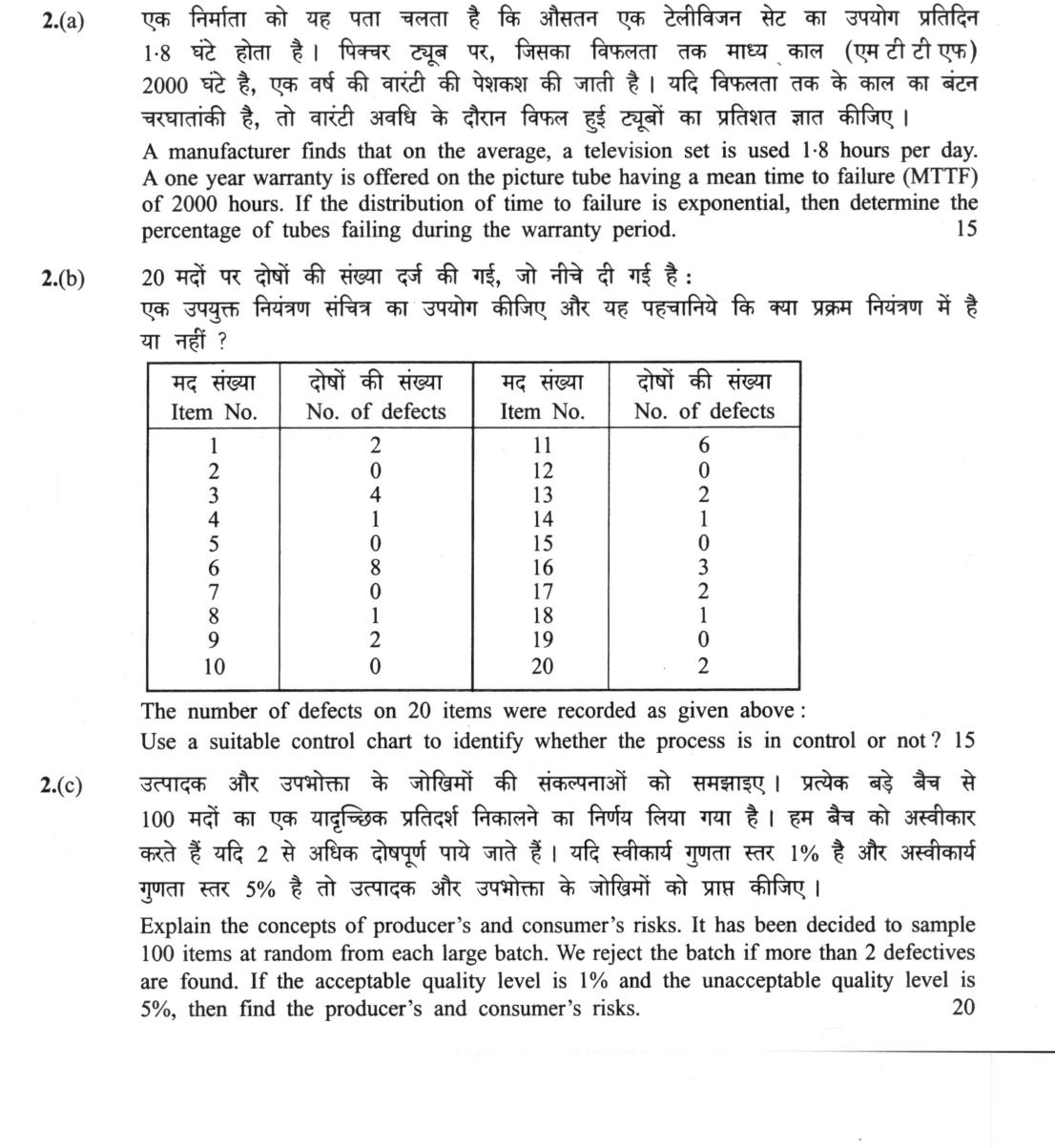
A manufacturer finds that on the average, a television set is used 1.8 hours per day. A one year warranty is offered on the…
A manufacturer finds that on the average, a television set is used 1.8 hours per day. A one year warranty is offered on the picture tube having a mean time to failure (MTTF) of 2000 hours. If the distribution of time to failure is exponential, then determine the percentage of tubes failing during the warranty period. 15 marks
The number of defects on 20 items were recorded as given above:
| Item No. | No. of defects | Item No. | No. of defects |
|---|---|---|---|
| 1 | 2 | 11 | 6 |
| 2 | 0 | 12 | 0 |
| 3 | 4 | 13 | 2 |
| 4 | 1 | 14 | 1 |
| 5 | 0 | 15 | 0 |
| 6 | 8 | 16 | 3 |
| 7 | 0 | 17 | 2 |
| 8 | 1 | 18 | 1 |
| 9 | 2 | 19 | 0 |
| 10 | 0 | 20 | 2 |
Use a suitable control chart to identify whether the process is in control or not? 15 marks
Explain the concepts of producer's and consumer's risks. It has been decided to sample 100 items at random from each large batch. We reject the batch if more than 2 defectives are found. If the acceptable quality level is 1% and the unacceptable quality level is 5%, then find the producer's and consumer's risks. 20 marks
हिंदी में प्रश्न पढ़ें
एक निर्माता को यह पता चलता है कि औसतन एक टेलीविजन सेट का उपयोग प्रतिदिन 1.8 घंटे होता है। पिक्चर ट्यूब पर, जिसका विफलता तक माध्य काल (एम टी टी एफ) 2000 घंटे है, एक वर्ष की वारंटी की पेशकश की जाती है। यदि विफलता तक के काल का बंटन चरघातांकी है, तो वारंटी अवधि के दौरान विफल हुई ट्यूबों का प्रतिशत ज्ञात कीजिए। (15 अंक)
20 मदों पर दोषों की संख्या दर्ज की गई, जो नीचे दी गई है :
| मद संख्या | दोषों की संख्या | मद संख्या | दोषों की संख्या |
|---|---|---|---|
| 1 | 2 | 11 | 6 |
| 2 | 0 | 12 | 0 |
| 3 | 4 | 13 | 2 |
| 4 | 1 | 14 | 1 |
| 5 | 0 | 15 | 0 |
| 6 | 8 | 16 | 3 |
| 7 | 0 | 17 | 2 |
| 8 | 1 | 18 | 1 |
| 9 | 2 | 19 | 0 |
| 10 | 0 | 20 | 2 |
एक उपयुक्त नियंत्रण सांचित्र का उपयोग कीजिए और यह पहचानिये कि क्या प्रक्रम नियंत्रण में है या नहीं ? (15 अंक)
उत्पादक और उपभोक्ता के जोखिमों की संकल्पनाओं को समझाइए। प्रत्येक बड़े बैच से 100 मदों का एक यादृच्छिक प्रतिदर्श निकालने का निर्णय लिया गया है। हम बैच को अस्वीकार करते हैं यदि 2 से अधिक दोषपूर्ण पाये जाते हैं। यदि स्वीकार्य गुणता स्तर 1% है और अस्वीकार्य गुणता स्तर 5% है तो उत्पादक और उपभोक्ता के जोखिमों को प्राप्त कीजिए। (20 अंक)
Model answer
Written by UPSC Answer Check against this question's marking rubric, to the expected length. UPSC does not publish answers for Mains — this is one way to score well, not an official key.
(a) Let T be the time to failure in hours. T is exponential with MTTF = 2000 hours, so rate λ = 1/2000 h⁻¹. Warranty usage = 1.8 × 365 = 657 hours. Using the exponential CDF, P(T ≤ t) = 1 − exp(−λt). Therefore P(failure during warranty) = 1 − exp(−657/2000) = 1 − exp(−0.3285). Now exp(−0.3285) = 0.720003. Hence P = 0.279997. So the percentage of tubes failing during warranty is about 27.9997%, i.e. 28.0%. Validity: constant average usage of 1.8 h/day and exponential failure law.
(b) Since the number of defects per item is recorded on a constant inspection unit, a c-chart is suitable. Total defects = 2+0+4+1+0+8+0+1+2+0+6+0+2+1+0+3+2+1+0+2 = 35. Mean defects per item: c̄ = 35/20 = 1.75. For a c-chart, UCL = c̄ + 3√c̄ and LCL = c̄ − 3√c̄. √1.75 = 1.3228757, so 3√c̄ = 3.968627. UCL = 1.75 + 3.968627 = 5.718627 ≈ 5.72. LCL = 1.75 − 3.968627 = −2.218627, taken as 0 because defects cannot be negative. Comparing observations with limits, item 6 has 8 defects and item 11 has 6 defects, both exceeding UCL = 5.72. Hence the process is not in control.
(c)(i) Producer’s risk α is the probability of rejecting a lot when its quality is actually acceptable, i.e. when p equals the acceptable quality level AQL. Consumer’s risk β is the probability of accepting a lot when its quality is actually unacceptable, i.e. when p equals the unacceptable quality level, also called LTPD. Here n = 100, reject if more than 2 defectives are found, so accept if X ≤ 2. AQL = 1% = 0.01, LTPD = 5% = 0.05. Since the batch is large, X is taken as Bin(100, p).
(c)(ii) Producer’s risk at p = 0.01: α = P(reject | p = 0.01) = P(X > 2) = 1 − P(X ≤ 2). P(X ≤ 2) = P₀ + P₁ + P₂. P₀ = (0.99)¹⁰⁰ = 0.3660323413. P₁ = C(100,1)(0.01)(0.99)⁹⁹ = 0.3697296376. P₂ = C(100,2)(0.01)²(0.99)⁹⁸ = 0.1848648188. Thus P(X ≤ 2) = 0.3660323413 + 0.3697296376 + 0.1848648188 = 0.9206267977. α = 1 − 0.9206267977 = 0.0793732023. So producer’s risk = 7.94%.
Consumer’s risk at p = 0.05: β = P(accept | p = 0.05) = P(X ≤ 2). P₀ = (0.95)¹⁰⁰ = 0.0059205292. P₁ = C(100,1)(0.05)(0.95)⁹⁹ = 0.0311606801. P₂ = C(100,2)(0.05)²(0.95)⁹⁸ = 0.0811817719. Thus β = 0.0059205292 + 0.0311606801 + 0.0811817719 = 0.1182629812. So consumer’s risk = 11.83%.
Final answers:
- (a) 28.0% tubes fail during warranty.
- (b) Process is not in control, because items 6 and 11 exceed UCL = 5.72.
- (c) Producer’s risk α ≈ 7.94%; consumer’s risk β ≈ 11.83%.
What "Solve" is asking you to do
Choose the method, then carry it through to a final answer. Identifying what kind of problem this is and why that method applies is the first thing marked; a correct figure arrived at invisibly earns almost nothing.
Structure that answers it
Given data and what is required → method chosen, with the reason it applies → set-up (equation, circuit, free body, trial balance) → working, step by step → answer with units and any condition of validity
Where marks are lost
Doing the middle steps mentally and writing only the result. In mathematics papers, a further loss comes from giving a decimal where the exact value in surds or fractions was wanted, or from skipping the justification a part explicitly asks for.
How this answer will be evaluated
Approach
Framework: Statistics, Paper 2. (a) calculate: given > formula > substitution > result with units > interpretation | (b) analyse: intro > causes > effects > stakeholders/linkages > way forward | (c) explain: definition/context > points in order > small example > short close Full marks: Rigorous application of formulas with clear interpretation and correct control chart selection.
Key points expected
- State exponential distribution assumption
- Calculate total warranty hours (1.8 × 365)
- Apply CDF formula P(T < t) = 1 - e^(-t/MTTF)
- Interpret result as percentage
- Select c-chart for defect data
- Calculate average defects (c-bar)
- Compute UCL and LCL limits
- Identify out-of-control points
Evaluation rubric
Each sub-part is marked on its own, against the marks and word limit printed on the paper.
- (a) Percentage of tubes failing within the one-year warranty period. 15 marks
calculate— given → formula → substitution → result with units → interpretation
Must cover
- State exponential distribution assumption
- Calculate total warranty hours (1.8 × 365)
- Apply CDF formula P(T < t) = 1 - e^(-t/MTTF)
- Interpret result as percentage
Loses marks
- Using PDF instead of CDF
- Incorrect calculation of total hours
- Missing percentage conversion
Earns more
- Explicitly define MTTF parameter
- Show step-by-step substitution
Extra mark
- Mention memoryless property of exponential distribution
- (b) Determine if the process is in statistical control using a control chart. 15 marks
analyse— intro → causes → effects → stakeholders/linkages → way forward
Must cover
- Select c-chart for defect data
- Calculate average defects (c-bar)
- Compute UCL and LCL limits
- Identify out-of-control points
Loses marks
- Using p-chart or u-chart incorrectly
- Failing to calculate control limits
- No conclusion on process status
Earns more
- Present data in a clean table
- State the specific rule violated (e.g., point > UCL)
Extra mark
- Suggest investigation for the specific out-of-control item
- (c) Define risks and calculate producer's and consumer's risks for the sampling plan. 20 marks
explain— definition/context → points in order → small example → short close
Must cover
- Define producer's and consumer's risks
- Use Binomial distribution for calculations
- Calculate P(accept | p=1%) for producer's risk
- Calculate P(reject | p=5%) for consumer's risk
Loses marks
- Confusing producer's and consumer's risk definitions
- Using Poisson approximation without justification
- Incorrect probability summation
Earns more
- Show summation of binomial probabilities
- Clearly distinguish between p1 and p2
Extra mark
- Reference to Operating Characteristic (OC) curve
Practice this exact question
Write your answer and it is marked point by point against the model answer above — what you covered, what you missed, what you got wrong.
Evaluate my answer →More from Statistics 2021 Paper II
- Q1 Explain Single Sampling Plan with the help of an example. Also, write the importance of a…
- Q2 A manufacturer finds that on the average, a television set is used 1.8 hours per day. A o…
- Q3 (a) Explain M|G|1 queuing system. Obtain Pollaczek-kinchine formula. (15 marks) (b) Use M…
- Q4 (a) Solve the following linear programming problem: Maximize z = 3x₁ + 5x₂ subject to the…
- Q5 (a) Explain Zellner's seemingly unrelated regression model and the feasible generalized l…