Paper II — Q6
(a) Explain Box-Jenkins methodology to build ARIMA models. (15 marks) (b) Prepare the cost of living index for 2006 on the basis…
Explain Box-Jenkins methodology to build ARIMA models. 15 marks
Prepare the cost of living index for 2006 on the basis of 2005 from the above data by (i) aggregative method and (ii) method of weighted relatives and comment. 15 marks
Explain price statistics relating to 'Price Quotations'. Elucidate publications of data concerning foreign trade of India. 20 marks
हिंदी में प्रश्न पढ़ें
अरीमा (ARIMA) निदर्शों को बनाने के लिए बाक्स-जेनकिंस विधि तंत्र की व्याख्या कीजिए। (15 अंक)
निम्नलिखित आंकड़ों से 2005 के आधार पर 2006 के लिए निर्वाह-सूचकांक तैयार कीजिए (i) सामुदायिक विधि द्वारा और (ii) भारित अनुपातों की विधि द्वारा, और अपनी टिप्पणी दीजिए। (15 अंक)
'मूल्य कोटेशनों' से संबंधित मूल्य आंकड़े बताइए। भारत के विदेशी व्यापार के विषय में आंकड़ों के प्रकाशनों को स्पष्ट कीजिए। (20 अंक)
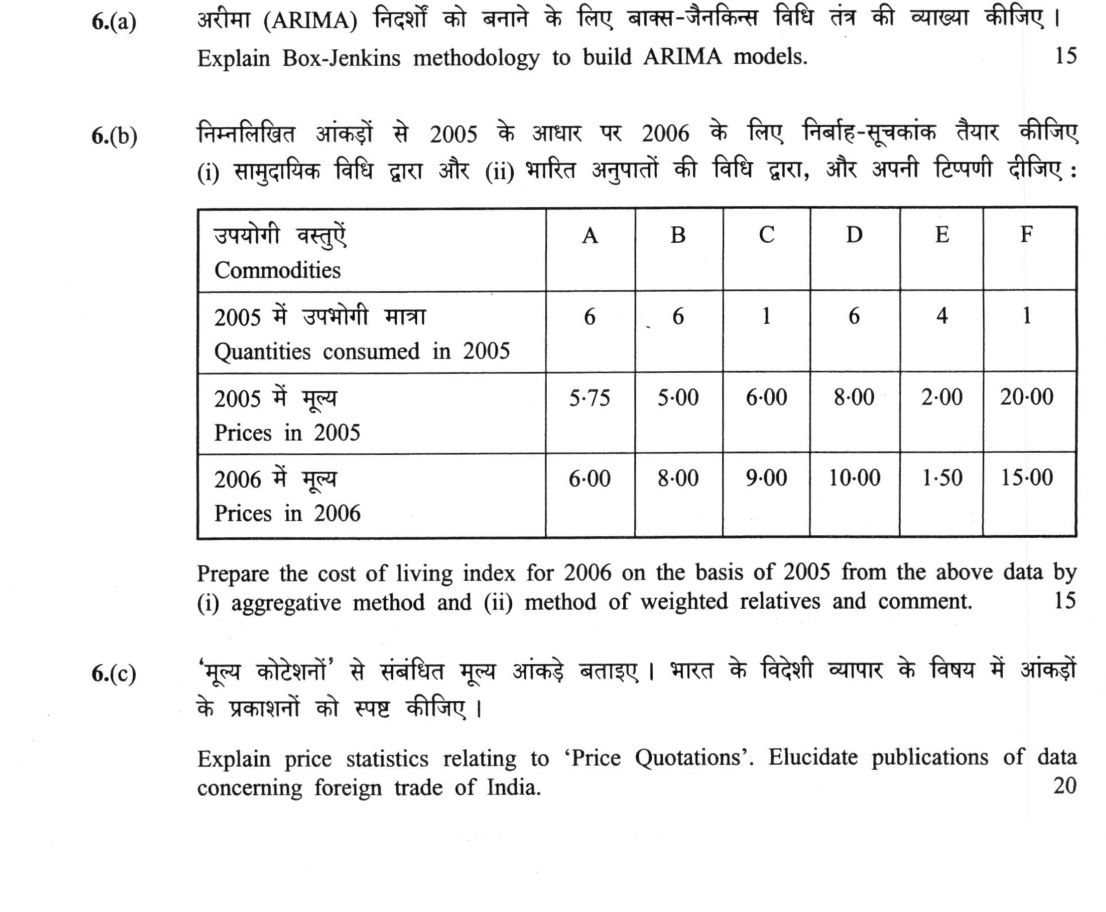
The figure this question refers to, in words
The question paper is a scan and the diagram did not survive as text. This is the figure as read from the original page — every component, value and label — so the question can be worked from the text below.
(b) Table with 4 rows and 7 columns.
Row 1 (Header): Column 1: "Commodities" Column 2: "A" Column 3: "B" Column 4: "C" Column 5: "D" Column 6: "E" Column 7: "F"
Row 2: Column 1: "Quantities consumed in 2005" Column 2: "6" Column 3: "6" Column 4: "1" Column 5: "6" Column 6: "4" Column 7: "1"
Row 3: Column 1: "Prices in 2005" Column 2: "5.75" Column 3: "5.00" Column 4: "6.00" Column 5: "8.00" Column 6: "2.00" Column 7: "20.00"
Row 4: Column 1: "Prices in 2006" Column 2: "6.00" Column 3: "8.00" Column 4: "9.00" Column 5: "10.00" Column 6: "1.50" Column 7: "15.00"
Model answer
Written by UPSC Answer Check against this question's marking rubric, to the expected length. UPSC does not publish answers for Mains — this is one way to score well, not an official key.
Box–Jenkins methodology. Box–Jenkins builds ARIMA(p,d,q) models by treating a time series as a stochastic process that can be made stationary, identified, estimated and checked. The model is φ(B)∇^d y_t = θ(B)ε_t, where ∇^d is the d-th difference, φ(B) the autoregressive polynomial of order p and θ(B) the moving-average polynomial of order q. First, the series is examined for trend, seasonality and unit root; ADF and KPSS tests help decide whether levels or differences are stationary. If non-stationary, differencing is applied until shocks do not persist, because only a stationary process has stable mean and autocovariances. Next, ACF and PACF are used for identification: a PACF that cuts off after p suggests AR(p), an ACF that cuts off after q suggests MA(q), while mixed decay suggests ARMA. Parameters are then estimated, usually by maximum likelihood, with constraints that roots lie outside the unit circle. Diagnostic checking asks whether residuals are white noise; the Ljung–Box test and residual ACF/PACF are used. If residuals show autocorrelation, the model is re-specified. Finally, forecasts are produced recursively with confidence intervals that widen over the horizon. In India, RBI has used ARIMA-type models for short-run forecasting of inflation and monetary aggregates, supporting monetary-policy analysis.
Cost of living index. From the given table, base-year outlays v0=p0q0 are A 34.5, B 30, C 6, D 48, E 8 and F 20, so Σv0=146.5. Current-year outlays at base quantities p1q0 are 36, 48, 9, 60, 6 and 15, so Σp1q0=174. By the aggregative Laspeyres method, the cost of living index for 2006 on 2005 base is (174/146.5)×100=118.77. By the weighted relatives method, price relatives R=(p1/p0)×100 are 104.35, 160, 150, 125, 75 and 75. Using exact relatives, Rw=100p1q0, so ΣRw=17400; the index is 17400/146.5=118.77. If the rounded relative 104.35 is used, ΣRw=17400.075, still giving 118.77 to two decimals. Thus the cost of living rose by about 18.77 per cent. The rise is driven mainly by B, C and D, while E and F fell. The two methods agree because the weighted relatives method is algebraically equivalent to the Laspeyres aggregative method when base-year expenditure weights are used. The result should be interpreted cautiously: index numbers can suffer substitution bias, quality changes and omission of new goods, so the 18.77 per cent is a fixed-basket measure rather than a full welfare measure.
Price quotations and foreign trade publications. Price statistics depend on price quotations, i.e. observed or reported prices for specified commodities in specified markets. The key problem is representativeness: items must be selected according to expenditure share and availability; quality, grade and pack size must be specified; markets must be chosen by population, trade volume and price variation; and collection timing must be fixed to avoid seasonal or temporary distortions. In India, NSSO household consumption surveys provide expenditure weights and item lists, while CSO/NSO and Labour Bureau construct CPI series such as CPI-AL, CPI-RL, CPI-U and CPI-IW; Labour Bureau is specifically responsible for CPI-IW. WPI, however, is compiled by the Office of Economic Adviser, Ministry of Commerce and Industry/DPIIT, not by CSO. For foreign trade, DGCI&S under the Ministry of Commerce publishes Monthly Statistics of Foreign Trade and the Annual Report on Foreign Trade, with commodity-wise and country-wise data, using the ITC-HS classification. These publications help track exports, imports, trade partners and commodity trends. The main limitations are the representativeness of price quotations, quality changes, new goods, and the timeliness of trade data, since monthly and annual releases may lag real-time economic conditions. Overall, Box–Jenkins gives a disciplined forecasting framework, the index shows a substantial fixed-basket cost increase, and Indian price and trade statistics are useful but require attention to collection quality and limitations.
What "Explain" is asking you to do
Make the working of something clear — what sets it off, what follows from what, and what it produces. Explain is the Commission's mechanism word: it dominates the technical papers and the “explain why” stems, where the marks sit in the causal chain and not in the label.
Structure that answers it
State what it is → the initiating condition → the chain of cause, step by step → an instance where it plays out → what the chain produces
Where marks are lost
Describing what something looks like instead of why it works that way. Naming the stages without linking them reads as description too.
How this answer will be evaluated
Approach
Framework: Box-Jenkins Methodology. (a) explain: definition/context > points in order > small example > short close | (b) calculate: given > formula > substitution > result with units > interpretation | (c) explain: definition/context > points in order > small example > short close Full marks: Precise methodology steps, error-free index calculations, and specific trade publication names.
Key points expected
- Identification stage (ACF/PACF analysis)
- Estimation stage (parameter fitting)
- Diagnostic checking (residual analysis)
- Forecasting stage
- Aggregative method calculation (Σp1q0/Σp0q0)
- Weighted relatives method calculation (ΣwR/Σw)
- Correct substitution of 2005/2006 data
- Final index values for both methods
Evaluation rubric
Each sub-part is marked on its own, against the marks and word limit printed on the paper.
- (a) Outline the three stages of Box-Jenkins methodology for ARIMA model building. 15 marks
explain— definition/context → points in order → small example → short close
Must cover
- Identification stage (ACF/PACF analysis)
- Estimation stage (parameter fitting)
- Diagnostic checking (residual analysis)
- Forecasting stage
Loses marks
- Confusing ARIMA with ARMA
- Omitting diagnostic checking
Earns more
- Mention of stationarity (differencing)
- White noise residuals check
Extra mark
- Specific ARIMA(p,q,r) notation
- (b) Compute Cost of Living Index for 2006 using aggregative and weighted relatives methods. 15 marks
calculate— given → formula → substitution → result with units → interpretation
Must cover
- Aggregative method calculation (Σp1q0/Σp0q0)
- Weighted relatives method calculation (ΣwR/Σw)
- Correct substitution of 2005/2006 data
- Final index values for both methods
Loses marks
- Using 2006 quantities as weights
- Arithmetic errors in summation
Earns more
- Comment on the difference between the two indices
- Clean tabular presentation of calculations
Extra mark
- Explicit calculation of weights (w)
- (c) Define price quotations and list publications on India's foreign trade data. 20 marks
explain— definition/context → points in order → small example → short close
Must cover
- Definition of price quotations (spot/futures)
- Types of quotations (cash/forward)
- Name of foreign trade publication (e.g., Foreign Trade Statistics)
- Publishing agency (e.g., DGFT/Ministry of Commerce)
Loses marks
- Confusing domestic price stats with foreign trade
- Vague references to 'government data'
Earns more
- Mention of specific data items (commodity-wise trade)
- Reference to trade policy reviews
Extra mark
- Specific report titles (e.g., 'India's Foreign Trade')
Practice this exact question
Write your answer and it is marked point by point against the model answer above — what you covered, what you missed, what you got wrong.
Evaluate my answer →More from Statistics 2021 Paper II
- Q3 (a) Explain M|G|1 queuing system. Obtain Pollaczek-kinchine formula. (15 marks) (b) Use M…
- Q4 (a) Solve the following linear programming problem: Maximize z = 3x₁ + 5x₂ subject to the…
- Q5 (a) Explain Zellner's seemingly unrelated regression model and the feasible generalized l…
- Q6 (a) Explain Box-Jenkins methodology to build ARIMA models. (15 marks) (b) Prepare the cos…
- Q7 (a) If c(x, t) denote observed proportion of females in the age group (x, x+t) and f(x, t…
- Q8 (a) What is autocorrelation ? What are its consequences ? Explain the Goldfeld-Quandt tes…