Paper II — Q5
(a) Explain Zellner's seemingly unrelated regression model and the feasible generalized least squares method of estimating the…
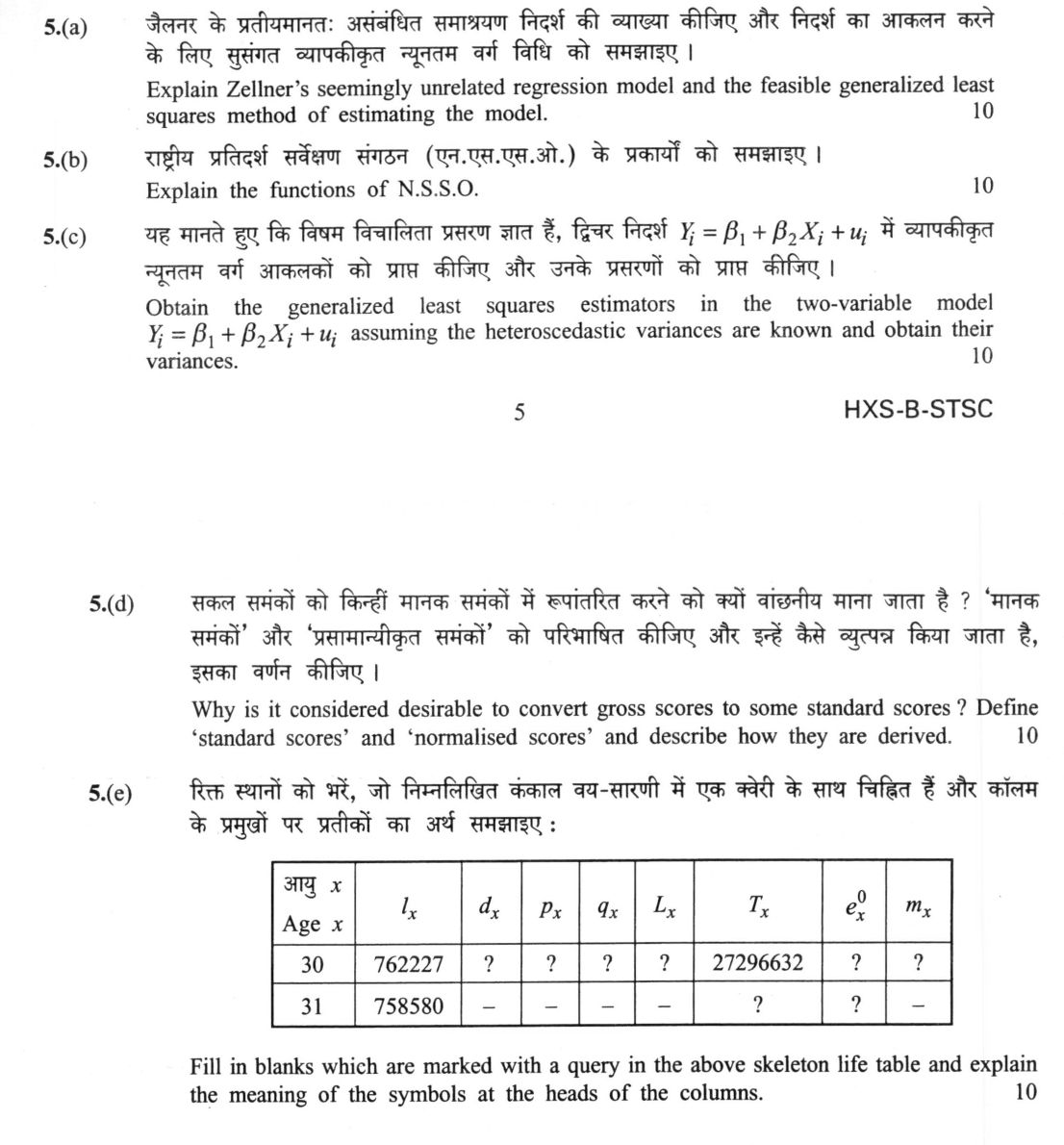
Explain Zellner's seemingly unrelated regression model and the feasible generalized least squares method of estimating the model. 10 marks
Explain the functions of N.S.S.O. 10 marks
Obtain the generalized least squares estimators in the two-variable model Yᵢ = β₁ + β₂Xᵢ + uᵢ assuming the heteroscedastic variances are known and obtain their variances. 10 marks
Why is it considered desirable to convert gross scores to some standard scores? Define 'standard scores' and 'normalised scores' and describe how they are derived. 10 marks
Fill in blanks which are marked with a query in the above skeleton life table and explain the meaning of the symbols at the heads of the columns. 10 marks
हिंदी में प्रश्न पढ़ें
जेलनर के प्रतीयमानतः असंबंधित समाश्रयण निदर्श की व्याख्या कीजिए और निदर्श का आकलन करने के लिए सुसंगत व्यापकीकृत न्यूनतम वर्ग विधि को समझाइए। (10 अंक)
राष्ट्रीय प्रतिदर्श सर्वेक्षण संगठन (एन.एस.एस.ओ.) के प्रकार्यों को समझाइए। (10 अंक)
यह मानते हुए कि विषम विचलिता प्रसरण ज्ञात है, द्विचर निदर्श Yᵢ = β₁ + β₂Xᵢ + uᵢ में व्यापकीकृत न्यूनतम वर्ग आकलकों को प्राप्त कीजिए और उनके प्रसरणों को प्राप्त कीजिए। (10 अंक)
सकल समकों को किन्हीं मानक समकों में रूपांतरित करने को क्यों वांछनीय माना जाता है? 'मानक समकों' और 'प्रसामान्यीकृत समकों' को परिभाषित कीजिए और इन्हें कैसे व्युत्पन्न किया जाता है, इसका वर्णन कीजिए। (10 अंक)
रिक्त स्थानों को भरें, जो निम्नलिखित कंकाल बय-सारणी में एक क्वेरी के साथ चिह्नित हैं और कॉलम के प्रमुखों पर प्रतीकों का अर्थ समझाइए। (10 अंक)
The figure this question refers to, in words
The question paper is a scan and the diagram did not survive as text. This is the figure as read from the original page — every component, value and label — so the question can be worked from the text below.
(e) A skeleton life table with 9 columns and 3 rows (including the header). The columns are headed: 'Age x', 'lx', 'dx', 'px', 'qx', 'Lx', 'Tx', 'e0x', 'mx'. The first data row corresponds to Age 30 and contains the following values: lx is 762227, dx is '?', px is '?', qx is '?', Lx is '?', Tx is 27296632, e0x is '?', mx is '?'. The second data row corresponds to Age 31 and contains the following values: lx is 758580, dx is '-', px is '-', qx is '-', Lx is '-', Tx is '?', e0x is '?', mx is '-'.
Model answer
Written by UPSC Answer Check against this question's marking rubric, to the expected length. UPSC does not publish answers for Mains — this is one way to score well, not an official key.
(a) SURE and FGLS. Zellner’s seemingly unrelated regression model is a system of M linear equations, yⱼ = Xⱼβⱼ + uⱼ, j = 1, …, M. The equations are “seemingly” unrelated because each has its own dependent variable and possibly different regressors, but they are related through the disturbance terms. The key assumption is no serial correlation, but contemporaneous correlation across equations: E(uⱼ uₖ′) = σ_jk Iₙ, with σ_jk possibly non-zero for j ≠ k. Stacking gives y = Xβ + u, where X is block diagonal, and Var(u) = Σ ⊗ Iₙ. Equation-by-equation OLS remains unbiased, but it is inefficient when Σ is not diagonal because it ignores the information in cross-equation covariance. FGLS makes the estimator feasible by estimating Σ. First estimate each equation by OLS, obtain residuals eⱼ, and set s_jk = n⁻¹∑ e_ij e_kj, or use a degrees-of-freedom correction. Then Ω̂ = Ŝ ⊗ Iₙ and β̂_FGLS = (X′Ω̂⁻¹X)⁻¹X′Ω̂⁻¹y. Equivalently, premultiply the stacked system by Ω̂⁻¹ᐟ² and apply OLS. If all Xⱼ are identical, FGLS reduces to OLS in each equation; when regressors differ, FGLS borrows strength across equations and has smaller variance.
(b) NSSO functions. The National Sample Survey Office, under the Ministry of Statistics and Programme Implementation, is the principal agency for large-scale sample surveys in India. Its first function is to design, field, process and analyse surveys such as the National Sample Survey rounds, the Annual Social Industry Survey, and special surveys on employment, household social consumption, agriculture, non-farm activity, education, health and housing. It prepares sampling frames, questionnaires, fieldwork manuals and quality-control procedures, and it disseminates results through reports, data tables, microdata and the NSO website. A second function is methodological research: improving sampling designs, weighting, imputation, data editing and estimation methods so that small-area and national estimates are reliable. A third function is coordination with state and district statistical offices, which support field operations and local data collection. Finally, NSSO supplies data for policy formulation, poverty and inequality measurement, and international reporting to bodies such as the UN, ILO and for SDG indicators. Thus it converts primary household data into official statistical evidence.
(c) GLS with known heteroscedastic variances. For Yᵢ = β₁ + β₂Xᵢ + uᵢ with known Var(uᵢ) = σᵢ², write Ω = diag(σ₁², …, σₙ²) and W = Ω⁻¹ = diag(wᵢ), where wᵢ = 1/σᵢ². GLS is weighted least squares: minimise ∑ wᵢ(Yᵢ − β₁ − β₂Xᵢ)². Equivalently, divide each observation by σᵢ and apply OLS to the transformed model. The normal equations are ∑ wᵢ(Yᵢ − β₁ − β₂Xᵢ) = 0 and ∑ w_iXᵢ(Yᵢ − β₁ − β₂Xᵢ) = 0. Let S₀ = ∑wᵢ, S₁ = ∑w_iXᵢ, S₂ = ∑w_iXᵢ², T₁ = ∑w_iYᵢ, T₂ = ∑w_iX_iYᵢ. Solving gives β̂₂ = (S₀T₂ − S₁T₁)/(S₀S₂ − S₁²) and β̂₁ = T₁/S₀ − β̂₂S₁/S₀. In matrix form β̂_GLS = (X′WX)⁻¹X′WY. The variance-covariance matrix is (X′WX)⁻¹ = (1/D) [[S₂, −S₁], [−S₁, S₀]], where D = S₀S₂ − S₁². Hence Var(β̂₁) = S₂/D, Var(β̂₂) = S₀/D and Cov(β̂₁, β̂₂) = −S₁/D. Because the weights are the true inverse variances, GLS is the BLUE; OLS is still unbiased but generally has larger variance and is inefficient under heteroscedasticity.
(d) Standard and normalised scores. Gross or raw scores are measured on the scale of the particular test, so two tests may have different means, ranges and units. Converting them to standard scores is desirable because it places different scores on a common metric, makes them comparable across tests, groups, years and selection contexts, and allows norm-referenced interpretation. A standard score is a linear transformation of a raw score to a fixed mean and standard deviation. The basic form is the z-score, z = (X − M)/SD; common normalised standard forms are T-scores, T = 50 + 10z, and stanines, stanine = 5 + 2z rounded to the nearest integer. When “normalised scores” is used in the stricter sense, it refers to scores obtained by forcing the transformed distribution to be approximately normal. They are derived by ranking the raw scores, assigning each score a percentile rank, converting that percentile to a z-value from the standard normal table, and then applying the chosen linear scale. This is useful when the raw-score distribution is skewed, because the final scores have a normal reference distribution while preserving the relative standing of the examinee.
(e) Life table blanks and symbols. Given l₃₀ = 762227, l₃₁ = 758580 and T₃₀ = 27296632, the deaths between ages 30 and 31 are d₃₀ = l₃₀ − l₃₁ = 3647. Therefore q₃₀ = d₃₀/l₃₀ = 3647/762227 = 0.004785 and p₃₀ = 1 − q₃₀ = 0.995215. The person-years lived between 30 and 31, assuming deaths are uniformly distributed, are L₃₀ = l₃₀ − 0.5d₃₀ = 762227 − 1823.5 = 760403.5. Using the usual convention Tₓ = ∑ₖ₌ₓ^∞ Lₖ, T₃₁ = T₃₀ − L₃₀ = 27296632 − 760403.5 = 26536228.5. The life expectancies are e₃₀ = T₃₀/l₃₀ = 35.81 and e₃₁ = T₃₁/l₃₁ = 34.98. The central death rate is m₃₀ = d₃₀/L₃₀ = 3647/760403.5 = 0.004796. The column symbols mean: x is age; lₓ is the number of survivors to exact age x; dₓ is the number of deaths between x and x+1; pₓ is the probability of surviving from x to x+1; qₓ is the probability of dying in that interval; Lₓ is the person-years lived between x and x+1; Tₓ is the total person-years lived from age x onward; eₓ, shown as e0x, is the expectation of life at age x; and mₓ is the central death rate, dₓ/Lₓ. If the skeleton table defines Tₓ as ∑lₓ rather than ∑Lₓ, T₃₁ would instead be T₃₀ − l₃₀ = 26534405, with e₃₁ still about 34.98.
Thus, these methods show how statistical inference and official statistics adjust for structure: SURE/FGLS and GLS use known or estimated covariance to obtain efficient estimators, NSSO provides the survey infrastructure for reliable Indian data, standard scores make measurements comparable, and life-table arithmetic converts survival counts into interpretable mortality and expectancy measures.
What "Explain" is asking you to do
Make the working of something clear — what sets it off, what follows from what, and what it produces. Explain is the Commission's mechanism word: it dominates the technical papers and the “explain why” stems, where the marks sit in the causal chain and not in the label.
Structure that answers it
State what it is → the initiating condition → the chain of cause, step by step → an instance where it plays out → what the chain produces
Where marks are lost
Describing what something looks like instead of why it works that way. Naming the stages without linking them reads as description too.
How this answer will be evaluated
Approach
(a) explain: definition/context > points in order > small example > short close | (b) explain: definition/context > points in order > small example > short close | (c) derive: given > assumptions > stepwise derivation > result > check | (d) define: precise definition > the distinguishing feature > one example | (e) calculate: given > formula > substitution > result with units > interpretation Full marks: All parts complete with correct derivations, formulas, and interpretations; no arithmetic errors; clear notation.
Key points expected
- Define SUR model with cross-equation error covariance
- State GLS estimator formula using inverse of Sigma
- Explain FGLS two-step estimation procedure
- Mention efficiency gain over OLS
- Define NSSO as statistical survey organization
- List at least 4 distinct functions
- Mention data collection and publication
- Note role in policy formulation
Evaluation rubric
Each sub-part is marked on its own, against the marks and word limit printed on the paper.
- (a) Define SUR model and derive FGLS estimation procedure. 10 marks
explain— definition/context → points in order → small example → short close
Must cover
- Define SUR model with cross-equation error covariance
- State GLS estimator formula using inverse of Sigma
- Explain FGLS two-step estimation procedure
- Mention efficiency gain over OLS
Loses marks
- Confusing SUR with simple multiple regression
- Omitting cross-equation covariance structure
- Treating FGLS as single-step method
Earns more
- Write matrix form of SUR system
- State conditions for FGLS consistency
- Mention Aitken's theorem
- Note when SUR reduces to OLS
Extra mark
- Cite Zellner (1962) paper
- Mention specific application example
- (b) List and describe the functions of NSSO. 10 marks
explain— definition/context → points in order → small example → short close
Must cover
- Define NSSO as statistical survey organization
- List at least 4 distinct functions
- Mention data collection and publication
- Note role in policy formulation
Loses marks
- Confusing NSSO with Census or RBI
- Listing only one or two functions
- Vague descriptions without specifics
Earns more
- Mention specific surveys (NSS, PLFS)
- Note frequency of data collection
- Mention data dissemination methods
- Note coordination with other agencies
Extra mark
- Mention parent ministry name
- Cite specific report or dataset
- (c) Derive GLS estimators and their variances for known heteroscedasticity. 10 marks
derive— given → assumptions → stepwise derivation → result → check
Must cover
- State model with known variance structure
- Write GLS estimator formula
- Derive variance of GLS estimators
- Show efficiency over OLS
Loses marks
- Confusing GLS with OLS
- Omitting variance derivation
- Incorrect matrix algebra
Earns more
- Write matrix form of derivation
- State Gauss-Markov conditions
- Mention Aitken's theorem
- Note when GLS equals OLS
Extra mark
- Provide numerical example
- Mention specific application
- (d) Define standard and normalized scores; explain derivation. 10 marks
define— precise definition → the distinguishing feature → one example
Must cover
- Define standard scores (z-scores)
- Define normalized scores
- Show derivation formula for each
- Explain why conversion is desirable
Loses marks
- Confusing standard with normalized
- Omitting derivation formulas
- Not explaining desirability
Earns more
- Mention mean and standard deviation
- Note use in comparing distributions
- Mention specific applications
- Show relationship between the two
Extra mark
- Provide numerical example
- Mention specific test or exam
- (e) Fill blanks in life table and explain column symbols. 10 marks
calculate— given → formula → substitution → result with units → interpretation
Must cover
- Calculate all missing values correctly
- Explain meaning of each column symbol
- Show calculation steps for at least 2 values
- Verify internal consistency of table
Loses marks
- Arithmetic errors in calculations
- Incorrect symbol definitions
- Omitting calculation steps
Earns more
- Use correct life table notation
- Mention standard life table formulas
- Note assumptions used
- Show relationship between columns
Extra mark
- Provide interpretation of results
- Mention specific population or dataset
Practice this exact question
Write your answer and it is marked point by point against the model answer above — what you covered, what you missed, what you got wrong.
Evaluate my answer →More from Statistics 2021 Paper II
- Q2 A manufacturer finds that on the average, a television set is used 1.8 hours per day. A o…
- Q3 (a) Explain M|G|1 queuing system. Obtain Pollaczek-kinchine formula. (15 marks) (b) Use M…
- Q4 (a) Solve the following linear programming problem: Maximize z = 3x₁ + 5x₂ subject to the…
- Q5 (a) Explain Zellner's seemingly unrelated regression model and the feasible generalized l…
- Q6 (a) Explain Box-Jenkins methodology to build ARIMA models. (15 marks) (b) Prepare the cos…
- Q7 (a) If c(x, t) denote observed proportion of females in the age group (x, x+t) and f(x, t…
- Q8 (a) What is autocorrelation ? What are its consequences ? Explain the Goldfeld-Quandt tes…