Paper II — Q7
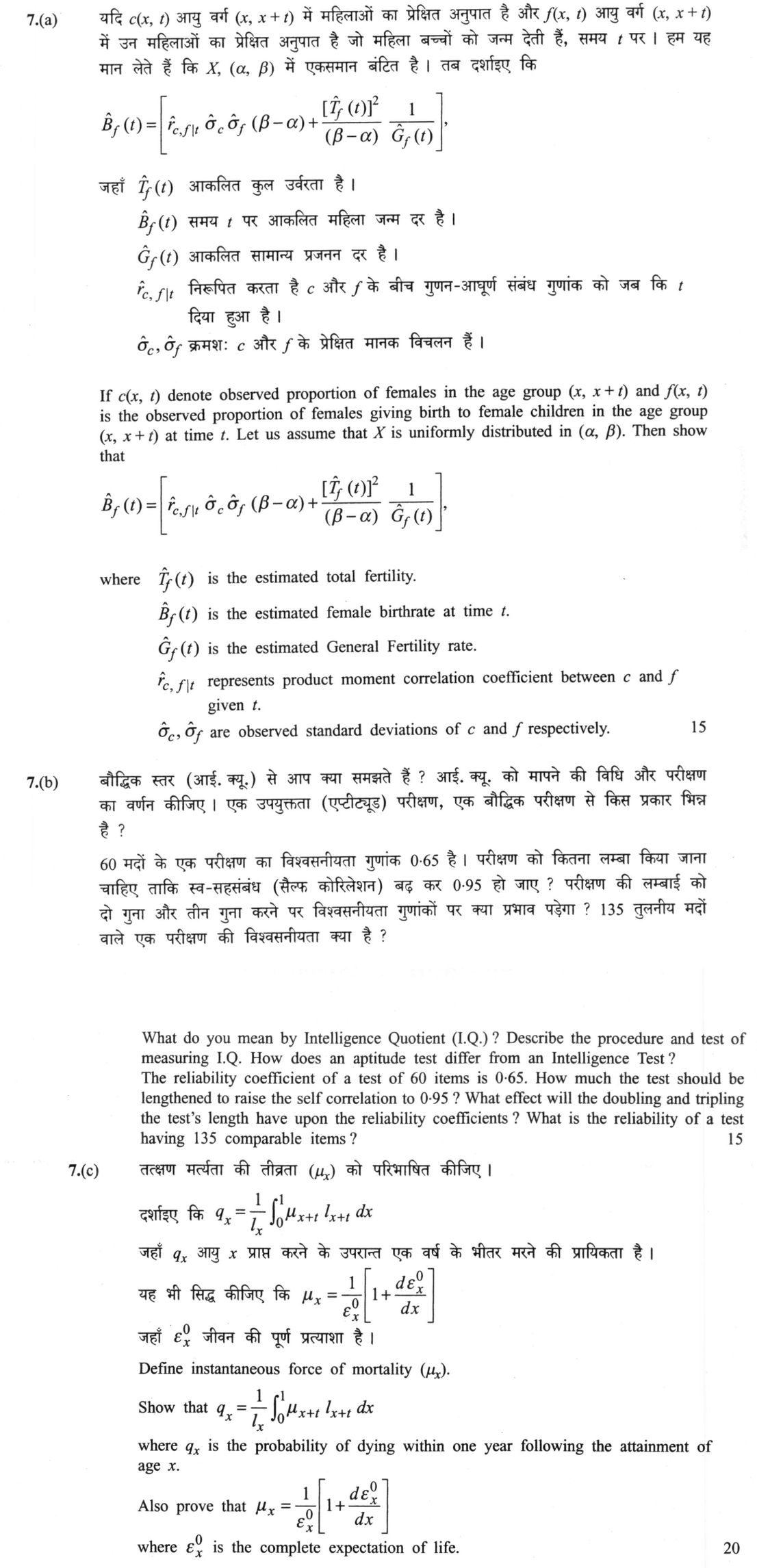
(a) If c(x, t) denote observed proportion of females in the age group (x, x+t) and f(x, t) is the observed proportion of females…
If c(x, t) denote observed proportion of females in the age group (x, x+t) and f(x, t) is the observed proportion of females giving birth to female children in the age group (x, x+t) at time t. Let us assume that X is uniformly distributed in (α, β). Then show that
B̂_f(t)=[r̂_c,f|t σ̂_c σ̂_f (β-α) + ([T̂_f(t)]²)/((β-α)) 1/(Ĝ_f(t))],
where T̂_f(t) is the estimated total fertility.
B̂_f(t) is the estimated female birthrate at time t.
Ĝ_f(t) is the estimated General Fertility rate.
r̂_c,f|t represents product moment correlation coefficient between c and f given t.
σ̂_c, σ̂_f are observed standard deviations of c and f respectively.
15 marks
What do you mean by Intelligence Quotient (I.Q.) ? Describe the procedure and test of measuring I.Q. How does an aptitude test differ from an Intelligence Test ?
The reliability coefficient of a test of 60 items is 0·65. How much the test should be lengthened to raise the self correlation to 0·95 ? What effect will the doubling and tripling the test's length have upon the reliability coefficients ? What is the reliability of a test having 135 comparable items ?
15 marks
Define instantaneous force of mortality (μₓ).
Show that qₓ = (1/lₓ) ∫₀¹ μₓ₊ₜ lₓ₊ₜ dx
where qₓ is the probability of dying within one year following the attainment of age x.
Also prove that μₓ = (1/eₓ⁰) [1 + (deₓ⁰/dx)]
where eₓ⁰ is the complete expectation of life.
20 marks
हिंदी में प्रश्न पढ़ें
यदि c(x, t) आयु वर्ग (x, x+t) में महिलाओं का प्रेक्षित अनुपात है और f(x, t) आयु वर्ग (x, x+t) में उन महिलाओं का प्रेक्षित अनुपात है जो महिला बच्चों को जन्म देती हैं, समय t पर। हम यह मान लेते हैं कि X, (α, β) में एकसमान बंटित है। तब दर्शाइए कि
B̂_f(t)=[r̂_c,f|t σ̂_c σ̂_f (β-α) + ([T̂_f(t)]²)/((β-α)) 1/(Ĝ_f(t))],
जहाँ T̂_f(t) आकलित कुल उर्वरता है।
B̂_f(t) समय t पर आकलित महिला जन्म दर है।
Ĝ_f(t) आकलित सामान्य प्रजनन दर है।
r̂_c,f|t निरूपित करता है c और f के बीच गुणन-आश्रित संबंध गुणांक को जब कि t दिया हुआ है।
σ̂_c, σ̂_f क्रमशः: c और f के प्रेक्षित मानक विचलन हैं।
(15 अंक)
बौद्धिक स्तर (आई. क्यू.) से आप क्या समझते हैं ? आई. क्यू. को मापने की विधि और परीक्षण का वर्णन कीजिए। एक उपयुक्ता (एप्टीट्यूड) परीक्षण, एक बौद्धिक परीक्षण से किस प्रकार भिन्न है ?
60 मदों के एक परीक्षण का विश्वसनीयता गुणांक 0.65 है। परीक्षण को कितना लम्बा किया जाना चाहिए ताकि स्व-सहसंबंध (सेल्फ कोरिलेशन) बढ़ कर 0.95 हो जाए ? परीक्षण की लम्बाई को दो गुना और तीन गुना करने पर विश्वसनीयता गुणांकों पर क्या प्रभाव पड़ेगा ? 135 तुलनीय मदों वाले एक परीक्षण की विश्वसनीयता क्या है ?
(15 अंक)
तत्क्षण मरता की तीव्रता (μₓ) को परिभाषित कीजिए ।
दर्शाइए कि qₓ = (1/lₓ) ∫₀¹ μₓ₊ₜ lₓ₊ₜ dx
जहाँ qₓ आयु x प्राप्त करने के उपरान्त एक वर्ष के भीतर मरने की प्रायिकता है ।
यह भी सिद्ध कीजिए कि μₓ = (1/eₓ⁰) [1 + (deₓ⁰/dx)]
जहाँ eₓ⁰ जीवन की पूर्ण प्रत्याशा है ।
(20 अंक)
Model answer
Written by UPSC Answer Check against this question's marking rubric, to the expected length. UPSC does not publish answers for Mains — this is one way to score well, not an official key.
(a) Let X, the age of a female, be uniform on (α, β), so its density is 1/(β−α). For fixed t write c=c(X,t), f=f(X,t). By definition of the product moment correlation,
Cov(c,f)=r̂(c,f|t) σ̂_c σ̂_f.
Also E(cf)=Cov(c,f)+E(c)E(f). Hence
(β−α)E(cf)=r̂(c,f|t) σ̂_c σ̂_f(β−α)+(β−α)E(c)E(f). (1)
Now the estimated female birth rate is
B̂_f(t)=∫_α^β c(x,t) f(x,t) dx=(β−α)E(cf).
The estimated total fertility is
T̂_f(t)=∫_α^β f(x,t) dx=(β−α)E(f), so E(f)=T̂_f(t)/(β−α).
The estimated general fertility rate is
Ĝ_f(t)=T̂_f(t)/∫_α^β c(x,t) dx, so ∫_α^β c dx=T̂_f(t)/Ĝ_f(t),
and therefore
E(c)=T̂_f(t)/[(β−α)Ĝ_f(t)].
Substituting in (1),
B̂_f(t)=r̂(c,f|t) σ̂_c σ̂_f(β−α)+(β−α)·T̂_f(t)/[(β−α)Ĝ_f(t)]·T̂_f(t)/(β−α)
= r̂(c,f|t) σ̂_c σ̂_f(β−α)+[T̂_f(t)]²/[(β−α)Ĝ_f(t)].
This proves the required result.
(b) I.Q. means Intelligence Quotient. Historically,
I.Q.=(Mental Age/Chronological Age)×100.
In modern tests, deviation I.Q. is used: scores are standardised to mean 100 and standard deviation 15. It measures general cognitive ability, reasoning, verbal comprehension, numerical ability, memory and problem solving. Procedure: a standardised intelligence test such as Stanford–Binet, Wechsler, Raven’s Progressive Matrices is administered under fixed instructions and time limits; raw scores are converted to mental-age or standard scores using norms for age, sex, culture and education; the quotient or deviation score is then interpreted. Reliability and validity are checked by test–retest, split-half and criterion methods.
An aptitude test differs from an intelligence test as follows. Intelligence tests measure present general mental ability and broad intellectual functioning. Aptitude tests measure a specific potential or capacity to acquire a particular skill, such as mechanical, clerical, musical, teaching or engineering aptitude. Intelligence tests are broad and general; aptitude tests are more specific and predictive of future training or job success. Aptitude tests are used in educational and vocational guidance, whereas intelligence tests are used to assess general cognitive level.
Using the Spearman–Brown prophecy formula,
r_n=n r/[1+(n−1)r],
where r=0.65 and n is the factor by which test length is multiplied. To raise reliability to 0.95:
0.95=0.65n/[1+0.65(n−1)]=0.65n/[0.35+0.65n].
Thus
n=0.95×0.35/[0.65×0.05]=0.3325/0.0325=10.23077.
Original length=60 items. New length=60×10.23077=613.85≈614 items. So the test should be lengthened by about 554 items.
For doubling, n=2:
r_2=2×0.65/[1+0.65]=1.30/1.65=0.7879.
For tripling, n=3:
r_3=3×0.65/[1+2×0.65]=1.95/2.30=0.8478.
For 135 comparable items, n=135/60=2.25:
r=2.25×0.65/[1+1.25×0.65]=1.4625/1.8125=117/145=0.8069.
(c) The instantaneous force of mortality μₓ is the limiting annual death rate at exact age x:
μₓ=lim_h→0+ [P(T≤x+h | T>x)/h]=−(1/lₓ) dlₓ/dx,
where T denotes age at death and lₓ is the number surviving to age x.
Number dying between ages x and x+1 is
∫₀¹ lₓ₊ₜ μₓ₊ₜ dt.
Hence the probability qₓ of dying within one year after age x is
qₓ=(1/lₓ)∫₀¹ μₓ₊ₜ lₓ₊ₜ dt.
This is the required identity.
For the second result, let eₓ⁰ be complete expectation of life:
eₓ⁰=∫₀∞ lₓ₊ₜ/lₓ dt=∫₀∞ pₓ(t) dt.
Differentiating with respect to x,
deₓ⁰/dx=∫₀∞ ∂/∂x(lₓ₊ₜ/lₓ) dt.
Since ∂lₓ₊ₜ/∂x=−μₓ₊ₜ lₓ₊ₜ and ∂(1/lₓ)/∂x=μₓ/lₓ,
deₓ⁰/dx=∫₀∞ [−μₓ₊ₜ lₓ₊ₜ/lₓ+μₓ lₓ₊ₜ/lₓ] dt
=μₓ eₓ⁰−∫₀∞ (lₓ₊ₜ/lₓ) μₓ₊ₜ dt.
But
d/dt(lₓ₊ₜ/lₓ)=−(lₓ₊ₜ/lₓ) μₓ₊ₜ,
so
∫₀∞ (lₓ₊ₜ/lₓ) μₓ₊ₜ dt=−[lₓ₊ₜ/lₓ]₀∞=1.
Therefore
deₓ⁰/dx=μₓ eₓ⁰−1.
Rearranging,
μₓ=(1/eₓ⁰)[1+deₓ⁰/dx].
Thus proved.
What "Derive" is asking you to do
Reach the stated expression from a starting relation, justifying every step. The destination is printed in the question, so only the route earns marks, and the assumptions you work under are part of that route.
Structure that answers it
Assumptions and notation defined → starting relation or governing equation → each step with its justification → the required expression → limiting case or boundary check
Where marks are lost
Writing the standard result first and fitting three lines to it, which an examiner reads at a glance. Marks also go on assumptions left unstated — lossless medium, small amplitude, errors independent with zero mean — and on symbols used before they are defined, even when the question says usual notations.
How this answer will be evaluated
Approach
(a) derive: given > assumptions > stepwise derivation > result > check | (b) calculate: given > formula > substitution > result with units > interpretation | (c) derive: given > assumptions > stepwise derivation > result > check Full marks: Rigorous derivations with all steps shown; correct application of formulas; clear definitions.
Key points expected
- State uniform distribution assumption for X in (α, β)
- Define T̂_f(t) and Ĝ_f(t) explicitly
- Show stepwise derivation of the correlation term
- Combine terms to reach the final formula
- Define I.Q. and distinguish from aptitude
- Apply Spearman-Brown prophecy formula
- Calculate length for reliability 0.95
- Calculate reliability for 135 items
Evaluation rubric
Each sub-part is marked on its own, against the marks and word limit printed on the paper.
- (a) Derive the estimator for female birthrate B̂_f(t) using the given definitions and uniform distribution assumption. 15 marks
derive— given → assumptions → stepwise derivation → result → check
Must cover
- State uniform distribution assumption for X in (α, β)
- Define T̂_f(t) and Ĝ_f(t) explicitly
- Show stepwise derivation of the correlation term
- Combine terms to reach the final formula
Loses marks
- Skipping intermediate algebraic steps
- Confusing correlation coefficient with covariance
Earns more
- Correct notation for estimator vs parameter
- Clear definition of c(x,t) and f(x,t)
Extra mark
- Mention of specific demographic model context
- (b) Define I.Q., describe measurement, and calculate test length changes for reliability using the Spearman-Brown formula. 15 marks
calculate— given → formula → substitution → result with units → interpretation
Must cover
- Define I.Q. and distinguish from aptitude
- Apply Spearman-Brown prophecy formula
- Calculate length for reliability 0.95
- Calculate reliability for 135 items
Loses marks
- Using wrong formula for test lengthening
- Failing to interpret the calculated reliability
Earns more
- Mention specific I.Q. tests (e.g., Stanford-Binet)
- Show formula before substitution
Extra mark
- Brief note on test validity vs reliability
- (c) Define force of mortality and prove the two given identities relating q_x, μ_x, and e_x^0. 20 marks
derive— given → assumptions → stepwise derivation → result → check
Must cover
- Define instantaneous force of mortality μ_x
- Prove q_x integral identity using l_x
- Prove μ_x identity using e_x^0
- Show differentiation steps for e_x^0
Loses marks
- Skipping the integration by parts step
- Incorrect differentiation of the expectation of life
Earns more
- Clear definition of l_x and e_x^0
- Logical flow from definitions to proofs
Extra mark
- Mention of Gompertz-Makeham law as an example
Practice this exact question
Write your answer and it is marked point by point against the model answer above — what you covered, what you missed, what you got wrong.
Evaluate my answer →More from Statistics 2021 Paper II
- Q4 (a) Solve the following linear programming problem: Maximize z = 3x₁ + 5x₂ subject to the…
- Q5 (a) Explain Zellner's seemingly unrelated regression model and the feasible generalized l…
- Q6 (a) Explain Box-Jenkins methodology to build ARIMA models. (15 marks) (b) Prepare the cos…
- Q7 (a) If c(x, t) denote observed proportion of females in the age group (x, x+t) and f(x, t…
- Q8 (a) What is autocorrelation ? What are its consequences ? Explain the Goldfeld-Quandt tes…