Paper II — Q3
(a) Explain M|G|1 queuing system. Obtain Pollaczek-kinchine formula. (15 marks) (b) Use MODI method to solve the above…
Explain M|G|1 queuing system. Obtain Pollaczek-kinchine formula. 15 marks
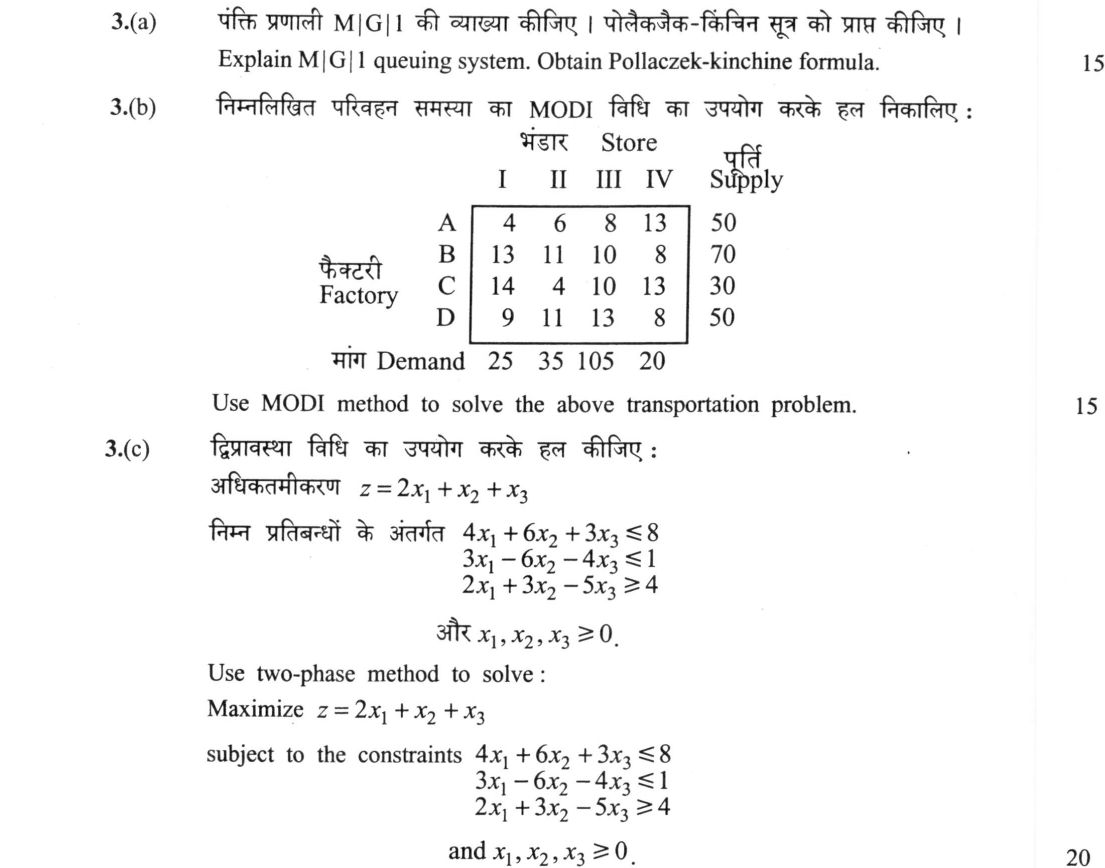
Use MODI method to solve the above transportation problem:
Store I II III IV A 4 6 8 13 B 13 11 10 8 C 14 4 10 13 D 9 11 13 8
Supply 50 70 30 50
Demand 25 35 105 20 15 marks
Use two-phase method to solve: Maximize z = 2x₁ + x₂ + x₃ subject to the constraints 4x₁ + 6x₂ + 3x₃ ≤ 8 3x₁ - 6x₂ - 4x₃ ≤ 1 2x₁ + 3x₂ - 5x₃ ≥ 4 and x₁, x₂, x₃ ≥ 0. 20 marks
हिंदी में प्रश्न पढ़ें
पंक्ति प्रणाली M|G|1 की व्याख्या कीजिए । पोलेकजेक-किंचिन सूत्र को प्राप्त कीजिए । (15 अंक)
निम्नलिखित परिवहन समस्या का MODI विधि का उपयोग करके हल निकालिए :
भंडार I II III IV A 4 6 8 13 B 13 11 10 8 C 14 4 10 13 D 9 11 13 8
पूर्ति 50 70 30 50
मांग 25 35 105 20 (15 अंक)
द्विप्रावस्था विधि का उपयोग करके हल कीजिए : अधिकतमीकरण z = 2x₁ + x₂ + x₃ निम्न प्रतिबंधों के अंतर्गत 4x₁ + 6x₂ + 3x₃ ≤ 8 3x₁ - 6x₂ - 4x₃ ≤ 1 2x₁ + 3x₂ - 5x₃ ≥ 4 और x₁, x₂, x₃ ≥ 0. (20 अंक)
The figure this question refers to, in words
The question paper is a scan and the diagram did not survive as text. This is the figure as read from the original page — every component, value and label — so the question can be worked from the text below.
(b) Table with rows labeled A, B, C, D and columns labeled I, II, III, IV, Supply. The values in the table are: Row A: 4, 6, 8, 13, 50 Row B: 13, 11, 10, 8, 70 Row C: 14, 4, 10, 13, 30 Row D: 9, 11, 13, 8, 50 Below the table, a row labeled Demand contains the values: 25, 35, 105, 20.
What "Solve" is asking you to do
Choose the method, then carry it through to a final answer. Identifying what kind of problem this is and why that method applies is the first thing marked; a correct figure arrived at invisibly earns almost nothing.
Structure that answers it
Given data and what is required → method chosen, with the reason it applies → set-up (equation, circuit, free body, trial balance) → working, step by step → answer with units and any condition of validity
Where marks are lost
Doing the middle steps mentally and writing only the result. In mathematics papers, a further loss comes from giving a decimal where the exact value in surds or fractions was wanted, or from skipping the justification a part explicitly asks for.
How this answer will be evaluated
Approach
Framework: Operations Research (Queuing Theory, Transportation, Linear Programming). (a) explain: definition/context > points in order > small example > short close | (b) calculate: given > formula > substitution > result with units > interpretation | (c) calculate: given > formula > substitution > result with units > interpretation Full marks: Flawless derivations and calculations with clear, logical steps and correct final answers.
Key points expected
- Define M/G/1 notation (Poisson arrivals, General service, 1 server)
- State Little's Law (L = λW)
- Derive mean queue length Lq using generating functions
- State final formula Lq = (λ²σ² + ρ²) / 2(1-ρ)
- Find Initial Basic Feasible Solution (e.g., Vogel's Approximation)
- Calculate u_i and v_j potentials for basic cells
- Compute net evaluations (Δ_ij) for non-basic cells
- Iterate until all Δ_ij ≥ 0 to find optimal solution
Evaluation rubric
Each sub-part is marked on its own, against the marks and word limit printed on the paper.
- (a) Define M/G/1 system and derive the Pollaczek-Khinchine formula. 15 marks
explain— definition/context → points in order → small example → short close
Must cover
- Define M/G/1 notation (Poisson arrivals, General service, 1 server)
- State Little's Law (L = λW)
- Derive mean queue length Lq using generating functions
- State final formula Lq = (λ²σ² + ρ²) / 2(1-ρ)
Loses marks
- Confusing M/G/1 with M/M/1
- Missing the variance term σ² in the final formula
- Derivation without stating assumptions
Earns more
- Define traffic intensity ρ = λ/μ
- Mention stability condition ρ < 1
- Show step-by-step algebraic manipulation
Extra mark
- Mention M/M/1 as a special case (σ² = 1/μ²)
- (b) Solve the transportation problem using the MODI method. 15 marks
calculate— given → formula → substitution → result with units → interpretation
Must cover
- Find Initial Basic Feasible Solution (e.g., Vogel's Approximation)
- Calculate u_i and v_j potentials for basic cells
- Compute net evaluations (Δ_ij) for non-basic cells
- Iterate until all Δ_ij ≥ 0 to find optimal solution
Loses marks
- Arithmetic errors in cost calculation
- Failing to check optimality condition (Δ_ij ≥ 0)
- Incorrect assignment of u and v values
Earns more
- Correctly identify degenerate solution if applicable
- Show clear table of u, v, and Δ values
- Calculate final minimum transportation cost
Extra mark
- Check for alternative optimal solutions (Δ_ij = 0)
- (c) Solve the Linear Programming problem using the two-phase method. 20 marks
calculate— given → formula → substitution → result with units → interpretation
Must cover
- Convert constraints to standard form (add slack/surplus/artificial variables)
- Phase I: Minimize sum of artificial variables (W)
- Phase II: Maximize original objective function (Z)
- Perform simplex iterations until optimal solution is reached
Loses marks
- Incorrect setup of Phase I objective function
- Arithmetic errors in simplex tableaus
- Failing to remove artificial variables before Phase II
Earns more
- Correctly identify entering and leaving variables
- Show clear simplex tableaus for both phases
- State final values of x1, x2, x3 and Z
Extra mark
- Check for unboundedness or infeasibility explicitly
Model answer coming soon
Every evaluation on this site is marked against a verified model answer. This question's answer is still being written; evaluation opens the moment it lands.
More from Statistics 2021 Paper II
- Q1 Explain Single Sampling Plan with the help of an example. Also, write the importance of a…
- Q2 A manufacturer finds that on the average, a television set is used 1.8 hours per day. A o…
- Q3 (a) Explain M|G|1 queuing system. Obtain Pollaczek-kinchine formula. (15 marks) (b) Use M…
- Q4 (a) Solve the following linear programming problem: Maximize z = 3x₁ + 5x₂ subject to the…
- Q5 (a) Explain Zellner's seemingly unrelated regression model and the feasible generalized l…
- Q6 (a) Explain Box-Jenkins methodology to build ARIMA models. (15 marks) (b) Prepare the cos…