Paper I — Q1
(a) Let X and Y be independent random variables with exponential distribution having respective means 1/(λ₁) and 1/(λ₂), λ₁ > 0…
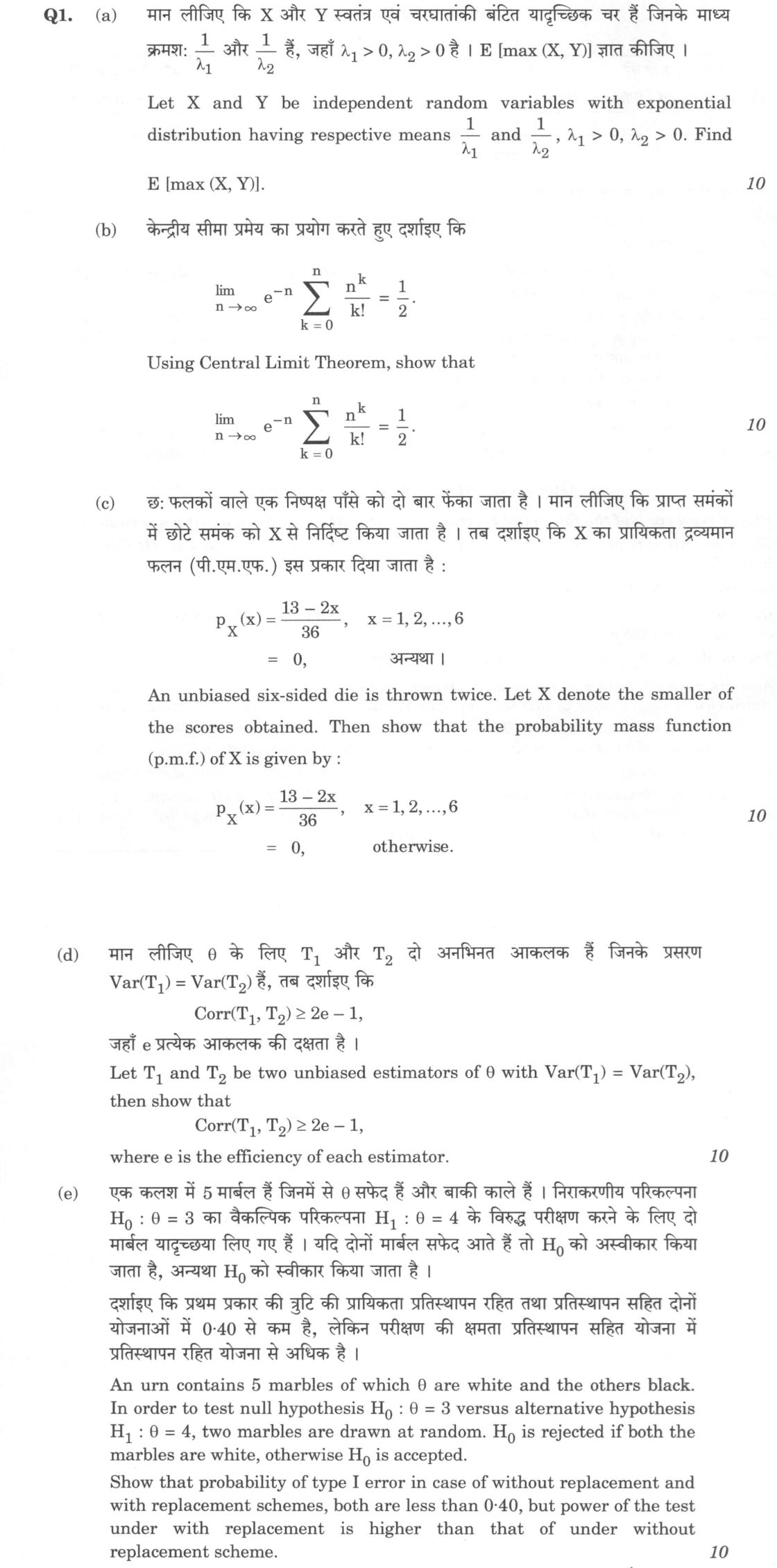
Let X and Y be independent random variables with exponential distribution having respective means 1/(λ₁) and 1/(λ₂), λ₁ > 0, λ₂ > 0. Find E [max (X, Y)]. 10 marks
Using Central Limit Theorem, show that limₙ → ∞ e⁻ⁿ Σₖ₌₀ⁿ (n^k)/(k!) = 1/2 10 marks
An unbiased six-sided die is thrown twice. Let X denote the smaller of the scores obtained. Then show that the probability mass function (p.m.f.) of X is given by : p_X(x) = (13-2x)/36, x = 1, 2, ..., 6 = 0, otherwise. 10 marks
Let T₁ and T₂ be two unbiased estimators of θ with Var(T₁) = Var(T₂), then show that Corr(T₁, T₂) ≥ 2e – 1, where e is the efficiency of each estimator. 10 marks
An urn contains 5 marbles of which θ are white and the others black. In order to test null hypothesis H₀ : θ = 3 versus alternative hypothesis H₁ : θ = 4, two marbles are drawn at random. H₀ is rejected if both the marbles are white, otherwise H₀ is accepted.
Show that probability of type I error in case of without replacement and with replacement schemes, both are less than 0·40, but power of the test under with replacement is higher than that of under without replacement scheme. 10 marks
हिंदी में प्रश्न पढ़ें
मान लीजिए कि X और Y स्वतंत्र एवं चरघातांकी बंटित यादृच्छिक चर हैं जिनके माध्य क्रमशः 1/(λ₁) और 1/(λ₂) हैं, जहाँ λ₁ > 0, λ₂ > 0 है। E [max (X, Y)] ज्ञात कीजिए। (10 अंक)
केन्द्रीय सीमा प्रमेय का प्रयोग करते हुए दर्शाइए कि limₙ → ∞ e⁻ⁿ Σₖ₌₀ⁿ (n^k)/(k!) = 1/2 (10 अंक)
छः फलकों वाले एक निष्पक्ष पाँसे को दो बार फेंका जाता है। मान लीजिए कि प्राप्त समंकों में छोटे समंक को X से निर्दिष्ट किया जाता है। तब दर्शाइए कि X का प्रायिकता द्रव्यमान फलन (पी.एम.एफ.) इस प्रकार दिया जाता है : p_X(x) = (13-2x)/36, x = 1, 2, ..., 6 = 0, अन्यथा। (10 अंक)
मान लीजिए θ के लिए T₁ और T₂ दो अनभिनत आकलक हैं जिनके प्रसरण Var(T₁) = Var(T₂) हैं, तब दर्शाइए कि Corr(T₁, T₂) ≥ 2e – 1, जहाँ e प्रत्येक आकलक की दक्षता है। (10 अंक)
एक कलश में 5 मार्बल हैं जिनमें से θ सफेद हैं और बाकी काले हैं। निराकरणीय परिकल्पना H₀ : θ = 3 का वैकल्पिक परिकल्पना H₁ : θ = 4 के विरुद्ध परीक्षण करने के लिए दो मार्बल यादृच्छया लिए गए हैं। यदि दोनों मार्बल सफेद आते हैं तो H₀ को अस्वीकार किया जाता है, अन्यथा H₀ को स्वीकार किया जाता है।
दर्शाइए कि प्रथम प्रकार की त्रुटि की प्रायिकता प्रतिस्थापन रहित तथा प्रतिस्थापन सहित दोनों योजनाओं में 0·40 से कम है, लेकिन परीक्षण की क्षमता प्रतिस्थापन सहित योजना में प्रतिस्थापन रहित योजना से अधिक है। (10 अंक)
Model answer
Written by UPSC Answer Check against this question's marking rubric, to the expected length. UPSC does not publish answers for Mains — this is one way to score well, not an official key.
(a) Let M = max(X, Y). Since X and Y are independent exponential variables with rates λ₁ and λ₂, their survival functions are P(X > t) = e^(−λ₁t) and P(Y > t) = e^(−λ₂t) for t ≥ 0.
Using the method of the survival function for a non-negative random variable:
P(M > t) = 1 − P(M ≤ t) = 1 − P(X ≤ t, Y ≤ t) = 1 − (1 − e^(−λ₁t))(1 − e^(−λ₂t)) = e^(−λ₁t) + e^(−λ₂t) − e^(−(λ₁+λ₂)t).
For a non-negative random variable M, E(M) = ∫₀^∞ P(M > t) dt. Therefore:
E(M) = ∫₀^∞ e^(−λ₁t) dt + ∫₀^∞ e^(−λ₂t) dt − ∫₀^∞ e^(−(λ₁+λ₂)t) dt = 1/λ₁ + 1/λ₂ − 1/(λ₁ + λ₂).
Final answer: E[max(X, Y)] = 1/λ₁ + 1/λ₂ − 1/(λ₁ + λ₂), valid for λ₁ > 0, λ₂ > 0.
(b) Let Y₁, Y₂, ..., Yₙ be independent and identically distributed Poisson(1) random variables. Then Sₙ = Y₁ + Y₂ + ... + Yₙ has Poisson(n) distribution.
Hence, for k = 0, 1, 2, ...,
P(Sₙ = k) = e⁻ⁿ nᵏ/k!.
Therefore:
e⁻ⁿ ∑ (k = 0 to n) nᵏ/k! = P(Sₙ ≤ n).
Now each Yᵢ has mean 1 and variance 1. Thus E(Sₙ) = n and Var(Sₙ) = n. By the Central Limit Theorem applied to the independent sum Sₙ,
(Sₙ − n)/√n → N(0, 1)
in distribution as n → ∞.
Consequently,
P(Sₙ ≤ n) = P((Sₙ − n)/√n ≤ 0) → P(Z ≤ 0),
where Z has the standard normal distribution. Since P(Z ≤ 0) = 1/2, we obtain:
lim (n → ∞) e⁻ⁿ ∑ (k = 0 to n) nᵏ/k! = 1/2.
Final answer: The limit is 1/2.
(c) Let the two independent die scores be U and V, each uniformly distributed on 1, 2, ..., 6. Let X = min(U, V).
For x = 1, 2, ..., 6,
P(X ≥ x) = P(U ≥ x, V ≥ x) = P(U ≥ x) P(V ≥ x) = ((7 − x)/6)((7 − x)/6) = (7 − x)²/36.
For x = 6, this gives P(X ≥ 6) = 1/36. For x = 7, P(X ≥ 7) = 0.
Now
p_X(x) = P(X = x) = P(X ≥ x) − P(X ≥ x + 1).
Thus for x = 1, 2, ..., 6,
p_X(x) = (7 − x)²/36 − (6 − x)²/36 = ((49 − 14x + x²) − (36 − 12x + x²))/36 = (13 − 2x)/36.
For all other values of x, p_X(x) = 0. Also,
∑ (x = 1 to 6) (13 − 2x)/36 = (11 + 9 + 7 + 5 + 3 + 1)/36 = 36/36 = 1.
Final answer: p_X(x) = (13 − 2x)/36 for x = 1, 2, ..., 6, and 0 otherwise.
(d) Let Var(T₁) = Var(T₂) = σ², and let ρ = Corr(T₁, T₂). Let V_min be the minimum variance among all unbiased estimators of θ. The efficiency of each estimator is
e = V_min/σ².
Since T₁ and T₂ are unbiased, the estimator A = (T₁ + T₂)/2 is also unbiased for θ.
Now
Var(A) = Var((T₁ + T₂)/2) = (1/4)(Var(T₁) + Var(T₂) + 2 Cov(T₁, T₂)) = (1/4)(σ² + σ² + 2ρσ²) = σ²(1 + ρ)/2.
Because V_min is the minimum variance among unbiased estimators, we must have
V_min ≤ Var(A).
Substituting V_min = eσ² and Var(A) = σ²(1 + ρ)/2, we get:
eσ² ≤ σ²(1 + ρ)/2.
Assuming σ² > 0, cancel σ²:
e ≤ (1 + ρ)/2.
Therefore,
ρ ≥ 2e − 1.
Final answer: Corr(T₁, T₂) ≥ 2e − 1.
(e) Under H₀: θ = 3, the urn has 3 white and 2 black marbles. Under H₁: θ = 4, the urn has 4 white and 1 black marble.
The test rejects H₀ if both drawn marbles are white.
Without replacement:
Type I error = P(both white | H₀) = (3/5)(2/4) = 6/20 = 3/10 = 0.30 < 0.40.
Power = P(both white | H₁) = (4/5)(3/4) = 12/20 = 3/5 = 0.60.
With replacement:
Type I error = P(both white | H₀) = (3/5)² = 9/25 = 0.36 < 0.40.
Power = P(both white | H₁) = (4/5)² = 16/25 = 0.64.
Thus the type I error probabilities are 0.30 and 0.36, both less than 0.40. The power under with replacement is 0.64, while under without replacement it is 0.60.
Final answer: Both type I errors are less than 0.40, and power with replacement, 0.64, is greater than power without replacement, 0.60.
What "Prove" is asking you to do
Establish that the statement holds for every case it claims, not for one representative case. The argument must be closed: each line follows from a definition, a hypothesis, or a named theorem you are entitled to use.
Structure that answers it
Given and to prove, restated → theorem or construction to be used, named → the argument line by line → conclusion stated as proved
Where marks are lost
Testing one example, which illustrates but proves nothing. On an if and only if claim, proving one direction and stopping forfeits that half outright, and degenerate cases — zero, the empty set, the equality case — have to be disposed of rather than assumed away.
How this answer will be evaluated
Approach
(a) calculate: given > formula > substitution > result with units > interpretation | (b) derive: given > assumptions > stepwise derivation > result > check | (c) derive: given > assumptions > stepwise derivation > result > check | (d) derive: given > assumptions > stepwise derivation > result > check | (e) calculate: given > formula > substitution > result with units > interpretation Full marks: Complete derivations with all steps shown, correct notation, and clear interpretation of results
Key points expected
- State independence and exponential parameters
- Use survival function P(max > t)
- Integrate survival function for expectation
- Final result in terms of λ₁ and λ₂
- Identify sum as Poisson CDF
- Apply CLT to standardized sum
- Show convergence to standard normal
- Evaluate limit as 1/2
Evaluation rubric
Each sub-part is marked on its own, against the marks and word limit printed on the paper.
- (a) Derive the expected value of the maximum of two independent exponential variables. 10 marks
calculate— given → formula → substitution → result with units → interpretation
Must cover
- State independence and exponential parameters
- Use survival function P(max > t)
- Integrate survival function for expectation
- Final result in terms of λ₁ and λ₂
Loses marks
- Assuming max is exponential
- Missing independence assumption
Earns more
- Alternative derivation via joint density
- Verification for λ₁ = λ₂ case
Extra mark
- Generalization to n variables
- (b) Prove the limit using the Central Limit Theorem. 10 marks
derive— given → assumptions → stepwise derivation → result → check
Must cover
- Identify sum as Poisson CDF
- Apply CLT to standardized sum
- Show convergence to standard normal
- Evaluate limit as 1/2
Loses marks
- Using Stirling's formula instead of CLT
- Skipping standardization step
Earns more
- Explicit standardization step
- Connection to De Moivre-Laplace
Extra mark
- Rate of convergence discussion
- (c) Derive the probability mass function for the minimum of two dice. 10 marks
derive— given → assumptions → stepwise derivation → result → check
Must cover
- Define X as min of two scores
- Count outcomes for each x value
- Derive formula (13-2x)/36
- Verify sum equals 1
Loses marks
- Confusing min with max
- Incorrect outcome counting
Earns more
- Complementary counting method
- Table of outcomes for each x
Extra mark
- Generalization to n dice
- (d) Prove the lower bound on correlation between two unbiased estimators. 10 marks
derive— given → assumptions → stepwise derivation → result → check
Must cover
- Define efficiency e for each estimator
- Use variance of linear combination
- Apply Cauchy-Schwarz or variance properties
- Derive inequality Corr ≥ 2e - 1
Loses marks
- Assuming independence
- Incorrect variance algebra
Earns more
- Geometric interpretation of correlation
- Equality conditions discussion
Extra mark
- Optimal linear combination weights
- (e) Compare Type I error and power for with/without replacement schemes. 10 marks
calculate— given → formula → substitution → result with units → interpretation
Must cover
- Calculate Type I error for both schemes
- Show both < 0.40
- Calculate power for both schemes
- Show with-replacement power is higher
Loses marks
- Confusing Type I and Type II error
- Incorrect hypergeometric calculation
Earns more
- Explicit probability calculations
- Interpretation of power difference
Extra mark
- General formula for n marbles
Practice this exact question
Write your answer and it is marked point by point against the model answer above — what you covered, what you missed, what you got wrong.
Evaluate my answer →More from Statistics 2022 Paper I
- Q1 (a) Let X and Y be independent random variables with exponential distribution having resp…
- Q2 (a) Let a random variable X have exponential distribution with mean 1/θ, θ > 0. To test H…
- Q3 (a) (i) How large a sample must be taken in order that the probability will be at least 0…
- Q4 (a) Consider Poisson distribution P_θ(X = j) = (e⁻θ θ^j)/(j!) = pⱼ, j = 0, 1, 2, .... Let…