Paper I — Q3
(a) (i) How large a sample must be taken in order that the probability will be at least 0·90 that the sample mean will be within…
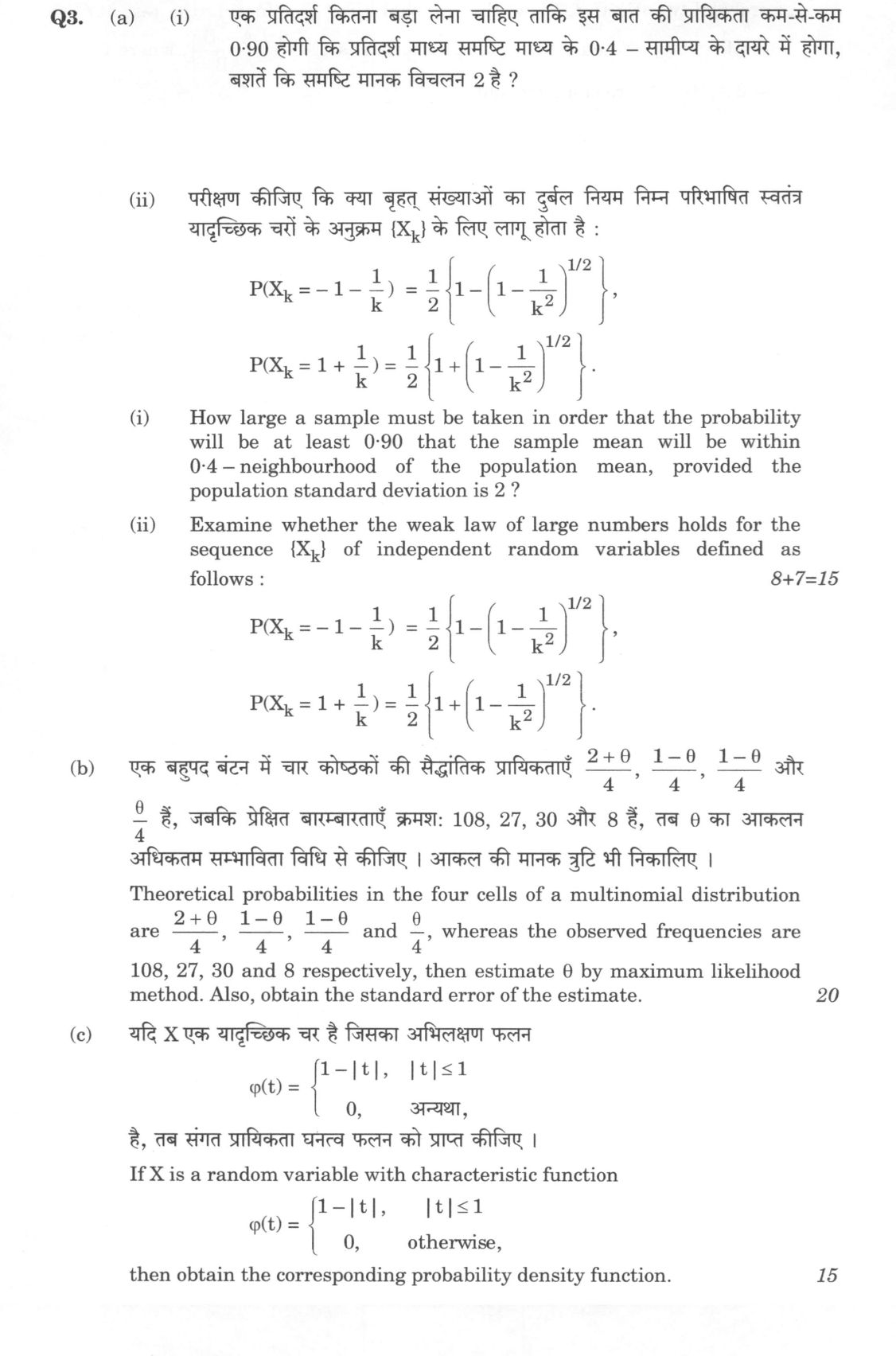
How large a sample must be taken in order that the probability will be at least 0·90 that the sample mean will be within 0·4 – neighbourhood of the population mean, provided the population standard deviation is 2 ? 8 marks
Examine whether the weak law of large numbers holds for the sequence Xₖ of independent random variables defined as follows :
P(Xₖ = -1 - 1/k) = 1/21 - (1 - 1/(k²))¹/2,
P(Xₖ = 1 + 1/k) = 1/21 + (1 - 1/(k²))¹/2. 7 marks
Theoretical probabilities in the four cells of a multinomial distribution are (2+θ)/4, (1-θ)/4, (1-θ)/4 and (θ)/4, whereas the observed frequencies are 108, 27, 30 and 8 respectively, then estimate θ by maximum likelihood method. Also, obtain the standard error of the estimate. 20 marks
If X is a random variable with characteristic function
φ(t) = 1-|t|, & |t| ≤ 1 0, & otherwise,
then obtain the corresponding probability density function. 15 marks
हिंदी में प्रश्न पढ़ें
एक प्रतिदर्श कितना बड़ा लेना चाहिए ताकि इस बात की प्रायिकता कम-से-कम 0·90 होगी कि प्रतिदर्श माध्य समष्टि माध्य के 0·4 - सामीप्य के दायरे में होगा, बशर्ते कि समष्टि मानक विचलन 2 है ? (8 अंक)
परीक्षण कीजिए कि क्या बहुत संख्याओं का दुर्बल नियम निम्न परिभाषित स्वतंत्र यादृच्छिक चरों के अनुक्रम Xₖ के लिए लागू होता है :
P(Xₖ = -1 - 1/k) = 1/21 - (1 - 1/(k²))¹/2,
P(Xₖ = 1 + 1/k) = 1/21 + (1 - 1/(k²))¹/2. (7 अंक)
एक बहुपद बंटन में चार कोष्ठकों की सैद्धांतिक प्रायिकताएं (2+θ)/4, (1-θ)/4, (1-θ)/4 और (θ)/4 हैं, जबकि प्रेक्षित बारंबारताएं क्रमशः: 108, 27, 30 और 8 हैं, तब θ का आकलन अधिकतम सम्भाविता विधि से कीजिए। आकल की मानक त्रुटि भी निकालिए। (20 अंक)
यदि X एक यादृच्छिक चर है जिसका अभिलक्षण फलन
φ(t) = 1-|t|, & |t| ≤ 1 0, & अन्यथा,
है, तब संगत प्रायिकता घनत्व फलन को प्राप्त कीजिए। (15 अंक)
Model answer
Written by UPSC Answer Check against this question's marking rubric, to the expected length. UPSC does not publish answers for Mains — this is one way to score well, not an official key.
(a)(i) Let X̄ be the sample mean. Then E(X̄)=μ and Var(X̄)=σ²/n=4/n. By Chebyshev’s inequality, P(|X̄−μ| ≥ 0.4) ≤ Var(X̄)/(0.4)² = (4/n)/0.16 = 25/n. Hence P(|X̄−μ| < 0.4) ≥ 1 − 25/n. We need 1 − 25/n ≥ 0.90, so 25/n ≤ 0.10, giving n ≥ 250. Thus the required sample size is n = 250.
(a)(ii) Let aₖ = √(1 − 1/k²). Then P(Xₖ = −1 − 1/k) = (1 − aₖ)/2, P(Xₖ = 1 + 1/k) = (1 + aₖ)/2. Therefore E(Xₖ) = (1 + 1/k)aₖ = (1 + 1/k)√(1 − 1/k²), and Var(Xₖ) = (1 + 1/k)²(1 − aₖ²) = (1 + 1/k)²/k² = (k + 1)²/k⁴. Now ∑ Var(Xₖ) converges, since Var(Xₖ) = O(1/k²). By Chebyshev’s inequality for independent random variables, P(|(1/n)∑ₖ₌₁ⁿ (Xₖ − E Xₖ)| > ε) ≤ (1/(n²ε²))∑ₖ₌₁ⁿ Var(Xₖ) → 0. Also E(Xₖ) → 1, so (1/n)∑ₖ₌₁ⁿ E(Xₖ) → 1. Hence (1/n)∑ₖ₌₁ⁿ Xₖ → 1 in probability. Therefore the weak law of large numbers holds for the sequence {Xₖ}.
(b) The total observed frequency is n = 108 + 27 + 30 + 8 = 173. The likelihood is proportional to L(θ) ∝ ((2+θ)/4)¹⁰⁸ ((1−θ)/4)⁵⁷ (θ/4)⁸, since the second and third cells have total frequency 57. Hence ℓ(θ) = constant + 108 ln(2+θ) + 57 ln(1−θ) + 8 ln θ. Differentiating, dℓ/dθ = 108/(2+θ) − 57/(1−θ) + 8/θ. Setting this to zero: 108/(2+θ) − 57/(1−θ) + 8/θ = 0. Multiplying by θ(1−θ)(2+θ): 108θ(1−θ) − 57θ(2+θ) + 8(1−θ)(2+θ) = 0, which simplifies to 16 − 14θ − 173θ² = 0, or 173θ² + 14θ − 16 = 0. Thus θ̂ = (−14 + √(14² + 4·173·16))/(2·173) = (−14 + √11268)/346 = (3√313 − 7)/173 ≈ 0.2663. The second derivative is negative at θ̂, so this is the maximum likelihood estimate.
For the standard error, the total Fisher information is I(θ) = n[1/(4(2+θ)) + 1/(2(1−θ)) + 1/(4θ)]. At θ̂ = 0.2663, I(θ̂) = 173[1/(4·2.2663) + 1/(2·0.7337) + 1/(4·0.2663)] ≈ 299.376. Hence SE(θ̂) = 1/√I(θ̂) = 1/√299.376 ≈ 0.0578. Thus θ̂ = (3√313 − 7)/173 ≈ 0.2663, and its asymptotic standard error is approximately 0.0578.
(c) By the inversion theorem, f(x) = (1/2π)∫₋∞^∞ exp(−itx)φ(t)dt. Since φ(t) = 1 − |t| for |t| ≤ 1 and 0 otherwise, f(x) = (1/2π)∫₋₁¹ (1 − |t|) exp(−itx)dt. Because φ is even and real, f(x) = (1/π)∫₀¹ (1 − t)cos(tx)dt. For x ≠ 0, ∫₀¹ (1 − t)cos(tx)dt = ∫₀¹ cos(tx)dt − ∫₀¹ t cos(tx)dt = sin x/x − [sin x/x + (cos x − 1)/x²] = (1 − cos x)/x². Thus f(x) = (1 − cos x)/(π x²), x ≠ 0. At x = 0, f(0) = (1/π)∫₀¹ (1 − t)dt = 1/(2π). Therefore the required probability density function is f(x) = (1 − cos x)/(π x²), x ≠ 0, f(0) = 1/(2π).
What "Solve" is asking you to do
Choose the method, then carry it through to a final answer. Identifying what kind of problem this is and why that method applies is the first thing marked; a correct figure arrived at invisibly earns almost nothing.
Structure that answers it
Given data and what is required → method chosen, with the reason it applies → set-up (equation, circuit, free body, trial balance) → working, step by step → answer with units and any condition of validity
Where marks are lost
Doing the middle steps mentally and writing only the result. In mathematics papers, a further loss comes from giving a decimal where the exact value in surds or fractions was wanted, or from skipping the justification a part explicitly asks for.
How this answer will be evaluated
Approach
(a(i)) calculate: given > formula > substitution > result with units > interpretation | (a(ii)) examine: intro > how/why with reasoning > evidence > conclusion | (b) calculate: given > formula > substitution > result with units > interpretation | (c) derive: given > assumptions > stepwise derivation > result > check Full marks: Rigorous derivation with all steps shown and correct final values.
Key points expected
- State Central Limit Theorem (CLT) assumption
- Define standard error of the mean (σ/√n)
- Set up probability inequality P(|X̄ - μ| < 0.4) ≥ 0.90
- Solve for n using standard normal quantile
- Calculate E(Xk) and Var(Xk) for the given distribution
- Check if E(Xk) converges to a constant
- Check if Var(Xk) converges to 0
- Conclude based on Chebyshev's inequality or WLLN theorem
Evaluation rubric
Each sub-part is marked on its own, against the marks and word limit printed on the paper.
- (a(i)) Determine the minimum sample size n for the specified probability and interval. 8 marks
calculate— given → formula → substitution → result with units → interpretation
Must cover
- State Central Limit Theorem (CLT) assumption
- Define standard error of the mean (σ/√n)
- Set up probability inequality P(|X̄ - μ| < 0.4) ≥ 0.90
- Solve for n using standard normal quantile
Loses marks
- Using population variance instead of standard error
- Incorrect z-value for the 0.90 confidence level
Earns more
- Correct identification of z-value for 0.90 probability
- Clear substitution of σ = 2 and margin 0.4
Extra mark
- Explicit check of the final integer value for n
- (a(ii)) Verify if the sequence {Xk} satisfies the conditions for the weak law of large numbers. 7 marks
examine— intro → how/why with reasoning → evidence → conclusion
Must cover
- Calculate E(Xk) and Var(Xk) for the given distribution
- Check if E(Xk) converges to a constant
- Check if Var(Xk) converges to 0
- Conclude based on Chebyshev's inequality or WLLN theorem
Loses marks
- Failing to calculate the variance of Xk
- Assuming convergence without checking the variance
Earns more
- Correct expansion of the probability terms
- Explicit statement of the WLLN conditions
Extra mark
- Mentioning the specific theorem used (e.g., Chebyshev)
- (b) Estimate θ using MLE and calculate the standard error of the estimate. 20 marks
calculate— given → formula → substitution → result with units → interpretation
Must cover
- Write the multinomial likelihood function L(θ)
- Differentiate log-likelihood to find the estimator θ̂
- Substitute observed frequencies to calculate θ̂
- Derive the standard error using the Fisher information
Loses marks
- Incorrect likelihood function for multinomial distribution
- Failing to calculate the standard error
Earns more
- Correct setup of the log-likelihood function
- Accurate calculation of the standard error formula
Extra mark
- Verification that the second derivative is negative (maximum)
- (c) Obtain the probability density function from the given characteristic function. 15 marks
derive— given → assumptions → stepwise derivation → result → check
Must cover
- State the inversion formula for characteristic functions
- Set up the integral for the PDF f(x)
- Evaluate the integral of (1-|t|)e^(-ixt) over [-1, 1]
- Simplify the result to the final PDF expression
Loses marks
- Incorrect limits of integration
- Algebraic errors in evaluating the integral
Earns more
- Correct handling of the absolute value in the integral
- Proper use of Euler's formula for the exponential term
Extra mark
- Identifying the resulting distribution (e.g., triangular)
Practice this exact question
Write your answer and it is marked point by point against the model answer above — what you covered, what you missed, what you got wrong.
Evaluate my answer →More from Statistics 2022 Paper I
- Q1 (a) Let X and Y be independent random variables with exponential distribution having resp…
- Q2 (a) Let a random variable X have exponential distribution with mean 1/θ, θ > 0. To test H…
- Q3 (a) (i) How large a sample must be taken in order that the probability will be at least 0…
- Q4 (a) Consider Poisson distribution P_θ(X = j) = (e⁻θ θ^j)/(j!) = pⱼ, j = 0, 1, 2, .... Let…
- Q5 (a) Define general linear model with usual assumptions. If y₁ = β₁ + u₁, y₂ = –β₁ + β₂ +…
- Q6 (a) In a set of two-way classified data according to k levels of factor A and r levels of…