Paper I — Q8
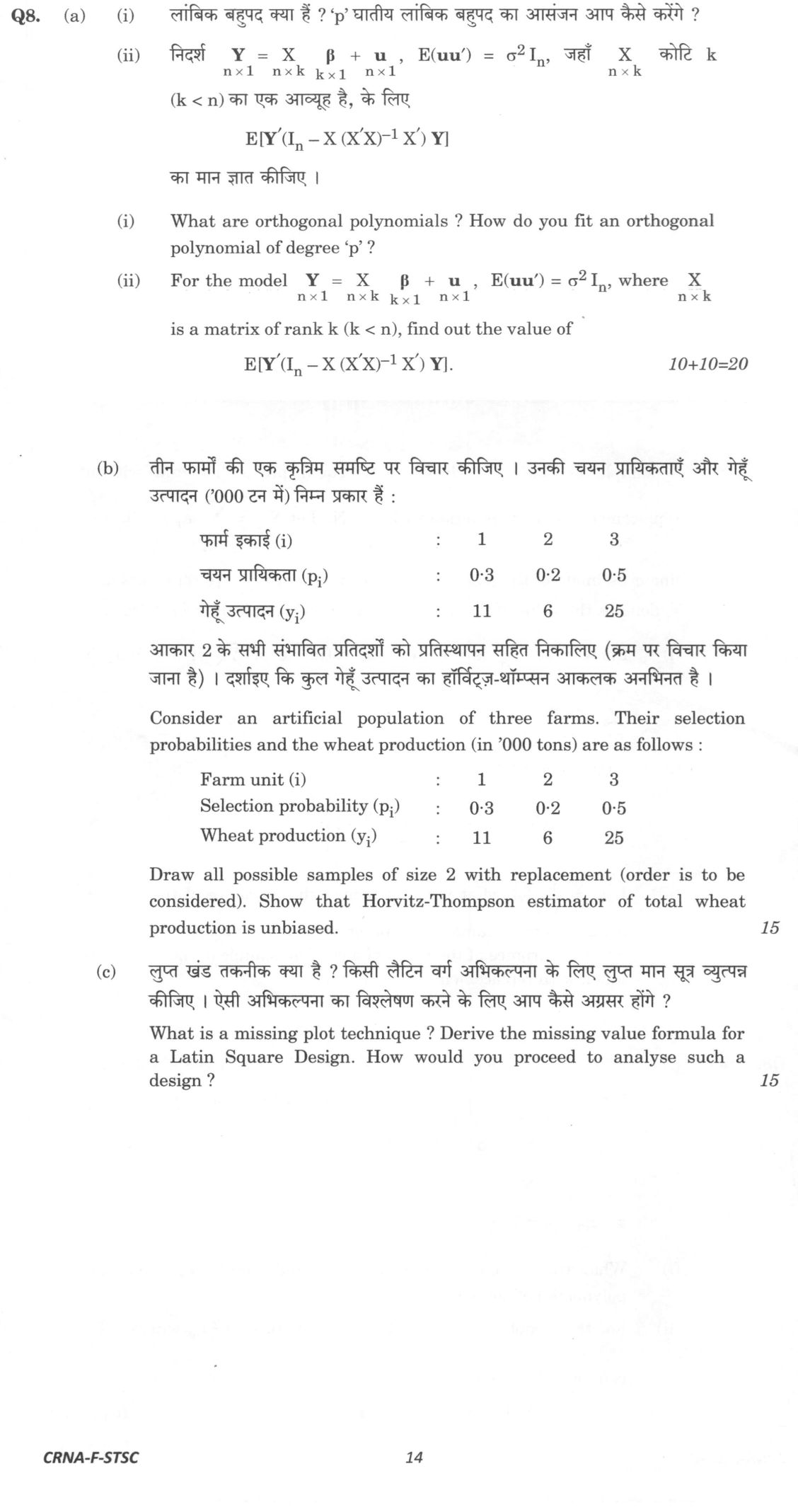
(a) (i) What are orthogonal polynomials ? How do you fit an orthogonal polynomial of degree 'p' ? (ii) For the model Y_(n×1) =…
What are orthogonal polynomials ? How do you fit an orthogonal polynomial of degree 'p' ?
For the model Y_(n×1) = X_(n×k) β_(k×1) + u_(n×1), E(uu') = σ² I_n, where X_(n×k) is a matrix of rank k (k < n), find out the value of E[Y'(I_n - X(X'X)⁻¹X')Y]. 10+10=20
Consider an artificial population of three farms. Their selection probabilities and the wheat production (in '000 tons) are as follows : Farm unit (i) : 1 2 3; Selection probability (pᵢ) : 0·3 0·2 0·5; Wheat production (yᵢ) : 11 6 25. Draw all possible samples of size 2 with replacement (order is to be considered). Show that Horvitz-Thompson estimator of total wheat production is unbiased. 15 marks
What is a missing plot technique ? Derive the missing value formula for a Latin Square Design. How would you proceed to analyse such a design ? 15 marks
हिंदी में प्रश्न पढ़ें
लांबिक बहुपद क्या हैं ? 'p' घातीय लांबिक बहुपद का आसंजन आप कैसे करेंगे ?
निर्देश Y_(n×1) = X_(n×k) β_(k×1) + u_(n×1), E(uu') = σ² I_n, जहाँ X_(n×k) (k < n) का एक आयुः है, के लिए E[Y'(I_n - X(X'X)⁻¹X')Y] का मान ज्ञात कीजिए । 10+10=20
तीन फार्मों की एक कृत्रिम समष्टि पर विचार कीजिए । उनकी चयन प्रायिकताएँ और गेहूँ उत्पादन ('000 टन में) निम्न प्रकार हैं : फार्म इकाई (i) : 1 2 3; चयन प्रायिकता (pᵢ) : 0·3 0·2 0·5; गेहूँ उत्पादन (yᵢ) : 11 6 25। आकार 2 के सभी संभावित प्रतिदर्शों को प्रतिस्थापन सहित निकालिए (क्रम पर विचार किया जाना है) । दर्शाइए कि कुल गेहूँ उत्पादन का हॉर्विट्ज़-थॉम्पसन आकलक अनभिनत है । 15
लुप्त खंड तकनीक क्या है ? किसी लैटिन वर्ग अभिकल्पना के लिए लुप्त मान सूत्र व्युत्पन्न कीजिए । ऐसी अभिकल्पना का विश्लेषण करने के लिए आप कैसे अग्रसर होंगे ? 15 marks
Model answer
Written by UPSC Answer Check against this question's marking rubric, to the expected length. UPSC does not publish answers for Mains — this is one way to score well, not an official key.
(a)(i) Orthogonal polynomials are polynomials Pⱼ(x) such that for j ≠ k, Σᵢ Pⱼ(xᵢ)Pₖ(xᵢ)=0 for a fixed set of xᵢ, or ∫ w(x)Pⱼ(x)Pₖ(x)dx=0 for a weight function w(x). To fit an orthogonal polynomial of degree p, take P₀=1 and construct P₁,…,P_p orthogonal over the given xᵢ values by Gram–Schmidt or recurrence. Fit the model yᵢ = θ₀P₀(xᵢ)+θ₁P₁(xᵢ)+…+θ_pP_p(xᵢ)+εᵢ. Because the columns are orthogonal, the normal equations separate, giving θ̂ⱼ = Σᵢ yᵢPⱼ(xᵢ) / Σᵢ Pⱼ²(xᵢ). The fitted polynomial is Σⱼ θ̂ⱼPⱼ(x). Residual SS = Σᵢ yᵢ² - Σⱼ θ̂ⱼ²ΣᵢPⱼ²(xᵢ), and Var(θ̂ⱼ)=σ²/ΣᵢPⱼ²(xᵢ). For equally spaced xᵢ, standard orthogonal polynomial tables are used; otherwise Gram–Schmidt is used.
(a)(ii) Let M = Iₙ - X(X'X)⁻¹X'. Then M is symmetric and idempotent, and MX=0. Hence Y'MY = (Xβ+u)'M(Xβ+u) = u'Mu. Therefore E[Y'MY] = E[u'Mu] = tr(M E[uu']) = σ² tr(M). Now tr(M) = tr(Iₙ) - tr(X(X'X)⁻¹X') = n - tr((X'X)⁻¹X'X) = n - k. So E[Y'(Iₙ - X(X'X)⁻¹X')Y] = (n-k)σ².
(b) For two draws with replacement, the inclusion probability of farm i is πᵢ = 1-(1-pᵢ)². Thus π₁ = 1-(1-0.3)² = 0.51 = 51/100, π₂ = 1-(1-0.2)² = 0.36 = 9/25, π₃ = 1-(1-0.5)² = 0.75 = 3/4. The Horvitz–Thompson estimator is T̂ = Σ_i∈s distinct yᵢ/πᵢ.
All ordered samples (i,j), their probabilities pᵢpⱼ, and T̂ are:
- (1,1): 9/100, T̂ = 11/(51/100) = 1100/51
- (1,2): 3/50, T̂ = 1100/51 + 6/(9/25) = 1100/51 + 50/3 = 650/17
- (1,3): 3/20, T̂ = 1100/51 + 25/(3/4) = 1100/51 + 100/3 = 2800/51
- (2,1): 3/50, T̂ = 650/17
- (2,2): 1/25, T̂ = 6/(9/25) = 50/3
- (2,3): 1/10, T̂ = 50/3 + 100/3 = 50
- (3,1): 3/20, T̂ = 2800/51
- (3,2): 1/10, T̂ = 50
- (3,3): 1/4, T̂ = 25/(3/4) = 100/3
Hence E(T̂) = (9/100)(1100/51) + (1/25)(50/3) + (1/4)(100/3) + (3/25)(650/17) + (3/10)(2800/51) + (1/5)(50) = 33/17 + 2/3 + 25/3 + 78/17 + 280/17 + 10 = (33+78+280)/17 + 27/3 + 10 = 391/17 + 9 + 10 = 23 + 19 = 42. Population total = 11+6+25 = 42. In general, E(Iᵢ)=πᵢ, so E(T̂)=Σᵢ yᵢ = Y. Thus the Horvitz–Thompson estimator is unbiased.
(c) Missing plot technique estimates a missing observation in a designed experiment so that the usual analysis of variance can be carried out. The estimate is chosen to minimise the error sum of squares under the additive model.
For a Latin Square Design with r rows, r columns and r treatments, let x be the missing value in row i, column j, treatment k. Let R, C, T be the sums of observed values in that row, column and treatment, and let G be the grand total of all observed values. After inserting x, the corresponding totals become R+x, C+x, T+x, G+x.
The complete Latin Square error sum of squares is SSE(x) = Σy² - (1/r)Σ(row totals)² - (1/r)Σ(column totals)² - (1/r)Σ(treatment totals)² + (2/r²)(grand total)². Only x varies, so SSE(x) = const + x² - (1/r)(R+x)² - (1/r)(C+x)² - (1/r)(T+x)² + (2/r²)(G+x)². Differentiating and setting dSSE/dx = 0 gives 2x - (2/r)(R+x) - (2/r)(C+x) - (2/r)(T+x) + (4/r²)(G+x)=0. Solving, x[(r-1)(r-2)] = r(R+C+T) - 2G. Therefore x = [r(R+C+T) - 2G] / [(r-1)(r-2)], valid for r ≥ 3.
To analyse the design, substitute this estimate for the missing value and perform the usual Latin Square ANOVA. The error degrees of freedom are reduced by 1, so error df becomes (r-1)(r-2)-1. Treatment comparisons involving the missing treatment need the appropriate adjusted standard error. If more than one value is missing, the procedure is repeated iteratively or handled by least-squares regression.
What "Derive" is asking you to do
Reach the stated expression from a starting relation, justifying every step. The destination is printed in the question, so only the route earns marks, and the assumptions you work under are part of that route.
Structure that answers it
Assumptions and notation defined → starting relation or governing equation → each step with its justification → the required expression → limiting case or boundary check
Where marks are lost
Writing the standard result first and fitting three lines to it, which an examiner reads at a glance. Marks also go on assumptions left unstated — lossless medium, small amplitude, errors independent with zero mean — and on symbols used before they are defined, even when the question says usual notations.
How this answer will be evaluated
Approach
(a(i)) explain: definition/context > points in order > small example > short close | (a(ii)) derive: given > assumptions > stepwise derivation > result > check | (b) calculate: given > formula > substitution > result with units > interpretation | (c) derive: given > assumptions > stepwise derivation > result > check Full marks: Rigorous derivations, complete sample enumeration, and clear definitions with correct notation.
Key points expected
- Definition: sum of products of values is zero
- Orthogonality condition: Σ y_i P_j(x_i) P_k(x_i) = 0
- Fitting method: least squares or Gram-Schmidt
- Mention of regression coefficients estimation
- Substitute Y = Xβ + u into the expression
- Show cross terms vanish (E[u] = 0)
- Use E(uu') = σ²I_n
- Final result: (n-k)σ²
Evaluation rubric
Each sub-part is marked on its own, against the marks and word limit printed on the paper.
- (a(i)) Define orthogonal polynomials and describe the fitting procedure for degree 'p'. 10 marks
explain— definition/context → points in order → small example → short close
Must cover
- Definition: sum of products of values is zero
- Orthogonality condition: Σ y_i P_j(x_i) P_k(x_i) = 0
- Fitting method: least squares or Gram-Schmidt
- Mention of regression coefficients estimation
Loses marks
- Confusing orthogonal with orthonormal
- Failing to state the orthogonality condition
Earns more
- Example of Legendre or Chebyshev polynomials
- Mention of numerical stability benefits
Extra mark
- Reference to specific polynomial families
- (a(ii)) Calculate the expectation of the quadratic form Y'(I - H)Y. 10 marks
derive— given → assumptions → stepwise derivation → result → check
Must cover
- Substitute Y = Xβ + u into the expression
- Show cross terms vanish (E[u] = 0)
- Use E(uu') = σ²I_n
- Final result: (n-k)σ²
Loses marks
- Incorrect matrix algebra steps
- Forgetting the rank k condition
Earns more
- Explicit calculation of trace(I - H)
- Mention of degrees of freedom
Extra mark
- Connection to residual sum of squares
- (b) List all samples of size 2 with replacement and verify HT estimator unbiasedness. 15 marks
calculate— given → formula → substitution → result with units → interpretation
Must cover
- List all 9 possible samples (i, j)
- Calculate HT estimator for each sample
- Compute probability of each sample
- Show E(HT) equals population total (42)
Loses marks
- Missing samples in the list
- Incorrect probability calculation
Earns more
- Clean tabular presentation of samples
- Explicit calculation of population total
Extra mark
- Mention of variance of the estimator
- (c) Define missing plot technique and derive the formula for Latin Square Design. 15 marks
derive— given → assumptions → stepwise derivation → result → check
Must cover
- Definition of missing plot technique
- Derivation of missing value formula for LSD
- Explanation of analysis procedure (ANOVA)
- Mention of degrees of freedom adjustment
Loses marks
- Incorrect formula for missing value
- Failing to explain the analysis procedure
Earns more
- Step-by-step algebraic derivation
- Clear explanation of ANOVA table structure
Extra mark
- Example of a 3x3 Latin Square
Practice this exact question
Write your answer and it is marked point by point against the model answer above — what you covered, what you missed, what you got wrong.
Evaluate my answer →More from Statistics 2022 Paper I
- Q5 (a) Define general linear model with usual assumptions. If y₁ = β₁ + u₁, y₂ = –β₁ + β₂ +…
- Q6 (a) In a set of two-way classified data according to k levels of factor A and r levels of…
- Q7 (a) Consider the following data given for a BIBD with v = b = 4, r = k = 3, λ = 2 and N =…
- Q8 (a) (i) What are orthogonal polynomials ? How do you fit an orthogonal polynomial of degr…