Paper I — Q2
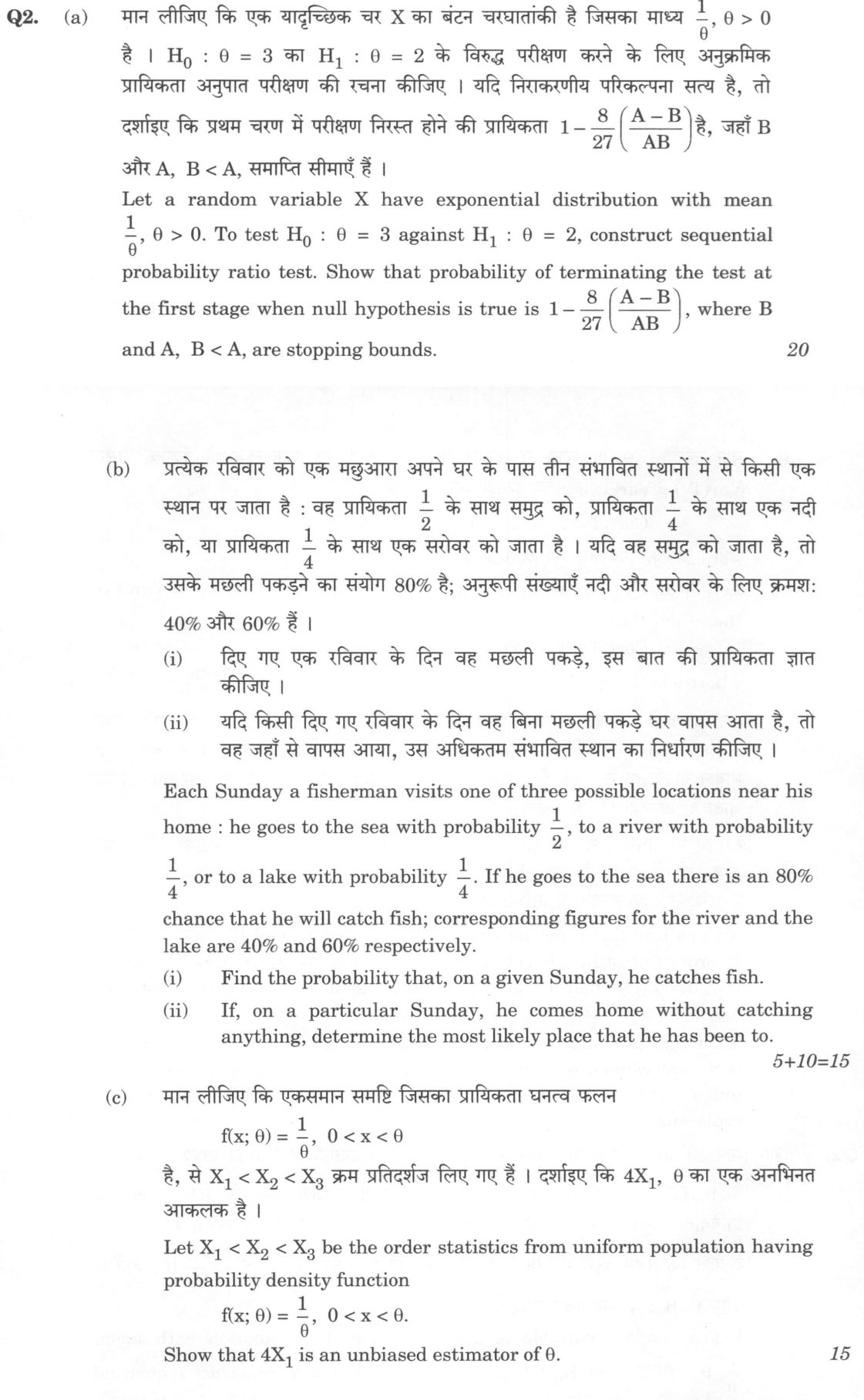
(a) Let a random variable X have exponential distribution with mean 1/θ, θ > 0. To test H₀ : θ = 3 against H₁ : θ = 2, construct…
Let a random variable X have exponential distribution with mean 1/θ, θ > 0. To test H₀ : θ = 3 against H₁ : θ = 2, construct sequential probability ratio test. Show that probability of terminating the test at the first stage when null hypothesis is true is 1 – 8/27 ((A–B)/AB), where B and A, B < A, are stopping bounds. 20 marks
Each Sunday a fisherman visits one of three possible locations near his home : he goes to the sea with probability 1/2, to a river with probability 1/4, or to a lake with probability 1/4. If he goes to the sea there is an 80% chance that he will catch fish; corresponding figures for the river and the lake are 40% and 60% respectively.
Find the probability that, on a given Sunday, he catches fish.
If, on a particular Sunday, he comes home without catching anything, determine the most likely place that he has been to. (5+10=15 marks)
Let X₁ < X₂ < X₃ be the order statistics from uniform population having probability density function f(x; θ) = 1/θ, 0 < x < θ. Show that 4X₁ is an unbiased estimator of θ. 15 marks
हिंदी में प्रश्न पढ़ें
मान लीजिए कि एक यादृच्छिक चर X का बंटन चरघातांकी है जिसका माध्य 1/θ, θ > 0 है। H₀ : θ = 3 का H₁ : θ = 2 के विरुद्ध परीक्षण करने के लिए अनुक्रमिक प्रायिकता अनुपात परीक्षण की रचना कीजिए। यदि निराकरणीय परिकल्पना सत्य है, तो दर्शाइए कि प्रथम चरण में परीक्षण निरस्त होने की प्रायिकता 1 – 8/27 ((A–B)/AB) है, जहाँ B और A, B < A, समाप्ति सीमाएँ हैं। (20 अंक)
प्रत्येक रविवार को एक मछुआरा अपने घर के पास तीन संभावित स्थानों में से किसी एक स्थान पर जाता है : वह प्रायिकता 1/2 के साथ समुद्र को, प्रायिकता 1/4 के साथ एक नदी को, या प्रायिकता 1/4 के साथ एक सरोवर को जाता है। यदि वह समुद्र को जाता है, तो उसके मछली पकड़ने का संयोग 80% है; अनुरूपी संख्याएँ नदी और सरोवर के लिए क्रमशः 40% और 60% हैं।
दिए गए एक रविवार के दिन वह मछली पकड़े, इस बात की प्रायिकता ज्ञात कीजिए।
यदि किसी दिए गए रविवार के दिन वह बिना मछली पकड़े घर वापस आता है, तो वह जहाँ से वापस आया, उस अधिकतम संभावित स्थान का निर्धारण कीजिए। (5+10=15 अंक)
मान लीजिए कि एकसमान समष्टि जिसका प्रायिकता घनत्व फलन f(x; θ) = 1/θ, 0 < x < θ है, से X₁ < X₂ < X₃ क्रम प्रतिदर्शज लिए गए हैं। दर्शाइए कि 4X₁, θ का एक अनभिनत आकलक है। (15 अंक)
Model answer
Written by UPSC Answer Check against this question's marking rubric, to the expected length. UPSC does not publish answers for Mains — this is one way to score well, not an official key.
(a) Let f(x;θ)=θ exp(−θx), x>0, so the mean is 1/θ. The likelihood ratio after n observations for H₁:θ=2 against H₀:θ=3 is
Λₙ = ∏ [2 exp(−2xᵢ)]/[3 exp(−3xᵢ)] = (2/3)ⁿ exp(Σxᵢ).
By the Sequential Probability Ratio Test, continue sampling while B < Λₙ < A; stop accepting H₁ if Λₙ ≥ A, and stop accepting H₀ if Λₙ ≤ B.
At the first stage, n=1, so
Λ₁ = (2/3) exp(X).
Under H₀, X has exponential density 3 exp(−3x). The test terminates at stage 1 iff Λ₁ ≤ B or Λ₁ ≥ A. Now
Λ₁ ≥ A ⇔ (2/3) exp(X) ≥ A ⇔ X ≥ ln(3A/2),
Λ₁ ≤ B ⇔ (2/3) exp(X) ≤ B ⇔ X ≤ ln(3B/2).
Hence, assuming the lower boundary is active at stage 1, i.e. ln(3B/2) > 0 or B > 2/3,
P(terminate at stage 1 | H₀) = P(X ≥ ln(3A/2)) + P(X ≤ ln(3B/2)) = exp[−3 ln(3A/2)] + 1 − exp[−3 ln(3B/2)] = (2/(3A))³ + 1 − (2/(3B))³ = 1 + 8/(27A³) − 8/(27B³) = 1 − (8/27)(1/B³ − 1/A³) = 1 − (8/27)((A³−B³)/(A³B³)).
If B ≤ 2/3, the lower stopping event is impossible at stage 1 and the probability is simply 8/(27A³).
Thus, with the standard likelihood-ratio stopping bounds A and B, the correct expression contains cubes. The form 1 − (8/27)((A−B)/(AB)) stated in the question is obtained only if the symbols A and B in that expression denote the cubes of the actual stopping bounds; otherwise it is a typographical omission of the cube.
(b)(i) Let S, R, L denote sea, river, lake, and F denote catching fish. By the law of total probability,
P(F)=P(S)P(F|S)+P(R)P(F|R)+P(L)P(F|L)
= (1/2)(4/5) + (1/4)(2/5) + (1/4)(3/5)
= 2/5 + 1/10 + 3/20
= 8/20 + 2/20 + 3/20 = 13/20.
Final: P(catches fish)=13/20=0.65.
(b)(ii) Given no catch, P(Fᶜ)=1−13/20=7/20. By Bayes' theorem,
P(S|Fᶜ)= [(1/2)(1/5)]/(7/20) = (1/10)(20/7)=2/7,
P(R|Fᶜ)= [(1/4)(3/5)]/(7/20) = (3/20)(20/7)=3/7,
P(L|Fᶜ)= [(1/4)(2/5)]/(7/20) = (1/10)(20/7)=2/7.
Since 3/7 is the largest posterior probability, the most likely place is the river.
Final: river, with posterior probability 3/7.
(c) Let X₁ be the minimum of three independent Uniform(0,θ) variables. Its survival function is
P(X₁>x)=P(all three observations >x)=(1−x/θ)³, 0<x<θ.
Hence the CDF is F₁(x)=1−(1−x/θ)³, and the density is
f₁(x)=3/θ (1−x/θ)², 0<x<θ.
Therefore,
E(X₁)=∫ from 0 to θ x · 3/θ (1−x/θ)² dx.
Put y=x/θ, so dx=θ dy. Then
E(X₁)=3θ ∫ from 0 to 1 y(1−y)² dy
=3θ ∫ from 0 to 1 (y−2y²+y³) dy
=3θ(1/2−2/3+1/4)
=3θ((6−8+3)/12)
=3θ(1/12)=θ/4.
Thus
E(4X₁)=4E(X₁)=4(θ/4)=θ.
Hence 4X₁ is an unbiased estimator of θ.
What "Construct" is asking you to do
Build the required object — a velocity diagram, a sequential test, a control chart, a geometrical figure — step by step, so the sequence is visible on the page. The steps are marked, not only the finished thing.
Structure that answers it
Data and requirement → scale or basis chosen, stated → construction steps in order → the finished construction, labelled → quantities read off, or the result it yields
Where marks are lost
A diagram drawn without a stated scale, so nothing can be scaled off it and the quantities that follow lose their support. In statistics, writing down the procedure without fixing its defining constants — stopping bounds in terms of the two error probabilities, or the control limits — leaves it unmarkable.
How this answer will be evaluated
Approach
Framework: SPRT (Sequential Probability Ratio Test). (a) derive: given > assumptions > stepwise derivation > result > check | (b(i)) calculate: given > formula > substitution > result with units > interpretation | (b(ii)) calculate: given > formula > substitution > result with units > interpretation | (c) derive: given > assumptions > stepwise derivation > result > check Full marks: Complete derivations with correct notation, clear interpretation, and proper statistical reasoning throughout.
Key points expected
- State likelihood ratio for exponential distribution
- Define stopping bounds A and B
- Derive probability of termination at first stage
- Show result equals 1 - 8/27((A-B)/AB)
- Apply law of total probability
- Use given probabilities for each location
- Calculate weighted sum of catch probabilities
- Provide final numerical answer
Evaluation rubric
Each sub-part is marked on its own, against the marks and word limit printed on the paper.
- (a) Construct SPRT for exponential distribution and derive first-stage termination probability. 20 marks
derive— given → assumptions → stepwise derivation → result → check
Must cover
- State likelihood ratio for exponential distribution
- Define stopping bounds A and B
- Derive probability of termination at first stage
- Show result equals 1 - 8/27((A-B)/AB)
Loses marks
- Incorrect likelihood ratio setup
- Algebraic errors in derivation
- Fails to connect to given formula
Earns more
- Correctly identifies θ=3 and θ=2 cases
- Clear step-by-step algebraic manipulation
- Proper notation for stopping regions
Extra mark
- Mentions Wald's SPRT theorem
- Discusses error probabilities α and β
- (b(i)) Calculate total probability of catching fish on a given Sunday. 5 marks
calculate— given → formula → substitution → result with units → interpretation
Must cover
- Apply law of total probability
- Use given probabilities for each location
- Calculate weighted sum of catch probabilities
- Provide final numerical answer
Loses marks
- Incorrect probability weighting
- Arithmetic errors in calculation
- Missing final answer
Earns more
- Clear tabular presentation of probabilities
- Correct multiplication of conditional probabilities
Extra mark
- Mentions Bayes' theorem context
- (b(ii)) Determine most likely location given no fish caught. 10 marks
calculate— given → formula → substitution → result with units → interpretation
Must cover
- Apply Bayes' theorem for posterior probabilities
- Calculate P(location|no fish) for each location
- Compare posterior probabilities
- Identify location with maximum posterior
Loses marks
- Incorrect application of Bayes' theorem
- Fails to normalize posterior probabilities
- Wrong identification of most likely location
Earns more
- Correct calculation of P(no fish|location)
- Clear comparison of three posterior values
- Proper interpretation of result
Extra mark
- Mentions maximum likelihood principle
- Discusses practical implications
- (c) Show that 4X₁ is an unbiased estimator of θ. 15 marks
derive— given → assumptions → stepwise derivation → result → check
Must cover
- Find distribution of X₁ (minimum order statistic)
- Calculate E[X₁] for uniform distribution
- Show E[4X₁] = θ
- Conclude unbiasedness
Loses marks
- Incorrect order statistic distribution
- Integration errors in expectation
- Fails to show E[4X₁] = θ
Earns more
- Correct derivation of X₁'s pdf
- Proper integration for expectation
- Clear statement of unbiasedness definition
Extra mark
- Mentions Cramér-Rao lower bound
- Discusses efficiency of estimator
Practice this exact question
Write your answer and it is marked point by point against the model answer above — what you covered, what you missed, what you got wrong.
Evaluate my answer →More from Statistics 2022 Paper I
- Q1 (a) Let X and Y be independent random variables with exponential distribution having resp…
- Q2 (a) Let a random variable X have exponential distribution with mean 1/θ, θ > 0. To test H…
- Q3 (a) (i) How large a sample must be taken in order that the probability will be at least 0…
- Q4 (a) Consider Poisson distribution P_θ(X = j) = (e⁻θ θ^j)/(j!) = pⱼ, j = 0, 1, 2, .... Let…
- Q5 (a) Define general linear model with usual assumptions. If y₁ = β₁ + u₁, y₂ = –β₁ + β₂ +…