Paper II — Q3
(a) It is planned to raise a research team to a strength of 50 chemists, which is to be maintained. The wastage of recruits…
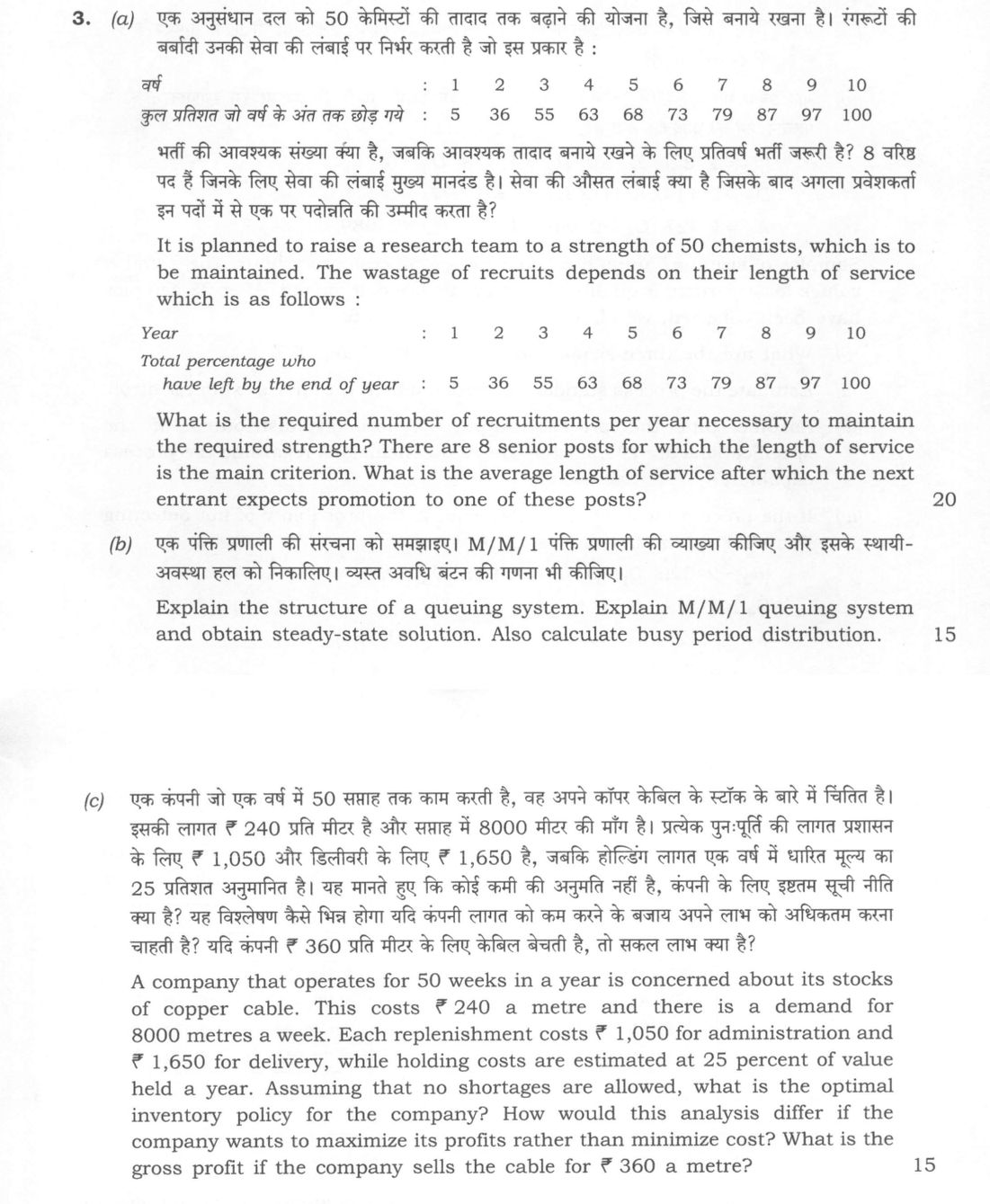
It is planned to raise a research team to a strength of 50 chemists, which is to be maintained. The wastage of recruits depends on their length of service which is as follows:
Year : 1 2 3 4 5 6 7 8 9 10
Total percentage who have left by the end of year : 5 36 55 63 68 73 79 87 97 100
What is the required number of recruitments per year necessary to maintain the required strength? There are 8 senior posts for which the length of service is the main criterion. What is the average length of service after which the next entrant expects promotion to one of these posts? 20 marks
Explain the structure of a queuing system. Explain M/M/1 queuing system and obtain steady-state solution. Also calculate busy period distribution. 15 marks
A company that operates for 50 weeks in a year is concerned about its stocks of copper cable. This costs ₹ 240 a metre and there is a demand for 8000 metres a week. Each replenishment costs ₹ 1,050 for administration and ₹ 1,650 for delivery, while holding costs are estimated at 25 percent of value held a year. Assuming that no shortages are allowed, what is the optimal inventory policy for the company? How would this analysis differ if the company wants to maximize its profits rather than minimize cost? What is the gross profit if the company sells the cable for ₹ 360 a metre? 15 marks
हिंदी में प्रश्न पढ़ें
एक अनुसंधान दल को 50 केमिस्टों की तादाद तक बढ़ाने की योजना है, जिसे बनाये रखना है। रंगड़ों की बर्बादी उनकी सेवा की लंबाई पर निर्भर करती है जो इस प्रकार है :
वर्ष : 1 2 3 4 5 6 7 8 9 10
कुल प्रतिशत जो वर्ष के अंत तक छोड़ गये : 5 36 55 63 68 73 79 87 97 100
भर्ती की आवश्यक संख्या क्या है, जबकि आवश्यक तादाद बनाये रखने के लिए प्रतिवर्ष भर्ती जरूरी है? 8 वरिष्ठ पद हैं जिनके लिए सेवा की लंबाई मुख्य मानदंड है। सेवा की औसत लंबाई क्या है जिसके बाद अगला प्रवेशकर्ता इन पदों में से एक पर पदोन्नति की उम्मीद करता है? (20 अंक)
एक पंक्ति प्रणाली की संरचना को समझाइए। M/M/1 पंक्ति प्रणाली की व्याख्या कीजिए और इसके स्थायी-अवस्था हल को निकालिए। व्यस्त अवधि बंटन की गणना भी कीजिए। (15 अंक)
एक कंपनी जो एक वर्ष में 50 सप्ताह तक काम करती है, वह अपने कॉपर केबल के स्टॉक के बारे में चिंतित है। इसकी लागत ₹ 240 प्रति मीटर है और सप्ताह में 8000 मीटर की माँग है। प्रत्येक पुनःपूर्ति की लागत प्रशासन के लिए ₹ 1,050 और डिलीवरी के लिए ₹ 1,650 है, जबकि होल्डिंग लागत एक वर्ष में धारित मूल्य का 25 प्रतिशत अनुमानित है। यह मानते हुए कि कोई कमी की अनुमति नहीं है, कंपनी के लिए इष्टतम सूची नीति क्या है? यह विश्लेषण कैसे भिन्न होगा यदि कंपनी लागत को कम करने के बजाय अपने लाभ को अधिकतम करना चाहती है? यदि कंपनी ₹ 360 प्रति मीटर के लिए केबल बेचती है, तो सकल लाभ क्या है? (15 अंक)
Model answer
Written by UPSC Answer Check against this question's marking rubric, to the expected length. UPSC does not publish answers for Mains — this is one way to score well, not an official key.
(a) Let F_y be the cumulative percentage who left by the end of year y. The percentage leaving during year y is w_y = F_y - F_y-1, with F_0 = 0. Thus w₁=5, w₂=31, w₃=19, w₄=8, w₅=5, w₆=5, w₇=6, w₈=8, w₉=10, w₁₀=3. These sum to 100%. The expected length of service is μ = Σ y w_y /100 = (1×5 + 2×31 + 3×19 + 4×8 + 5×5 + 6×5 + 7×6 + 8×8 + 9×10 + 10×3)/100 = 437/100 = 4.37 years. Equivalently, μ = (100+95+64+45+37+32+27+21+13+3)/100 = 4.37 years.
For a maintained strength N = 50, the steady-state annual recruitment is R = N/μ = 50/4.37 = 5000/437 ≈ 11.44 chemists per year. So the average requirement is about 11.44 recruits per year, i.e. in practice 11 or 12 recruits per year, or 12 in some years and 11 in others.
For the 8 senior posts, promotion is by length of service. In steady state, a new entrant expects promotion when the expected number of employees with longer service equals 8. Thus R ∫_t^∞ S(u) du = 8, where S(u) is the survival function. Here R = 50/4.37, so ∫_t^∞ S(u) du = 8/R = 8×4.37/50 = 0.6992 years. Using the survival values, for t between 5 and 6 years, 0.32(6-t) + (0.27+0.21+0.13+0.03) = 0.6992. So 0.32(6-t) + 0.64 = 0.6992, giving 6-t = 0.0592/0.32 = 0.185, hence t = 5.815 years. Thus the average length of service after which the next entrant expects promotion is about 5.82 years.
(b) A queuing system has:
- input process: how customers arrive, e.g. Poisson;
- service mechanism: number of servers and service-time distribution;
- queue discipline: order of service, e.g. FCFS;
- system capacity: finite or infinite waiting room;
- calling population: finite or infinite.
For an M/M/1 queue, arrivals are Poisson with rate λ, service times are exponential with rate μ, there is one server, infinite capacity, FCFS discipline. Let N be the number in the system and pₙ = P(N=n) in steady state. The birth-death balance equations are λ p₀ = μ p₁, (λ+μ)pₙ = λ pₙ₋₁ + μ pₙ₊₁, n ≥ 1. Let ρ = λ/μ. From the first equation, p₁ = ρ p₀. Substituting pₙ = ρⁿ p₀ in the second equation satisfies all balance equations. Normalising, Σₙ₌₀^∞ pₙ = p₀/(1-ρ) = 1, so p₀ = 1-ρ. Hence pₙ = (1-ρ)ρⁿ, n = 0,1,2,…, provided ρ < 1. Then L = ρ/(1-ρ) = λ/(μ-λ), L_q = ρ²/(1-ρ) = λ²/[μ(μ-λ)], W = 1/(μ-λ), W_q = λ/[μ(μ-λ)].
For the busy period B, start with one customer. Let b(s) = E(e^(-sB)). During the first service time X ~ Exp(μ), K arrivals occur with K|X ~ Poisson(λX). After X, the remaining busy period is the sum of K independent busy periods. Hence b(s) = ∫₀^∞ μ e^(-(μ+s)x) e^(-λx(1-b(s))) dx = μ/[μ+s+λ(1-b(s))]. Solving, b(s) = [μ+s+λ - √((μ+s+λ)² - 4λμ)]/(2λ). Inverting this Laplace transform gives the busy-period density f_B(t) = (1/(t√ρ)) e^(-(λ+μ)t) I₁(2t√(λμ)), t > 0, where ρ = λ/μ < 1 and I₁ is the modified Bessel function of order 1. Its mean is E(B) = 1/(μ-λ). If ρ ≥ 1, the busy period may be infinite with positive probability.
(c) Annual demand D = 8000 × 50 = 400000 metres per year. Ordering cost per replenishment K = 1050 + 1650 = ₹2700. Holding cost h = 25% of ₹240 = 0.25 × 240 = ₹60 per metre per year. Using the EOQ formula, Q* = √(2DK/h) = √(2 × 400000 × 2700 / 60) = √(36,000,000) = 6000 metres. So the optimal policy is to order 6000 metres per order. Number of orders per year = D/Q* = 400000/6000 = 66.6667 orders/year. Cycle time = Q*/D = 6000/400000 = 0.015 year = 0.75 week. Thus the company should replenish every 0.75 week. Annual ordering cost = (D/Q*)K = 66.6667 × 2700 = ₹180000. Annual holding cost = (Q*/2)h = 3000 × 60 = ₹180000. Total inventory cost = ₹360000 per year. Including purchase cost, total cost = 400000 × 240 + 360000 = ₹96,360,000 per year.
For profit maximisation, write annual profit as P(Q) = (selling price - cost price)D - KD/Q - hQ/2. Since the first term does not depend on Q, differentiating with respect to Q gives the same condition -KD/Q² + h/2 = 0, so Q* = √(2DK/h). Thus, under fixed demand and selling price, the optimal lot size is unchanged. The analysis would differ only if price affects demand, quantity discounts exist, or shortages/backorders are allowed.
Selling price = ₹360 per metre, so gross profit per metre = 360 - 240 = ₹120. Annual gross profit = 120 × 400000 = ₹48,000,000 per year. Net profit after ordering and holding costs = 48,000,000 - 360,000 = ₹47,640,000 per year.
What "Solve" is asking you to do
Choose the method, then carry it through to a final answer. Identifying what kind of problem this is and why that method applies is the first thing marked; a correct figure arrived at invisibly earns almost nothing.
Structure that answers it
Given data and what is required → method chosen, with the reason it applies → set-up (equation, circuit, free body, trial balance) → working, step by step → answer with units and any condition of validity
Where marks are lost
Doing the middle steps mentally and writing only the result. In mathematics papers, a further loss comes from giving a decimal where the exact value in surds or fractions was wanted, or from skipping the justification a part explicitly asks for.
How this answer will be evaluated
Approach
Framework: Operations Research / Management Science. (a) calculate: given > formula > substitution > result with units > interpretation | (b) explain: definition/context > points in order > small example > short close | (c) calculate: given > formula > substitution > result with units > interpretation Full marks: Rigorous derivation, correct units, clear interpretation of results in context.
Key points expected
- Construct survival table from cumulative wastage data
- Calculate steady-state strength per recruit (sum of survival rates)
- Compute annual recruitment as 50 divided by steady-state strength
- Determine average service length for the 8 senior posts
- Define queuing system components (arrival, service, queue discipline)
- State M/M/1 assumptions (Poisson arrivals, exponential service)
- Derive or state steady-state probability $P_n$ and utilization $ ho$
- Provide the distribution function for the busy period
Evaluation rubric
Each sub-part is marked on its own, against the marks and word limit printed on the paper.
- (a) Determine annual recruitment strength and average service length for promotion. 20 marks
calculate— given → formula → substitution → result with units → interpretation
Must cover
- Construct survival table from cumulative wastage data
- Calculate steady-state strength per recruit (sum of survival rates)
- Compute annual recruitment as 50 divided by steady-state strength
- Determine average service length for the 8 senior posts
Loses marks
- Using cumulative wastage directly as annual survival rate
- Failing to distinguish between annual and cumulative percentages
Earns more
- Explicit calculation of annual wastage rates
- Clear tabular presentation of survival probabilities
- Logical deduction of promotion timing based on seniority
Extra mark
- Verification of total strength summing to 50
- (b) Describe queuing structure, M/M/1 steady-state solution, and busy period distribution. 15 marks
explain— definition/context → points in order → small example → short close
Must cover
- Define queuing system components (arrival, service, queue discipline)
- State M/M/1 assumptions (Poisson arrivals, exponential service)
- Derive or state steady-state probability $P_n$ and utilization $ ho$
- Provide the distribution function for the busy period
Loses marks
- Confusing arrival rate $ ho$ with utilization factor
- Omitting the condition $ ho < 1$ for steady state
Earns more
- Labelled diagram of the queuing system
- Derivation of the balance equations for steady state
- Mention of the Bessel function in busy period derivation
Extra mark
- Comparison with M/M/c or M/G/1 systems
- (c) Determine optimal inventory policy, profit maximization difference, and gross profit. 15 marks
calculate— given → formula → substitution → result with units → interpretation
Must cover
- Calculate annual demand (8000 m/week * 50 weeks)
- Compute Economic Order Quantity (EOQ) using given costs
- Determine optimal inventory policy (order quantity and frequency)
- Calculate gross profit using selling price of ₹360/metre
Loses marks
- Using weekly demand instead of annual demand in EOQ formula
- Ignoring the 50-week operating year in demand calculation
Earns more
- Explicit calculation of holding cost per unit per year
- Discussion of how profit maximization changes the objective function
- Clear separation of administration and delivery costs
Extra mark
- Sensitivity analysis on demand or cost parameters
Practice this exact question
Write your answer and it is marked point by point against the model answer above — what you covered, what you missed, what you got wrong.
Evaluate my answer →More from Statistics 2022 Paper II
- Q1 (a) Distinguish between process control and product control. Explain the various sources…
- Q2 (a) Samples of size n = 5 units are taken from a process every hour. The x̄ and R̄ values…
- Q3 (a) It is planned to raise a research team to a strength of 50 chemists, which is to be m…
- Q4 (a) Use penalty method to solve the following linear programming problem : Maximize Z = x…
- Q5 (a) Apply the method of link relatives to the following data and calculate the seasonal i…
- Q6 (a) Explain Akaike information criterion for order selection in an ARMA (p, q) process. 1…