Paper II — Q5
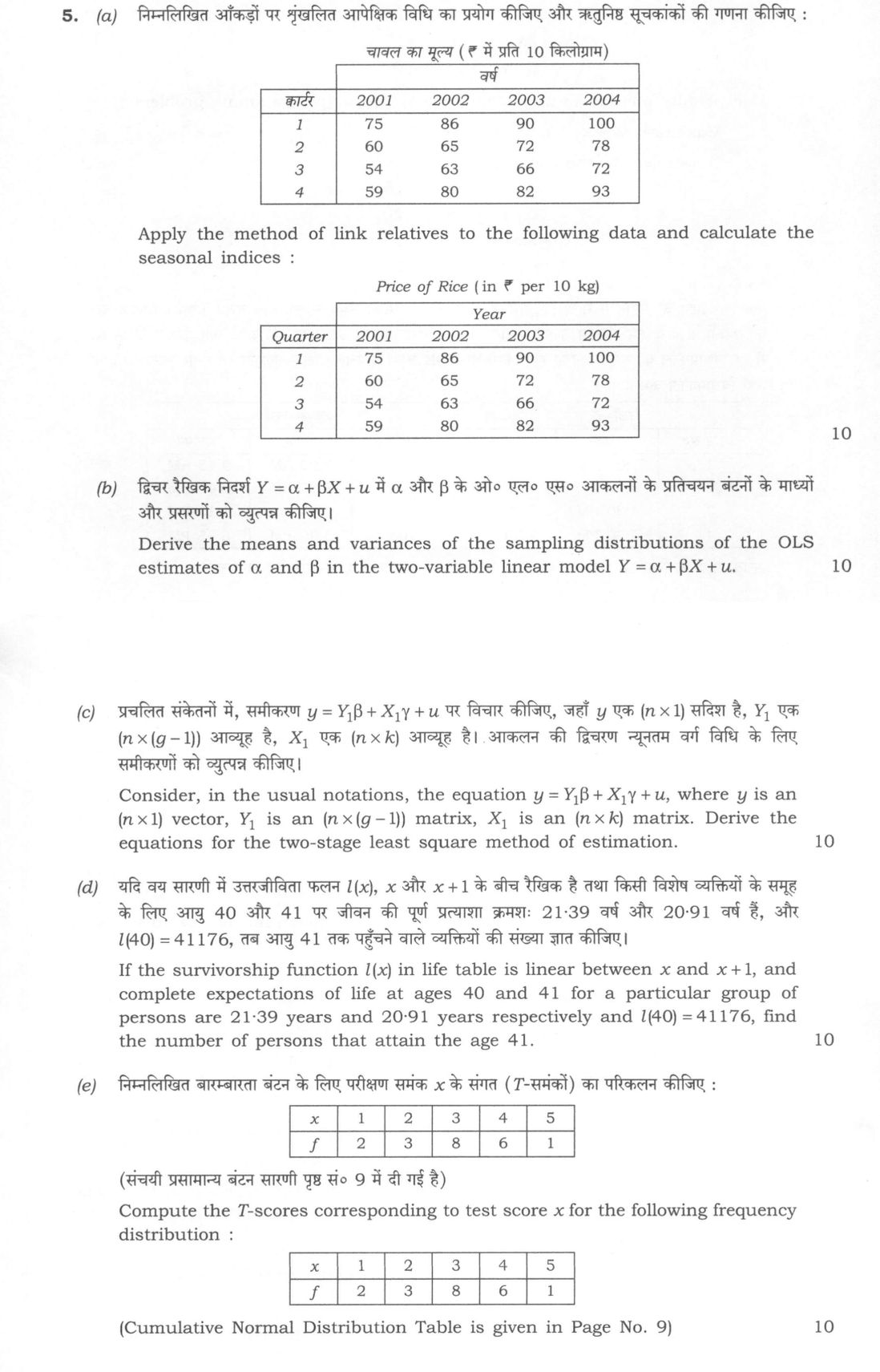
(a) Apply the method of link relatives to the following data and calculate the seasonal indices : Price of Rice (in ₹ per 10…
Apply the method of link relatives to the following data and calculate the seasonal indices :
Price of Rice (in ₹ per 10 kg)
| Quarter | 2001 | 2002 | 2003 | 2004 |
|---|---|---|---|---|
| 1 | 75 | 86 | 90 | 100 |
| 2 | 60 | 65 | 72 | 78 |
| 3 | 54 | 63 | 66 | 72 |
| 4 | 59 | 80 | 82 | 93 |
10 marks
Derive the means and variances of the sampling distributions of the OLS estimates of α and β in the two-variable linear model Y = α + βX + u. 10 marks
Consider, in the usual notations, the equation y = Y₁β + X₁γ + u, where y is an (n × 1) vector, Y₁ is an (n × (g-1)) matrix, X₁ is an (n × k) matrix. Derive the equations for the two-stage least square method of estimation. 10 marks
If the survivorship function l(x) in life table is linear between x and x+1, and complete expectations of life at ages 40 and 41 for a particular group of persons are 21·39 years and 20·91 years respectively and l(40) = 41176, find the number of persons that attain the age 41. 10 marks
Compute the T-scores corresponding to test score x for the following frequency distribution :
| x | 1 | 2 | 3 | 4 | 5 |
|---|---|---|---|---|---|
| f | 2 | 3 | 8 | 6 | 1 |
(Cumulative Normal Distribution Table is given in Page No. 9)
10 marks
हिंदी में प्रश्न पढ़ें
निम्नलिखित आँकड़ों पर शृंखलित आपेक्षिक विधि का प्रयोग कीजिए और ऋतुनिष्ठ सूचकांकों की गणना कीजिए :
चावल का मूल्य (₹ में प्रति 10 किलोग्राम)
| क्वार्टर | 2001 | 2002 | 2003 | 2004 |
|---|---|---|---|---|
| 1 | 75 | 86 | 90 | 100 |
| 2 | 60 | 65 | 72 | 78 |
| 3 | 54 | 63 | 66 | 72 |
| 4 | 59 | 80 | 82 | 93 |
10
द्विचर रैखिक निदर्श Y = α + βX + u में α और β के ओ. एल. एस. आकलनों के प्रतिचयन बंटनों के मध्यों और प्रसरणों को व्युत्पन्न कीजिए।
10
प्रचलित संकेतों में, समीकरण y = Y₁β + X₁γ + u पर विचार कीजिए, जहाँ y एक (n × 1) सदिश है, Y₁ एक (n × (g-1)) आव्यूह है, X₁ एक (n × k) आव्यूह है। आकलन की द्विचरण न्यूनतम वर्ग विधि के लिए समीकरणों को व्युत्पन्न कीजिए।
10
यदि वय सारणी में उत्तरजीविता फलन l(x), x और x+1 के बीच रैखिक है तथा किसी विशेष व्यक्तियों के समूह के लिए आयु 40 और 41 पर जीवन की पूर्ण प्रत्याशा क्रमशः 21·39 वर्ष और 20·91 वर्ष हैं, और l(40) = 41176, तब आयु 41 तक पहुँचने वाले व्यक्तियों की संख्या ज्ञात कीजिए।
10
निम्नलिखित बारंबारता बंटन के लिए परीक्षण स्कोर x के संगत (T-समांकी) का परिकलन कीजिए :
| x | 1 | 2 | 3 | 4 | 5 |
|---|---|---|---|---|---|
| f | 2 | 3 | 8 | 6 | 1 |
(संचयी प्रसामान्य बंटन सारणी पृष्ठ सं० 9 में दी गई है)
10
Model answer
Written by UPSC Answer Check against this question's marking rubric, to the expected length. UPSC does not publish answers for Mains — this is one way to score well, not an official key.
(a) Method of link relatives: link relative for a quarter = (price in that quarter / price in preceding quarter) × 100. The prices are in ₹ per 10 kg, but link relatives and seasonal indices are pure numbers. Q1 of 2001 is omitted because its preceding quarter is not given.
- 2001: Q2 = 60/75 × 100 = 80.00; Q3 = 54/60 × 100 = 90.00; Q4 = 59/54 × 100 = 109.26.
- 2002: Q1 = 86/59 × 100 = 145.76; Q2 = 65/86 × 100 = 75.58; Q3 = 72/65 × 100 = 110.77; Q4 = 80/72 × 100 = 111.11.
- 2003: Q1 = 90/80 × 100 = 112.50; Q2 = 72/90 × 100 = 80.00; Q3 = 66/72 × 100 = 91.67; Q4 = 82/66 × 100 = 124.24.
- 2004: Q1 = 100/82 × 100 = 121.95; Q2 = 78/100 × 100 = 78.00; Q3 = 72/78 × 100 = 92.31; Q4 = 93/72 × 100 = 129.17.
Average link relatives, using unrounded values:
- Q1 = (145.7627 + 112.5000 + 121.9512)/3 = 126.7380.
- Q2 = (80.0000 + 75.5814 + 80.0000 + 78.0000)/4 = 78.3953.
- Q3 = (90.0000 + 110.7692 + 91.6667 + 92.3077)/4 = 96.1859.
- Q4 = (109.2593 + 111.1111 + 124.2424 + 129.1667)/4 = 118.4449.
Their sum is 419.7641. Adjust to make the four seasonal indices sum to 400 by multiplying each average by 400/419.7641.
Seasonal indices: Q1 = 120.77, Q2 = 74.70, Q3 = 91.66, Q4 = 112.87. They sum to 400.00 and are dimensionless percentages, not ₹ per 10 kg.
(b) Model: Yᵢ = α + βXᵢ + uᵢ, i = 1, ..., n. Assume E(uᵢ|X) = 0, Var(uᵢ|X) = σ², Cov(uᵢ, uⱼ|X) = 0 for i ≠ j, and define Xbar = (1/n)ΣXᵢ and Sxx = Σ(Xᵢ − Xbar)², with Sxx > 0. Let xᵢ = Xᵢ − Xbar.
The OLS estimators are: βhat = ΣxᵢYᵢ / Sxx, αhat = Ybar − βhatXbar.
Substitute Yᵢ = α + βXᵢ + uᵢ: βhat = β + Σxᵢuᵢ / Sxx.
Mean: E(βhat|X) = β + (1/Sxx)ΣxᵢE(uᵢ|X) = β.
Variance: Var(βhat|X) = (1/Sxx²)Σxᵢ²Var(uᵢ|X) = (σ²/Sxx²)Σxᵢ² = σ²Sxx/Sxx² = σ²/Sxx.
For αhat: αhat = α + ubar − XbarΣxᵢuᵢ/Sxx, where ubar = (1/n)Σuᵢ.
Mean: E(αhat|X) = α.
Let C = Σxᵢuᵢ/Sxx. Then: Var(αhat|X) = Var(ubar) + Xbar²Var(C) − 2XbarCov(ubar, C).
Now: Var(ubar) = σ²/n, Var(C) = σ²/Sxx, Cov(ubar, C) = (1/(nSxx))ΣᵢΣⱼxⱼCov(uᵢ, uⱼ) = (σ²/(nSxx))Σⱼxⱼ = 0, because Σxᵢ = 0.
Therefore: Var(αhat|X) = σ²/n + Xbar²σ²/Sxx = σ²(1/n + Xbar²/Sxx).
Since ΣXᵢ² = Sxx + nXbar², this can also be written as: Var(αhat|X) = σ²ΣXᵢ²/(nSxx).
If uᵢ are normally distributed, the sampling distributions are normal with these means and variances.
E(βhat|X) = β, Var(βhat|X) = σ²/Sxx; E(αhat|X) = α, Var(αhat|X) = σ²(1/n + Xbar²/Sxx) = σ²ΣXᵢ²/(nSxx).
(c) Let X be the n × m matrix of instruments. In the usual 2SLS setup, X must contain the exogenous regressors X₁ as columns; if the question’s X₁ already denotes the full instrument matrix, take X = X₁. Define P_X = X(X′X)⁻¹X′.
First stage: regress each column of Y₁ on X: Y₁ = XΠ + V, with E(V|X) = 0.
The first-stage OLS normal equations are: X′XΠhat = X′Y₁.
If X′X is nonsingular: Πhat = (X′X)⁻¹X′Y₁.
The fitted endogenous regressors are: Y₁* = XΠhat = P_XY₁.
Second stage: regress y on Y₁* and X₁: y = Y₁*β + X₁γ + e.
The second-stage normal equations are: Y₁*′Y₁*β + Y₁*′X₁γ = Y₁*′y, X₁′Y₁*β + X₁′X₁γ = X₁′y.
Hence, with θ = (β′, γ′)′: θhat = ([Y₁* X₁]′[Y₁* X₁])⁻¹[Y₁* X₁]′y.
Equivalently, let Z = [Y₁ X₁]. Since P_XX₁ = X₁ and P_XY₁ = Y₁*, the 2SLS estimator can be written compactly as: θhat = (Z′P_XZ)⁻¹Z′P_Xy.
Identification requires the order condition m ≥ (g − 1) + k, or, if X₁ contains k included exogenous regressors, the number of excluded instruments m − k must be at least g − 1. The exact rank condition is: rank(Z′P_XZ) = g − 1 + k, equivalently: rank([X₁, P_XY₁]) = k + g − 1.
If no excluded instruments are available and X = X₁, this rank condition fails when g > 1.
**2SLS estimator: θhat = ([Y₁* X₁]′[Y₁* X₁])⁻¹[Y₁* X₁]′y, where Y₁* = P_XY₁ and X contains X₁.**
(d) Under the assumption that l(x) is linear between x and x + 1: l(x + t) = l(x) − t[l(x) − l(x + 1)], for 0 ≤ t ≤ 1.
The complete expectation of life at age x is: e°(x) = ∫ from 0 to ∞ l(x + t)/l(x) dt.
Split the integral at t = 1: e°(x) = [∫ from 0 to 1 l(x + t)dt]/l(x) + [l(x + 1)/l(x)]e°(x + 1).
Because l(x + t) is linear on [0, 1], the integral is the trapezoidal area: ∫ from 0 to 1 l(x + t)dt = [l(x) + l(x + 1)]/2.
Let p = l(x + 1)/l(x). Then: e°(x) = (1 + p)/2 + p e°(x + 1).
Solve for p: p = [e°(x) − 1/2]/[e°(x + 1) + 1/2].
For x = 40: p = (21.39 − 0.5)/(20.91 + 0.5) = 20.89/21.41.
Therefore: l(41) = l(40)p = 41176 × 20.89/21.41.
Using exact fractions: l(41) = 41176 × 2089/2141 = 40175.93.
Rounding to the nearest whole person:
Number of persons attaining age 41 = 40176 persons.
(e) Total frequency N = 2 + 3 + 8 + 6 + 1 = 20.
For a discrete score x, use the midpoint percentile rank: P = 100(cf below x + f/2)/N.
Then convert P to a standard normal deviate z = Φ⁻¹(P/100), and compute the T-score: T = 50 + 10z.
- x = 1: cf below = 0, f = 2. P = 100(0 + 2/2)/20 = 5%. z = Φ⁻¹(0.05) = −1.645. T = 50 + 10(−1.645) = 33.55.
- x = 2: cf below = 2, f = 3. P = 100(2 + 3/2)/20 = 17.5%. From the cumulative normal table, z ≈ −0.935. T = 50 + 10(−0.935) = 40.65.
- x = 3: cf below = 5, f = 8. P = 100(5 + 8/2)/20 = 45%. z = Φ⁻¹(0.45) ≈ −0.126. T = 50 + 10(−0.126) = 48.74.
- x = 4: cf below = 13, f = 6. P = 100(13 + 6/2)/20 = 80%. z = Φ⁻¹(0.80) ≈ 0.842. T = 50 + 10(0.842) = 58.42.
- x = 5: cf below = 19, f = 1. P = 100(19 + 1/2)/20 = 97.5%. z = Φ⁻¹(0.975) ≈ 1.960. T = 50 + 10(1.960) = 69.60.
T-scores: x = 1: 33.55, x = 2: 40.65, x = 3: 48.74, x = 4: 58.42, x = 5: 69.60.
What "Calculate" is asking you to do
Apply the standard formula or schedule to data the question has already supplied — a table of readings, cost records, a balance sheet — and produce the number. The method is rarely in doubt; the marks sit in the named intermediate quantities, each of which has to appear as a labelled line.
Structure that answers it
Data as given → formula or standard treatment, named → substitution → each intermediate, labelled → result with units
Where marks are lost
Omitting an intermediate the marking scheme pays for separately, or rounding at an intermediate line so the final figure drifts. In commerce and accountancy, any figure in a statement that no numbered working note supports is treated as unearned.
How this answer will be evaluated
Approach
Framework: UPSC Statistics Paper 2. (a) calculate: given > formula > substitution > result with units > interpretation | (b) derive: given > assumptions > stepwise derivation > result > check | (c) derive: given > assumptions > stepwise derivation > result > check | (d) calculate: given > formula > substitution > result with units > interpretation | (e) calculate: given > formula > substitution > result with units > interpretation Full marks: All derivations complete with correct notation; all calculations accurate with proper interpretation; clean tables throughout
Key points expected
- Compute link relatives for all 15 data points
- Calculate average link relatives for each quarter
- Convert to seasonal indices (base 100)
- Present results in a clear table
- State OLS estimator formulas for α and β
- Derive E(α̂) = α and E(β̂) = β (unbiasedness)
- Derive Var(β̂) = σ²/Σ(xᵢ-x̄)²
- Derive Var(α̂) = σ²[1/n + x̄²/Σ(xᵢ-x̄)²]
Evaluation rubric
Each sub-part is marked on its own, against the marks and word limit printed on the paper.
- (a) Seasonal indices for 4 quarters using link relatives method. 10 marks
calculate— given → formula → substitution → result with units → interpretation
Must cover
- Compute link relatives for all 15 data points
- Calculate average link relatives for each quarter
- Convert to seasonal indices (base 100)
- Present results in a clear table
Loses marks
- Missing link relative calculations
- Incorrect conversion to seasonal indices
- No tabular presentation of results
Earns more
- Correct handling of first quarter (no previous quarter)
- Explicit formula for link relatives shown
- Verification that indices sum to 400
Extra mark
- Interpretation of seasonal pattern in rice prices
- (b) Means and variances of sampling distributions for OLS estimates α and β. 10 marks
derive— given → assumptions → stepwise derivation → result → check
Must cover
- State OLS estimator formulas for α and β
- Derive E(α̂) = α and E(β̂) = β (unbiasedness)
- Derive Var(β̂) = σ²/Σ(xᵢ-x̄)²
- Derive Var(α̂) = σ²[1/n + x̄²/Σ(xᵢ-x̄)²]
Loses marks
- Missing variance derivations
- No statement of assumptions
- Confusing estimator notation with parameter notation
Earns more
- Explicit statement of Gauss-Markov assumptions
- Covariance term Cov(α̂, β̂) derived
- Clear notation distinguishing estimators from parameters
Extra mark
- Mention of BLUE property under Gauss-Markov
- (c) Equations for two-stage least squares (2SLS) estimation method. 10 marks
derive— given → assumptions → stepwise derivation → result → check
Must cover
- Identify endogenous variable Y₁ and exogenous X₁
- Stage 1: Regress Y₁ on X₁ to get Ŷ₁
- Stage 2: Regress y on Ŷ₁ and X₁
- State 2SLS estimator formula β̂₂ₛₗₛ
Loses marks
- Missing stage 1 regression
- No matrix notation for estimators
- Confusing 2SLS with OLS procedure
Earns more
- Matrix notation used correctly throughout
- Explanation of why OLS is inconsistent here
- Instrumental variable conditions stated
Extra mark
- Mention of overidentification test (Sargan/Hansen)
- (d) Number of persons attaining age 41 given l(40) and life expectations. 10 marks
calculate— given → formula → substitution → result with units → interpretation
Must cover
- Use linear interpolation for l(x) between 40 and 41
- Relate eₓ to l(x) and l(x+1) correctly
- Calculate l(41) from given e₄₀ and e₄₁
- State final answer as integer count
Loses marks
- Incorrect interpolation method
- Missing relationship between eₓ and l(x)
- Final answer not in integer persons
Earns more
- Explicit formula for linear survivorship function
- Correct use of life table relationships
- Units and context stated for final answer
Extra mark
- Verification using alternative life table formula
- (e) T-scores for each test score x in the frequency distribution. 10 marks
calculate— given → formula → substitution → result with units → interpretation
Must cover
- Calculate mean and standard deviation of x
- Compute z-scores for each x value
- Convert z-scores to T-scores (T = 50 + 10z)
- Present T-scores in a table for x=1 to 5
Loses marks
- Missing mean/standard deviation calculation
- Incorrect T-score formula used
- No tabular presentation of results
Earns more
- Correct use of cumulative normal distribution
- Clear formula for T-score transformation
- Table with all 5 T-scores shown
Extra mark
- Interpretation of T-score distribution shape
Practice this exact question
Write your answer and it is marked point by point against the model answer above — what you covered, what you missed, what you got wrong.
Evaluate my answer →More from Statistics 2022 Paper II
- Q2 (a) Samples of size n = 5 units are taken from a process every hour. The x̄ and R̄ values…
- Q3 (a) It is planned to raise a research team to a strength of 50 chemists, which is to be m…
- Q4 (a) Use penalty method to solve the following linear programming problem : Maximize Z = x…
- Q5 (a) Apply the method of link relatives to the following data and calculate the seasonal i…
- Q6 (a) Explain Akaike information criterion for order selection in an ARMA (p, q) process. 1…
- Q7 (a) What are the various indices of mortality measure? Explain the purpose and procedure…
- Q8 (a) How does the concept of wholesale price index work? Describe the major components of…