Paper II — Q6
(a) Explain Akaike information criterion for order selection in an ARMA (p, q) process. 15 marks (b) Define autocorrelation…
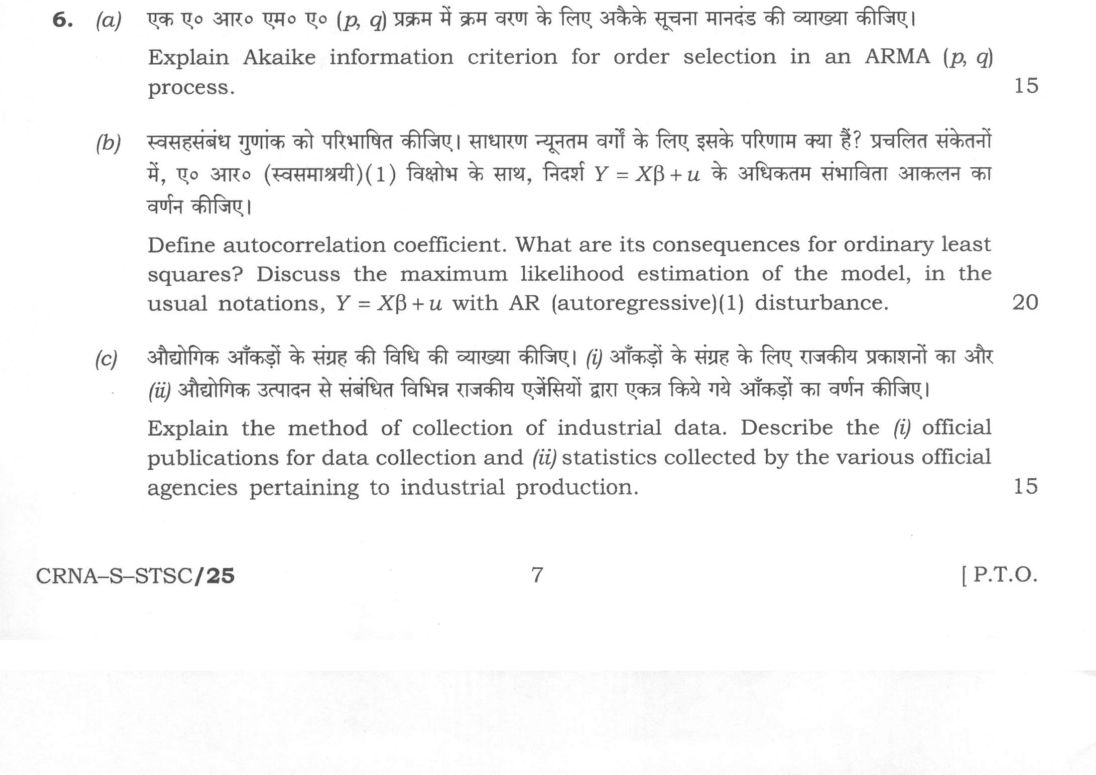
Explain Akaike information criterion for order selection in an ARMA (p, q) process. 15 marks
Define autocorrelation coefficient. What are its consequences for ordinary least squares? Discuss the maximum likelihood estimation of the model, in the usual notations, Y = Xβ + u with AR (autoregressive)(1) disturbance. 20 marks
Explain the method of collection of industrial data. Describe the (i) official publications for data collection and (ii) statistics collected by the various official agencies pertaining to industrial production. 15 marks
हिंदी में प्रश्न पढ़ें
एक ए० आर० एम० ए० (p, q) प्रक्रम में क्रम चयन के लिए अकैके सूचना मानदंड की व्याख्या कीजिए।
15
स्वसहसंबंध गुणांक को परिभाषित कीजिए। साधारण न्यूनतम वर्गों के लिए इसके परिणाम क्या हैं? प्रचलित संकेतों में, ए० आर० (स्वसमाश्रयी)(1) विघोष के साथ, निदर्श Y = Xβ + u के अधिकतम संभाविता आकलन का वर्णन कीजिए।
20
औद्योगिक आँकड़ों के संग्रह की विधि की व्याख्या कीजिए। (i) आँकड़ों के संग्रह के लिए राजकीय प्रकाशनों का और (ii) औद्योगिक उत्पादन से संबंधित विभिन्न राजकीय एजेंसियों द्वारा एकत्र किये गये आँकड़ों का वर्णन कीजिए।
15
Model answer
Written by UPSC Answer Check against this question's marking rubric, to the expected length. UPSC does not publish answers for Mains — this is one way to score well, not an official key.
(a) Akaike Information Criterion for ARMA Order Selection
The Akaike Information Criterion (AIC) is a penalised likelihood measure used to select the orders (p, q) of an ARMA process. For a candidate model with likelihood L and k free parameters, AIC = −2 log L + 2k. The first term falls as fit improves; the second penalises complexity, so AIC trades goodness-of-fit against parsimony. For ARMA(p, q), k = p + q + 1 (including the variance), and one estimates each candidate model by conditional or exact MLE, computes AIC, and selects the (p, q) minimising it. Because AIC is not consistent, the BIC (−2 log L + k log n) is preferred for large samples, while AICc (−2 log L + 2kn/(n−k−1)) corrects small-sample bias. The selected order balances underfitting (biased forecasts) against overfitting (inflated variance).
(b) Autocorrelation Coefficient and MLE with AR(1) Disturbances
The autocorrelation coefficient at lag k is ρₖ = Cov(uₜ, uₜ₋ₖ)/Var(uₜ), with ρ₀ = 1 and |ρₖ| ≤ 1. Under spherical errors OLS is BLUE; with autocorrelated errors, E(uu′) = σ²Ω ≠ σ²I, so OLS remains unbiased and consistent but is inefficient, its standard errors are biased (usually understated), and the t and F statistics are invalid, leading to spurious significance. GLS is BLUE.
For Y = Xβ + u, uₜ = ρuₜ₋₁ + εₜ, |ρ| < 1, εₜ ~ N(0, σ²), the covariance matrix is Ω = (1/(1−ρ²)) times the AR(1) correlation matrix. The likelihood is L(β, ρ, σ²) = (2πσ²)^−n/2|Ω|^−1/2 exp[−(Y−Xβ)′Ω⁻¹(Y−Xβ)/(2σ²)]. Since Ω⁻¹ = P′P with P the Prais–Winsten transformation matrix, the model becomes PY = PXβ + Pu, whose errors are spherical. Maximising the concentrated log-likelihood in ρ and β yields GLS estimates β̂ = (X′Ω⁻¹X)⁻¹X′Ω⁻¹Y, with σ̂² = û′Ω⁻¹û/n. Because ρ is unknown, estimation is iterative: estimate β by OLS, obtain residuals, estimate ρ, transform, re-estimate, and repeat until convergence (Cochrane–Orcutt). The estimator is consistent and asymptotically efficient, and testing ρ̂ = 0 validates the OLS specification.
(c) Collection of Industrial Data
Industrial data are collected by census (complete enumeration, e.g., Economic Census) and sample surveys (e.g., Annual Survey of Industries, ASI), using establishment schedules that record output, inputs, employment, wages and capital. The ASI, under the Collection of Statistics Act, covers registered manufacturing establishments; the IIP uses a weighted basket of 697 items from selected industries.
Official publications include the ASI Summary Results, Index of Industrial Production, Economic Census reports, and RBI Handbook of Statistics. Agencies: the National Statistical Office (erstwhile CSO) compiles IIP and ASI; DIPP (now DPIIT) publishes industrial licensing and production data; the Labour Bureau reports wages and employment; RBI compiles industrial statistics for monetary policy. Limitations include weak coverage of the informal sector and time lags in ASI release.
In sum, AIC provides a principled order-selection rule, GLS/MLE corrects autocorrelation-induced inefficiency, and India's industrial statistics rest on ASI and IIP, whose coverage gaps call for periodic revision.
What "Explain" is asking you to do
Make the working of something clear — what sets it off, what follows from what, and what it produces. Explain is the Commission's mechanism word: it dominates the technical papers and the “explain why” stems, where the marks sit in the causal chain and not in the label.
Structure that answers it
State what it is → the initiating condition → the chain of cause, step by step → an instance where it plays out → what the chain produces
Where marks are lost
Describing what something looks like instead of why it works that way. Naming the stages without linking them reads as description too.
How this answer will be evaluated
Approach
Framework: null. (a) explain: definition/context > points in order > small example > short close | (b) discuss: intro > 3-4 dimensions > example > balanced close | (c) describe: define > structure or process in order > labelled diagram > significance Full marks: Precise formulas, clear distinction between OLS and MLE, specific examples of publications.
Key points expected
- Formula for AIC: -2 log L + 2k
- Definition of k as number of parameters
- Criterion: select model with minimum AIC
- Context of ARMA(p,q) order selection
- Definition of autocorrelation coefficient
- Consequences: biased standard errors, inefficient OLS
- Model setup: Y = Xβ + u, u_t = ρu_{t-1} + ε_t
- Maximum likelihood estimation procedure
Evaluation rubric
Each sub-part is marked on its own, against the marks and word limit printed on the paper.
- (a) Definition of AIC and its application to ARMA(p,q) order selection. 15 marks
explain— definition/context → points in order → small example → short close
Must cover
- Formula for AIC: -2 log L + 2k
- Definition of k as number of parameters
- Criterion: select model with minimum AIC
- Context of ARMA(p,q) order selection
Loses marks
- Missing the penalty term in formula
- Confusing AIC with log-likelihood
Earns more
- Mention of log-likelihood calculation
- Comparison with BIC or other criteria
- Mention of overfitting penalty
Extra mark
- Example of AIC values for different (p,q)
- (b) Definition of autocorrelation, OLS consequences, and MLE for AR(1) model. 20 marks
discuss— intro → 3-4 dimensions → example → balanced close
Must cover
- Definition of autocorrelation coefficient
- Consequences: biased standard errors, inefficient OLS
- Model setup: Y = Xβ + u, u_t = ρu_{t-1} + ε_t
- Maximum likelihood estimation procedure
Loses marks
- Claiming OLS coefficients are biased (they are consistent)
- Missing the AR(1) disturbance structure
Earns more
- Mention of Durbin-Watson test
- Derivation of likelihood function
- Comparison of MLE vs OLS efficiency
Extra mark
- Cochrane-Orcutt procedure mention
- (c) Method of collection and specific official publications/statistics for industrial data. 15 marks
describe— define → structure or process in order → labelled diagram → significance
Must cover
- Method of collection (surveys, returns, etc.)
- Official publications (e.g., IIP, Annual Survey)
- Statistics collected (production, capacity, etc.)
- Role of official agencies
Loses marks
- Vague description without specific examples
- Confusing industrial with agricultural data
Earns more
- Mention of specific agencies (e.g., NSO, RBI)
- Distinction between primary and secondary data
- Mention of specific indices (e.g., IIP)
Extra mark
- Specific example of a publication title
Practice this exact question
Write your answer and it is marked point by point against the model answer above — what you covered, what you missed, what you got wrong.
Evaluate my answer →More from Statistics 2022 Paper II
- Q3 (a) It is planned to raise a research team to a strength of 50 chemists, which is to be m…
- Q4 (a) Use penalty method to solve the following linear programming problem : Maximize Z = x…
- Q5 (a) Apply the method of link relatives to the following data and calculate the seasonal i…
- Q6 (a) Explain Akaike information criterion for order selection in an ARMA (p, q) process. 1…
- Q7 (a) What are the various indices of mortality measure? Explain the purpose and procedure…
- Q8 (a) How does the concept of wholesale price index work? Describe the major components of…