Paper II — Q4
(a) Use penalty method to solve the following linear programming problem : Maximize Z = x₁ + 2x₂ + 3x₃ - x₄ subject to the…
Use penalty method to solve the following linear programming problem :
Maximize Z = x₁ + 2x₂ + 3x₃ - x₄
subject to the constraints
x₁ + 2x₂ + 3x₃ = 15 2x₁ + x₂ + 5x₃ = 20 x₁ + 2x₂ + x₃ + x₄ = 10 x₁, x₂, x₃, x₄ ≥ 0
20 marks
An airline that operates seven days a week has the time-table shown below. Crew must have a minimum layover of 5 hours between flights. Obtain the pairing of flights that minimizes layover time away from home. For any given pairing, crew will be based at the city that results in the smaller layover :
Delhi-Jaipur Flight No. | Departure | Arrival 1 | 7:00 AM | 8:00 AM 2 | 8:00 AM | 9:00 AM 3 | 1:30 PM | 2:30 PM 4 | 6:30 PM | 7:30 PM
Jaipur-Delhi Flight No. | Departure | Arrival 101 | 8:00 AM | 9:15 AM 102 | 8:30 AM | 9:45 AM 103 | 12 Noon | 1:15 PM 104 | 5:30 PM | 6:45 PM
For each pair, also mention the city where the crew should be based. 15 marks
What are sequential sampling plans? Suggest a sequential sampling plan for which p₁ = 0·01, α = 0·05, p₂ = 0·06 and β = 0·10. 15 marks
हिंदी में प्रश्न पढ़ें
निम्नलिखित रैखिक प्रोग्रामन समस्या का हल दण्ड विधि का प्रयोग करके निकालिए :
अधिकतमीकरण Z = x₁ + 2x₂ + 3x₃ - x₄
निम्न प्रतिबंधों के अंतर्गत
x₁ + 2x₂ + 3x₃ = 15 2x₁ + x₂ + 5x₃ = 20 x₁ + 2x₂ + x₃ + x₄ = 10 x₁, x₂, x₃, x₄ ≥ 0
(20 अंक)
एक एयरलाइन जो सप्ताह में सातों दिन परिचालन करती है, उसकी समय-सारणी नीचे दर्शाई गई है। चालक-दल को उड़ानों के बीच कम-से-कम 5 घंटे का विश्रामकाल लेना चाहिए। उन उड़ानों की जोड़ी प्राप्त कीजिए जिनमें घर से दूर विश्रामकाल का समय न्यूनतम हो। किसी भी दी गई जोड़ी के लिए चालक-दल उस शहर पर आधारित होगा जहाँ विश्रामकाल कम होगा :
दिल्ली-जयपुर उड़ान सं० | प्रस्थान | आगमन 1 | 7:00 AM | 8:00 AM 2 | 8:00 AM | 9:00 AM 3 | 1:30 PM | 2:30 PM 4 | 6:30 PM | 7:30 PM
जयपुर-दिल्ली उड़ान सं० | प्रस्थान | आगमन 101 | 8:00 AM | 9:15 AM 102 | 8:30 AM | 9:45 AM 103 | 12 मध्याह्न | 1:15 PM 104 | 5:30 PM | 6:45 PM
प्रत्येक जोड़ी के लिए उस शहर का भी उल्लेख कीजिए जहाँ चालक-दल को आधारित होना चाहिए। (15 अंक)
अनुक्रमिक प्रतिचयन आयोजनाएं क्या हैं? एक अनुक्रमिक प्रतिचयन आयोजना सुझाइए, जिसके लिए p₁ = 0·01, α = 0·05, p₂ = 0·06 और β = 0·10 हो। (15 अंक)
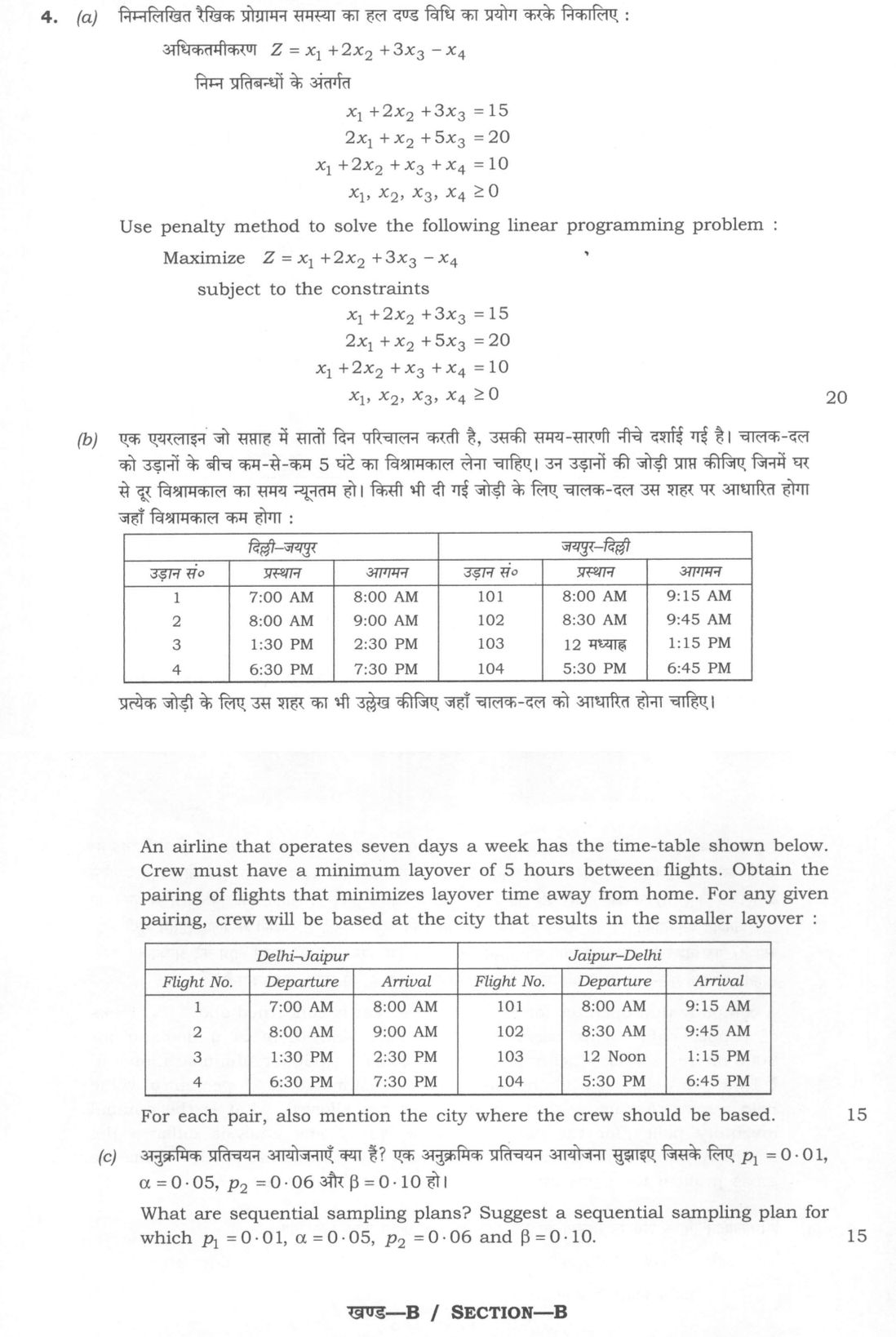
The figure this question refers to, in words
The question paper is a scan and the diagram did not survive as text. This is the figure as read from the original page — every component, value and label — so the question can be worked from the text below.
(b) Table titled 'Delhi-Jaipur' and 'Jaipur-Delhi'.
Columns for Delhi-Jaipur: Flight No., Departure, Arrival. Rows: 1, 7:00 AM, 8:00 AM 2, 8:00 AM, 9:00 AM 3, 1:30 PM, 2:30 PM 4, 6:30 PM, 7:30 PM
Columns for Jaipur-Delhi: Flight No., Departure, Arrival. Rows: 101, 8:00 AM, 9:15 AM 102, 8:30 AM, 9:45 AM 103, 12 Noon, 1:15 PM 104, 5:30 PM, 6:45 PM
What "Solve" is asking you to do
Choose the method, then carry it through to a final answer. Identifying what kind of problem this is and why that method applies is the first thing marked; a correct figure arrived at invisibly earns almost nothing.
Structure that answers it
Given data and what is required → method chosen, with the reason it applies → set-up (equation, circuit, free body, trial balance) → working, step by step → answer with units and any condition of validity
Where marks are lost
Doing the middle steps mentally and writing only the result. In mathematics papers, a further loss comes from giving a decimal where the exact value in surds or fractions was wanted, or from skipping the justification a part explicitly asks for.
How this answer will be evaluated
Approach
(a) calculate: given > formula > substitution > result with units > interpretation | (b) calculate: given > formula > substitution > result with units > interpretation | (c) explain: definition/context > points in order > small example > short close Full marks: Complete, error-free working with clear interpretation and correct notation.
Key points expected
- Convert maximization to minimization or handle signs correctly
- Introduce artificial variables for equality constraints
- Set up the initial simplex tableau with penalty terms
- Perform iterations until optimality condition is met
- List all valid flight pairs with layover >= 5 hours
- Calculate layover time for each valid pair
- Identify the pair with minimum layover time
- Determine the base city for the optimal pair
Evaluation rubric
Each sub-part is marked on its own, against the marks and word limit printed on the paper.
- (a) Solve the LPP using the penalty method to find the optimal values of x1, x2, x3, x4 and Z. 20 marks
calculate— given → formula → substitution → result with units → interpretation
Must cover
- Convert maximization to minimization or handle signs correctly
- Introduce artificial variables for equality constraints
- Set up the initial simplex tableau with penalty terms
- Perform iterations until optimality condition is met
Loses marks
- Fails to introduce artificial variables for equalities
- Arithmetic errors in simplex tableaus
- Does not check for feasibility of final solution
Earns more
- Correctly identifies basic feasible solution
- Shows all intermediate simplex tableaus clearly
- Verifies final solution satisfies original constraints
- States the maximum value of Z explicitly
Extra mark
- Checks for alternative optimal solutions
- Mentions sensitivity analysis or shadow prices
- (b) Pair Delhi-Jaipur and Jaipur-Delhi flights to minimize layover time, respecting 5-hour minimum. 15 marks
calculate— given → formula → substitution → result with units → interpretation
Must cover
- List all valid flight pairs with layover >= 5 hours
- Calculate layover time for each valid pair
- Identify the pair with minimum layover time
- Determine the base city for the optimal pair
Loses marks
- Ignores the 5-hour minimum layover constraint
- Calculates layover incorrectly (e.g., wrong time zones)
- Fails to identify the base city for the optimal pair
Earns more
- Presents layover calculations in a clear table
- Explains why certain pairs are invalid (< 5 hours)
- Justifies base city choice based on smaller layover
- Considers all possible combinations systematically
Extra mark
- Provides a visual timeline of flight operations
- Discusses operational constraints beyond layover
- (c) Define sequential sampling plans and derive the plan for given p1, p2, alpha, beta. 15 marks
explain— definition/context → points in order → small example → short close
Must cover
- Define sequential sampling plan and its purpose
- State the decision boundaries (accept/reject lines)
- Calculate the slope and intercept of the boundaries
- Determine the maximum sample size (if applicable)
Loses marks
- Confuses sequential with double sampling
- Incorrect calculation of decision boundaries
- Fails to interpret the statistical parameters correctly
Earns more
- Explains the logic of sequential decision making
- Shows the formula for the acceptance and rejection numbers
- Interprets the meaning of alpha and beta in context
- Provides a clear step-by-step derivation
Extra mark
- Compares with fixed sample size plans
- Mentions practical applications of sequential sampling
Model answer coming soon
Every evaluation on this site is marked against a verified model answer. This question's answer is still being written; evaluation opens the moment it lands.
More from Statistics 2022 Paper II
- Q1 (a) Distinguish between process control and product control. Explain the various sources…
- Q2 (a) Samples of size n = 5 units are taken from a process every hour. The x̄ and R̄ values…
- Q3 (a) It is planned to raise a research team to a strength of 50 chemists, which is to be m…
- Q4 (a) Use penalty method to solve the following linear programming problem : Maximize Z = x…
- Q5 (a) Apply the method of link relatives to the following data and calculate the seasonal i…
- Q6 (a) Explain Akaike information criterion for order selection in an ARMA (p, q) process. 1…
- Q7 (a) What are the various indices of mortality measure? Explain the purpose and procedure…