Paper II — Q7
(a) What are the various indices of mortality measure? Explain the purpose and procedure for standardizing them. (20 marks) (b)…
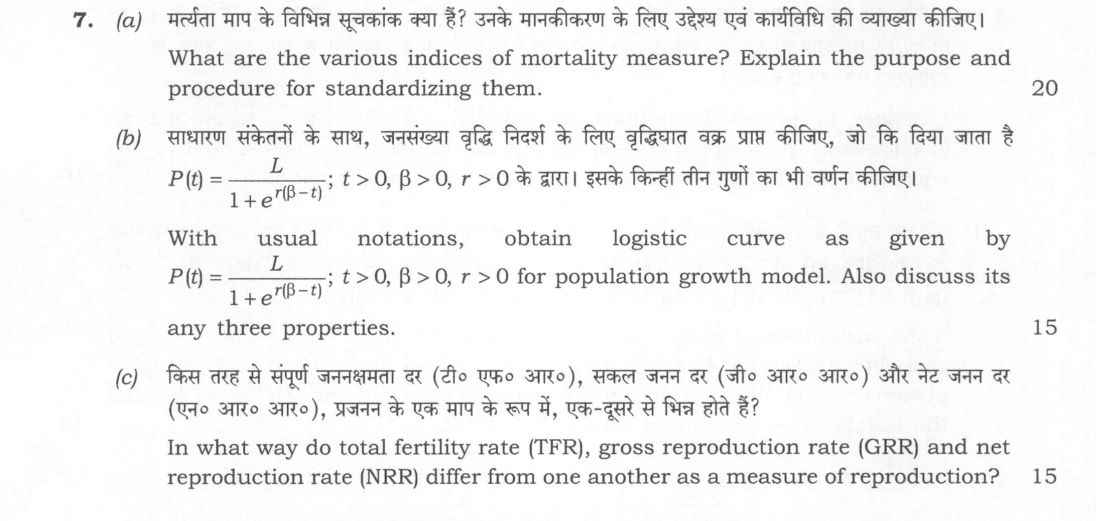
What are the various indices of mortality measure? Explain the purpose and procedure for standardizing them. 20 marks
With usual notations, obtain logistic curve as given by
P(t) = L / (1 + e^(r(β-t))) ; t > 0, β > 0, r > 0
for population growth model. Also discuss its any three properties. 15 marks
In what way do total fertility rate (TFR), gross reproduction rate (GRR) and net reproduction rate (NRR) differ from one another as a measure of reproduction? 15 marks
हिंदी में प्रश्न पढ़ें
मृत्यता माप के विभिन्न सूचकांक क्या हैं? उनके मानकीकरण के लिए उद्देश्य एवं कार्यविधि की व्याख्या कीजिए। (20 अंक)
साधारण संकेतनों के साथ, जनसंख्या वृद्धि निदर्श के लिए बृद्धियत वक्र प्राप्त कीजिए, जो कि दिया जाता है
P(t) = L / (1 + e^(r(β-t))) ; t > 0, β > 0, r > 0
के द्वारा। इसके किन्हीं तीन गुणों का भी वर्णन कीजिए। (15 अंक)
किस तरह से संपूर्ण जननक्षमता दर (टी० एफ० आर०), सकल जनन दर (जी० आर० आर०) और नेट जनन दर (एन० आर० आर०), प्रजनन के एक माप के रूप में, एक-दूसरे से भिन्न होते हैं? (15 अंक)
Model answer
Written by UPSC Answer Check against this question's marking rubric, to the expected length. UPSC does not publish answers for Mains — this is one way to score well, not an official key.
Mortality indices and standardization. Mortality measurement requires crude, age-specific and cause-specific rates because age structure affects comparisons. The crude death rate (CDR) is total deaths in a year divided by mid-year population, usually ×1000. Age-specific death rate (ASDR) for age group x is deaths in that group divided by mid-year population in that group ×1000. Infant mortality rate (IMR) is deaths under one year per 1,000 live births. Maternal mortality ratio (MMR) is maternal deaths per 100,000 live births. Under-five mortality rate (U5MR) is deaths before age five per 1,000 live births. They measure overall burden, age pattern, child survival and pregnancy-related risk. Standardization is needed because a population with more old people will have a higher CDR even if age-specific risks are lower. It removes the effect of different age distributions, so changes in the standardized rate reflect changes in age-specific mortality rather than demographic ageing. Direct standardization applies study ASDRs to standard population weights: expected deaths = standard group population × study ASDR (with per-1000 factor); total expected deaths divided by total standard population gives the directly standardized rate. Indirect standardization is used when study ASDRs are unstable: apply standard ASDRs to the study population to obtain expected deaths; SMR = observed deaths / expected deaths, often ×100. An SMR above 100 indicates higher mortality than standard. The indirectly standardized rate can be obtained as SMR × standard CDR, but the SMR itself is not multiplied by the standard CDR. In India, Sample Registration System data provide ASDRs, from which age-standardized mortality estimates are computed for interstate and temporal comparison.
Logistic curve. Let P(t) be population and L carrying capacity. The logistic growth model is dP/dt = rP(1-P/L), r>0. The model assumes density-dependent growth: at low P, growth is nearly exponential; near L, the limiting term (1-P/L) reduces growth. Separating variables, dP/[P(1-P/L)] = r dt. Since 1/[P(1-P/L)] = 1/P + 1/(L-P), integration gives ln(P/(L-P)) = rt + C. With P(0)=P0, C=ln(P0/(L-P0)). Hence P/(L-P) = (P0/(L-P0)) e^rt. Solving for P, for t>0, P(t)=L/[1+((L-P0)/P0)e^-rt]. Put β=(1/r)ln[(L-P0)/P0]; then ((L-P0)/P0)e^-rt=e^r(β-t), giving P(t)=L/[1+e^r(β-t)]. The stated condition β>0 requires P0<L/2; if P0=L/2, β=0, and if P0>L/2, β<0. Three properties: first, the curve is sigmoidal, with maximum growth at the inflection point P=L/2 and t=β; second, L is the upper asymptote, so growth slows as P approaches carrying capacity; third, r controls steepness, larger r producing faster approach to L, and it is symmetric about the inflection point, P(β+s)+P(β-s)=L.
Reproduction measures. TFR, GRR and NRR differ in sex specificity and mortality adjustment. TFR sums age-specific fertility rates; for 5-year groups, TFR=5ΣASFRₓ, or 5Σ(ASFRₓ/1000) if per 1,000 women. It measures total daughters and sons a woman would have, without mortality adjustment. GRR is TFR × proportion female births, i.e. the sum of female-specific ASFRs; it counts only female births and ignores survival. It overstates replacement if child mortality is high. NRR weights each female ASFR by the probability of surviving to that childbearing age, NRR=5Σ(lₓ/l₀)(female ASFRₓ/1000) for 5-year groups, where lₓ/l₀ is survival from birth to age x. Thus NRR estimates the average number of daughters who would survive to reproductive age per woman in a hypothetical generation. All three are period measures based on current ASFRs, with NRR additionally using current survival probabilities; NRR is the most complete for projection because it incorporates survival, while TFR is most commonly reported. NRR=1 indicates exact replacement; in India, TFR≈2.1 is commonly used as the replacement level, though it is higher where child mortality is substantial. Thus, demographic measurement moves from crude rates to age-, sex- and survival-adjusted indicators for better comparison and projection.
What "Explain" is asking you to do
Make the working of something clear — what sets it off, what follows from what, and what it produces. Explain is the Commission's mechanism word: it dominates the technical papers and the “explain why” stems, where the marks sit in the causal chain and not in the label.
Structure that answers it
State what it is → the initiating condition → the chain of cause, step by step → an instance where it plays out → what the chain produces
Where marks are lost
Describing what something looks like instead of why it works that way. Naming the stages without linking them reads as description too.
How this answer will be evaluated
Approach
Framework: UPSC Statistics Paper 2. (a) explain: definition/context > points in order > small example > short close | (b) derive: given > assumptions > stepwise derivation > result > check | (c) compare: paired headings or table > key differences > significance > conclusion Full marks: Rigorous derivation in (b) and precise definitions in (c) with clear distinctions.
Key points expected
- Define Crude, Age-Specific, and Infant Mortality Rates
- State the purpose of standardization (comparability)
- Distinguish between Direct and Indirect methods
- Show the formula for the Standardized Mortality Rate
- Start with the differential equation dP/dt = rP(1 - P/L)
- Show the integration steps to reach the solution
- Identify L as the carrying capacity
- State three properties (e.g., S-shape, inflection point)
Evaluation rubric
Each sub-part is marked on its own, against the marks and word limit printed on the paper.
- (a) List mortality indices and detail the standardization procedure. 20 marks
explain— definition/context → points in order → small example → short close
Must cover
- Define Crude, Age-Specific, and Infant Mortality Rates
- State the purpose of standardization (comparability)
- Distinguish between Direct and Indirect methods
- Show the formula for the Standardized Mortality Rate
Loses marks
- Confusing mortality rate with mortality ratio
- Omitting the denominator in rate definitions
Earns more
- Mention the choice of standard population (e.g., WHO)
- Explain the logic of the Indirect method (SMR)
Extra mark
- Provide a numerical example of standardization
- (b) Derive the logistic curve from the growth model and list three properties. 15 marks
derive— given → assumptions → stepwise derivation → result → check
Must cover
- Start with the differential equation dP/dt = rP(1 - P/L)
- Show the integration steps to reach the solution
- Identify L as the carrying capacity
- State three properties (e.g., S-shape, inflection point)
Loses marks
- Skipping the integration steps
- Failing to define the parameters r and L
Earns more
- Mention the inflection point occurs at P = L/2
- Discuss the asymptotic behavior as t approaches infinity
Extra mark
- Sketch the S-shaped curve with labeled axes
- (c) Differentiate TFR, GRR, and NRR as measures of reproduction. 15 marks
compare— paired headings or table → key differences → significance → conclusion
Must cover
- Define TFR as the average number of children per woman
- Define GRR as the number of daughters per woman
- Define NRR as the number of daughters surviving to reproductive age
- Explain the relationship between GRR and NRR (survival factor)
Loses marks
- Confusing GRR with TFR
- Ignoring the survival component in NRR
Earns more
- Mention that NRR = 1 indicates zero population growth
- Note that TFR includes both male and female births
Extra mark
- Provide a hypothetical numerical example of the three rates
Practice this exact question
Write your answer and it is marked point by point against the model answer above — what you covered, what you missed, what you got wrong.
Evaluate my answer →More from Statistics 2022 Paper II
- Q4 (a) Use penalty method to solve the following linear programming problem : Maximize Z = x…
- Q5 (a) Apply the method of link relatives to the following data and calculate the seasonal i…
- Q6 (a) Explain Akaike information criterion for order selection in an ARMA (p, q) process. 1…
- Q7 (a) What are the various indices of mortality measure? Explain the purpose and procedure…
- Q8 (a) How does the concept of wholesale price index work? Describe the major components of…