Paper I — Q1
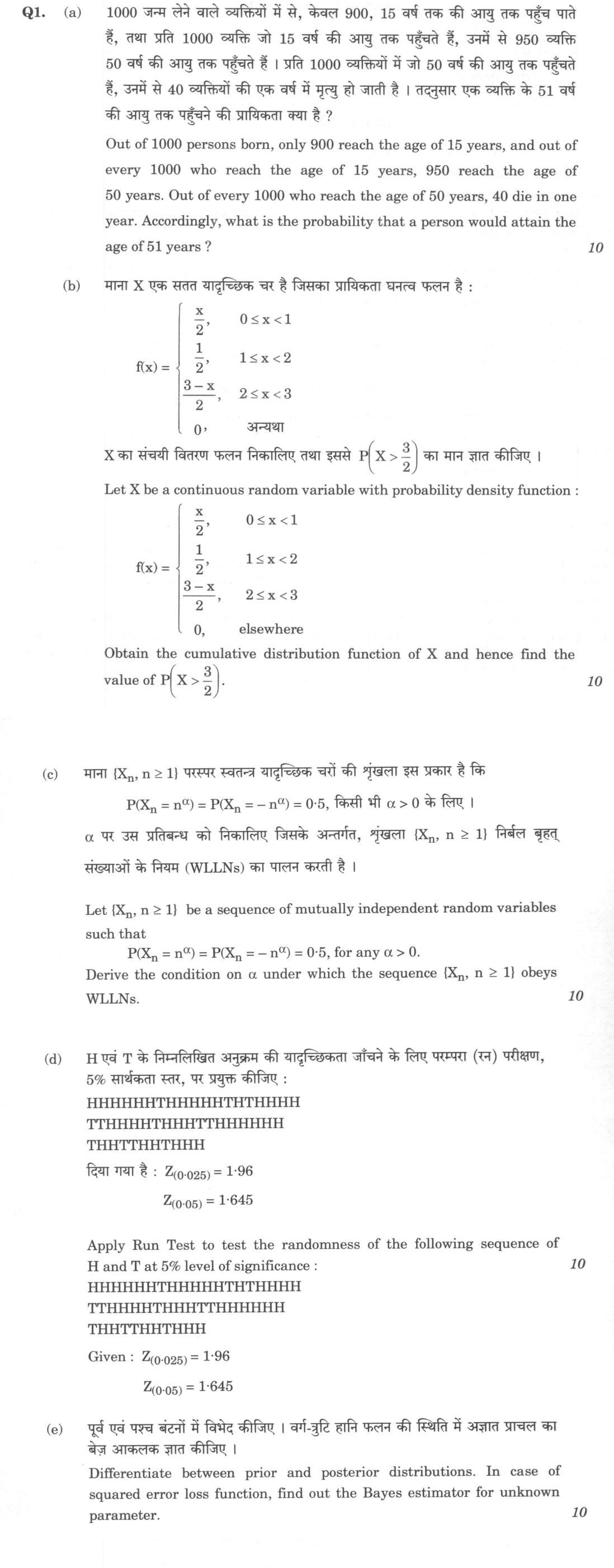
(a) Out of 1000 persons born, only 900 reach the age of 15 years, and out of every 1000 who reach the age of 15 years, 950 reach…
Out of 1000 persons born, only 900 reach the age of 15 years, and out of every 1000 who reach the age of 15 years, 950 reach the age of 50 years. Out of every 1000 who reach the age of 50 years, 40 die in one year. Accordingly, what is the probability that a person would attain the age of 51 years ? 10 marks
Let X be a continuous random variable with probability density function : f(x) = x/2, & 0 ≤ x < 1 1/2, & 1 ≤ x < 2 (3-x)/2, & 2 ≤ x < 3 0, & elsewhere Obtain the cumulative distribution function of X and hence find the value of P(X > 3/2). 10 marks
Let Xₙ, n ≥ 1 be a sequence of mutually independent random variables such that P(Xₙ = nᵅ) = P(Xₙ = – nᵅ) = 0·5, for any α > 0. Derive the condition on α under which the sequence Xₙ, n ≥ 1 obeys WLLNs. 10 marks
Apply Run Test to test the randomness of the following sequence of H and T at 5% level of significance : HHHHHHTHHHHHTHTHHHH TTHHHHTHHHTTHHHHHH THHTTHHTHHH Given : Z₍₀·₀₂₅₎ = 1·96 Z₍₀·₀₅₎ = 1·645 10 marks
Differentiate between prior and posterior distributions. In case of squared error loss function, find out the Bayes estimator for unknown parameter. 10 marks
हिंदी में प्रश्न पढ़ें
1000 जन्म लेने वाले व्यक्तियों में से, केवल 900, 15 वर्ष तक की आयु तक पहुँच पाते हैं, तथा प्रति 1000 व्यक्ति जो 15 वर्ष की आयु तक पहुँचते हैं, उनमें से 950 व्यक्ति 50 वर्ष की आयु तक पहुँचते हैं। प्रति 1000 व्यक्तियों में जो 50 वर्ष की आयु तक पहुँचते हैं, उनमें से 40 व्यक्तियों की एक वर्ष में मृत्यु हो जाती है। तदनुसार एक व्यक्ति के 51 वर्ष की आयु तक पहुँचने की प्रायिकता क्या है ? (10 अंक)
माना X एक सतत यादृच्छिक चर है जिसका प्रायिकता घनत्व फलन है : f(x) = x/2, & 0 ≤ x < 1 1/2, & 1 ≤ x < 2 (3-x)/2, & 2 ≤ x < 3 0, & अन्यथा X का संचयी वितरण फलन निकालिए तथा इससे P(X > 3/2) का मान ज्ञात कीजिए। (10 अंक)
माना Xₙ, n ≥ 1 परस्पर स्वतंत्र यादृच्छिक चरों की श्रृंखला इस प्रकार है कि P(Xₙ = nᵅ) = P(Xₙ = – nᵅ) = 0·5, किसी भी α > 0 के लिए । α पर उस प्रतिबंध को निकालिए जिसके अंतर्गत, श्रृंखला Xₙ, n ≥ 1 निबल बृहत् संख्याओं के नियम (WLLNs) का पालन करती है । (10 अंक)
H एवं T के निम्नलिखित अनुक्रम की यादृच्छिकता जाँचने के लिए परम्परा (रन) परीक्षण, 5% सार्थकता स्तर, पर प्रयुक्त कीजिए : HHHHHHTHHHHHTHTHHHH TTHHHHTHHHTTHHHHHH THHTTHHTHHH दिया गया है : Z₍₀·₀₂₅₎ = 1·96 Z₍₀·₀₅₎ = 1·645 (10 अंक)
पूर्व एवं पश्च बंटनों में विभेद कीजिए । वर्ग-त्रुटि हानि फलन की स्थिति में अज्ञात प्राचल का बेज़ आकलक ज्ञात कीजिए । (10 अंक)
Model answer
Written by UPSC Answer Check against this question's marking rubric, to the expected length. UPSC does not publish answers for Mains — this is one way to score well, not an official key.
(a) Let A₁₅, A₅₀ and A₅₁ denote the events that a person reaches ages 15, 50 and 51 respectively.
Given:
- P(A₁₅) = 900/1000 = 9/10.
- P(A₅₀ | A₁₅) = 950/1000 = 19/20.
- Out of every 1000 persons reaching age 50, 40 die in one year, so 960 reach age 51: P(A₅₁ | A₅₀) = 960/1000 = 24/25.
By the chain rule of conditional probability, P(A₅₁) = P(A₁₅) · P(A₅₀ | A₁₅) · P(A₅₁ | A₅₀) = (9/10) · (19/20) · (24/25) = 4104/5000 = 513/625 = 0·8208.
Therefore the probability that a person attains the age of 51 years is 0·8208, i.e. 513/625.
(b) The cumulative distribution function is F(x) = ∫₋∞ˣ f(t) dt.
For x < 0, F(x) = 0.
For 0 ≤ x < 1: F(x) = ∫₀ˣ (t/2) dt = x²/4.
At x = 1⁻, F(1) = 1/4.
For 1 ≤ x < 2: F(x) = 1/4 + ∫₁ˣ (1/2) dt = 1/4 + (x − 1)/2 = x/2 − 1/4.
At x = 2⁻, F(2) = 2/2 − 1/4 = 3/4.
For 2 ≤ x < 3: F(x) = 3/4 + ∫₂ˣ (3 − t)/2 dt = 3/4 + [3t/2 − t²/4]₂ˣ = 3/4 + (3x/2 − x²/4 − 2) = (6x − x² − 5)/4.
At x = 3, F(3) = 1.
Thus F(x) = 0, for x < 0; x²/4, for 0 ≤ x < 1; x/2 − 1/4, for 1 ≤ x < 2; (6x − x² − 5)/4, for 2 ≤ x < 3; 1, for x ≥ 3.
Now, P(X > 3/2) = 1 − F(3/2). Since 3/2 lies in [1, 2), F(3/2) = (3/2)/2 − 1/4 = 3/4 − 1/4 = 1/2.
Hence, P(X > 3/2) = 1 − 1/2 = 1/2.
(c) Let Sₙ = X₁ + X₂ + … + Xₙ. Since P(Xₙ = nᵅ) = P(Xₙ = −nᵅ) = 1/2, we have E(Xₙ) = 0, Var(Xₙ) = E(Xₙ²) = n^(2α).
Because the Xₙ are mutually independent, Var(Sₙ) = Σᵢ₌₁ⁿ Var(Xᵢ) = Σᵢ₌₁ⁿ i^(2α).
By Chebyshev’s inequality, for any ε > 0, P(|Sₙ/n| > ε) ≤ Var(Sₙ)/(n² ε²) = (1/(n² ε²)) Σᵢ₌₁ⁿ i^(2α).
For 0 < α < 1/2, Σᵢ₌₁ⁿ i^(2α) = O(n^(2α+1)). Hence (1/n²) Σᵢ₌₁ⁿ i^(2α) = O(n^(2α−1)) → 0, because 2α − 1 < 0.
Therefore, P(|Sₙ/n| > ε) → 0, so the weak law of large numbers holds.
For α ≥ 1/2, the variance of the average does not vanish. When α = 1/2, Var(Sₙ/n) = (1/n²) Σᵢ₌₁ⁿ i ≈ 1/2, so Sₙ/n converges to a non-degenerate normal distribution, not to 0. For α > 1/2, Lindeberg’s central limit theorem gives Sₙ/√(Σᵢ₌₁ⁿ i^(2α)) ⇒ N(0,1), and the scale factor √(Σᵢ₌₁ⁿ i^(2α))/n grows like n^(α−1/2), so Sₙ/n cannot converge in probability to 0.
Hence the sequence obeys the weak law of large numbers if and only if 0 < α < 1/2.
(d) Concatenating the given three lines, the sequence has:
- Number of H’s, n₁ = 36
- Number of T’s, n₂ = 12
- Total n = n₁ + n₂ = 48
The observed number of runs is R = 19.
For the run test of randomness, the expected number of runs is μ_R = 1 + 2n₁n₂/(n₁ + n₂) = 1 + 2·36·12/48 = 1 + 18 = 19.
The variance of R is σ_R² = [2n₁n₂(2n₁n₂ − n₁ − n₂)] / [(n₁ + n₂)²(n₁ + n₂ − 1)] = [864(864 − 48)] / [48²·47] = [864·816] / [2304·47] = 705024/108288 = 306/47 ≈ 6·511.
Thus σ_R = √(306/47) ≈ 2·552.
The test statistic is Z = (R − μ_R)/σ_R = (19 − 19)/2·552 = 0.
At 5% level of significance for a two-tailed test, the critical value is Z₀.₀₂₅ = 1·96. Since |Z| = 0 < 1·96, we fail to reject the null hypothesis of randomness.
Hence the sequence may be regarded as random at the 5% level of significance.
(e) The prior distribution and posterior distribution differ as follows:
- The prior distribution π(θ) expresses belief or information about the unknown parameter θ before observing the sample. It is fixed before the experiment.
- The posterior distribution π(θ|x) is the conditional distribution of θ after observing the data x. It is obtained by Bayes’ theorem: π(θ|x) = [L(θ|x)π(θ)] / ∫ L(u|x)π(u) du, where L(θ|x) is the likelihood function.
- The prior does not depend on the sample, whereas the posterior depends on the observed sample.
- The prior may be informative or non-informative; the posterior summarizes the updated knowledge and is used for Bayesian inference.
Now consider squared error loss: L(θ, a) = (θ − a)², where a is an estimator of θ.
Given the data x, the posterior risk is E[(θ − a)² | x] = E[θ² | x] − 2a E[θ | x] + a² = Var(θ | x) + (a − E[θ | x])².
Since Var(θ | x) does not depend on a, the posterior risk is minimized when a − E[θ | x] = 0, that is, a = E[θ | x].
Therefore, under squared error loss, the Bayes estimator is the posterior mean: δ^π(x) = E[θ | x] = ∫ θ π(θ|x) dθ for continuous θ, or δ^π(x) = Σ θ π(θ|x) for discrete θ.
Thus the Bayes estimator for the unknown parameter θ under squared error loss is the mean of the posterior distribution.
What "Solve" is asking you to do
Choose the method, then carry it through to a final answer. Identifying what kind of problem this is and why that method applies is the first thing marked; a correct figure arrived at invisibly earns almost nothing.
Structure that answers it
Given data and what is required → method chosen, with the reason it applies → set-up (equation, circuit, free body, trial balance) → working, step by step → answer with units and any condition of validity
Where marks are lost
Doing the middle steps mentally and writing only the result. In mathematics papers, a further loss comes from giving a decimal where the exact value in surds or fractions was wanted, or from skipping the justification a part explicitly asks for.
How this answer will be evaluated
Approach
Framework: UPSC Statistics Paper 1. (a) calculate: given > formula > substitution > result with units > interpretation | (b) derive: given > assumptions > stepwise derivation > result > check | (c) derive: given > assumptions > stepwise derivation > result > check | (d) calculate: given > formula > substitution > result with units > interpretation | (e) explain: definition/context > points in order > small example > short close Full marks: All parts answered with correct calculations, clear derivations, and proper interpretations.
Key points expected
- Define survival probabilities for each age interval
- Apply multiplication rule for sequential survival
- Calculate probability of surviving from 50 to 51
- Compute final product of all survival probabilities
- Integrate the PDF to find the CDF for each interval
- Ensure the CDF is continuous and non-decreasing
- Calculate P(X > 3/2) using the CDF
- Verify that the CDF approaches 1 as x approaches infinity
Evaluation rubric
Each sub-part is marked on its own, against the marks and word limit printed on the paper.
- (a) Probability of a person attaining age 51 years. 10 marks
calculate— given → formula → substitution → result with units → interpretation
Must cover
- Define survival probabilities for each age interval
- Apply multiplication rule for sequential survival
- Calculate probability of surviving from 50 to 51
- Compute final product of all survival probabilities
Loses marks
- Incorrect calculation of survival probability from 50 to 51
- Failure to multiply the probabilities correctly
Earns more
- Explicitly state the survival rate from 50 to 51 as 0.96
- Show the calculation steps clearly
Extra mark
- Provide a brief interpretation of the result
- (b) Cumulative distribution function (CDF) of X and P(X > 3/2). 10 marks
derive— given → assumptions → stepwise derivation → result → check
Must cover
- Integrate the PDF to find the CDF for each interval
- Ensure the CDF is continuous and non-decreasing
- Calculate P(X > 3/2) using the CDF
- Verify that the CDF approaches 1 as x approaches infinity
Loses marks
- Incorrect integration of the PDF
- Failure to ensure the CDF is continuous
Earns more
- Show the integration steps for each interval
- Clearly state the CDF for all intervals
Extra mark
- Provide a graph of the CDF
- (c) Condition on α for the sequence to obey WLLN. 10 marks
derive— given → assumptions → stepwise derivation → result → check
Must cover
- State the conditions for WLLN
- Calculate the mean and variance of Xₙ
- Apply the WLLN conditions to find the range of α
- Justify the derived condition for α
Loses marks
- Incorrect calculation of the mean or variance
- Failure to apply the WLLN conditions correctly
Earns more
- Show the calculation of the mean and variance
- Clearly state the WLLN conditions
Extra mark
- Provide a brief explanation of the significance of the condition
- (d) Apply Run Test to test the randomness of the sequence. 10 marks
calculate— given → formula → substitution → result with units → interpretation
Must cover
- Count the number of runs in the sequence
- Calculate the expected number of runs
- Compute the test statistic using the given Z-values
- Compare the test statistic with the critical value
Loses marks
- Incorrect count of the number of runs
- Failure to compare the test statistic with the critical value
Earns more
- Show the calculation of the expected number of runs
- Clearly state the decision based on the test statistic
Extra mark
- Provide a brief interpretation of the result
- (e) Differentiate between prior and posterior distributions and find the Bayes estimator. 10 marks
explain— definition/context → points in order → small example → short close
Must cover
- Define prior and posterior distributions
- Explain the difference between them
- State the formula for the Bayes estimator under squared error loss
- Derive the Bayes estimator for the unknown parameter
Loses marks
- Incorrect definition of prior or posterior distributions
- Failure to derive the Bayes estimator correctly
Earns more
- Provide a clear example to illustrate the difference
- Show the derivation of the Bayes estimator
Extra mark
- Mention the significance of the Bayes estimator in statistical inference
Practice this exact question
Write your answer and it is marked point by point against the model answer above — what you covered, what you missed, what you got wrong.
Evaluate my answer →More from Statistics 2023 Paper I
- Q1 (a) Out of 1000 persons born, only 900 reach the age of 15 years, and out of every 1000 w…
- Q2 (a) Let X, Y, Z be three mutually independent standard exponential variates and W₁ = X +…
- Q3 (a) (i) If X is a random variable with finite variance, show that lim n² P{|X| > n} = 0.…
- Q4 (a) What is the role of properties of completeness and sufficiency in Statistical Inferen…