Paper I — Q8
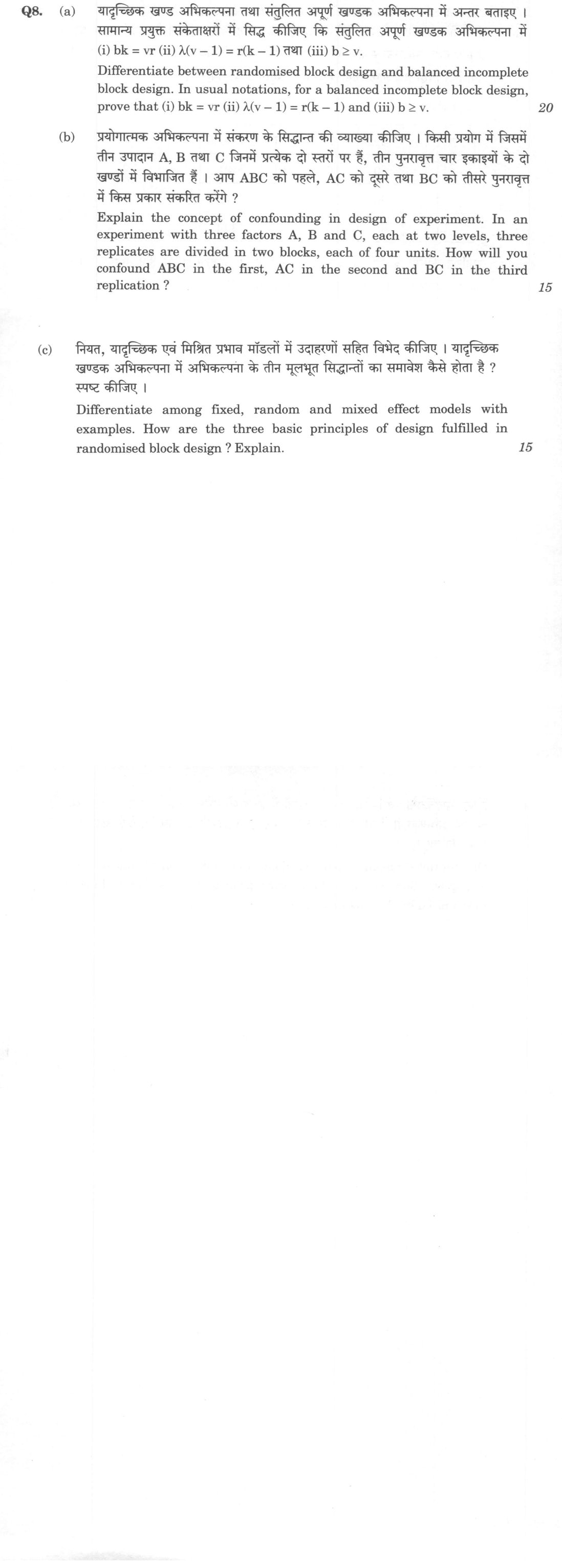
(a) Differentiate between randomised block design and balanced incomplete block design. In usual notations, for a balanced…
Differentiate between randomised block design and balanced incomplete block design. In usual notations, for a balanced incomplete block design, prove that (i) bk = vr (ii) λ(v – 1) = r(k – 1) and (iii) b ≥ v. 20 marks
Explain the concept of confounding in design of experiment. In an experiment with three factors A, B and C, each at two levels, three replicates are divided in two blocks, each of four units. How will you confound ABC in the first, AC in the second and BC in the third replication ? 15 marks
Differentiate among fixed, random and mixed effect models with examples. How are the three basic principles of design fulfilled in randomised block design ? Explain. 15 marks
हिंदी में प्रश्न पढ़ें
यादृच्छिक खंड अभिकल्पना तथा संतुलित अपूर्ण खंडक अभिकल्पना में अंतर बताइए । सामान्य प्रयुक्त संकेताक्षरों में सिद्ध कीजिए कि संतुलित अपूर्ण खंडक अभिकल्पना में (i) bk = vr (ii) λ(v – 1) = r(k – 1) तथा (iii) b ≥ v. 20 marks
प्रयोगात्मक अभिकल्पना में संकरण के सिद्धांत की व्याख्या कीजिए । किसी प्रयोग में जिसमें तीन उपादान A, B तथा C जिनमें प्रत्येक दो स्तरों पर हैं, तीन पुनरावृत्त चार इकाइयों के दो खंडों में विभाजित हैं । आप ABC को पहले, AC को दूसरे तथा BC को तीसरे पुनरावृत्त में किस प्रकार संकीर्ण करेंगे ? 15 marks
नियत, यादृच्छिक एवं मिश्रित प्रभाव मॉडलों में उदाहरणों सहित विभेद कीजिए । यादृच्छिक खण्डक अभिकल्पना में अभिकल्पना के तीन मूलभूत सिद्धान्तों का समावेश कैसे होता है ? स्पष्ट कीजिए । 15
Model answer
Written by UPSC Answer Check against this question's marking rubric, to the expected length. UPSC does not publish answers for Mains — this is one way to score well, not an official key.
Part (a). In the usual notation, v treatments, b blocks, r replications, k plots per block and λ pairwise concurrence, RBD and BIBD differ in block completeness. In RBD every block contains all v treatments, so k=v, r=b, and each pair of treatments occurs in every block; local control is obtained by grouping homogeneous units. In BIBD each block contains only k<v treatments, so blocks are incomplete; each treatment appears r times and every pair appears in λ blocks, with λ constant. RBD is therefore a complete-block design, while BIBD is an incomplete-block design used when block size is restricted. Let N be the v×b incidence matrix, N_ij=1 if treatment i is in block j. Counting treatment occurrences gives bk=vr. Counting treatment pairs within blocks gives b k(k−1)/2 = λ v(v−1)/2; using bk=vr gives r(k−1)=λ(v−1). For b≥v, since v>k, r>λ. Then NN^T=(r−λ)I+λJ is nonsingular, where I and J are identity and all-ones matrices, so rank(NN^T)=v. Since rank(NN^T)≤rank(N)≤b, Fisher’s inequality gives b≥v. The first two identities are double-counting identities; the third shows that incomplete blocks require at least as many blocks as treatments.
Part (b). Confounding occurs when a treatment effect is deliberately aliased with a block effect, so that effect cannot be estimated separately; in factorial experiments a higher-order interaction is usually sacrificed to obtain smaller, more homogeneous blocks. Complete confounding would confound the same interaction in all replications, making it wholly unestimable; partial confounding confounds different interactions in different replications, so each is lost only in part. For a 2^3 factorial, write combinations in Yates notation as (1), a, b, ab, c, ac, bc, abc. In each replication, put combinations having the same sign of the confounded interaction in one block; the block contrast is that interaction. Replication I, confounding ABC: Block 1: a, b, c, abc; Block 2: (1), ab, ac, bc. Replication II, confounding AC: Block 1: (1), b, ac, abc; Block 2: a, c, ab, bc. Replication III, confounding BC: Block 1: (1), a, bc, abc; Block 2: b, c, ab, ac. Thus ABC is lost in Rep I, AC in Rep II and BC in Rep III, while main effects and the other interactions remain estimable from the remaining replications.
Part (c). Fixed, random and mixed models differ in the nature of factor levels, the error structure, and the target of inference. In a fixed-effect model the levels are specifically chosen and conclusions apply only to those levels; the treatment effects are constants, e.g. comparing three named paddy varieties or fixed doses of urea at 0, 50 and 100 kg N/ha. In a random-effect model the levels are a random sample from a larger population, and the interest is in variance components and generalisation, e.g. randomly selected villages, fields, years or batches. A mixed model contains both, e.g. fixed fertilizer levels applied over randomly selected farms, or fixed varieties tested over random locations. In Indian agricultural trials, fixed varieties and random districts illustrate such a mixed model. RBD fulfils the three basic principles of experimental design. Replication is achieved because each treatment is repeated in every block, so r=b, giving independent error estimates. Randomisation is applied within each block by assigning treatments to plots at random, preventing systematic bias and justifying the error term. Local control is obtained by forming blocks of homogeneous units, such as plots with similar soil fertility, slope or moisture, so block-to-block variation is removed from experimental error. Hence RBD is a complete-block design, BIBD an incomplete-block design, confounding is controlled aliasing, and the effect model is chosen according to whether factor levels are fixed, random or mixed.
What "Differentiate" is asking you to do
Fix the criteria on which the two differ and apply each criterion to both, so the pair can no longer be mixed up. Differentiate stems usually carry a further task attached — describe the mechanism, set out the principles, discuss the applications — and that task carries its own marks.
Structure that answers it
Criterion 1 applied to both → criterion 2 → criterion 3 → summary line or table → the attached second demand answered in full
Where marks are lost
Two standalone definitions placed side by side, leaving the reader to extract the difference. The second common loss is running out of space before the attached task, which is often worth as much as the differentiation.
How this answer will be evaluated
Approach
Framework: Design of Experiments (DOE) & Statistical Models. (a) compare: paired headings or table > key differences > significance > conclusion | (b) explain: definition/context > points in order > small example > short close | (c) compare: paired headings or table > key differences > significance > conclusion Full marks: Rigorous proofs for (a); precise block construction for (b); clear model distinctions for (c).
Key points expected
- Define RBD (complete blocks) vs BIBD (incomplete blocks)
- Prove bk = vr via total treatment occurrences
- Prove λ(v-1) = r(k-1) via pair co-occurrence
- Prove b ≥ v using the derived relationship
- Define confounding (aliasing with block effect)
- Identify 4 treatment combinations for Block 1 (ABC)
- Identify 4 treatment combinations for Block 2 (AC)
- Identify 4 treatment combinations for Block 3 (BC)
Evaluation rubric
Each sub-part is marked on its own, against the marks and word limit printed on the paper.
- (a) Differentiate RBD and BIBD; prove three BIBD properties. 20 marks
compare— paired headings or table → key differences → significance → conclusion
Must cover
- Define RBD (complete blocks) vs BIBD (incomplete blocks)
- Prove bk = vr via total treatment occurrences
- Prove λ(v-1) = r(k-1) via pair co-occurrence
- Prove b ≥ v using the derived relationship
Loses marks
- Stating formulas without derivation steps
- Confusing RBD and BIBD definitions
Earns more
- Explicit definition of parameters v, b, r, k, λ
- Clear logical steps in the derivation
- Mention of orthogonality in RBD
Extra mark
- Example of a BIBD parameter set (e.g., Fano plane)
- (b) Explain confounding; construct 3 replications for 2^3 design. 15 marks
explain— definition/context → points in order → small example → short close
Must cover
- Define confounding (aliasing with block effect)
- Identify 4 treatment combinations for Block 1 (ABC)
- Identify 4 treatment combinations for Block 2 (AC)
- Identify 4 treatment combinations for Block 3 (BC)
Loses marks
- Incorrect treatment combinations in blocks
- Failing to explain why specific effects are confounded
Earns more
- Use of defining contrast subgroups
- Correct assignment of + and - signs to blocks
- Mention of loss of degrees of freedom
Extra mark
- Table showing the specific treatment combinations per block
- (c) Differentiate fixed, random, mixed models; explain RBD principles. 15 marks
compare— paired headings or table → key differences → significance → conclusion
Must cover
- Define Fixed, Random, and Mixed effect models
- Provide a distinct example for each model type
- Identify the three basic principles of design
- Explain how RBD fulfills each principle
Loses marks
- Vague definitions without examples
- Listing principles without explaining RBD's role
Earns more
- Mention of general linear model equation for each
- Specific examples (e.g., fertilizer levels vs random plots)
- Clear mapping of RBD to Replication, Randomization, Local Control
Extra mark
- Discussion of variance components in random models
Practice this exact question
Write your answer and it is marked point by point against the model answer above — what you covered, what you missed, what you got wrong.
Evaluate my answer →More from Statistics 2023 Paper I
- Q5 (a) (i) If **X** = (X₁ X₂ X₃)' is distributed as N₃ (μ, Σ), find the distribution of [(X₁…
- Q6 (a) Let **X** = (X₁ X₂ X₃)' be distributed as N₃ (μ, Σ), where μ = (2 −1 3)' and Σ = 4 &…
- Q7 (a) Discuss the difference between sampling for variables and sampling for attributes wit…
- Q8 (a) Differentiate between randomised block design and balanced incomplete block design. I…