Paper I — Q2
(a) Let X, Y, Z be three mutually independent standard exponential variates and W₁ = X + Y + Z, W₂ = (X + Y)/(X + Y + Z), W₃ =…
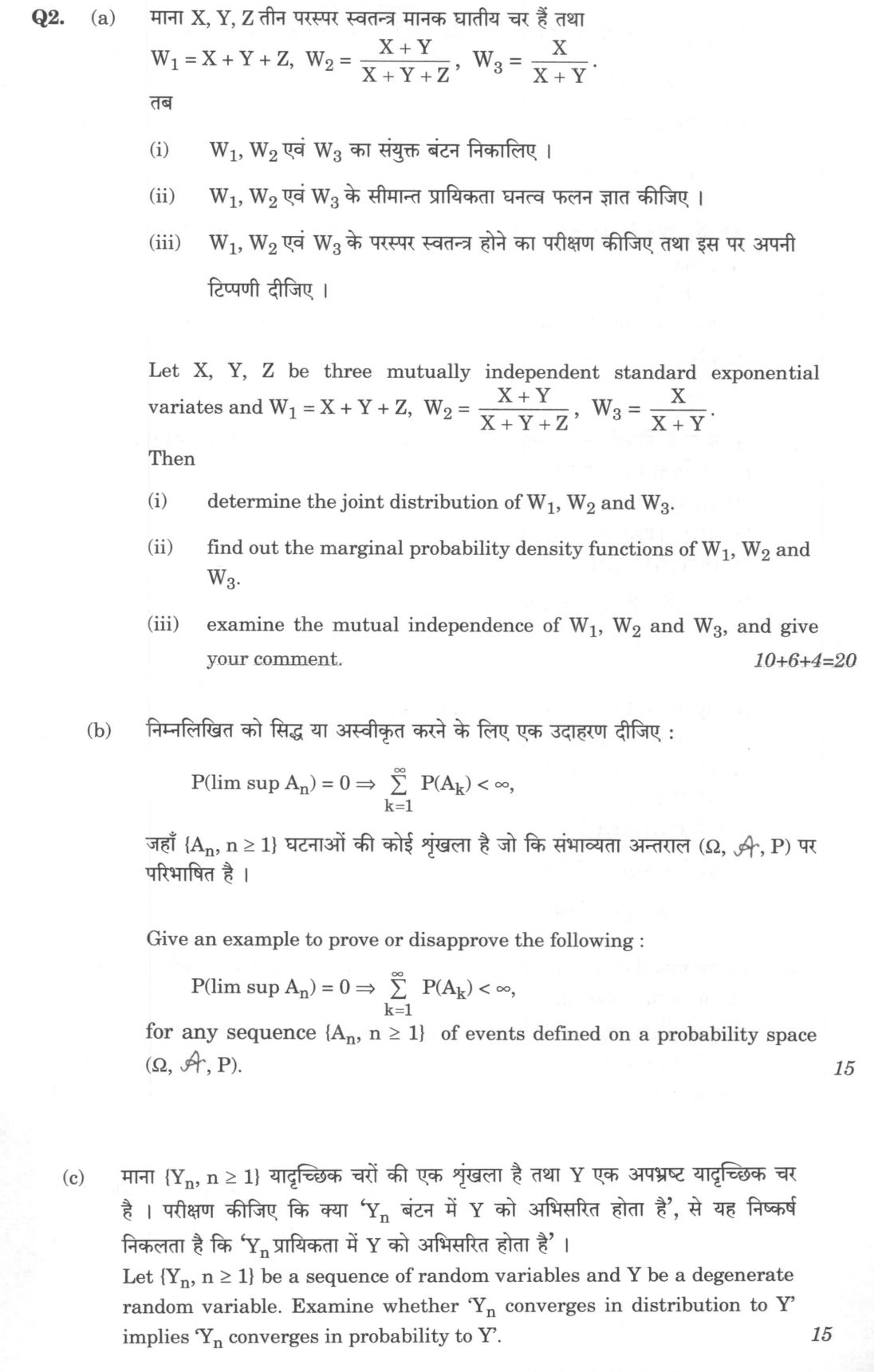
Let X, Y, Z be three mutually independent standard exponential variates and W₁ = X + Y + Z, W₂ = (X + Y)/(X + Y + Z), W₃ = X/(X + Y). Then determine the joint distribution of W₁, W₂ and W₃.
find out the marginal probability density functions of W₁, W₂ and W₃.
examine the mutual independence of W₁, W₂ and W₃, and give your comment. (10+6+4=20 marks)
Give an example to prove or disprove the following : P(lim sup Aₙ) = 0 ⇒ Σₖ₌₁^∞ P(Aₖ) < ∞, for any sequence {Aₙ, n ≥ 1} of events defined on a probability space (Ω, 𝓐, P). 15 marks
Let {Yₙ, n ≥ 1} be a sequence of random variables and Y be a degenerate random variable. Examine whether 'Yₙ converges in distribution to Y' implies 'Yₙ converges in probability to Y'. 15 marks
हिंदी में प्रश्न पढ़ें
माना X, Y, Z तीन परस्पर स्वतंत्र मानक घातीय चर हैं तथा W₁ = X + Y + Z, W₂ = (X + Y)/(X + Y + Z), W₃ = X/(X + Y). तब W₁, W₂ एवं W₃ का संयुक्त बंटन निकालिए ।
W₁, W₂ एवं W₃ के सीमांत प्रायिकता घनत्व फलन ज्ञात कीजिए ।
W₁, W₂ एवं W₃ के परस्पर स्वतंत्र होने का परीक्षण कीजिए तथा इस पर अपनी टिप्पणी दीजिए । (10+6+4=20 अंक)
निम्नलिखित को सिद्ध या अस्वीकृत करने के लिए एक उदाहरण दीजिए : P(lim sup Aₙ) = 0 ⇒ Σₖ₌₁^∞ P(Aₖ) < ∞, जहाँ {Aₙ, n ≥ 1} घटनाओं की कोई श्रृंखला है जो कि संभाव्यता अंतराल (Ω, 𝓐, P) पर परिभाषित है । (15 अंक)
माना {Yₙ, n ≥ 1} यादृच्छिक चरों की एक श्रृंखला है तथा Y एक अपभ्रष्ट यादृच्छिक चर है । परीक्षण कीजिए कि क्या 'Yₙ बंटन में Y को अभिसरित होता है', से यह निष्कर्ष निकलता है कि 'Yₙ प्रायिकता में Y को अभिसरित होता है' । (15 अंक)
Model answer
Written by UPSC Answer Check against this question's marking rubric, to the expected length. UPSC does not publish answers for Mains — this is one way to score well, not an official key.
(a)(i) Let S = W₁, U = W₂, V = W₃. Then the inverse transformation is X = S U V, Y = S U(1 − V), Z = S(1 − U). The support is s > 0, 0 < u < 1, 0 < v < 1. The Jacobian determinant is |∂(x,y,z)/∂(s,u,v)| = s² u. Since X, Y, Z are independent standard exponential variates, f(x,y,z) = exp(−(x+y+z)) = exp(−s). Therefore the joint density of W₁, W₂, W₃ is f(s,u,v) = s² u exp(−s), s > 0, 0 < u < 1, 0 < v < 1. This is the joint distribution.
(a)(ii) The marginal densities are obtained by integrating the joint density.
For W₁: f₁(s) = ∫₀¹∫₀¹ s² u exp(−s) du dv = s² exp(−s) ∫₀¹ u du = s² exp(−s)/2, s > 0. Thus W₁ ~ Gamma(3,1).
For W₂: f₂(u) = ∫₀∞∫₀¹ s² u exp(−s) dv ds = u ∫₀∞ s² exp(−s) ds = u Γ(3) = 2u, 0 < u < 1. Thus W₂ ~ Beta(2,1).
For W₃: f₃(v) = ∫₀∞∫₀¹ s² u exp(−s) du ds = (∫₀∞ s² exp(−s) ds)(∫₀¹ u du) = 2 × 1/2 = 1, 0 < v < 1. Thus W₃ ~ Uniform(0,1).
Hence the marginal pdfs are f₁(s) = s² exp(−s)/2, s > 0; f₂(u) = 2u, 0 < u < 1; f₃(v) = 1, 0 < v < 1.
(a)(iii) The joint density factorises as s² u exp(−s) = [s² exp(−s)/2] [2u] [1]. Therefore W₁, W₂, W₃ are mutually independent. Comment: the sum W₁ is independent of the ratios W₂ and W₃, and the two ratios W₂ and W₃ are also independent.
(b) The statement is false. The first Borel–Cantelli lemma gives Σₖ₌₁^∞ P(Aₖ) < ∞ ⇒ P(lim sup Aₙ) = 0, but the converse need not hold.
Counterexample: Take Ω = (0,1), with P equal to Lebesgue measure, and define Aₙ = (0, 1/n), n ≥ 1. Then P(Aₙ) = 1/n, so Σₙ₌₁^∞ P(Aₙ) = Σₙ₌₁^∞ 1/n = ∞. But {Aₙ} is decreasing, so lim sup Aₙ = ∩ₙ₌₁^∞ Aₙ = ∩ₙ₌₁^∞ (0, 1/n) = ∅. Therefore P(lim sup Aₙ) = P(∅) = 0, although the sum of probabilities diverges. Hence P(lim sup Aₙ) = 0 does not imply Σₖ₌₁^∞ P(Aₖ) < ∞.
(c) Yes. If Y is degenerate, say Y ≡ c, then convergence in distribution of Yₙ to Y does imply convergence in probability of Yₙ to c.
Let Y ≡ c. Its distribution function is F_Y(x) = 0 for x < c, and F_Y(x) = 1 for x ≥ c. Fix ε > 0. The points c − ε and c + ε/2 are continuity points of F_Y. Since Yₙ ⇒ Y, P(Yₙ ≤ c − ε) → F_Y(c − ε) = 0, and P(Yₙ ≤ c + ε/2) → F_Y(c + ε/2) = 1. Thus P(|Yₙ − c| ≥ ε) = P(Yₙ ≤ c − ε) + P(Yₙ ≥ c + ε) ≤ P(Yₙ ≤ c − ε) + P(Yₙ > c + ε/2) = P(Yₙ ≤ c − ε) + [1 − P(Yₙ ≤ c + ε/2)] → 0 + [1 − 1] = 0. Therefore Yₙ → c in probability. So convergence in distribution to a degenerate random variable implies convergence in probability to that degenerate value.
What "Derive" is asking you to do
Reach the stated expression from a starting relation, justifying every step. The destination is printed in the question, so only the route earns marks, and the assumptions you work under are part of that route.
Structure that answers it
Assumptions and notation defined → starting relation or governing equation → each step with its justification → the required expression → limiting case or boundary check
Where marks are lost
Writing the standard result first and fitting three lines to it, which an examiner reads at a glance. Marks also go on assumptions left unstated — lossless medium, small amplitude, errors independent with zero mean — and on symbols used before they are defined, even when the question says usual notations.
How this answer will be evaluated
Approach
(a(i)) derive: given > assumptions > stepwise derivation > result > check | (a(ii)) calculate: given > formula > substitution > result with units > interpretation | (a(iii)) examine: intro > how/why with reasoning > evidence > conclusion | (b) justify: claim > 3-4 reasons > evidence > conclusion | (c) examine: intro > how/why with reasoning > evidence > conclusion Full marks: Rigorous derivations, correct distributions, clear counterexamples, precise definitions.
Key points expected
- Define inverse transformation X, Y, Z
- Compute Jacobian determinant of transformation
- Substitute into joint PDF of X, Y, Z
- State support region for W1, W2, W3
- Integrate joint PDF to find marginals
- Identify distribution of W1 (Gamma)
- Identify distribution of W2 (Beta)
- Identify distribution of W3 (Beta)
Evaluation rubric
Each sub-part is marked on its own, against the marks and word limit printed on the paper.
- (a(i)) Joint PDF of W1, W2, W3 via transformation. 10 marks
derive— given → assumptions → stepwise derivation → result → check
Must cover
- Define inverse transformation X, Y, Z
- Compute Jacobian determinant of transformation
- Substitute into joint PDF of X, Y, Z
- State support region for W1, W2, W3
Loses marks
- Missing Jacobian determinant
- Incorrect support region definition
Earns more
- Correct Jacobian calculation steps
- Explicit use of exponential PDF
Extra mark
- Verification of transformation invertibility
- (a(ii)) Marginal PDFs of W1, W2, W3. 6 marks
calculate— given → formula → substitution → result with units → interpretation
Must cover
- Integrate joint PDF to find marginals
- Identify distribution of W1 (Gamma)
- Identify distribution of W2 (Beta)
- Identify distribution of W3 (Beta)
Loses marks
- Incorrect integration limits
- Missing parameter values
Earns more
- Correct integration limits
- Parameter identification for distributions
Extra mark
- Mention of standard distribution names
- (a(iii)) Check mutual independence of W1, W2, W3. 4 marks
examine— intro → how/why with reasoning → evidence → conclusion
Must cover
- Compare joint PDF with product of marginals
- State conclusion on independence
- Provide reasoning for conclusion
Loses marks
- Conclusion without factorization check
- Vague reasoning
Earns more
- Explicit factorization check
Extra mark
- Reference to Dirichlet distribution properties
- (b) Example to prove or disprove the implication. 15 marks
justify— claim → 3-4 reasons → evidence → conclusion
Must cover
- Construct specific probability space
- Define sequence of events An
- Calculate P(lim sup An)
- Calculate sum of P(Ak)
Loses marks
- Vague example without calculation
- Incorrect probability space definition
Earns more
- Clear counterexample construction
- Explicit calculation of series
Extra mark
- Reference to Borel-Cantelli lemma
- (c) Check if convergence in distribution implies in probability. 15 marks
examine— intro → how/why with reasoning → evidence → conclusion
Must cover
- Define degenerate random variable
- State relationship between convergence types
- Provide proof or counterexample
- State final conclusion
Loses marks
- Missing definition of degenerate variable
- Conclusion without proof
Earns more
- Reference to Portmanteau theorem
- Clear logical steps
Extra mark
- General theorem citation
Practice this exact question
Write your answer and it is marked point by point against the model answer above — what you covered, what you missed, what you got wrong.
Evaluate my answer →More from Statistics 2023 Paper I
- Q1 (a) Out of 1000 persons born, only 900 reach the age of 15 years, and out of every 1000 w…
- Q2 (a) Let X, Y, Z be three mutually independent standard exponential variates and W₁ = X +…
- Q3 (a) (i) If X is a random variable with finite variance, show that lim n² P{|X| > n} = 0.…
- Q4 (a) What is the role of properties of completeness and sufficiency in Statistical Inferen…
- Q5 (a) (i) If **X** = (X₁ X₂ X₃)' is distributed as N₃ (μ, Σ), find the distribution of [(X₁…