Paper I — Q3
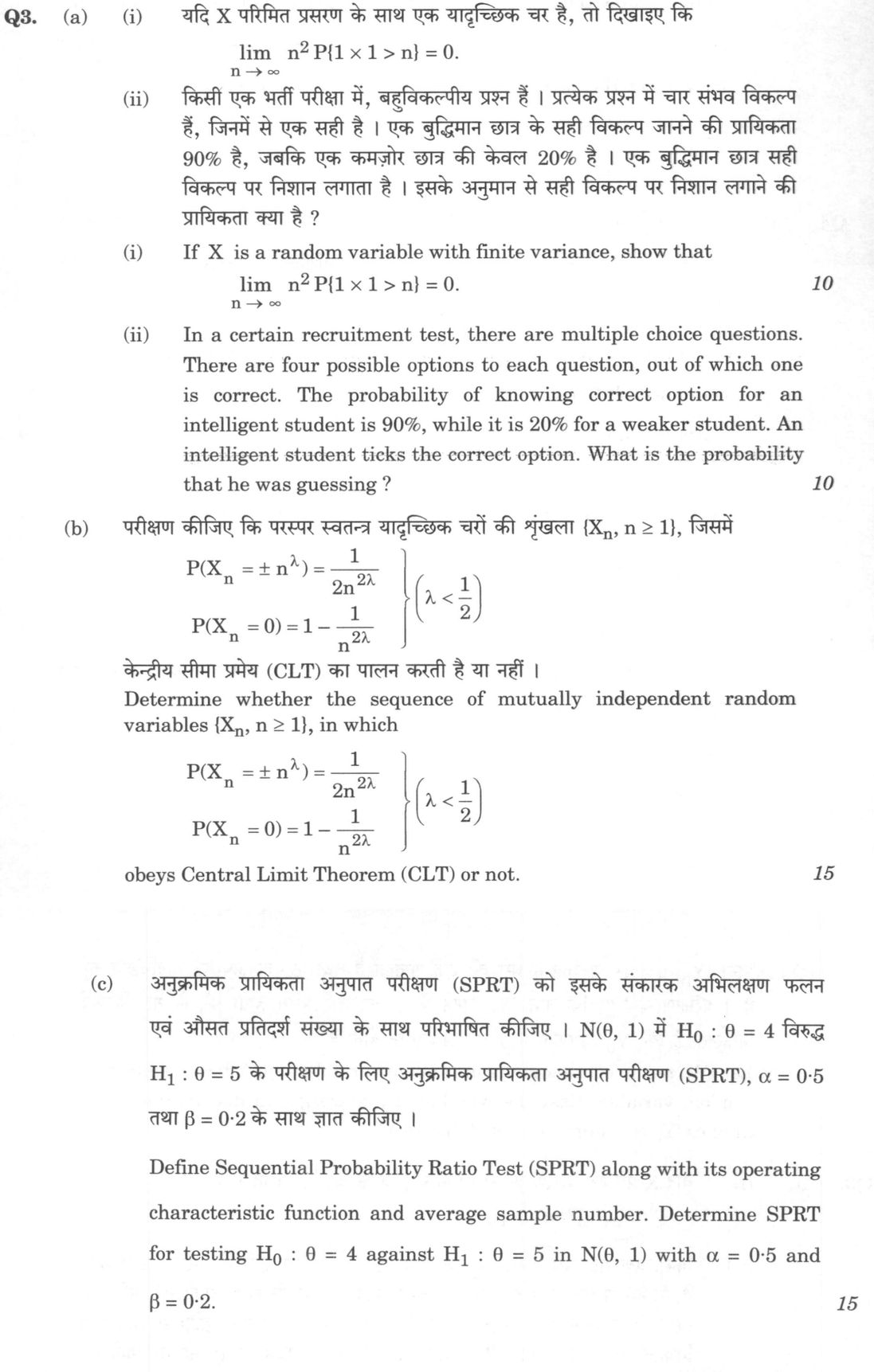
(a) (i) If X is a random variable with finite variance, show that lim n² P{|X| > n} = 0. n → ∞ (10 marks) (ii) In a certain…
If X is a random variable with finite variance, show that
lim n² P{|X| > n} = 0. n → ∞
10 marks
In a certain recruitment test, there are multiple choice questions. There are four possible options to each question, out of which one is correct. The probability of knowing correct option for an intelligent student is 90%, while it is 20% for a weaker student. An intelligent student ticks the correct option. What is the probability that he was guessing ?
10 marks
Determine whether the sequence of mutually independent random variables {Xₙ, n ≥ 1}, in which
P(Xₙ = ± n^λ) = 1/(2n^(2λ)) P(Xₙ = 0) = 1 - 1/n^(2λ)
(λ < 1/2)
obeys Central Limit Theorem (CLT) or not.
15 marks
Define Sequential Probability Ratio Test (SPRT) along with its operating characteristic function and average sample number. Determine SPRT for testing H₀ : θ = 4 against H₁ : θ = 5 in N(θ, 1) with α = 0·5 and β = 0·2.
15 marks
हिंदी में प्रश्न पढ़ें
यदि X परिमित प्रसरण के साथ एक यादृच्छिक चर है, तो दिखाइए कि
lim n² P{|X| > n} = 0. n → ∞
(10 अंक)
किसी एक भर्ती परीक्षा में, बहुविकल्पीय प्रश्न हैं । प्रत्येक प्रश्न में चार संभव विकल्प हैं, जिनमें से एक सही है । एक बुद्धिमान छात्र के सही विकल्प जानने की प्रायिकता 90% है, जबकि एक कमजोर छात्र की केवल 20% है । एक बुद्धिमान छात्र सही विकल्प पर निशान लगाता है । इसके अनुमान से सही विकल्प पर निशान लगाने की प्रायिकता क्या है ?
(10 अंक)
परीक्षण कीजिए कि परस्पर स्वतंत्र यादृच्छिक चरों की श्रृंखला {Xₙ, n ≥ 1}, जिसमें
P(Xₙ = ± n^λ) = 1/(2n^(2λ)) P(Xₙ = 0) = 1 - 1/n^(2λ)
(λ < 1/2)
केंद्रीय सीमा प्रमेय (CLT) का पालन करती है या नहीं ।
(15 अंक)
अनुक्रमिक प्रायिकता अनुपात परीक्षण (SPRT) को इसके संकारक अभिलक्षण फलन एवं औसत प्रतिदर्श संख्या के साथ परिभाषित कीजिए । N(θ, 1) में H₀ : θ = 4 विरुद्ध H₁ : θ = 5 के परीक्षण के लिए अनुक्रमिक प्रायिकता अनुपात परीक्षण (SPRT), α = 0·5 तथा β = 0·2 के साथ ज्ञात कीजिए ।
(15 अंक)
Model answer
Written by UPSC Answer Check against this question's marking rubric, to the expected length. UPSC does not publish answers for Mains — this is one way to score well, not an official key.
(a)(i) Let X have finite variance. Then μ=E X exists and E X²<∞. For n>0, on the set {|X|>n} we have n²≤X². Hence n² P{|X|>n} = E[n² 1_|X|>n] ≤ E[X² 1_|X|>n]. As n→∞, the sets {|X|>n} decrease to the empty set. Since X² is integrable, the dominated convergence theorem gives E[X² 1_|X|>n] → 0. Therefore 0 ≤ n² P{|X|>n} ≤ E[X² 1_|X|>n] → 0, so lim n² P{|X|>n} = 0 as n→∞. Valid whenever E X²<∞.
(a)(ii) Let G be the event “the intelligent student is guessing” and C be “he ticks the correct option”. For an intelligent student, P(G)=1−0.90=0.10. If he guesses, one option out of four is correct, so P(C|G)=1/4. If he knows, P(C|Gᶜ)=1. By Bayes’ theorem, P(G|C)= [P(G)P(C|G)]/[P(G)P(C|G)+P(Gᶜ)P(C|Gᶜ)] = (0.10×1/4)/[(0.10×1/4)+(0.90×1)] = 0.025/0.925 = 1/37 ≈ 0.02703. Final answer: P(he was guessing | correct) = 1/37 ≈ 0.02703. The weaker-student information is irrelevant because the student is specified to be intelligent.
(b) For the probabilities to be valid, take 0≤λ<1/2. For each Xₙ, E Xₙ = n^λ(1/(2n^(2λ))) + (−n^λ)(1/(2n^(2λ))) + 0 = 0. Also, E Xₙ² = n^(2λ)(1/n^(2λ)) = 1, so Var(Xₙ)=1. Let Sₙ=X₁+…+Xₙ. Then sₙ² = Var(Sₙ) = n. Further, E|Xₙ|⁴ = n^(4λ)(1/n^(2λ)) = n^(2λ). Use Lyapunov’s CLT for independent zero-mean variables with δ=2. The Lyapunov ratio is (1/sₙ⁴) ∑ from k=1 to n E|Xₖ|⁴ = (1/n²) ∑ from k=1 to n k^(2λ). Since k≤n, ∑ from k=1 to n k^(2λ) ≤ n·n^(2λ) = n^(1+2λ). Hence (1/n²) ∑ from k=1 to n k^(2λ) ≤ n^(2λ−1) → 0, because λ<1/2. Thus Lyapunov’s condition holds. Therefore Sₙ/√n = (X₁+…+Xₙ)/√n → N(0,1) in distribution. The sequence obeys the Central Limit Theorem.
(c) Let X₁,X₂,… be i.i.d. with density f(x;θ). For H₀:θ=θ₀ against H₁:θ=θ₁, define the likelihood ratio Λₙ = ∏ from i=1 to n f(Xᵢ;θ₁)/f(Xᵢ;θ₀). Choose constants 0<B<1<A. The SPRT is:
- continue sampling if B<Λₙ<A;
- accept H₀ if Λₙ≤B;
- accept H₁ if Λₙ≥A. For error probabilities α=P(reject H₀|H₀) and β=P(accept H₀|H₁), take A=(1−β)/α and B=β/(1−α) (Wald approximations). The operating characteristic function is L(θ)=Pθ(accept H₀). The average sample number is ASN(θ)=Eθ[N], where N is the stopping time.
Now take N(θ,1), with H₀:θ₀=4, H₁:θ₁=5, α=0.5, β=0.2. Then A=(1−0.2)/0.5=8/5=1.6, B=0.2/(1−0.5)=2/5=0.4. For n observations, Λₙ = exp[−1/2 ∑(Xᵢ−5)² + 1/2 ∑(Xᵢ−4)²] = exp[∑(Xᵢ−4.5)] = exp[∑Xᵢ−4.5n]. Thus continue while 0.4 < exp(∑Xᵢ−4.5n) < 1.6. Taking logs: ln 0.4 < ∑Xᵢ−4.5n < ln 1.6. So the SPRT is:
- continue if 4.5n+ln 0.4 < ∑Xᵢ < 4.5n+ln 1.6;
- accept H₀ if ∑Xᵢ ≤ 4.5n+ln 0.4;
- accept H₁ if ∑Xᵢ ≥ 4.5n+ln 1.6. Equivalently, with X̄=∑Xᵢ/n:
- continue if 4.5+ln 0.4/n < X̄ < 4.5+ln 1.6/n;
- accept H₀ if X̄ ≤ 4.5+ln 0.4/n;
- accept H₁ if X̄ ≥ 4.5+ln 1.6/n. Numerically, ln 0.4=−0.9163 and ln 1.6=0.4700, so the sum boundaries are 4.5n−0.9163 and 4.5n+0.4700. Final SPRT as above.
What "Prove" is asking you to do
Establish that the statement holds for every case it claims, not for one representative case. The argument must be closed: each line follows from a definition, a hypothesis, or a named theorem you are entitled to use.
Structure that answers it
Given and to prove, restated → theorem or construction to be used, named → the argument line by line → conclusion stated as proved
Where marks are lost
Testing one example, which illustrates but proves nothing. On an if and only if claim, proving one direction and stopping forfeits that half outright, and degenerate cases — zero, the empty set, the equality case — have to be disposed of rather than assumed away.
How this answer will be evaluated
Approach
(a(i)) derive: given > assumptions > stepwise derivation > result > check | (a(ii)) calculate: given > formula > substitution > result with units > interpretation | (b) examine: intro > how/why with reasoning > evidence > conclusion | (c) define: precise definition > the distinguishing feature > one example Full marks: Rigorous derivations, correct application of theorems, clear interpretation of results.
Key points expected
- State assumption Var(X) < ∞
- Apply Chebyshev's inequality or Markov's inequality
- Show n²P{|X| > n} ≤ Var(X)
- Conclude limit is 0
- Define events: Intelligent (I), Weaker (W), Correct (C)
- State P(C|I) = 0.9 and P(C|W) = 0.2
- Apply Bayes' theorem formula
- Calculate final probability value
Evaluation rubric
Each sub-part is marked on its own, against the marks and word limit printed on the paper.
- (a(i)) Prove the limit of n²P{|X| > n} is 0 for finite variance X. 10 marks
derive— given → assumptions → stepwise derivation → result → check
Must cover
- State assumption Var(X) < ∞
- Apply Chebyshev's inequality or Markov's inequality
- Show n²P{|X| > n} ≤ Var(X)
- Conclude limit is 0
Loses marks
- Using Markov's inequality on X instead of X²
- Failing to state the finite variance assumption
Earns more
- Explicitly define E[X²] in terms of variance
- Mention convergence in probability
Extra mark
- Reference to Borel-Cantelli lemma
- (a(ii)) Compute probability of guessing given correct answer. 10 marks
calculate— given → formula → substitution → result with units → interpretation
Must cover
- Define events: Intelligent (I), Weaker (W), Correct (C)
- State P(C|I) = 0.9 and P(C|W) = 0.2
- Apply Bayes' theorem formula
- Calculate final probability value
Loses marks
- Confusing P(C|I) with P(I|C)
- Omitting the prior probabilities in Bayes' formula
Earns more
- Explicitly state prior probabilities P(I) and P(W)
- Interpret result in context of student type
Extra mark
- Discussion of base rate fallacy
- (b) Determine if the sequence {Xn} obeys the Central Limit Theorem. 15 marks
examine— intro → how/why with reasoning → evidence → conclusion
Must cover
- Calculate E[Xn] and Var(Xn)
- Check Lindeberg condition or Lyapunov condition
- Analyze behavior of n^(2λ) as n → ∞
- Conclude whether CLT holds for λ < 1/2
Loses marks
- Assuming CLT holds without checking conditions
- Incorrect calculation of variance for Xn
Earns more
- Explicitly state the condition for CLT applicability
- Show the sum of variances diverges
Extra mark
- Reference to specific CLT theorem name (e.g., Lindeberg-Feller)
- (c) Define SPRT and determine it for the given hypothesis test. 15 marks
define— precise definition → the distinguishing feature → one example
Must cover
- Define SPRT and operating characteristic function
- State hypotheses H0: θ=4, H1: θ=5
- Calculate likelihood ratio for N(θ,1)
- Determine stopping boundaries using α=0.5, β=0.2
Loses marks
- Failing to define the operating characteristic function
- Incorrect likelihood ratio for normal distribution
Earns more
- Explicitly write the likelihood ratio formula
- Calculate the specific numerical boundaries
Extra mark
- Mention average sample number formula
Practice this exact question
Write your answer and it is marked point by point against the model answer above — what you covered, what you missed, what you got wrong.
Evaluate my answer →More from Statistics 2023 Paper I
- Q1 (a) Out of 1000 persons born, only 900 reach the age of 15 years, and out of every 1000 w…
- Q2 (a) Let X, Y, Z be three mutually independent standard exponential variates and W₁ = X +…
- Q3 (a) (i) If X is a random variable with finite variance, show that lim n² P{|X| > n} = 0.…
- Q4 (a) What is the role of properties of completeness and sufficiency in Statistical Inferen…
- Q5 (a) (i) If **X** = (X₁ X₂ X₃)' is distributed as N₃ (μ, Σ), find the distribution of [(X₁…
- Q6 (a) Let **X** = (X₁ X₂ X₃)' be distributed as N₃ (μ, Σ), where μ = (2 −1 3)' and Σ = 4 &…