Paper II — Q2
(a) What do you understand by control chart for fraction defective? Explain its construction. Give the theoretical distribution…
What do you understand by control chart for fraction defective? Explain its construction. Give the theoretical distribution on which the control limits are based. 15 marks
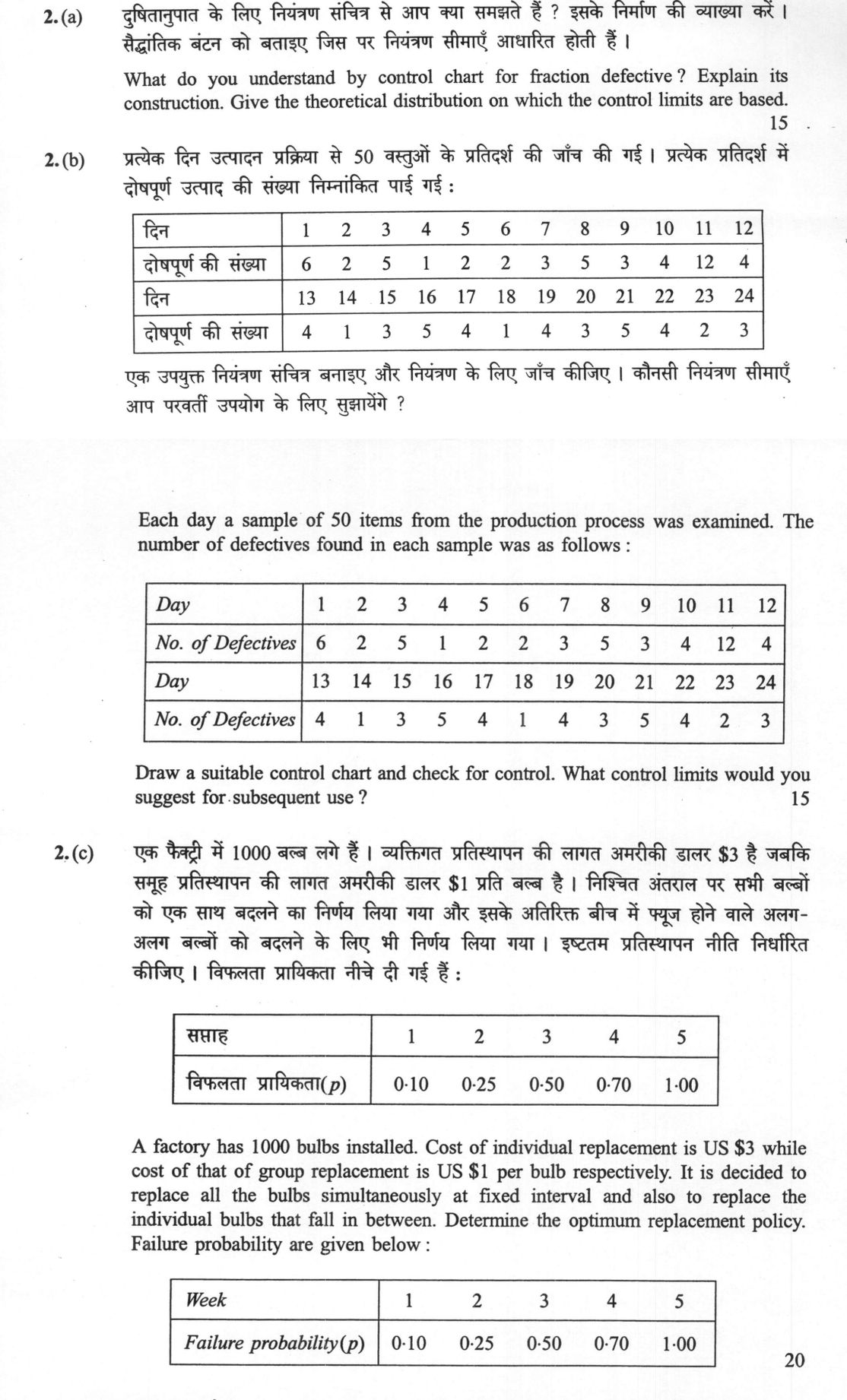
Each day a sample of 50 items from the production process was examined. The number of defectives found in each sample was as follows:
| Day | 1 | 2 | 3 | 4 | 5 | 6 | 7 | 8 | 9 | 10 | 11 | 12 |
|---|---|---|---|---|---|---|---|---|---|---|---|---|
| No. of Defectives | 6 | 2 | 5 | 1 | 2 | 2 | 3 | 5 | 3 | 4 | 12 | 4 |
| Day | 13 | 14 | 15 | 16 | 17 | 18 | 19 | 20 | 21 | 22 | 23 | 24 |
|---|---|---|---|---|---|---|---|---|---|---|---|---|
| No. of Defectives | 4 | 1 | 3 | 5 | 4 | 1 | 4 | 3 | 5 | 4 | 2 | 3 |
Draw a suitable control chart and check for control. What control limits would you suggest for subsequent use? 15 marks
A factory has 1000 bulbs installed. Cost of individual replacement is US $3 while cost of that of group replacement is US $1 per bulb respectively. It is decided to replace all the bulbs simultaneously at fixed interval and also to replace the individual bulbs that fall in between. Determine the optimum replacement policy. Failure probability are given below:
| Week | 1 | 2 | 3 | 4 | 5 | |
|---|---|---|---|---|---|---|
| Failure probability(p) | 0·10 | 0·25 | 0·50 | 0·70 | 1·00 | (20 marks) |
हिंदी में प्रश्न पढ़ें
दुष्पितानुपात के लिए नियंत्रण सांचित्र से आप क्या समझते हैं? इसके निर्माण की व्याख्या करें। सैद्धांतिक बंटन को बताइए जिस पर नियंत्रण सीमाएं आधारित होती हैं। (15 अंक)
प्रत्येक दिन उत्पादन प्रक्रिया से 50 वस्तुओं के प्रतिदर्श की जांच की गई। प्रत्येक प्रतिदर्श में दोषपूर्ण उत्पाद की संख्या निम्नांकित पाई गई:
| दिन | 1 | 2 | 3 | 4 | 5 | 6 | 7 | 8 | 9 | 10 | 11 | 12 |
|---|---|---|---|---|---|---|---|---|---|---|---|---|
| दोषपूर्ण की संख्या | 6 | 2 | 5 | 1 | 2 | 2 | 3 | 5 | 3 | 4 | 12 | 4 |
| दिन | 13 | 14 | 15 | 16 | 17 | 18 | 19 | 20 | 21 | 22 | 23 | 24 |
|---|---|---|---|---|---|---|---|---|---|---|---|---|
| दोषपूर्ण की संख्या | 4 | 1 | 3 | 5 | 4 | 1 | 4 | 3 | 5 | 4 | 2 | 3 |
एक उपयुक्त नियंत्रण सांचित्र बनाइए और नियंत्रण के लिए जांच कीजिए। कौन सी नियंत्रण सीमाएं आप पर्वर्ती उपयोग के लिए सुझाएंगे? (15 अंक)
एक फैक्ट्री में 1000 बल्ब लगे हैं । व्यक्तिगत प्रतिस्थापन की लागत अमरीकी डालर $3 है जबकि समूह प्रतिस्थापन की लागत अमरीकी डालर $1 प्रति बल्ब है । निश्चित अंतराल पर सभी बल्बों को एक साथ बदलने का निर्णय लिया गया और इसके अतिरिक्त बीच में फ्यूज होने वाले अलग-अलग बल्बों को बदलने के लिए भी निर्णय लिया गया । इष्टतम प्रतिस्थापन नीति निर्धारित कीजिए । विफलता प्रायिकता नीचे दी गई है :
| सप्ताह | 1 | 2 | 3 | 4 | 5 | |
|---|---|---|---|---|---|---|
| विफलता प्रायिकता(p) | 0·10 | 0·25 | 0·50 | 0·70 | 1·00 | (20 अंक) |
The figure this question refers to, in words
The question paper is a scan and the diagram did not survive as text. This is the figure as read from the original page — every component, value and label — so the question can be worked from the text below.
(b) Table 2: Day 13 to 24. Row 1 (Day): 13, 14, 15, 16, 17, 18, 19, 20, 21, 22, 23, 24. Row 2 (No. of Defectives): 4, 1, 3, 5, 4, 1, 4, 3, 5, 4, 2, 3.
(c) Table: Row 1 (Week): 1, 2, 3, 4, 5. Row 2 (Failure probability(p)): 0.10, 0.25, 0.50, 0.70, 1.00.
Model answer
Written by UPSC Answer Check against this question's marking rubric, to the expected length. UPSC does not publish answers for Mains — this is one way to score well, not an official key.
Part (a) A control chart for fraction defective, or p-chart, is an attribute control chart used when each unit is inspected and classified as defective or acceptable, and the interest is in the proportion defective rather than a measurement. It is appropriate when sample sizes are constant or known; if they vary, the limits must be adjusted for each sample. For sample i, pᵢ = dᵢ/nᵢ. The chart shows how pᵢ varies over time around a centre line. Construction: collect m samples, compute pᵢ, estimate p̄ = Σdᵢ/Σnᵢ (or Σdᵢ/(mn) if n constant), compute 3-sigma limits p̄ ± 3√[p̄(1-p̄)/nᵢ], plot points with CL and limits. The theoretical distribution is binomial: dᵢ ~ Binomial(nᵢ,p), because each item is a Bernoulli trial with probability p of being defective; hence E(pᵢ)=p and Var(pᵢ)=p(1-p)/nᵢ. For large nᵢ, the binomial is approximated by a normal distribution, so the 3-sigma limits capture about 99.7% of common-cause variation. A point beyond limits, or a run/trend, means the probability of defectives has changed due to an assignable cause; if none, the process is stable and limits can be used for future monitoring.
Part (b) Here n=50 for all 24 days, so a p-chart is suitable. Total defectives = 88; p̄=88/1200=0.0733. Standard error = √[0.0733(0.9267)/50]=0.0369. Initial limits: CL=0.0733; UCL=0.0733+3(0.0369)=0.1839; LCL=0.0733-0.1106<0, so 0. The 24 plotted points pᵢ=dᵢ/50 are: 0.12, 0.04, 0.10, 0.02, 0.04, 0.04, 0.06, 0.10, 0.06, 0.08, 0.24, 0.08, 0.08, 0.02, 0.06, 0.10, 0.08, 0.02, 0.08, 0.06, 0.10, 0.08, 0.04, 0.06. All lie between 0 and 0.1839 except day 11, p=12/50=0.24, which exceeds UCL. This single point indicates an assignable cause on day 11, such as a machine fault or material batch, and the process was not in control then. After investigating and removing day 11, total defectives=76 over 23 samples; p̄=76/1150=0.0661. New SE=√[0.0661(0.9339)/50]=0.0351. Revised limits: CL=0.0661; UCL=0.0661+3(0.0351)=0.1715; LCL=0. The remaining 23 points are within these limits and show no obvious run or trend, so the process may be regarded as in statistical control. For subsequent use, adopt CL=0.0661, UCL=0.1715, LCL=0; if future sample sizes differ, use p̄ ± 3√[p̄(1-p̄)/nᵢ].
Part (c) The given failure probabilities are cumulative by week, not weekly. Therefore weekly failure probabilities fᵢ = pᵢ - pᵢ₋₁ are 0.10, 0.15, 0.25, 0.20, 0.30. For 1000 bulbs, expected weekly failures N fᵢ are 100, 150, 250, 200, 300; cumulative expected failures N p_T by end of weeks 1-5 are 100, 250, 500, 700, 1000. Under a policy of group replacement every T weeks plus individual replacement of failures in between, group cost per cycle is 1000×$1=$1000. Individual replacement cost is $3 multiplied by expected failures during the T-week interval. Average weekly cost = (group cost + individual cost)/T.
T | Cumulative failures | Total cost | Average cost/week 1 | 100 | 1000+300=1300 | 1300 2 | 250 | 1000+750=1750 | 875 3 | 500 | 1000+1500=2500 | 833.33 4 | 700 | 1000+2100=3100 | 775 5 | 1000 | 1000+3000=4000 | 800
The minimum average cost is $775 per week at T=4. Thus the optimum replacement policy is to replace all 1000 bulbs simultaneously at the end of every 4 weeks and replace failed bulbs individually in the intervening weeks. This is the economic balance: if group replacement is done too often (T=1 or 2), the fixed group cost is spread over too few weeks and average cost is high; if it is delayed to week 5, many bulbs fail individually before group replacement, raising the $3 individual cost. Week 4 minimizes the total expected cost per week.
What "Explain" is asking you to do
Make the working of something clear — what sets it off, what follows from what, and what it produces. Explain is the Commission's mechanism word: it dominates the technical papers and the “explain why” stems, where the marks sit in the causal chain and not in the label.
Structure that answers it
State what it is → the initiating condition → the chain of cause, step by step → an instance where it plays out → what the chain produces
Where marks are lost
Describing what something looks like instead of why it works that way. Naming the stages without linking them reads as description too.
How this answer will be evaluated
Approach
Framework: Operations Research / Quality Control. (a) explain: definition/context > points in order > small example > short close | (b) calculate: given > formula > substitution > result with units > interpretation | (c) calculate: given > formula > substitution > result with units > interpretation Full marks: Correct formulas, accurate calculations, clear interpretation of control status and optimal policy.
Key points expected
- Define fraction defective (p) and p-chart
- State construction steps (data, center line, limits)
- Identify Binomial distribution as basis
- State formula for control limits (p-bar ± 3σ)
- Calculate p-bar (total defectives / total items)
- Compute UCL and LCL using 3-sigma limits
- Identify out-of-control points (specifically Day 11)
- Recalculate limits excluding out-of-control data
Evaluation rubric
Each sub-part is marked on its own, against the marks and word limit printed on the paper.
- (a) Definition, construction steps, and theoretical basis of p-chart. 15 marks
explain— definition/context → points in order → small example → short close
Must cover
- Define fraction defective (p) and p-chart
- State construction steps (data, center line, limits)
- Identify Binomial distribution as basis
- State formula for control limits (p-bar ± 3σ)
Loses marks
- Confusing p-chart with c-chart or u-chart
- Omitting the theoretical distribution name
Earns more
- Mention assumption of constant sample size
- Distinguish p-chart from np-chart
Extra mark
- Mention conditions for normal approximation
- (b) Compute p-chart limits, check for control, and suggest new limits. 15 marks
calculate— given → formula → substitution → result with units → interpretation
Must cover
- Calculate p-bar (total defectives / total items)
- Compute UCL and LCL using 3-sigma limits
- Identify out-of-control points (specifically Day 11)
- Recalculate limits excluding out-of-control data
Loses marks
- Using np-chart limits instead of p-chart limits
- Failing to recalculate limits after removing outliers
Earns more
- Presenting data in a clear table
- Explicitly stating the process is out of control
Extra mark
- Drawing a sketch of the control chart
- (c) Determine optimum replacement policy for 1000 bulbs using cost analysis. 20 marks
calculate— given → formula → substitution → result with units → interpretation
Must cover
- Calculate weekly failure probabilities (f_n)
- Compute expected number of failures per week (N_n)
- Calculate average cost per week for each interval
- Identify the interval with minimum average cost
Loses marks
- Confusing failure probability with survival probability
- Ignoring the cost of individual replacements in the total
Earns more
- Showing the recursive formula for N_n
- Comparing individual vs group replacement costs
Extra mark
- Providing a summary table of costs for weeks 1-5
Practice this exact question
Write your answer and it is marked point by point against the model answer above — what you covered, what you missed, what you got wrong.
Evaluate my answer →More from Statistics 2023 Paper II
- Q1 (a) What do you understand by Statistical Quality Control (SQC)? Discuss briefly its need…
- Q2 (a) What do you understand by control chart for fraction defective? Explain its construct…
- Q3 (a) Solve the following Linear Programming problem using Two Phase method : Maximize Z =…
- Q4 (a) A Company ships truckloads of grain from three silos to four mills. The supply (in tr…
- Q5 (c) What do you mean by reliability and validity of tests ? What is the difference betwee…