Paper II — Q7
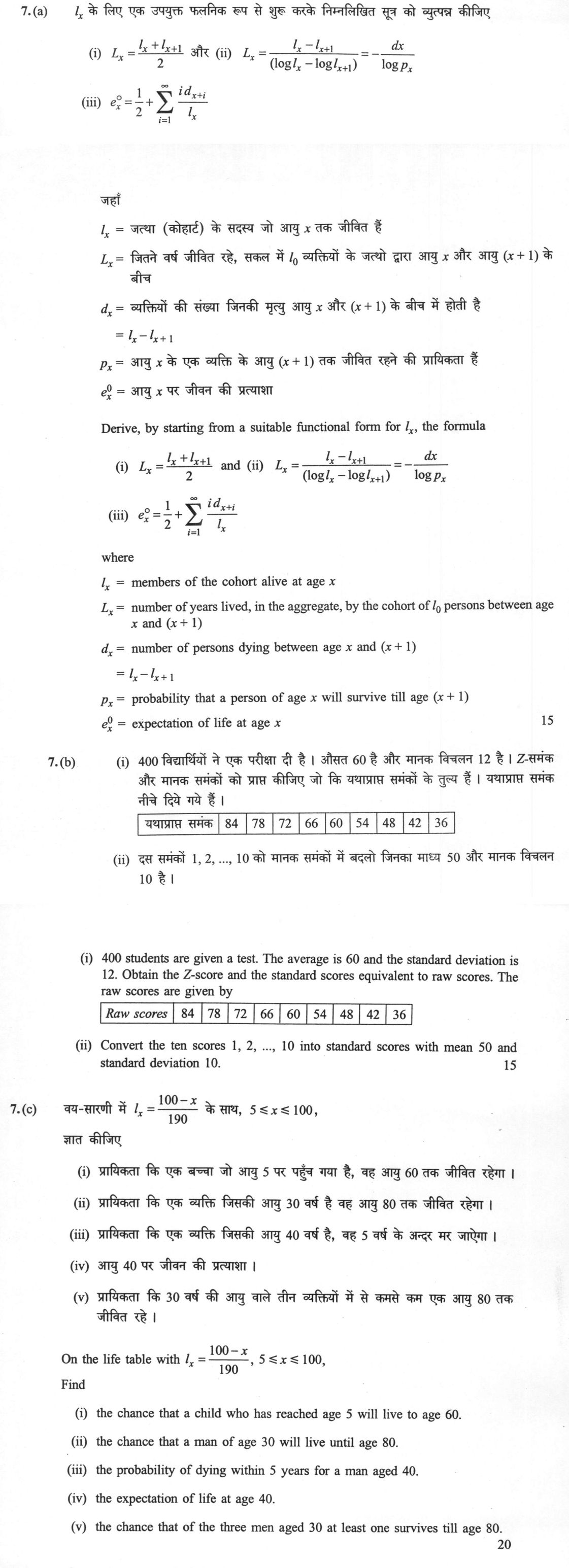
7.(a) Derive, by starting from a suitable functional form for lₓ, the formula (i) Lₓ = (lₓ + lₓ₊₁)/2 and (ii) Lₓ = (lₓ …
7.(a) Derive, by starting from a suitable functional form for lₓ, the formula Lₓ = (lₓ + lₓ₊₁)/2 and (ii) Lₓ = (lₓ - lₓ₊₁)/((log lₓ - log lₓ₊₁)) = -(dₓ)/(log pₓ)
eₓ⁰ = 1/2 + Σlimitsᵢ₌₁^∞ (i dₓ₊ᵢ)/(lₓ)
where
lₓ = members of the cohort alive at age x
Lₓ = number of years lived, in the aggregate, by the cohort of l₀ persons between age x and (x+1)
dₓ = number of persons dying between age x and (x+1) = lₓ - lₓ₊₁
pₓ = probability that a person of age x will survive till age (x+1)
eₓ⁰ = expectation of life at age x
7.(b) (i) 400 students are given a test. The average is 60 and the standard deviation is 12. Obtain the Z-score and the standard scores equivalent to raw scores. The raw scores are given by
| Raw scores | 84 | 78 | 72 | 66 | 60 | 54 | 48 | 42 | 36 |
|---|
Convert the ten scores 1, 2, ..., 10 into standard scores with mean 50 and standard deviation 10.
7.(c) On the life table with lₓ = (100-x)/190, 5 ≤ x ≤ 100,
Find
the chance that a child who has reached age 5 will live to age 60.
the chance that a man of age 30 will live until age 80.
the probability of dying within 5 years for a man aged 40.
the expectation of life at age 40.
the chance that of the three men aged 30 at least one survives till age 80.
हिंदी में प्रश्न पढ़ें
7.(a) lₓ के लिए एक उपयुक्त फलनिक रूप से शुरू करके निम्नलिखित सूत्र को व्युत्पन्न कीजिए
Lₓ = (lₓ + lₓ₊₁)/2 और (ii) Lₓ = (lₓ – lₓ₊₁)/(log lₓ – log lₓ₊₁) = – dx/log pₓ
e°ₓ = 1/2 + Σᵢ₌₁^∞ (i dₓ₊ᵢ)/lₓ
जहाँ
lₓ = जत्था (कोहोर्ट) के सदस्य जो आयु x तक जीवित हैं
Lₓ = जितने वर्ष जीवित रहे, सकल में l₀ व्यक्तियों के जत्थों द्वारा आयु x और आयु (x+1) के बीच
dₓ = व्यक्तियों की संख्या जिनकी मृत्यु आयु x और (x+1) के बीच में होती है = lₓ - lₓ₊₁
pₓ = आयु x के एक व्यक्ति के आयु (x+1) तक जीवित रहने की प्रायिकता है
eₓ⁰ = आयु x पर जीवन की प्रत्याशा
7.(b) (i) 400 विद्यार्थियों ने एक परीक्षा दी है। औसत 60 है और मानक विचलन 12 है। Z-समंक और मानक समंकों को प्राप्त कीजिए जो कि यथाप्रास समंकों के तुल्य हैं। यथाप्रास समंक नीचे दिये गये हैं।
| यथाप्रास समंक | 84 | 78 | 72 | 66 | 60 | 54 | 48 | 42 | 36 |
|---|
दस समंकों 1, 2, ..., 10 को मानक समंकों में बदलो जिनका माध्य 50 और मानक विचलन 10 है।
7.(c) वय-सारणी में lₓ = (100-x)/190 के साथ, 5 ≤ x ≤ 100,
ज्ञात कीजिए
प्रायिकता कि एक बच्चा जो आयु 5 पर पहुँच गया है, वह आयु 60 तक जीवित रहेगा।
प्रायिकता कि एक व्यक्ति जिसकी आयु 30 वर्ष है वह आयु 80 तक जीवित रहेगा।
प्रायिकता कि एक व्यक्ति जिसकी आयु 40 वर्ष है, वह 5 वर्ष के अन्दर मर जायेगा।
आयु 40 पर जीवन की प्रत्याशा।
प्रायिकता कि 30 वर्ष की आयु वाले तीन व्यक्तियों में से कमसे कम एक आयु 80 तक जीवित रहे।
Model answer
Written by UPSC Answer Check against this question's marking rubric, to the expected length. UPSC does not publish answers for Mains — this is one way to score well, not an official key.
(a)(i) Assume lₓ is linear on (x, x+1): lₓ₊ₜ = lₓ + (lₓ₊₁ − lₓ)t, 0 ≤ t ≤ 1. Then Lₓ = ∫₀¹ lₓ₊ₜ dt = ∫₀¹ [lₓ + (lₓ₊₁ − lₓ)t] dt = lₓ + (lₓ₊₁ − lₓ)/2 = (lₓ + lₓ₊₁)/2. So Lₓ = (lₓ + lₓ₊₁)/2 .
(a)(ii) Assume constant force of mortality, i.e. lₓ₊ₜ = lₓ pₓᵗ, where pₓ = lₓ₊₁/lₓ. Then Lₓ = ∫₀¹ lₓ pₓᵗ dt = lₓ (pₓ − 1)/log pₓ = (lₓ₊₁ − lₓ)/log pₓ = −dₓ/log pₓ. Also log lₓ − log lₓ₊₁ = log(lₓ/lₓ₊₁) = −log pₓ, hence Lₓ = (lₓ − lₓ₊₁)/(log lₓ − log lₓ₊₁) = −dₓ/log pₓ , valid when pₓ ≠ 1.
(a)(iii) The complete expectation is eₓ⁰ = (1/lₓ) ∫₀∞ lₓ₊ₜ dt. Using (i) on each unit interval, ∫₀∞ lₓ₊ₜ dt = Lₓ + Lₓ₊₁ + Lₓ₊₂ + ... = lₓ/2 + lₓ₊₁ + lₓ₊₂ + ... Now lₓ₊₁ + lₓ₊₂ + ... = dₓ₊₁ + 2dₓ₊₂ + 3dₓ₊₃ + ... = ∑ᵢ i dₓ₊ᵢ, i = 1,2,... Therefore eₓ⁰ = 1/2 + (1/lₓ) ∑ᵢ i dₓ₊ᵢ, i = 1,2,... .
(b)(i) Mean μ = 60, σ = 12. Z = (X − 60)/12. For X = 84, 78, 72, 66, 60, 54, 48, 42, 36: Z = 2, 1.5, 1, 0.5, 0, −0.5, −1, −1.5, −2. Taking standard score as T = 50 + 10Z, the standard scores are 70, 65, 60, 55, 50, 45, 40, 35, 30 .
(b)(ii) For scores 1,2,...,10: mean = (1+10)/2 = 5.5. Using the ten scores as the population, σ = √[∑(X−5.5)²/10] = √(82.5/10) = √33/2. So standard score = 50 + 10(X − 5.5)/(√33/2) = 50 + 20(X − 5.5)/√33. Thus, rounded to 2 decimals: 1→34.33, 2→37.81, 3→41.30, 4→44.78, 5→48.26, 6→51.74, 7→55.22, 8→58.70, 9→62.19, 10→65.67 .
(c)(i) lₓ = (100−x)/190. P(live from 5 to 60) = l₆₀/l₅ = (40/190)/(95/190) = 40/95 = 8/19 ≈ 0.4211 .
(c)(ii) P(live from 30 to 80) = l₈₀/l₃₀ = (20/190)/(70/190) = 20/70 = 2/7 ≈ 0.2857 .
(c)(iii) P(die within 5 years after 40) = 1 − l₄₅/l₄₀ = 1 − (55/190)/(60/190) = 1 − 55/60 = 5/60 = 1/12 ≈ 0.0833 .
(c)(iv) e₄₀⁰ = (1/l₄₀) ∫₀⁶⁰ l₄₀₊ₜ dt = (190/60) ∫₀⁶⁰ [(60−t)/190] dt = (1/60)(60t − t²/2)₀⁶⁰ = (1/60)(3600 − 1800) = 30 years .
(c)(v) Probability one man aged 30 survives to 80 is p = 2/7. For three independent men, P(at least one survives) = 1 − (1−p)³ = 1 − (5/7)³ = 1 − 125/343 = 218/343 ≈ 0.6356 .
What "Derive" is asking you to do
Reach the stated expression from a starting relation, justifying every step. The destination is printed in the question, so only the route earns marks, and the assumptions you work under are part of that route.
Structure that answers it
Assumptions and notation defined → starting relation or governing equation → each step with its justification → the required expression → limiting case or boundary check
Where marks are lost
Writing the standard result first and fitting three lines to it, which an examiner reads at a glance. Marks also go on assumptions left unstated — lossless medium, small amplitude, errors independent with zero mean — and on symbols used before they are defined, even when the question says usual notations.
How this answer will be evaluated
Approach
(a) derive: given > assumptions > stepwise derivation > result > check | (b(i)) calculate: given > formula > substitution > result with units > interpretation | (b(ii)) calculate: given > formula > substitution > result with units > interpretation | (c(i)) calculate: given > formula > substitution > result with units > interpretation | (c(ii)) calculate: given > formula > substitution > result with units > interpretation | (c(iii)) calculate: given > formula > substitution > result with units > interpretation | (c(iv)) calculate: given > formula > substitution > result with units > interpretation | (c(v)) calculate: given > formula > substitution > result with units > interpretation Full marks: All derivations correct, all calculations accurate, clear presentation
Key points expected
- State suitable functional form for lx
- Derive Lx = (lx + lx+1)/2
- Derive Lx = dx / (log lx - log lx+1)
- Derive ex0 = 1/2 + sum(idx+i/lx)
- State Z-score formula
- Calculate Z-scores for all raw scores
- Convert Z-scores to standard scores
- Present results in a table
Evaluation rubric
Each sub-part is marked on its own, against the marks and word limit printed on the paper.
- (a) Derive formulas for Lx and ex0 from a functional form for lx.
derive— given → assumptions → stepwise derivation → result → check
Must cover
- State suitable functional form for lx
- Derive Lx = (lx + lx+1)/2
- Derive Lx = dx / (log lx - log lx+1)
- Derive ex0 = 1/2 + sum(idx+i/lx)
Loses marks
- Skipping functional form assumption
- Algebraic errors in derivation
Earns more
- Show intermediate integration steps
- Define all symbols clearly
Extra mark
- Mention specific functional form used
- (b(i)) Calculate Z-scores and standard scores for given raw scores.
calculate— given → formula → substitution → result with units → interpretation
Must cover
- State Z-score formula
- Calculate Z-scores for all raw scores
- Convert Z-scores to standard scores
- Present results in a table
Loses marks
- Arithmetic errors in Z-score
- Missing standard score conversion
Earns more
- Show calculation for one score explicitly
Extra mark
- Interpret one score in context
- (b(ii)) Convert scores 1-10 to standard scores (mean 50, SD 10).
calculate— given → formula → substitution → result with units → interpretation
Must cover
- State linear transformation formula
- Calculate standard scores for 1-10
- Verify mean is 50 and SD is 10
Loses marks
- Incorrect transformation formula
- Calculation errors
Earns more
- Show formula derivation
Extra mark
- Present in a clean table
- (c(i)) Find probability child age 5 lives to age 60.
calculate— given → formula → substitution → result with units → interpretation
Must cover
- Use lx = (100-x)/190
- Calculate l5 and l60
- Compute probability l60/l5
Loses marks
- Incorrect lx values
- Wrong probability formula
Earns more
- Show substitution steps
Extra mark
- Interpret result
- (c(ii)) Find probability man age 30 lives to age 80.
calculate— given → formula → substitution → result with units → interpretation
Must cover
- Calculate l30 and l80
- Compute probability l80/l30
Loses marks
- Incorrect lx values
- Wrong probability formula
Earns more
- Show substitution steps
Extra mark
- Interpret result
- (c(iii)) Find probability man age 40 dies within 5 years.
calculate— given → formula → substitution → result with units → interpretation
Must cover
- Calculate l40 and l45
- Compute 1 - (l45/l40)
Loses marks
- Incorrect lx values
- Wrong probability formula
Earns more
- Show substitution steps
Extra mark
- Interpret result
- (c(iv)) Find expectation of life at age 40.
calculate— given → formula → substitution → result with units → interpretation
Must cover
- Use ex0 formula
- Calculate sum of idx+i/lx
- Compute final expectation
Loses marks
- Incorrect summation
- Wrong formula application
Earns more
- Show summation steps
Extra mark
- Interpret result
- (c(v)) Find probability at least one of three men age 30 survives to 80.
calculate— given → formula → substitution → result with units → interpretation
Must cover
- Use complement probability
- Calculate 1 - (1-p)^3
- Use p from part c(ii)
Loses marks
- Wrong complement formula
- Incorrect p value
Earns more
- Show complement logic
Extra mark
- Interpret result
Practice this exact question
Write your answer and it is marked point by point against the model answer above — what you covered, what you missed, what you got wrong.
Evaluate my answer →More from Statistics 2023 Paper II
- Q4 (a) A Company ships truckloads of grain from three silos to four mills. The supply (in tr…
- Q5 (c) What do you mean by reliability and validity of tests ? What is the difference betwee…
- Q6 (a) Explain the principle of least squares. How it is used in fitting trend in time serie…
- Q7 7.(a) Derive, by starting from a suitable functional form for lₓ, the formula (i) Lₓ = (l…
- Q8 8.(a) Explain the method of collection of agriculture data. Describe the (i) official pub…