Paper II — Q8
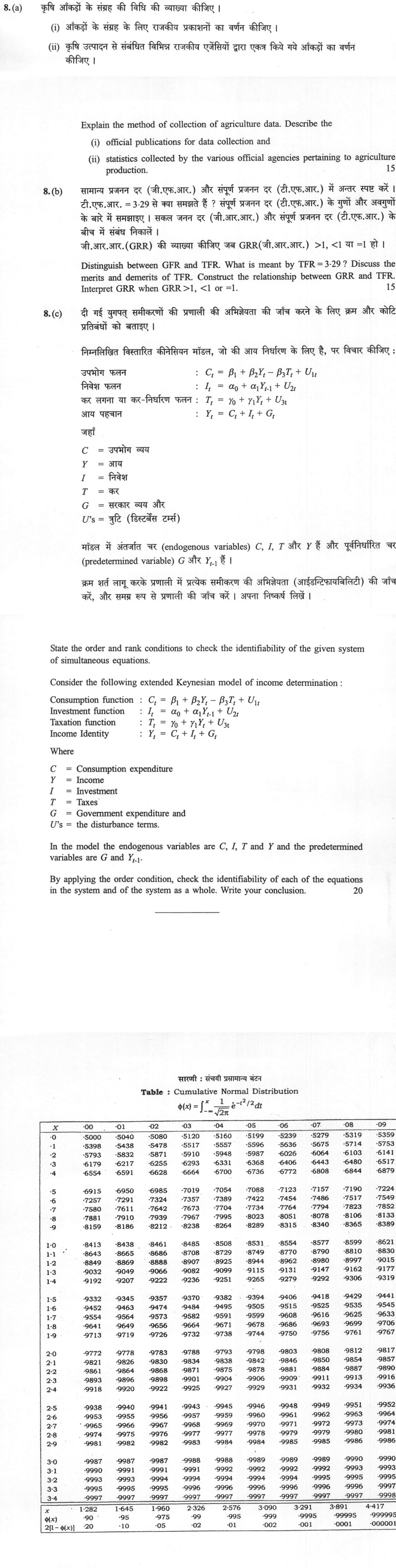
8.(a) Explain the method of collection of agriculture data. Describe the (i) official publications for data collection and (ii)…
8.(a) Explain the method of collection of agriculture data. Describe the official publications for data collection and
statistics collected by the various official agencies pertaining to agriculture production.
8.(b) Distinguish between GFR and TFR. What is meant by TFR = 3.29 ? Discuss the merits and demerits of TFR. Construct the relationship between GRR and TFR. Interpret GRR when GRR >1, <1 or =1.
8.(c) State the order and rank conditions to check the identifiability of the given system of simultaneous equations.
Consider the following extended Keynesian model of income determination :
Consumption function : Cₜ = β₁ + β₂ Yₜ - β₃ Tₜ + U₁ₜ
Investment function : Iₜ = α₀ + α₁ Yₜ₋₁ + U₂ₜ
Taxation function : Tₜ = γ₀ + γ₁ Yₜ + U₃ₜ
Income Identity : Yₜ = Cₜ + Iₜ + Gₜ
Where
C = Consumption expenditure
Y = Income
I = Investment
T = Taxes
G = Government expenditure and
U's = the disturbance terms.
In the model the endogenous variables are C, I, T and Y and the predetermined variables are G and Yₜ₋₁.
By applying the order condition, check the identifiability of each of the equations in the system and of the system as a whole. Write your conclusion.
हिंदी में प्रश्न पढ़ें
8.(a) कृषि आँकड़ों के संग्रह की विधि की व्याख्या कीजिए।
आँकड़ों के संग्रह के लिए राजकीय प्रकाशनों का वर्णन कीजिए।
कृषि उत्पादन से संबंधित विभिन्न राजकीय एजेंसियों द्वारा एकत्र किये गये आँकड़ों का वर्णन कीजिए।
8.(b) सामान्य प्रजनन दर (जी.एफ.आर.) और संपूर्ण प्रजनन दर (टी.एफ.आर.) में अंतर स्पष्ट करें । टी.एफ.आर. = 3.29 से क्या समझते हैं ? संपूर्ण प्रजनन दर (टी.एफ.आर.) के गुणों और अवगुणों के बारे में समझाइए । सकल जनन दर (जी.आर.आर.) और संपूर्ण प्रजनन दर (टी.एफ.आर.) के बीच में संबंध निकालें । जी.आर.आर.(GRR) की व्याख्या कीजिए जब GRR(जी.आर.आर.) >1, <1 या =1 हो ।
8.(c) दी गई युगपत् समीकरणों की प्रणाली की अभिज्ञेयता की जाँच करने के लिए क्रम और कोटि प्रतिबंधों को बताइए ।
निम्नलिखित विस्तारित किनेसियन मॉडल, जो कि आय निर्धारण के लिए है, पर विचार कीजिए :
उपभोग फलन : Cₜ = β₁ + β₂ Yₜ - β₃ Tₜ + U₁ₜ
निवेश फलन : Iₜ = α₀ + α₁ Yₜ₋₁ + U₂ₜ
कर लगना या कर-निर्धारण फलन : Tₜ = γ₀ + γ₁ Yₜ + U₃ₜ
आय पहचान : Yₜ = Cₜ + Iₜ + Gₜ
जहाँ
C = उपभोग व्यय
Y = आय
I = निवेश
T = कर
G = सरकार व्यय और
U's = त्रुटि (डिस्टर्बेंस टर्म्स)
मॉडल में अंतर्जात चर (endogenous variables) C, I, T और Y हैं और पूर्वनिर्धारित चर (predetermined variable) G और Yₜ₋₁ हैं ।
क्रम शर्त लागू करके प्रणाली में प्रत्येक समीकरण की अभिज्ञेयता (आइडेंटिफाइबिलिटी) की जाँच करें, और समग्र रूप से प्रणाली की जाँच करें । अपना निष्कर्ष लिखें ।
Model answer
Written by UPSC Answer Check against this question's marking rubric, to the expected length. UPSC does not publish answers for Mains — this is one way to score well, not an official key.
8(a) Agriculture data are collected through censuses of agriculture/land, sample surveys, and administrative records. The Agricultural Census (all-India, quinquennial) and state land records give area, ownership and crop patterns; NSSO rounds and agricultural sample surveys estimate production and input use; departmental returns from MoA&FW, DES, RBI and NABARD provide administrative series. Official publications include Agricultural Statistics at a Glance, State Statistical Abstracts, DES reports, CSO publications, FAO Yearbook and NABARD/RBI reports. By agency: MoA&FW publishes crop area, yield and production; CSO estimates agriculture value added in national income; RBI reports agricultural credit; NABARD compiles rural credit, WDRA and cooperative data; State DES publish state-level production, prices and farm statistics.
8(b) GFR is total births per 1,000 women aged 15–49 in a year; TFR is the sum of age-specific fertility rates, i.e. the average number of children a woman would bear over her reproductive life if exposed to current age-specific rates. For five-year age groups, TFR = 5 Σ ASFR if ASFR is per woman per year, or (5/1000) Σ ASFR if per 1,000 women. TFR=3.29 means a woman would have 3.29 children under current rates, above replacement (~2.1), implying growth if mortality unchanged. Merits: age-specific, comparable, independent of age structure, useful for replacement and policy. Demerits: period measure, sensitive to short-term changes, needs reliable age data, ignores mortality and assumes rates persist. GRR is TFR multiplied by the proportion of births that are male: GRR = TFR × (male births/total births); if sex ratio at birth is r males per 100 females, GRR = TFR × r/(100+r). GRR>1: each generation replaces itself and population grows; GRR<1: declines; GRR=1: stationary, ignoring mortality.
8(c) Let M=4 endogenous variables (C,I,T,Y) and K=2 predetermined (G,Yₜ₋₁). For an equation including m endogenous and k predetermined variables, order condition is excluded variables (endogenous + predetermined) ≥ M−1=3, equivalently K−k ≥ m−1. Rank condition: the rank of the coefficient matrix of variables excluded from the equation must be M−1=3. Consumption includes C,Y,T and excludes I,G,Yₜ₋₁ (3), so just identified by order; but its excluded-variable matrix from other equations is [[1,0,−α1],[0,0,0],[−1,−1,0]] (I,G,Yₜ₋₁), rank 2<3, so underidentified. Investment includes I,Yₜ₋₁; excludes C,T,Y,G (4>3), and its excluded-variable matrix has rank 3, so overidentified. Taxation includes T,Y; excludes C,I,G,Yₜ₋₁ (4>3), rank 3, so overidentified. Identity includes Y,C,I,G; excludes T,Yₜ₋₁ (2<3), so fails order and is underidentified. Hence the system is underidentified because at least one equation is not identified.
What "Explain" is asking you to do
Make the working of something clear — what sets it off, what follows from what, and what it produces. Explain is the Commission's mechanism word: it dominates the technical papers and the “explain why” stems, where the marks sit in the causal chain and not in the label.
Structure that answers it
State what it is → the initiating condition → the chain of cause, step by step → an instance where it plays out → what the chain produces
Where marks are lost
Describing what something looks like instead of why it works that way. Naming the stages without linking them reads as description too.
How this answer will be evaluated
Approach
Framework: UPSC Statistics Paper 2. (a) explain: definition/context > points in order > small example > short close | (b) compare: paired headings or table > key differences > significance > conclusion | (c) enumerate: list the items in order > one line each > no commentary Full marks: Precise definitions, correct application of conditions, and clear interpretation of all values.
Key points expected
- Define method of collection of agriculture data
- Describe official publications for data collection
- Name official agencies for agriculture production statistics
- List specific statistics collected by these agencies
- Distinguish between GFR and TFR
- Interpret the specific value TFR = 3.29
- Discuss merits and demerits of TFR
- Construct relationship between GRR and TFR
Evaluation rubric
Each sub-part is marked on its own, against the marks and word limit printed on the paper.
- (a) Method of collection and description of official publications/agencies for agriculture data. 15 marks
explain— definition/context → points in order → small example → short close
Must cover
- Define method of collection of agriculture data
- Describe official publications for data collection
- Name official agencies for agriculture production statistics
- List specific statistics collected by these agencies
Loses marks
- Confusing general statistics with agriculture-specific data
- Listing agencies without describing their specific statistics
Earns more
- Mention specific publication titles (e.g., Agricultural Statistics of India)
- Identify specific agencies (e.g., Ministry of Agriculture, NABARD)
Extra mark
- Reference to specific data sources like CSD or NSSO
- (b) Distinguish GFR/TFR, interpret TFR=3.29, merits/demerits, GRR-TFR relationship, and GRR interpretation. 15 marks
compare— paired headings or table → key differences → significance → conclusion
Must cover
- Distinguish between GFR and TFR
- Interpret the specific value TFR = 3.29
- Discuss merits and demerits of TFR
- Construct relationship between GRR and TFR
Loses marks
- Confusing GRR with GFR in the relationship
- Failing to interpret the specific value 3.29
Earns more
- Interpret GRR when GRR > 1, < 1, or = 1
- Use correct demographic terminology throughout
Extra mark
- Provide a numerical example for GRR calculation
- (c) State order/rank conditions and check identifiability of the Keynesian model using the order condition. 20 marks
enumerate— list the items in order → one line each → no commentary
Must cover
- State the order condition for identifiability
- State the rank condition for identifiability
- Apply order condition to each equation in the system
- Conclude on the identifiability of the system as a whole
Loses marks
- Applying the order condition incorrectly to the system
- Failing to distinguish between identified and unidentified equations
Earns more
- Correctly identify endogenous and predetermined variables
- Show the count of excluded variables for each equation
Extra mark
- Verify the rank condition using a determinant
Practice this exact question
Write your answer and it is marked point by point against the model answer above — what you covered, what you missed, what you got wrong.
Evaluate my answer →More from Statistics 2023 Paper II
- Q5 (c) What do you mean by reliability and validity of tests ? What is the difference betwee…
- Q6 (a) Explain the principle of least squares. How it is used in fitting trend in time serie…
- Q7 7.(a) Derive, by starting from a suitable functional form for lₓ, the formula (i) Lₓ = (l…
- Q8 8.(a) Explain the method of collection of agriculture data. Describe the (i) official pub…