Paper II — Q5
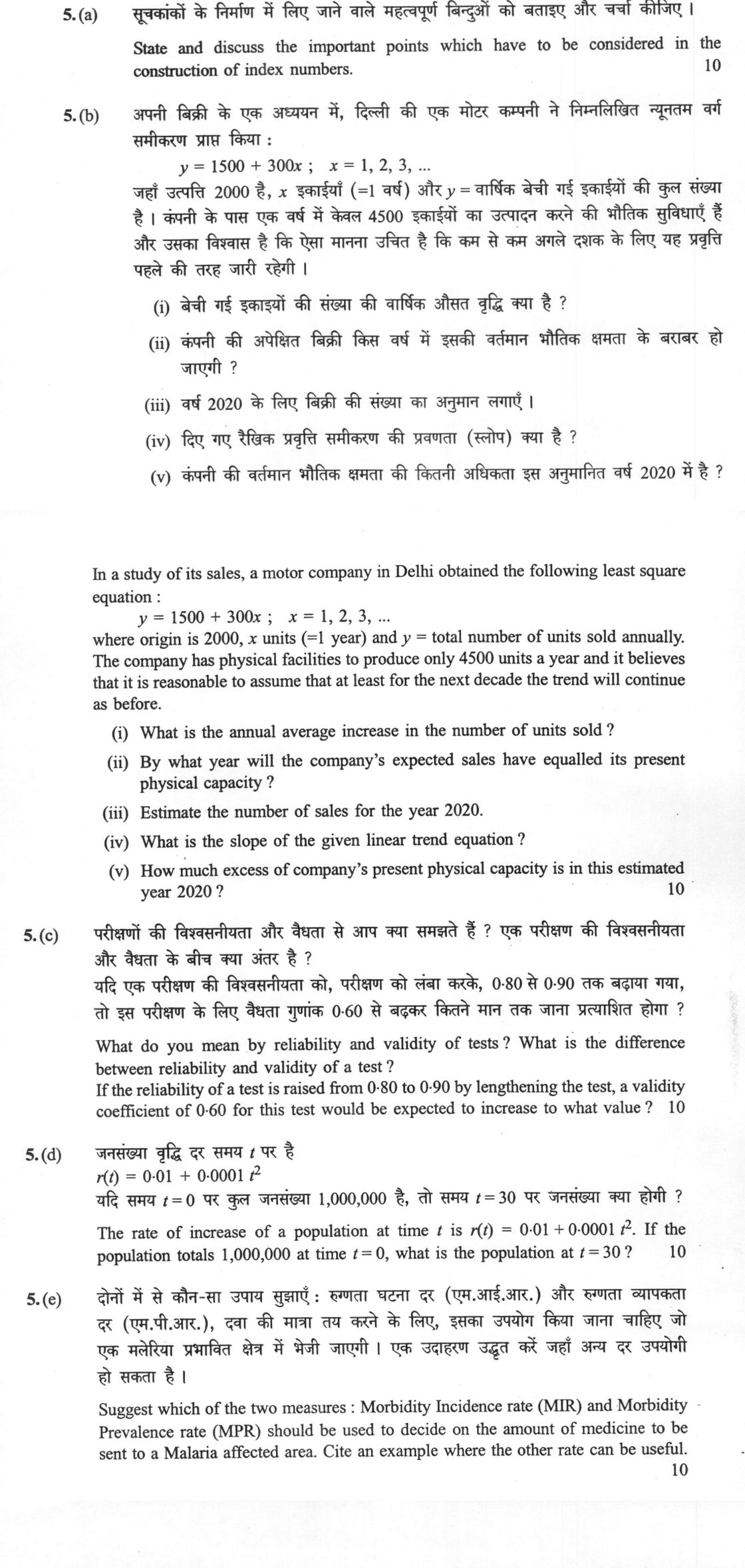
(c) What do you mean by reliability and validity of tests ? What is the difference between reliability and validity of a test ?…
What do you mean by reliability and validity of tests ? What is the difference between reliability and validity of a test ? If the reliability of a test is raised from 0·80 to 0·90 by lengthening the test, a validity coefficient of 0·60 for this test would be expected to increase to what value ? 10 marks
The rate of increase of a population at time t is r(t) = 0·01 + 0·0001 t². If the population totals 1,000,000 at time t = 0, what is the population at t = 30 ? 10 marks
Suggest which of the two measures : Morbidity Incidence rate (MIR) and Morbidity Prevalence rate (MPR) should be used to decide on the amount of medicine to be sent to a Malaria affected area. Cite an example where the other rate can be useful. 10 marks
हिंदी में प्रश्न पढ़ें
परीक्षणों की विश्वसनीयता और वैधता से आप क्या समझते हैं ? एक परीक्षण की विश्वसनीयता और वैधता के बीच क्या अंतर है ? यदि एक परीक्षण की विश्वसनीयता को, परीक्षण को लंबा करके, 0·80 से 0·90 तक बढ़ाया गया, तो इस परीक्षण के लिए वैधता गुणांक 0·60 से बढ़कर कितने मान तक जाना प्रत्याशित होगा ? 10 marks
जनसंख्या वृद्धि दर समय t पर है r(t) = 0·01 + 0·0001 t² यदि समय t = 0 पर कुल जनसंख्या 1,000,000 है, तो समय t = 30 पर जनसंख्या क्या होगी ? 10 marks
दोनों में से कौन-सा उपाय सुझाएं : रुग्णता घटना दर (एम.आई.आर.) और रुग्णता व्यापकता दर (एम.पी.आर.), दवा की मात्रा तय करने के लिए, इसका उपयोग किया जाना चाहिए जो एक मलेरिया प्रभावित क्षेत्र में भेजी जाएगी । एक उदाहरण उद्धृत करें जहाँ अन्य दर उपयोगी हो सकता है । 10
Model answer
Written by UPSC Answer Check against this question's marking rubric, to the expected length. UPSC does not publish answers for Mains — this is one way to score well, not an official key.
(c) Reliability and validity. Reliability is the consistency or stability of a test: if the same persons are retested under equivalent conditions, scores should be nearly the same. It reflects freedom from random error. Validity is the extent to which a test measures the construct or criterion it claims to measure; a valid test yields scores that are meaningfully related to the intended attribute. The difference is that reliability is a necessary but not sufficient condition for validity. A test can be highly reliable yet invalid if it consistently measures the wrong thing; a test that is not reliable cannot be valid, because random error prevents a stable relation with the intended attribute. If reliability is raised from 0.80 to 0.90 by lengthening the test, the Spearman–Brown prophecy formula gives the expected validity: r_new = r_old × √(R_new/R_old). The original validity of 0.60 at R = 0.80 has a reliability-corrected value of 0.60/√0.80 ≈ 0.67; applying the new reliability gives 0.67 × √0.90 ≈ 0.64, equivalently 0.60 × √(0.90/0.80) ≈ 0.636. Thus the expected validity coefficient rises to about 0.64.
(d) Population at t = 30. The rate of increase is treated as a relative rate, so dP/dt = P r(t) = P(0.01 + 0.0001t²). Separating variables gives dP/P = (0.01 + 0.0001t²)dt. Integrating, ln P = 0.01t + 0.0001t³/3 + C. At t = 0, P = 1,000,000, so C = ln(10⁶). Therefore P(t) = 10⁶ exp(0.01t + 0.0001t³/3). At t = 30, the exponent is 0.3 + 0.9 = 1.2, so P(30) = 10⁶ e^1.2 ≈ 3,320,117. The population grows from one million to about 3.32 million because the relative growth rate itself rises with t², so later periods add a larger proportion of the existing population.
(e) Malaria medicine allocation. For deciding the amount of medicine to be sent to a malaria-affected area, the Morbidity Prevalence Rate (MPR) should be used. MPR counts all existing cases—old and new—present in the population at a point or over a defined period. Medicine dispatch is a stock requirement: it must cover the number of persons who are currently diseased and need treatment, not merely those who become newly infected during a short interval. If MPR is high, the immediate treatment burden is high, so more antimalarials, rapid diagnostic tests, and supportive supplies are needed. If MPR is low, smaller quantities may suffice even if some new cases are appearing. This causal chain—prevalence identifies current patients, current patients determine drug consumption, and drug consumption determines the quantity to send—makes MPR the appropriate operational measure. In India, malaria case management under the National Malaria Elimination Programme uses RDTs and ACTs; the quantity of ACTs to be dispatched to a block should be based on prevalent cases requiring treatment at the time of dispatch.
MIR, by contrast, measures new cases arising over time. It is useful for understanding transmission dynamics, detecting outbreaks, and evaluating control measures. For example, in a district implementing the National Malaria Elimination Programme, a falling MIR after distribution of long-lasting insecticidal nets or indoor residual spraying would show that prevention is reducing new infections, even if MPR remains temporarily high because existing cases still need treatment. MIR can also guide future planning, such as estimating next season’s drug demand or targeting high-incidence blocks, but it should not be the sole basis for the immediate quantity of medicine to dispatch.
Reliability and validity distinguish stable measurement from meaningful measurement; the population equation shows how a time-varying relative rate compounds; and in public health, prevalence determines present treatment needs while incidence reveals the process generating future needs. Hence MPR is the correct basis for medicine allocation, with MIR retained for surveillance and control evaluation.
What "Explain" is asking you to do
Make the working of something clear — what sets it off, what follows from what, and what it produces. Explain is the Commission's mechanism word: it dominates the technical papers and the “explain why” stems, where the marks sit in the causal chain and not in the label.
Structure that answers it
State what it is → the initiating condition → the chain of cause, step by step → an instance where it plays out → what the chain produces
Where marks are lost
Describing what something looks like instead of why it works that way. Naming the stages without linking them reads as description too.
How this answer will be evaluated
Approach
(c) explain: definition/context > points in order > small example > short close | (d) calculate: given > formula > substitution > result with units > interpretation | (e) suggest: the problem in one line > implementable measures > who acts > conclusion Full marks: Precise definitions, correct calculations, clear distinctions, practical examples
Key points expected
- Define reliability as consistency of results
- Define validity as measuring intended construct
- Distinguish reliability (internal) vs validity (external)
- Apply Spearman-Brown prophecy formula
- Set up definite integral of r(t) from 0 to 30
- Correctly integrate 0.01 + 0.0001t^2
- Add initial population 1,000,000
- Provide final numerical answer
Evaluation rubric
Each sub-part is marked on its own, against the marks and word limit printed on the paper.
- (c) Define reliability/validity, distinguish them, and calculate new validity coefficient. 10 marks
explain— definition/context → points in order → small example → short close
Must cover
- Define reliability as consistency of results
- Define validity as measuring intended construct
- Distinguish reliability (internal) vs validity (external)
- Apply Spearman-Brown prophecy formula
Loses marks
- Confusing reliability with validity
- Incorrect application of Spearman-Brown formula
- Failing to distinguish internal vs external consistency
Earns more
- Correct calculation of new validity (0.648)
- Mention lengthening test increases reliability
- Note validity cannot exceed 1.0
Extra mark
- Mention Cronbach's alpha for reliability
- Cite specific validity types (content/criterion)
- (d) Integrate rate function to find population at t=30. 10 marks
calculate— given → formula → substitution → result with units → interpretation
Must cover
- Set up definite integral of r(t) from 0 to 30
- Correctly integrate 0.01 + 0.0001t^2
- Add initial population 1,000,000
- Provide final numerical answer
Loses marks
- Incorrect integration of t^2 term
- Forgetting to add initial population
- Arithmetic errors in final sum
Earns more
- Correct integration steps shown
- Accurate arithmetic in final calculation
- Proper units (population count)
Extra mark
- Verify result with alternative method
- Discuss assumptions of continuous growth
- (e) Recommend MIR or MPR for medicine allocation and justify. 10 marks
suggest— the problem in one line → implementable measures → who acts → conclusion
Must cover
- Define Morbidity Incidence Rate (MIR)
- Define Morbidity Prevalence Rate (MPR)
- Select appropriate rate for medicine needs
- Provide example for the other rate's use
Loses marks
- Confusing incidence with prevalence
- Choosing wrong rate for acute disease
- Failing to provide example for other rate
Earns more
- Correct choice of MIR for new cases
- Clear distinction between incidence and prevalence
- Practical example for MPR (e.g., chronic disease)
Extra mark
- Mention time period for rate calculation
- Discuss limitations of each measure
Practice this exact question
Write your answer and it is marked point by point against the model answer above — what you covered, what you missed, what you got wrong.
Evaluate my answer →More from Statistics 2023 Paper II
- Q2 (a) What do you understand by control chart for fraction defective? Explain its construct…
- Q3 (a) Solve the following Linear Programming problem using Two Phase method : Maximize Z =…
- Q4 (a) A Company ships truckloads of grain from three silos to four mills. The supply (in tr…
- Q5 (c) What do you mean by reliability and validity of tests ? What is the difference betwee…
- Q6 (a) Explain the principle of least squares. How it is used in fitting trend in time serie…
- Q7 7.(a) Derive, by starting from a suitable functional form for lₓ, the formula (i) Lₓ = (l…
- Q8 8.(a) Explain the method of collection of agriculture data. Describe the (i) official pub…