Paper II — Q6
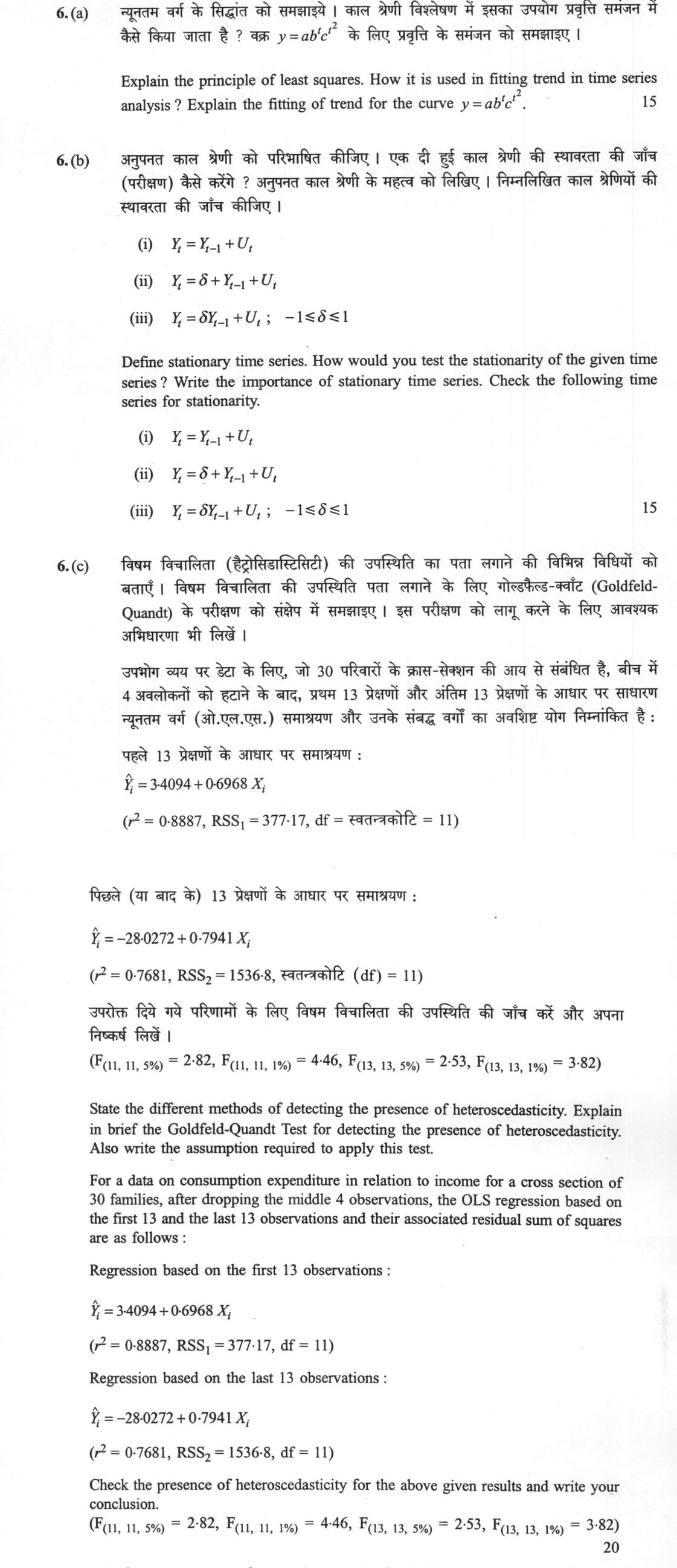
(a) Explain the principle of least squares. How it is used in fitting trend in time series analysis ? Explain the fitting of…
Explain the principle of least squares. How it is used in fitting trend in time series analysis ? Explain the fitting of trend for the curve y=ab^tc^t². 15 marks
Define stationary time series. How would you test the stationarity of the given time series ? Write the importance of stationary time series. Check the following time series for stationarity.
Yₜ = Yₜ₋₁ + Uₜ
Yₜ = δ + Yₜ₋₁ + Uₜ
Yₜ = δ Yₜ₋₁ + Uₜ ; -1 ≤ δ ≤ 1 15 marks
State the different methods of detecting the presence of heteroscedasticity. Explain in brief the Goldfeld-Quandt Test for detecting the presence of heteroscedasticity. Also write the assumption required to apply this test.
For a data on consumption expenditure in relation to income for a cross section of 30 families, after dropping the middle 4 observations, the OLS regression based on the first 13 and the last 13 observations and their associated residual sum of squares are as follows :
Regression based on the first 13 observations :
Ŷᵢ = 3.4094 + 0.6968 Xᵢ
(r² = 0.8887, RSS₁ = 377.17, df = 11)
Regression based on the last 13 observations :
Ŷᵢ = -28.0272 + 0.7941 Xᵢ
(r² = 0.7681, RSS₂ = 1536.8, df = 11)
Check the presence of heteroscedasticity for the above given results and write your conclusion.
(F_(11, 11, 5%) = 2.82, F_(11, 11, 1%) = 4.46, F_(13, 13, 5%) = 2.53, F_(13, 13, 1%) = 3.82) 20 marks
हिंदी में प्रश्न पढ़ें
न्यूनतम वर्ग के सिद्धांत को समझाइये । काल श्रेणी विश्लेषण में इसका उपयोग प्रवृत्ति समंजन में कैसे किया जाता है ? वक्र y=ab^tc^t² के लिए प्रवृत्ति के समंजन को समझाइए । 15
अनुपन्न काल श्रेणी को परिभाषित कीजिए । एक दी हुई काल श्रेणी की स्थावरता की जाँच (परीक्षण) कैसे करेंगे ? अनुपन्न काल श्रेणी के महत्व को लिखिए । निम्नलिखित काल श्रेणियों की स्थावरता की जाँच कीजिए ।
Yₜ = Yₜ₋₁ + Uₜ
Yₜ = δ + Yₜ₋₁ + Uₜ
Yₜ = δ Yₜ₋₁ + Uₜ ; -1 ≤ δ ≤ 1 15
विषम विचलितता (हैट्रोसिडास्टिसिटी) की उपस्थिति का पता लगाने की विभिन्न विधियों को बताइए । विषम विचलितता की उपस्थिति पता लगाने के लिए गोल्डफेल्ड-क्वांड्ट (Goldfeld-Quandt) के परीक्षण को संक्षेप में समझाइए । इस परीक्षण को लागू करने के लिए आवश्यक अभिधारणा भी लिखें ।
उपभोग व्यय पर डेटा के लिए, जो 30 परिवारों के क्रॉस-सेक्शन की आय से संबंधित है, बीच में 4 अवलोकनों को हटाने के बाद, प्रथम 13 प्रेक्षणों और अंतिम 13 प्रेक्षणों के आधार पर साधारण न्यूनतम वर्ग (ओ.एल.एस.) समाश्रयण और उनके संबद्ध वर्गों का अवशिष्ट योग निम्नांकित है :
पहले 13 प्रेक्षणों के आधार पर समाश्रयण :
Ŷᵢ = 3.4094 + 0.6968 Xᵢ
(r² = 0.8887, RSS₁ = 377.17, df = स्वतंत्रकोटि = 11)
पिछले (या बाद के) 13 प्रेक्षणों के आधार पर समाश्रयण :
Ŷᵢ = -28.0272 + 0.7941 Xᵢ
(r² = 0.7681, RSS₂ = 1536.8, स्वतंत्रकोटि (df) = 11)
उपरोक्त दिये गये परिणामों के लिए विषम विचलितता की उपस्थिति की जाँच करें और अपना निष्कर्ष लिखें ।
(F_(11, 11, 5%) = 2.82, F_(11, 11, 1%) = 4.46, F_(13, 13, 5%) = 2.53, F_(13, 13, 1%) = 3.82) 20 marks
Model answer
Written by UPSC Answer Check against this question's marking rubric, to the expected length. UPSC does not publish answers for Mains — this is one way to score well, not an official key.
(a) Principle of Least Squares and Trend Fitting
The principle of least squares states that the best-fitting curve to a set of observations is the one for which the sum of the squares of the vertical deviations (residuals) between observed and estimated values is minimum, i.e. minimise Σ(Yᵢ − Ŷᵢ)². Squaring removes sign cancellation and penalises large deviations heavily; differentiating this sum with respect to each parameter and equating to zero yields the normal equations, whose solution gives the least-squares estimators.
In time series, trend is fitted by treating time t as the independent variable and the series Yₜ as dependent, choosing a functional form (linear, quadratic, exponential, logistic) that reflects the underlying growth mechanism. For the curve y = abᵗc^t², take logarithms: log y = log a + t log b + t² log c, i.e. Y = A + Bt + Ct², where Y = log y, A = log a, B = log b, C = log c. This is linear in the transformed parameters, so the normal equations are:
ΣY = nA + BΣt + CΣt² ΣtY = AΣt + BΣt² + CΣt³ Σt²Y = AΣt² + BΣt³ + CΣt⁴
Solving these three equations gives A, B, C, and back-transformation gives a = antilog A, b = antilog B, c = antilog C. The curve captures exponential growth modified by a squared-exponential term, useful where growth accelerates or decelerates over time.
(b) Stationarity
A time series is (weakly/covariately) stationary if its mean E(Yₜ) = μ, variance Var(Yₜ) = σ², and autocovariance Cov(Yₜ, Yₜ₊ₖ) = γₖ are all finite and constant over time, independent of t; strong stationarity requires the entire joint distribution to be time-invariant. Stationarity is tested graphically (ACF/PACF plots), by unit root tests (Dickey–Fuller, ADF, Phillips–Perron), or by the correlogram test. Its importance lies in valid inference: non-stationary series give spurious regressions, invalid t and F statistics, and unreliable forecasts.
(i) Yₜ = Yₜ₋₁ + Uₜ is a pure random walk. Substituting recursively, Yₜ = Y₀ + ΣUᵢ, so Var(Yₜ) = tσ² grows with t — variance is non-constant, hence non-stationary.
(ii) Yₜ = δ + Yₜ₋₁ + Uₜ is a random walk with drift. Yₜ = Y₀ + δt + ΣUᵢ; the mean grows linearly with t and variance grows with t, so it is non-stationary.
(iii) Yₜ = δYₜ₋₁ + Uₜ is an AR(1) process. Its mean is zero, variance is σ²/(1−δ²) and autocovariance γₖ = δᵏσ²/(1−δ²), both finite and time-invariant provided |δ| < 1. Hence it is stationary for −1 < δ < 1; at δ = ±1 it reduces to a random walk and becomes non-stationary.
(c) Detecting Heteroscedasticity
Methods include: graphical inspection of residuals against fitted values or an explanatory variable; Park test; Glejser test; Spearman's rank correlation test; Goldfeld–Quandt test; White's general test; and Breusch–Pagan–Godfrey test.
The Goldfeld–Quandt test proceeds by ordering observations by the variable suspected to cause heteroscedasticity, omitting c central observations, fitting separate regressions to the first n₁ and last n₂ observations, and computing F = RSS₂/RSS₁ (larger over smaller), compared with F(n₂−k, n₁−k) at the chosen level. Assumptions: errors are normal; under H₀ (homoscedasticity) variance is constant; the alternative is that variance increases (or decreases) monotonically with the ordering variable; the two sub-samples are independent.
Here, H₀: homoscedasticity; H₁: variance increases with income. F = RSS₂/RSS₁ = 1536.8/377.17 = 4.075, with df (11, 11). Since 4.075 > F₀.₀₅(11,11) = 2.82, we reject H₀ at 5%; but 4.075 < F₀.₀₁(11,11) = 4.46, so it is not significant at 1%. Since RSS₂ > RSS₁, variance rises with income. Conclusion: heteroscedasticity is present in consumption expenditure, significant at the 5% level.
What "Explain" is asking you to do
Make the working of something clear — what sets it off, what follows from what, and what it produces. Explain is the Commission's mechanism word: it dominates the technical papers and the “explain why” stems, where the marks sit in the causal chain and not in the label.
Structure that answers it
State what it is → the initiating condition → the chain of cause, step by step → an instance where it plays out → what the chain produces
Where marks are lost
Describing what something looks like instead of why it works that way. Naming the stages without linking them reads as description too.
How this answer will be evaluated
Approach
Framework: UPSC Statistics Paper 2. (a) explain: definition/context > points in order > small example > short close | (b) define: precise definition > the distinguishing feature > one example | (c) explain: definition/context > points in order > small example > short close Full marks: Complete derivations, correct tests, clear interpretation, all assumptions stated
Key points expected
- Define least squares as minimizing sum of squared residuals
- Explain linearization of y = ab^t c^t² via logarithms
- Derive normal equations for transformed parameters
- Show solution for log a, log b, log c
- Define stationarity (constant mean, variance, autocovariance)
- Identify (i) as random walk (non-stationary)
- Identify (ii) as random walk with drift (non-stationary)
- Identify (iii) as stationary if |δ| < 1
Evaluation rubric
Each sub-part is marked on its own, against the marks and word limit printed on the paper.
- (a) Principle of least squares and trend fitting for y = ab^t c^t² 15 marks
explain— definition/context → points in order → small example → short close
Must cover
- Define least squares as minimizing sum of squared residuals
- Explain linearization of y = ab^t c^t² via logarithms
- Derive normal equations for transformed parameters
- Show solution for log a, log b, log c
Loses marks
- Fitting without linearization step
- Confusing parameters with estimators
- Missing normal equations derivation
Earns more
- Mention Gauss-Markov theorem context
- State assumptions of OLS (homoscedasticity, no autocorrelation)
- Show step-by-step differentiation of S.E.
- Provide final trend equation in original form
Extra mark
- Mention geometric interpretation of least squares
- Reference to Gauss's original derivation
- (b) Stationarity definition, testing, importance, and check 3 series 15 marks
define— precise definition → the distinguishing feature → one example
Must cover
- Define stationarity (constant mean, variance, autocovariance)
- Identify (i) as random walk (non-stationary)
- Identify (ii) as random walk with drift (non-stationary)
- Identify (iii) as stationary if |δ| < 1
Loses marks
- Treating (iii) as non-stationary without checking |δ|
- Missing definition of weak vs strong stationarity
- No testing method mentioned
Earns more
- Mention ADF or Dickey-Fuller test for stationarity
- Explain importance for ARIMA modeling
- Show characteristic equation for (iii)
- Discuss unit root implications
Extra mark
- Mention Box-Jenkins methodology
- Reference to Granger-Newbold spurious regression
- (c) Heteroscedasticity detection methods and Goldfeld-Quandt test application 20 marks
explain— definition/context → points in order → small example → short close
Must cover
- List methods: Goldfeld-Quandt, Breusch-Pagan, White test
- State Goldfeld-Quandt assumption (ordered by X)
- Calculate F = RSS₂/RSS₁ = 1536.8/377.17 = 4.07
- Compare with F(11,11,5%) = 2.82 and conclude heteroscedasticity
Loses marks
- Using wrong RSS ratio (RSS₁/RSS₂)
- Missing assumption about ordering by X
- No comparison with critical F-value
Earns more
- Explain why middle observations are dropped
- Show F-statistic formula explicitly
- Mention alternative: Park's or Glejser's test
- Discuss consequences of heteroscedasticity (inefficient OLS)
Extra mark
- Mention White's general test
- Reference to Breusch-Pagan 1978 paper
Practice this exact question
Write your answer and it is marked point by point against the model answer above — what you covered, what you missed, what you got wrong.
Evaluate my answer →More from Statistics 2023 Paper II
- Q3 (a) Solve the following Linear Programming problem using Two Phase method : Maximize Z =…
- Q4 (a) A Company ships truckloads of grain from three silos to four mills. The supply (in tr…
- Q5 (c) What do you mean by reliability and validity of tests ? What is the difference betwee…
- Q6 (a) Explain the principle of least squares. How it is used in fitting trend in time serie…
- Q7 7.(a) Derive, by starting from a suitable functional form for lₓ, the formula (i) Lₓ = (l…
- Q8 8.(a) Explain the method of collection of agriculture data. Describe the (i) official pub…