Paper II — Q3
(a) Solve the following Linear Programming problem using Two Phase method : Maximize Z = 3x₁ - x₂ Subject to 2x₁ + x₂ ≥ 2, x₁ +…
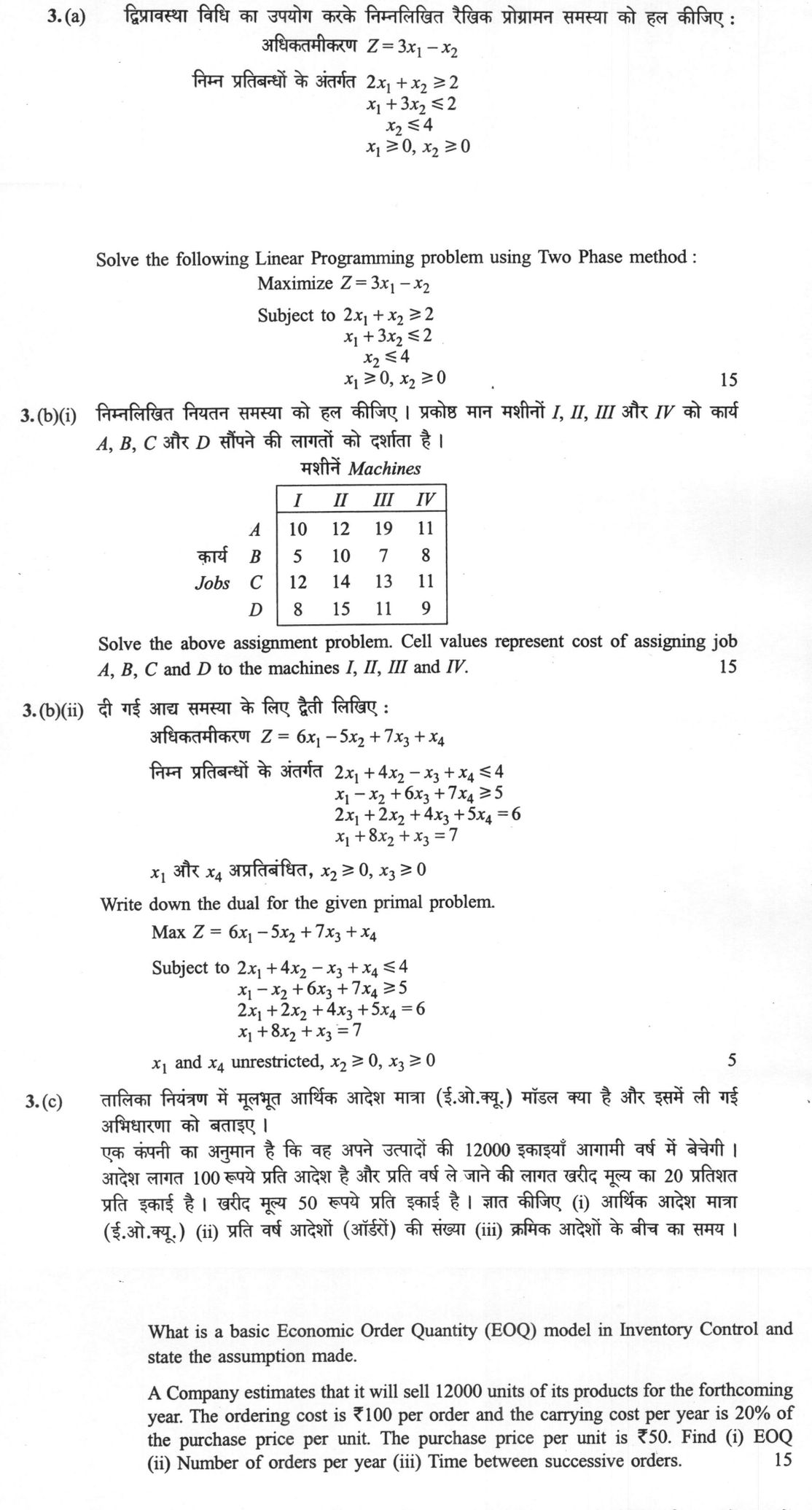
Solve the following Linear Programming problem using Two Phase method : Maximize Z = 3x₁ - x₂ Subject to 2x₁ + x₂ ≥ 2, x₁ + 3x₂ ≤ 2, x₂ ≤ 4, x₁ ≥ 0, x₂ ≥ 0
Solve the above assignment problem. Cell values represent cost of assigning job A, B, C and D to the machines I, II, III and IV.
Write down the dual for the given primal problem. Max Z = 6x₁ - 5x₂ + 7x₃ + x₄ Subject to 2x₁ + 4x₂ - x₃ + x₄ ≤ 4, x₁ - x₂ + 6x₃ + 7x₄ ≥ 5, 2x₁ + 2x₂ + 4x₃ + 5x₄ = 6, x₁ + 8x₂ + x₃ = 7; x₁ and x₄ unrestricted, x₂ ≥ 0, x₃ ≥ 0
What is a basic Economic Order Quantity (EOQ) model in Inventory Control and state the assumption made. A Company estimates that it will sell 12000 units of its products for the forthcoming year. The ordering cost is ₹100 per order and the carrying cost per year is 20% of the purchase price per unit. The purchase price per unit is ₹50. Find (i) EOQ (ii) Number of orders per year (iii) Time between successive orders.
हिंदी में प्रश्न पढ़ें
द्विप्रावस्था विधि का उपयोग करके निम्नलिखित रैखिक प्रोग्रामन समस्या को हल कीजिए : अधिकतमीकरण Z = 3x₁ - x₂ निम्न प्रतिबंधों के अंतर्गत 2x₁ + x₂ ≥ 2, x₁ + 3x₂ ≤ 2, x₂ ≤ 4, x₁ ≥ 0, x₂ ≥ 0
निम्नलिखित नियत समस्या को हल कीजिए । प्रत्येक मान मशीनों I, II, III और IV को कार्य A, B, C और D सौंपने की लागतों को दर्शाता है ।
दी गई आद्य समस्या के लिए द्वैति लिखिए : अधिकतमीकरण Z = 6x₁ - 5x₂ + 7x₃ + x₄ निम्न प्रतिबंधों के अंतर्गत 2x₁ + 4x₂ - x₃ + x₄ ≤ 4, x₁ - x₂ + 6x₃ + 7x₄ ≥ 5, 2x₁ + 2x₂ + 4x₃ + 5x₄ = 6, x₁ + 8x₂ + x₃ = 7; x₁ और x₄ अप्रतिबंधित, x₂ ≥ 0, x₃ ≥ 0
तालिका नियंत्रण में मूलभूत आर्थिक आदेश मात्रा (ई.ओ.क्यू.) मॉडल क्या है और इसमें ली गई अभिधारणा को बताइए । एक कंपनी का अनुमान है कि वह अपने उत्पादों की 12000 इकाइयाँ आगामी वर्ष में बेचेगी । आदेश लागत 100 रुपये प्रति आदेश है और प्रति वर्ष ले जाने की लागत खरीद मूल्य का 20 प्रतिशत प्रति इकाई है । खरीद मूल्य 50 रुपये प्रति इकाई है । ज्ञात कीजिए (i) आर्थिक आदेश मात्रा (ई.ओ.क्यू.) (ii) प्रति वर्ष आदेशों (ऑर्डरों) की संख्या (iii) क्रमिक आदेशों के बीच का समय ।
The figure this question refers to, in words
The question paper is a scan and the diagram did not survive as text. This is the figure as read from the original page — every component, value and label — so the question can be worked from the text below.
(b(i)) Table showing cost of assigning Jobs to Machines: Machines: I, II, III, IV Job A: 10, 12, 19, 11 Job B: 5, 10, 7, 8 Job C: 12, 14, 13, 11 Job D: 8, 15, 11, 9
(b(i)) Table titled 'Machines' with rows labeled 'Jobs' (A, B, C, D) and columns labeled I, II, III, IV. The values in the table are: Row A: 10, 12, 19, 11; Row B: 5, 10, 7, 8; Row C: 12, 14, 13, 11; Row D: 8, 15, 11, 9.
(b(i)) Table titled 'Machines' with rows labeled 'Jobs' A, B, C, D and columns labeled I, II, III, IV. The values in the table are: Row A: 10, 12, 19, 11; Row B: 5, 10, 7, 8; Row C: 12, 14, 13, 11; Row D: 8, 15, 11, 9.
Model answer
Written by UPSC Answer Check against this question's marking rubric, to the expected length. UPSC does not publish answers for Mains — this is one way to score well, not an official key.
(a) Convert to equality form. For 2x₁ + x₂ ≥ 2, subtract surplus s₁ and add artificial a₁: 2x₁ + x₂ - s₁ + a₁ = 2. For x₁ + 3x₂ ≤ 2 add slack s₂: x₁ + 3x₂ + s₂ = 2. For x₂ ≤ 4 add slack s₃: x₂ + s₃ = 4. All variables are non-negative.
Phase I minimises W = a₁. Initial basis is a₁, s₂, s₃, with a₁ = 2, s₂ = 2, s₃ = 4. From row 1, a₁ = 2 - 2x₁ - x₂ + s₁, so W = 2 - 2x₁ - x₂ + s₁. The most negative coefficient is -2, so x₁ enters. Ratio test: a₁ row gives 2/2 = 1, s₂ row gives 2/1 = 2; hence a₁ leaves. Pivot on the coefficient 2 in row 1.
After pivot: x₁ = 1 - 1/2x₂ + 1/2s₁ - 1/2a₁, s₂ = 1 - 5/2x₂ - 1/2s₁ + 1/2a₁, s₃ = 4 - x₂, W = a₁. With nonbasic variables x₂ = s₁ = a₁ = 0, W = 0 and the reduced costs are non-negative. Thus Phase I is optimal and the artificial variable is removed. The basic feasible solution is x₁ = 1, x₂ = 0, s₂ = 1, s₃ = 4.
Phase II maximises Z = 3x₁ - x₂. Using the x₁ row with a₁ = 0, Z = 3(1 - 1/2x₂ + 1/2s₁) - x₂ = 3 - 5/2x₂ + 3/2s₁. For maximisation, s₁ enters because its coefficient is positive. Ratio test: only s₂ decreases as s₁ increases, since s₂ = 1 - 5/2x₂ - 1/2s₁; ratio is 1/(1/2) = 2, so s₂ leaves. Pivot gives s₁ = 2 - 5x₂ - 2s₂.
Updated equations: x₁ = 2 - 3x₂ - s₂, s₁ = 2 - 5x₂ - 2s₂, s₃ = 4 - x₂, Z = 6 - 10x₂ - 3s₂. All nonbasic coefficients in the Z-row are non-positive, so the tableau is optimal at x₂ = s₂ = 0. Hence x₁ = 2, x₂ = 0 and maximum Z = 6; this point satisfies 4 ≥ 2, 2 ≤ 2 and 0 ≤ 4.
(b)(i) Use Hungarian method to minimise total cost. Row minima are 10, 5, 11, 8. Subtracting row minima gives: A: 0, 2, 9, 1; B: 0, 5, 2, 3; C: 1, 3, 2, 0; D: 0, 7, 3, 1. Column minima are 0, 2, 2, 0. Subtracting column minima gives: A: 0, 0, 7, 1; B: 0, 3, 0, 3; C: 1, 1, 0, 0; D: 0, 5, 1, 1. Independent zeros can be assigned as A-II, B-III, C-IV, D-I. Since four independent zeros exist, the assignment is optimal. The total row and column reduction is 38; because the selected cells are zero in the reduced matrix, their original cost equals this lower bound. Minimum cost is 12 + 7 + 11 + 8 = 38. Assignment: A to II, B to III, C to IV, D to I; minimum cost = 38 cost units.
(b)(ii) Let y₁, y₂, y₃, y₄ be dual variables for the four primal constraints. Since the primal is a maximisation problem, the dual is a minimisation problem. For a max primal, a ≤ constraint gives a non-negative dual variable, a ≥ constraint gives a non-positive dual variable, and an equality constraint gives an unrestricted dual variable. Thus y₁ ≥ 0, y₂ ≤ 0, y₃ and y₄ are unrestricted. Since x₁ and x₄ are unrestricted, their dual constraints are equalities; since x₂ and x₃ are non-negative, their dual constraints are ≥. The left-hand sides are obtained by taking the coefficients of each primal variable down the columns.
Dual: Minimise W = 4y₁ + 5y₂ + 6y₃ + 7y₄ subject to 2y₁ + y₂ + 2y₃ + y₄ = 6, 4y₁ - y₂ + 2y₃ + 8y₄ ≥ -5, -y₁ + 6y₂ + 4y₃ + y₄ ≥ 7, y₁ + 7y₂ + 5y₃ = 1, with y₁ ≥ 0, y₂ ≤ 0, y₃, y₄ unrestricted.
(c) A basic EOQ model is a deterministic single-item inventory model. It assumes constant annual demand D, fixed ordering cost S per order, constant unit purchase price P, linear holding cost H per unit per year, no shortages, instantaneous replenishment, constant lead time, and no quantity discounts. The formula is valid when D, S and H are positive and the order quantity is treated as continuous; if whole units are required, the result is rounded.
Here D = 12000 units/year, S = ₹100/order, P = ₹50/unit. The holding cost is 20% of purchase price, so H = 20% × 50 = ₹10/unit/year.
The EOQ formula is Q = √(2DS/H). Therefore Q = √(2 × 12000 × 100 / 10) = √240000 = 200√6 units.
Number of orders per year: N = D/Q = 12000/(200√6) = 10√6 orders/year.
Time between successive orders: T = 1/N = √6/60 year. If a 365-day year is taken, T = 365√6/60 = 73√6/12 days.
EOQ = 200√6 units; number of orders = 10√6 orders/year; time between orders = √6/60 year (73√6/12 days for 365 days/year).
What "Solve" is asking you to do
Choose the method, then carry it through to a final answer. Identifying what kind of problem this is and why that method applies is the first thing marked; a correct figure arrived at invisibly earns almost nothing.
Structure that answers it
Given data and what is required → method chosen, with the reason it applies → set-up (equation, circuit, free body, trial balance) → working, step by step → answer with units and any condition of validity
Where marks are lost
Doing the middle steps mentally and writing only the result. In mathematics papers, a further loss comes from giving a decimal where the exact value in surds or fractions was wanted, or from skipping the justification a part explicitly asks for.
How this answer will be evaluated
Approach
Framework: Operations Research / Management Science. (a) calculate: given > formula > substitution > result with units > interpretation | (b(i)) calculate: given > formula > substitution > result with units > interpretation | (b(ii)) write short notes: define > 3-4 key features > one example > one-line significance | (c) calculate: given > formula > substitution > result with units > interpretation Full marks: All parts solved with correct methodology, clear steps, and accurate final answers.
Key points expected
- Formulate Phase I with artificial variables
- Perform simplex iterations for Phase I
- Formulate Phase II with original objective
- State final optimal values for x1, x2, Z
- Apply row and column reduction
- Find minimum number of independent assignments
- Perform iterations to reach optimal assignment
- State final assignment and total cost
Evaluation rubric
Each sub-part is marked on its own, against the marks and word limit printed on the paper.
- (a) Solve the LP problem using the Two Phase method. 15 marks
calculate— given → formula → substitution → result with units → interpretation
Must cover
- Formulate Phase I with artificial variables
- Perform simplex iterations for Phase I
- Formulate Phase II with original objective
- State final optimal values for x1, x2, Z
Loses marks
- Skipping Phase I directly to Phase II
- Arithmetic errors in tableau calculations
- Failure to check for optimality conditions
Earns more
- Correctly identifies infeasibility if applicable
- Clean simplex tableaus
- Explicit handling of constraints
Extra mark
- Graphical verification of the solution
- (b(i)) Solve the assignment problem for jobs A-D to machines I-IV. 15 marks
calculate— given → formula → substitution → result with units → interpretation
Must cover
- Apply row and column reduction
- Find minimum number of independent assignments
- Perform iterations to reach optimal assignment
- State final assignment and total cost
Loses marks
- Incorrect reduction steps
- Failure to cover all zeros with minimum lines
- Incorrect final assignment mapping
Earns more
- Correct use of Hungarian method steps
- Clear display of opportunity cost matrix
- Accurate final cost calculation
Extra mark
- Alternative optimal solutions identified
- (b(ii)) Write the dual for the given primal problem. 5 marks
write short notes— define → 3-4 key features → one example → one-line significance
Must cover
- Identify dual variables for each constraint
- Correctly map primal constraints to dual variables
- Handle unrestricted variables x1, x4 correctly
- State the dual objective and constraints
Loses marks
- Incorrect sign for dual variables
- Failure to handle unrestricted variables
- Mismatched coefficients in dual constraints
Earns more
- Correct sign of dual variables
- Accurate dual constraint coefficients
- Clear notation for dual variables
Extra mark
- Explicit statement of duality rules used
- (c) Define EOQ model, state assumptions, and calculate EOQ, orders/year, and time between orders. 15 marks
calculate— given → formula → substitution → result with units → interpretation
Must cover
- Define EOQ model and state key assumptions
- Calculate EOQ using formula sqrt(2DS/H)
- Calculate number of orders per year
- Calculate time between successive orders
Loses marks
- Incorrect EOQ formula or substitution
- Missing assumptions for EOQ model
- Calculation errors in orders or time
Earns more
- Correct identification of D, S, H values
- Clear step-by-step calculation
- Proper units in final answers
Extra mark
- Graphical representation of EOQ model
- Sensitivity analysis on parameters
Practice this exact question
Write your answer and it is marked point by point against the model answer above — what you covered, what you missed, what you got wrong.
Evaluate my answer →More from Statistics 2023 Paper II
- Q1 (a) What do you understand by Statistical Quality Control (SQC)? Discuss briefly its need…
- Q2 (a) What do you understand by control chart for fraction defective? Explain its construct…
- Q3 (a) Solve the following Linear Programming problem using Two Phase method : Maximize Z =…
- Q4 (a) A Company ships truckloads of grain from three silos to four mills. The supply (in tr…
- Q5 (c) What do you mean by reliability and validity of tests ? What is the difference betwee…
- Q6 (a) Explain the principle of least squares. How it is used in fitting trend in time serie…