Paper II — Q2
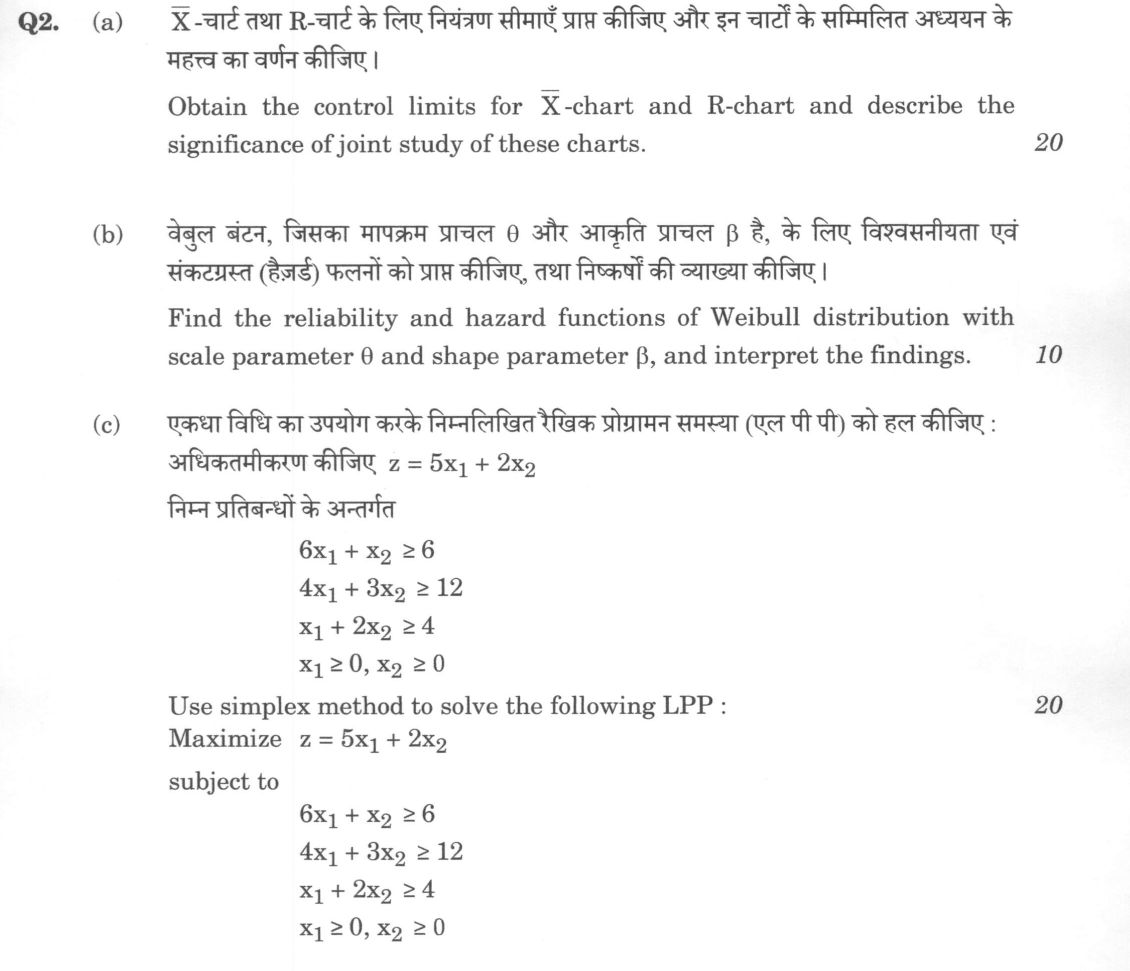
(a) Obtain the control limits for X̄-chart and R-chart and describe the significance of joint study of these charts. 20…
Obtain the control limits for X̄-chart and R-chart and describe the significance of joint study of these charts. 20 marks
Find the reliability and hazard functions of Weibull distribution with scale parameter θ and shape parameter β, and interpret the findings. 10 marks
Use simplex method to solve the following LPP : Maximize z = 5x₁ + 2x₂ subject to 6x₁ + x₂ ≥ 6 4x₁ + 3x₂ ≥ 12 x₁ + 2x₂ ≥ 4 x₁ ≥ 0, x₂ ≥ 0 20 marks
हिंदी में प्रश्न पढ़ें
X̄-चार्ट तथा R-चार्ट के लिए नियंत्रण सीमाएँ प्राप्त कीजिए और इन चार्टों के साम्मिलित अध्ययन के महत्व का वर्णन कीजिए। 20 अंक
वेबुल बंटन, जिसका मापक्रम प्राचल θ और आकृति प्राचल β है, के लिए विश्वसनीयता एवं संकटप्रस्त (हेजर्ड) फलनों को प्राप्त कीजिए, तथा निष्कर्षों की व्याख्या कीजिए। 10 अंक
एकदा विधि का उपयोग करके निम्नलिखित रैखिक प्रोग्रामन समस्या (एल पी पी) को हल कीजिए : अधिकतमीकरण कीजिए z = 5x₁ + 2x₂ निम्न प्रतिबंधों के अंतर्गत 6x₁ + x₂ ≥ 6 4x₁ + 3x₂ ≥ 12 x₁ + 2x₂ ≥ 4 x₁ ≥ 0, x₂ ≥ 0 20 अंक
Model answer
Written by UPSC Answer Check against this question's marking rubric, to the expected length. UPSC does not publish answers for Mains — this is one way to score well, not an official key.
(a) Let samples of size n have mean X̄ and range R. For an in-control normal process with mean μ and standard deviation σ, the sample mean satisfies X̄ ~ N(μ, σ²/n), so its 3-sigma limits are μ ± 3σ/√n. Since μ and σ are unknown, estimate μ by X̄̄ and σ by R̄/d₂, because E(R)=d₂σ.
Hence for the X̄-chart:
- CL = X̄̄
- UCL = X̄̄ + A₂R̄
- LCL = X̄̄ − A₂R̄ where A₂ = 3/(d₂√n).
For the R-chart, E(R)=d₂σ and SD(R)=d₃σ, so the 3-sigma limits are (d₂ ± 3d₃)σ. Replacing σ by R̄/d₂ gives:
- CL = R̄
- UCL = D₄R̄
- LCL = D₃R̄ where D₄ = 1 + 3d₃/d₂ and D₃ = max(0, 1 − 3d₃/d₂). In standard tables D₃=0 for n≤6; if D₃<0, take LCL=0. Conditions: independent observations, fixed subgroup size, and approximate normality.
Significance of joint study: The X̄-chart detects shifts in the process mean, while the R-chart detects changes in process variability. They must be used together because the X̄-chart limits depend on R̄. If the R-chart is out of control, R̄ is not a reliable estimate of σ, so X̄-chart signals may be misleading. Usually the R-chart is examined first. If R is in control and X̄ is out, the location has shifted. If R is out, variability has changed and may explain apparent mean shifts. Joint patterns help diagnose assignable causes such as sudden shifts, increasing spread, or gradual drift.
(b) For a Weibull distribution with scale θ and shape β, the density is f(t) = (β/θ)(t/θ)^(β−1) exp[−(t/θ)^β], t≥0, θ>0, β>0. The distribution function is F(t) = 1 − exp[−(t/θ)^β]. Hence the reliability function is R(t) = P(T>t) = 1 − F(t) = exp[−(t/θ)^β]. The hazard function is h(t) = f(t)/R(t) = (β/θ)(t/θ)^(β−1) = β t^(β−1)/θ^β, t≥0, with unit “per unit time” if t is time.
Interpretation: β<1 gives a decreasing hazard, representing infant mortality. β=1 gives a constant hazard h(t)=1/θ, the exponential memoryless case. β>1 gives an increasing hazard, representing wear-out or aging. The scale θ is the characteristic life because R(θ)=exp(−1).
(c) Introduce surplus variables s₁,s₂,s₃≥0: 6x₁ + x₂ − s₁ = 6 4x₁ + 3x₂ − s₂ = 12 x₁ + 2x₂ − s₃ = 4 x₁,x₂,s₁,s₂,s₃ ≥ 0.
A feasible basic solution is x₁=4, x₂=0, s₁=18, s₂=4, s₃=0. Taking x₂ and s₃ as nonbasic, solve for the basic variables: x₁ = 4 − 2x₂ + s₃ s₁ = 18 − 11x₂ + 6s₃ s₂ = 4 − 5x₂ + 4s₃. Then z = 5x₁ + 2x₂ = 20 − 8x₂ + 5s₃. The coefficient of s₃ in z is +5, so s₃ enters. For fixed x₂=0, as s₃ increases: x₁ = 4 + s₃, s₁ = 18 + 6s₃, s₂ = 4 + 4s₃, all of which remain nonnegative and increase. No basic variable decreases to zero, so there is no leaving variable. Thus the objective increases without bound: z = 20 + 5s₃ → ∞ as s₃ → ∞.
Therefore the LPP has no finite maximum; z is unbounded above.
What "Solve" is asking you to do
Choose the method, then carry it through to a final answer. Identifying what kind of problem this is and why that method applies is the first thing marked; a correct figure arrived at invisibly earns almost nothing.
Structure that answers it
Given data and what is required → method chosen, with the reason it applies → set-up (equation, circuit, free body, trial balance) → working, step by step → answer with units and any condition of validity
Where marks are lost
Doing the middle steps mentally and writing only the result. In mathematics papers, a further loss comes from giving a decimal where the exact value in surds or fractions was wanted, or from skipping the justification a part explicitly asks for.
How this answer will be evaluated
Approach
Framework: Statistics, Paper 2. (a) describe: define > structure or process in order > labelled diagram > significance | (b) calculate: given > formula > substitution > result with units > interpretation | (c) calculate: given > formula > substitution > result with units > interpretation Full marks: Rigorous derivation, correct notation, and clear interpretation of statistical concepts.
Key points expected
- Formulas for UCL/LCL of X-bar chart (UCL = X̄ + A2R̄)
- Formulas for UCL/LCL of R-chart (UCL = D4R̄, LCL = D3R̄)
- Explanation of why both charts are needed (mean vs variability)
- Mention of control chart constants (A2, D3, D4)
- Reliability function R(t) = exp(-(t/θ)^β)
- Hazard function h(t) = (β/θ)(t/θ)^(β-1)
- Interpretation of β < 1 (decreasing failure rate)
- Interpretation of β > 1 (increasing failure rate)
Evaluation rubric
Each sub-part is marked on its own, against the marks and word limit printed on the paper.
- (a) Derive control limits for X-bar and R charts and explain the significance of their joint study. 20 marks
describe— define → structure or process in order → labelled diagram → significance
Must cover
- Formulas for UCL/LCL of X-bar chart (UCL = X̄ + A2R̄)
- Formulas for UCL/LCL of R-chart (UCL = D4R̄, LCL = D3R̄)
- Explanation of why both charts are needed (mean vs variability)
- Mention of control chart constants (A2, D3, D4)
Loses marks
- Confusing X-bar chart limits with R-chart limits
- Failing to define the relationship between R̄ and X̄
Earns more
- Distinction between Type I and Type II errors in context
- Mention of process capability indices (Cp, Cpk)
Extra mark
- Reference to specific control chart constants table
- (b) Derive reliability and hazard functions for Weibull distribution and interpret the shape parameter. 10 marks
calculate— given → formula → substitution → result with units → interpretation
Must cover
- Reliability function R(t) = exp(-(t/θ)^β)
- Hazard function h(t) = (β/θ)(t/θ)^(β-1)
- Interpretation of β < 1 (decreasing failure rate)
- Interpretation of β > 1 (increasing failure rate)
Loses marks
- Incorrect exponent in the reliability function
- Failing to interpret the physical meaning of β
Earns more
- Mention of β = 1 as exponential distribution case
- Graphical representation of hazard rate curves
Extra mark
- Connection to bathtub curve
- (c) Solve the given Linear Programming Problem using the simplex method. 20 marks
calculate— given → formula → substitution → result with units → interpretation
Must cover
- Conversion of ≥ constraints to standard form (surplus/artificial variables)
- Correct setup of the initial simplex tableau
- Step-by-step pivot operations (entering/leaving variables)
- Final optimal solution for x1, x2, and z
Loses marks
- Arithmetic errors in the simplex tableau
- Failure to handle the ≥ constraints correctly
Earns more
- Use of Big-M method or Two-Phase method explicitly
- Verification of optimality condition (all Cj-Zj ≤ 0)
Extra mark
- Graphical verification of the optimal point
Practice this exact question
Write your answer and it is marked point by point against the model answer above — what you covered, what you missed, what you got wrong.
Evaluate my answer →More from Statistics 2024 Paper II
- Q1 (a) Consider a system consisting of three identical units connected in parallel. The unit…
- Q2 (a) Obtain the control limits for X̄-chart and R-chart and describe the significance of j…
- Q3 (a) With respect to a given Linear Programming Problem (LPP), explain the following conce…
- Q4 (a) A manually handled toll-booth has two tellers, who are each capable of handling an av…
- Q5 (a) Discuss the Indian Statistical System. State some important organisations and explain…