Paper II — Q6
(a) For the linear model Y = Xβ + u, obtain the expressions for Ordinary Least Squares (OLS) and Generalised Least Squares (GLS)…
For the linear model Y = Xβ + u, obtain the expressions for Ordinary Least Squares (OLS) and Generalised Least Squares (GLS) estimators of the parameters. Discuss their properties and compare them. 20 marks
Explain Time Reversal Test, Factor Reversal Test and Circular Test in the Index Number Theory.
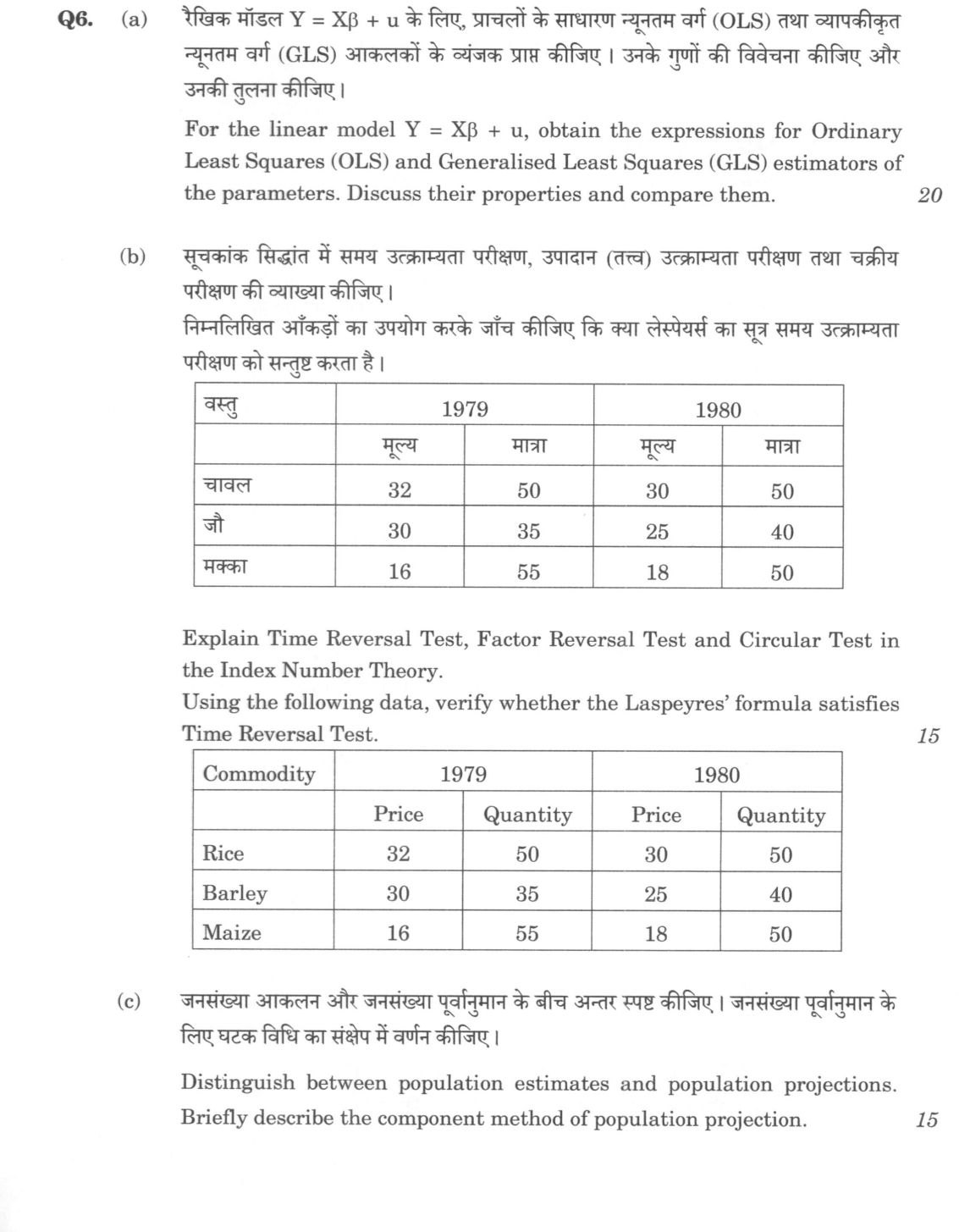
Using the following data, verify whether the Laspeyres' formula satisfies Time Reversal Test. 15 marks
Distinguish between population estimates and population projections. Briefly describe the component method of population projection. 15 marks
हिंदी में प्रश्न पढ़ें
रैखिक मॉडल Y = Xβ + u के लिए, प्राचलों के साधारण न्यूनतम वर्ग (OLS) तथा व्यापकीकृत न्यूनतम वर्ग (GLS) आकलकों के व्यंजक प्राप्त कीजिए। उनके गुणों की विवेचना कीजिए और उनकी तुलना कीजिए। 20
सूचकांक सिद्धांत में समय उत्क्रमता परीक्षण, उपादान (तत्व) उत्क्रमता परीक्षण तथा चक्रीय परीक्षण की व्याख्या कीजिए।
निम्नलिखित आँकड़ों का उपयोग करके जाँच कीजिए कि क्या लासपेयर्स का सूत्र समय उत्क्रमता परीक्षण को संतुष्ट करता है। 15
जनसंख्या आकलन और जनसंख्या पूर्वानुमान के बीच अंतर स्पष्ट कीजिए। जनसंख्या पूर्वानुमान के लिए घटक विधि का संक्षेप में वर्णन कीजिए। 15
The figure this question refers to, in words
The question paper is a scan and the diagram did not survive as text. This is the figure as read from the original page — every component, value and label — so the question can be worked from the text below.
(b) Table with 4 rows and 5 columns. Row 1 (Header): Commodity | 1979 (spanning 2 columns) | 1980 (spanning 2 columns) Row 2 (Sub-header): [Empty] | Price | Quantity | Price | Quantity Row 3: Rice | 32 | 50 | 30 | 50 Row 4: Barley | 30 | 35 | 25 | 40 Row 5: Maize | 16 | 55 | 18 | 50
What "Derive" is asking you to do
Reach the stated expression from a starting relation, justifying every step. The destination is printed in the question, so only the route earns marks, and the assumptions you work under are part of that route.
Structure that answers it
Assumptions and notation defined → starting relation or governing equation → each step with its justification → the required expression → limiting case or boundary check
Where marks are lost
Writing the standard result first and fitting three lines to it, which an examiner reads at a glance. Marks also go on assumptions left unstated — lossless medium, small amplitude, errors independent with zero mean — and on symbols used before they are defined, even when the question says usual notations.
How this answer will be evaluated
Approach
Framework: UPSC Statistics Paper 2. (a) compare: paired headings or table > key differences > significance > conclusion | (b) explain: definition/context > points in order > small example > short close | (c) compare: paired headings or table > key differences > significance > conclusion Full marks: Rigorous derivations, correct calculations, clear distinctions, and proper interpretation of results.
Key points expected
- Derive OLS estimator β̂ = (X'X)⁻¹X'Y
- Derive GLS estimator β̂ = (X'Ω⁻¹X)⁻¹X'Ω⁻¹Y
- State Gauss-Markov theorem for OLS (BLUE under homoscedasticity)
- Compare efficiency of OLS vs GLS under heteroscedasticity
- Define Time Reversal Test (P₀₁ × P₁₀ = 1)
- Define Factor Reversal Test (P₀₁ × Q₀₁ = V₀₁)
- Calculate Laspeyres' index for 1979-1980 and 1980-1979
- Verify if product of indices equals 1
Evaluation rubric
Each sub-part is marked on its own, against the marks and word limit printed on the paper.
- (a) Derive OLS and GLS estimators for Y=Xβ+u and compare their properties. 20 marks
compare— paired headings or table → key differences → significance → conclusion
Must cover
- Derive OLS estimator β̂ = (X'X)⁻¹X'Y
- Derive GLS estimator β̂ = (X'Ω⁻¹X)⁻¹X'Ω⁻¹Y
- State Gauss-Markov theorem for OLS (BLUE under homoscedasticity)
- Compare efficiency of OLS vs GLS under heteroscedasticity
Loses marks
- Deriving only one estimator without comparison
- Failing to state assumptions for OLS (homoscedasticity)
- Confusing OLS and GLS properties
Earns more
- Mention Aitken's theorem for GLS
- Show OLS is consistent but inefficient under heteroscedasticity
- Mention BLUE property of GLS under general covariance
Extra mark
- Mention Feasible GLS (FGLS) for unknown Ω
- (b) Explain Time, Factor, and Circular tests; verify Laspeyres' Time Reversal Test. 15 marks
explain— definition/context → points in order → small example → short close
Must cover
- Define Time Reversal Test (P₀₁ × P₁₀ = 1)
- Define Factor Reversal Test (P₀₁ × Q₀₁ = V₀₁)
- Calculate Laspeyres' index for 1979-1980 and 1980-1979
- Verify if product of indices equals 1
Loses marks
- Defining tests without performing the calculation
- Incorrect calculation of index values
- Failing to conclude whether the test is satisfied
Earns more
- Define Circular Test (P₀₁ × P₁₂ × P₂₀ = 1)
- Show step-by-step calculation of Σp₀q₀ and Σp₁q₀
- State that Laspeyres' fails Time Reversal Test
Extra mark
- Mention Fisher's Ideal Index satisfies all three tests
- (c) Distinguish population estimates from projections; describe component method. 15 marks
compare— paired headings or table → key differences → significance → conclusion
Must cover
- Define population estimate (interpolating past data)
- Define population projection (extrapolating to future)
- Describe component method (births, deaths, migration)
- Distinguish between the two concepts clearly
Loses marks
- Confusing estimates with projections
- Failing to describe the component method
- Vague definitions without distinction
Earns more
- Mention arithmetic/geometric methods for estimation
- Mention cohort-component method for projection
- Note that estimates are for past/present, projections for future
Extra mark
- Mention UN population projections as an example
Model answer coming soon
Every evaluation on this site is marked against a verified model answer. This question's answer is still being written; evaluation opens the moment it lands.
More from Statistics 2024 Paper II
- Q3 (a) With respect to a given Linear Programming Problem (LPP), explain the following conce…
- Q4 (a) A manually handled toll-booth has two tellers, who are each capable of handling an av…
- Q5 (a) Discuss the Indian Statistical System. State some important organisations and explain…
- Q6 (a) For the linear model Y = Xβ + u, obtain the expressions for Ordinary Least Squares (O…
- Q7 (a) Explain the problem of identification with a suitable example. Also discuss the condi…
- Q8 (a) Four items are to be constructed so that they are equispaced on the difficulty scale.…