Paper I — Q1
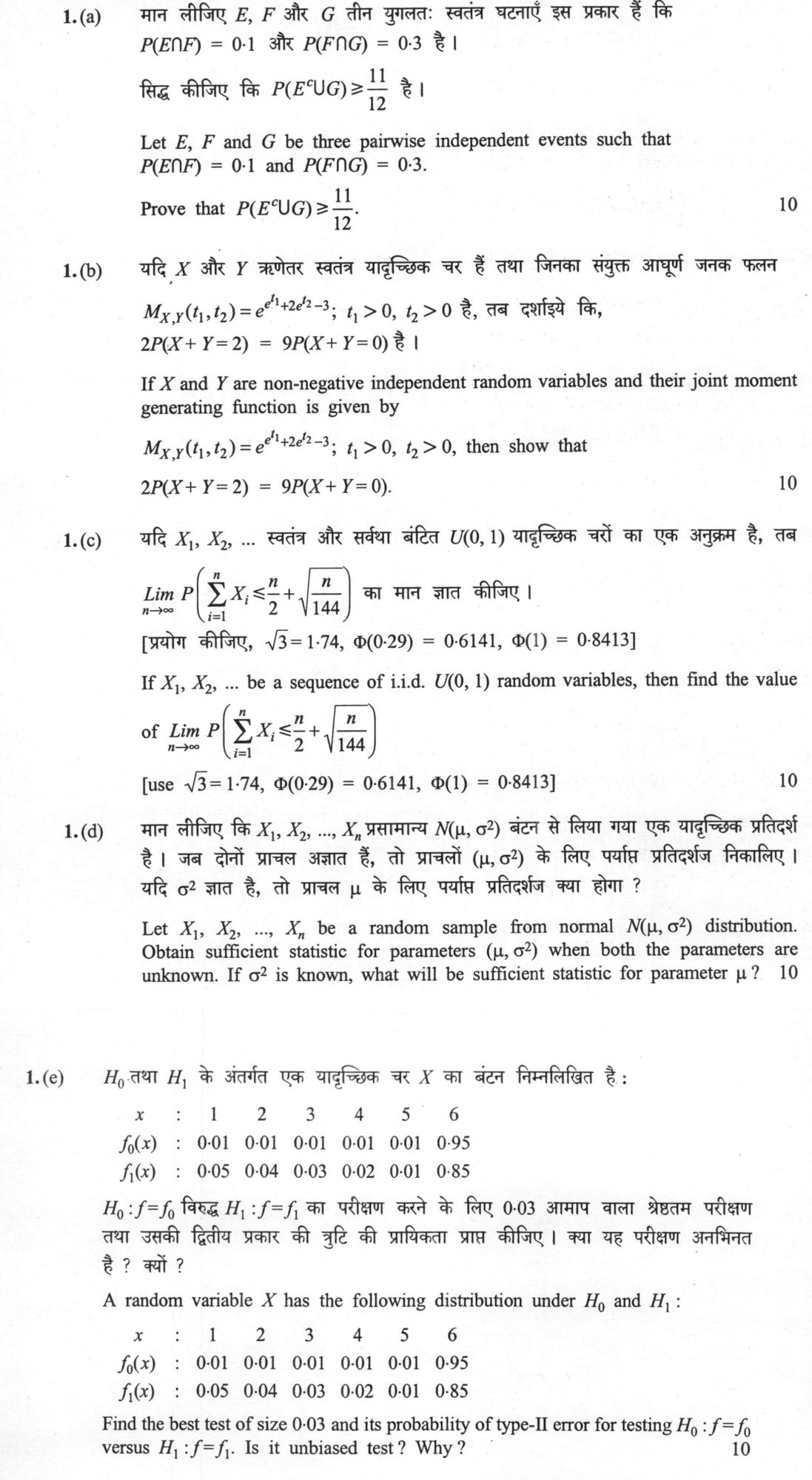
(a) Let E, F and G be three pairwise independent events such that P(E∩F) = 0·1 and P(F∩G) = 0·3. Prove that P(Eᶜ∪G) ≥ 11/12. 10…
Let E, F and G be three pairwise independent events such that P(E∩F) = 0·1 and P(F∩G) = 0·3. Prove that P(Eᶜ∪G) ≥ 11/12. 10 marks
If X and Y are non-negative independent random variables and their joint moment generating function is given by M_X,Y(t₁,t₂) = e^t₁+2e^t₂-3; t₁ > 0, t₂ > 0, then show that 2P(X+Y=2) = 9P(X+Y=0). 10 marks
If X₁, X₂, ... be a sequence of i.i.d. U(0, 1) random variables, then find the value of Limₙ→∞ P(∑ᵢ₌₁ⁿ Xᵢ ≤ n/2 + √(n/144)) [use √3 = 1·74, Φ(0·29) = 0·6141, Φ(1) = 0·8413]. 10 marks
Let X₁, X₂, ..., Xₙ be a random sample from normal N(μ, σ²) distribution. Obtain sufficient statistic for parameters (μ, σ²) when both the parameters are unknown. If σ² is known, what will be sufficient statistic for parameter μ ? 10 marks
A random variable X has the following distribution under H₀ and H₁ : x : 1 2 3 4 5 6 f₀(x) : 0·01 0·01 0·01 0·01 0·01 0·95 f₁(x) : 0·05 0·04 0·03 0·02 0·01 0·85 Find the best test of size 0·03 and its probability of type-II error for testing H₀ : f = f₀ versus H₁ : f = f₁. Is it unbiased test ? Why ? 10 marks
हिंदी में प्रश्न पढ़ें
मान लीजिए E, F और G तीन युग्मतः स्वतंत्र घटनाएँ इस प्रकार हैं कि P(E∩F) = 0·1 और P(F∩G) = 0·3 है। सिद्ध कीजिए कि P(Eᶜ∪G) ≥ 11/12 है। 10
यदि X और Y ऋणेतर स्वतंत्र यादृच्छिक चर हैं तथा जिनका संयुक्त आघूर्ण जनक फलन M_X,Y(t₁,t₂) = e^t₁+2e^t₂-3; t₁ > 0, t₂ > 0 है, तब दर्शाइए कि, 2P(X+Y=2) = 9P(X+Y=0) है। 10
यदि X₁, X₂, ... स्वतंत्र और सर्वथा बंटित U(0, 1) यादृच्छिक चरों का एक अनुक्रम है, तब Limₙ→∞ P(∑ᵢ₌₁ⁿ Xᵢ ≤ n/2 + √(n/144)) का मान ज्ञात कीजिए। [प्रयोग कीजिए, √3 = 1·74, Φ(0·29) = 0·6141, Φ(1) = 0·8413] 10
मान लीजिए कि X₁, X₂, ..., Xₙ प्रसामान्य N(μ, σ²) बंटन से लिया गया एक यादृच्छिक प्रतिदर्श है। जब दोनों प्राचल अज्ञात हैं, तो प्राचलों (μ, σ²) के लिए पर्याप्त प्रतिदर्शज निकालिए। यदि σ² ज्ञात है, तो प्राचल μ के लिए पर्याप्त प्रतिदर्शज क्या होगा ? 10 marks
H₀ तथा H₁ के अंतर्गत एक यादृच्छिक चर X का बंटन निम्नलिखित है : x : 1 2 3 4 5 6 f₀(x) : 0·01 0·01 0·01 0·01 0·01 0·95 f₁(x) : 0·05 0·04 0·03 0·02 0·01 0·85 H₀ : f = f₀ विरुद्ध H₁ : f = f₁ का परीक्षण करने के लिए 0·03 आमाप वाला श्रेष्ठतम परीक्षण तथा उसकी द्वितीय प्रकार की त्रुटि की प्रायिकता प्राप्त कीजिए। क्या यह परीक्षण अनभिनत है ? क्यों ? 10 marks
Model answer
Written by UPSC Answer Check against this question's marking rubric, to the expected length. UPSC does not publish answers for Mains — this is one way to score well, not an official key.
(a) Let p = P(E), q = P(F), r = P(G). Pairwise independence gives P(E∩F) = pq = 1/10 and P(F∩G) = qr = 3/10. Hence p = 1/(10q) and r = 3/(10q).
Now Eᶜ ∪ G is the complement of E ∩ Gᶜ. Therefore P(Eᶜ ∪ G) = 1 − P(E ∩ Gᶜ).
Because E and G are independent, P(E∩G) = pr. So P(E ∩ Gᶜ) = P(E) − P(E∩G) = p − pr = p(1−r). Thus P(Eᶜ ∪ G) = 1 − p(1−r).
We need p(1−r) ≤ 1/12. Substitute p and r: p(1−r) = [1/(10q)] [1 − 3/(10q)] = 1/(10q) − 3/(100q²). Then p(1−r) ≤ 1/12 ⇔ 1/(10q) − 3/(100q²) ≤ 1/12 ⇔ multiply by 300q²: 30q − 9 ≤ 25q² ⇔ 25q² − 30q + 9 ≥ 0 ⇔ (5q − 3)² ≥ 0, which is always true. Hence p(1−r) ≤ 1/12. Therefore P(Eᶜ ∪ G) = 1 − p(1−r) ≥ 1 − 1/12 = 11/12.
Therefore P(Eᶜ ∪ G) ≥ 11/12.
(b) As printed, M(t₁,t₂) = e^(t₁+2e^(t₂)−3) gives M(0,0) = e^(−1) ≠ 1, so it cannot be a joint moment generating function. The intended valid form that matches the conclusion is M(t₁,t₂) = exp(e^(t₁) + 2e^(t₂) − 3). Assume this standard correction.
Since X and Y are independent, M(t₁,t₂) = M_X(t₁) M_Y(t₂). Now exp(e^(t₁) + 2e^(t₂) − 3) = exp(e^(t₁) − 1) · exp(2e^(t₂) − 2).
The mgf of Poisson(λ) is exp(λ(e^t − 1)). Hence M_X(t₁) = exp(1·(e^(t₁) − 1)) ⇒ X ∼ Poisson(1), M_Y(t₂) = exp(2·(e^(t₂) − 1)) ⇒ Y ∼ Poisson(2).
Therefore X + Y ∼ Poisson(1+2) = Poisson(3). So for S = X + Y, P(S = k) = e^(−3) 3^k / k! , k = 0,1,2,...
Thus P(X+Y = 0) = P(S=0) = e^(−3), P(X+Y = 2) = P(S=2) = e^(−3) 3² / 2! = 9e^(−3)/2.
Hence 2P(X+Y = 2) = 2 · 9e^(−3)/2 = 9e^(−3) = 9P(X+Y = 0).
Therefore 2P(X+Y = 2) = 9P(X+Y = 0).
(c) Let S_n = ∑ (i=1 to n) X_i, where X_i ∼ U(0,1). Then E(X_i) = 1/2, Var(X_i) = 1/12. So E(S_n) = n/2, Var(S_n) = n/12, standard deviation √(n/12).
By the Lindeberg–Lévy Central Limit Theorem, (S_n − n/2) / √(n/12) → N(0,1) in distribution.
Now P(S_n ≤ n/2 + √(n/144)) = P( (S_n − n/2)/√(n/12) ≤ √(n/144)/√(n/12) ).
The standardized upper limit is √(n/144)/√(n/12) = √(12/144) = √(1/12) = 1/√12 = √3/6.
Given √3 = 1·74, √3/6 = 1·74/6 = 0·29.
Therefore the limiting probability is Φ(0·29) = 0·6141.
Hence Lim_n→∞ P(∑ (i=1 to n) X_i ≤ n/2 + √(n/144)) = 0·6141.
(d) (i) Both μ and σ² unknown. The joint density of X₁, X₂, ..., Xₙ is f(x₁,...,xₙ; μ,σ²) = (2πσ²)^(−n/2) exp[ −(1/(2σ²)) ∑ (i=1 to n) (x_i − μ)² ].
Expand the exponent: ∑ (x_i − μ)² = ∑ x_i² − 2μ ∑ x_i + nμ². Thus f = (2πσ²)^(−n/2) exp[ −∑ x_i²/(2σ²) + μ∑ x_i/σ² − nμ²/(2σ²) ].
By the Neyman–Fisher factorization theorem, the density depends on the sample only through ∑ X_i and ∑ X_i². Therefore a sufficient statistic for (μ,σ²) when both are unknown is T = (∑ X_i, ∑ X_i²). Equivalently, T = (X̄, S²), where X̄ is the sample mean and S² is the sample variance.
(ii) If σ² is known. Then the joint density becomes f = (2πσ²)^(−n/2) exp[ −∑ (x_i − μ)²/(2σ²) ] = (2πσ²)^(−n/2) exp[ −∑ x_i²/(2σ²) ] exp[ μ∑ x_i/σ² − nμ²/(2σ²) ].
The factor depending on both μ and the data is exp[ μ∑ x_i/σ² ]. Hence by factorization, the sufficient statistic for μ is ∑ X_i, or equivalently X̄.
Therefore, for known σ², ∑ X_i is sufficient for μ.
(e) By the Neyman–Pearson Lemma, the best test rejects H₀ for large values of the likelihood ratio Λ(x) = f₁(x)/f₀(x).
Compute Λ(x): x=1: 0·05/0·01 = 5 x=2: 0·04/0·01 = 4 x=3: 0·03/0·01 = 3 x=4: 0·02/0·01 = 2 x=5: 0·01/0·01 = 1 x=6: 0·85/0·95 = 17/19 < 1.
The largest likelihood ratios occur at x = 1, 2, 3, 4, 5. We need size 0·03 under H₀. Under H₀, P(X=1)=0·01, P(X=2)=0·01, P(X=3)=0·01. So rejecting H₀ when X ∈ {1,2,3} gives size α = 0·01 + 0·01 + 0·01 = 0·03.
Thus the best critical region is C = {1,2,3}. Reject H₀ if X = 1, 2, or 3.
Type-II error is the probability of accepting H₀ when H₁ is true: β = P_H₁(X ∈ {4,5,6}) = 0·02 + 0·01 + 0·85 = 0·88.
The power of the test is 1 − β = 0·12.
Since power = 0·12 > size = 0·03, the test is unbiased.
Therefore the best test of size 0·03 rejects H₀ for X = 1,2,3; its type-II error is 0·88; and it is unbiased because its power exceeds its size.
What "Prove" is asking you to do
Establish that the statement holds for every case it claims, not for one representative case. The argument must be closed: each line follows from a definition, a hypothesis, or a named theorem you are entitled to use.
Structure that answers it
Given and to prove, restated → theorem or construction to be used, named → the argument line by line → conclusion stated as proved
Where marks are lost
Testing one example, which illustrates but proves nothing. On an if and only if claim, proving one direction and stopping forfeits that half outright, and degenerate cases — zero, the empty set, the equality case — have to be disposed of rather than assumed away.
How this answer will be evaluated
Approach
Framework: UPSC Statistics Paper 1. (a) justify: claim > 3-4 reasons > evidence > conclusion | (b) derive: given > assumptions > stepwise derivation > result > check | (c) calculate: given > formula > substitution > result with units > interpretation | (d) derive: given > assumptions > stepwise derivation > result > check | (e) derive: given > assumptions > stepwise derivation > result > check Full marks: Complete derivations with all steps shown, correct final answers, and clear interpretation of results.
Key points expected
- State pairwise independence assumption
- Use inclusion-exclusion or complement rule
- Substitute P(E∩F) and P(F∩G) values
- Derive final inequality ≥ 11/12
- Identify MGF form for discrete variables
- Extract coefficients for P(X+Y=0) and P(X+Y=2)
- Perform algebraic simplification
- Verify the 2:9 ratio
Evaluation rubric
Each sub-part is marked on its own, against the marks and word limit printed on the paper.
- (a) Prove the inequality for the union of complements of independent events. 10 marks
justify— claim → 3-4 reasons → evidence → conclusion
Must cover
- State pairwise independence assumption
- Use inclusion-exclusion or complement rule
- Substitute P(E∩F) and P(F∩G) values
- Derive final inequality ≥ 11/12
Loses marks
- Ignoring independence condition
- Arithmetic error in substitution
Earns more
- Correct set algebra notation
- Clear logical steps
Extra mark
- Alternative proof method
- (b) Show the relationship between probabilities using the joint MGF. 10 marks
derive— given → assumptions → stepwise derivation → result → check
Must cover
- Identify MGF form for discrete variables
- Extract coefficients for P(X+Y=0) and P(X+Y=2)
- Perform algebraic simplification
- Verify the 2:9 ratio
Loses marks
- Incorrect MGF interpretation
- Algebraic errors in expansion
Earns more
- Correct expansion of exponential terms
- Clear coefficient identification
Extra mark
- General formula for MGF coefficients
- (c) Find the limit probability using the Central Limit Theorem. 10 marks
calculate— given → formula → substitution → result with units → interpretation
Must cover
- State mean and variance of U(0,1)
- Apply Central Limit Theorem
- Standardize the sum variable
- Use provided Φ values for final answer
Loses marks
- Incorrect variance calculation
- Failure to standardize properly
Earns more
- Correct standardization formula
- Accurate use of given constants
Extra mark
- Convergence rate discussion
- (d) Obtain sufficient statistics for normal distribution parameters. 10 marks
derive— given → assumptions → stepwise derivation → result → check
Must cover
- Write likelihood function for normal sample
- Apply Factorization Theorem
- Identify sufficient statistic for (μ, σ²)
- Identify sufficient statistic for μ when σ² known
Loses marks
- Incorrect likelihood function
- Missing factorization step
Earns more
- Correct factorization steps
- Clear distinction between cases
Extra mark
- Minimal sufficient statistic discussion
- (e) Find the best test of size 0.03 and its type-II error probability. 10 marks
derive— given → assumptions → stepwise derivation → result → check
Must cover
- Apply Neyman-Pearson lemma
- Determine critical region for size 0.03
- Calculate type-II error probability
- Check unbiasedness condition
Loses marks
- Incorrect critical region
- Missing unbiasedness check
Earns more
- Correct likelihood ratio calculation
- Accurate critical region selection
Extra mark
- Power function analysis
Practice this exact question
Write your answer and it is marked point by point against the model answer above — what you covered, what you missed, what you got wrong.
Evaluate my answer →More from Statistics 2025 Paper I
- Q1 (a) Let E, F and G be three pairwise independent events such that P(E∩F) = 0·1 and P(F∩G)…
- Q2 (a) Let X be a continuous random variable having probability density function f(x) = (2/2…
- Q3 (a) Let probability of obtaining Head on a biased coin be 4/5 and X be the number of head…
- Q4 (a) Let X₁, X₂, ... be a sequence of random variables from Bernoulli distribution with me…