Paper I — Q8
(a)(i) What are principal components ? Show that the principal components are uncorrelated. (10 marks) (a)(ii) Obtain the…
What are principal components ? Show that the principal components are uncorrelated. 10 marks
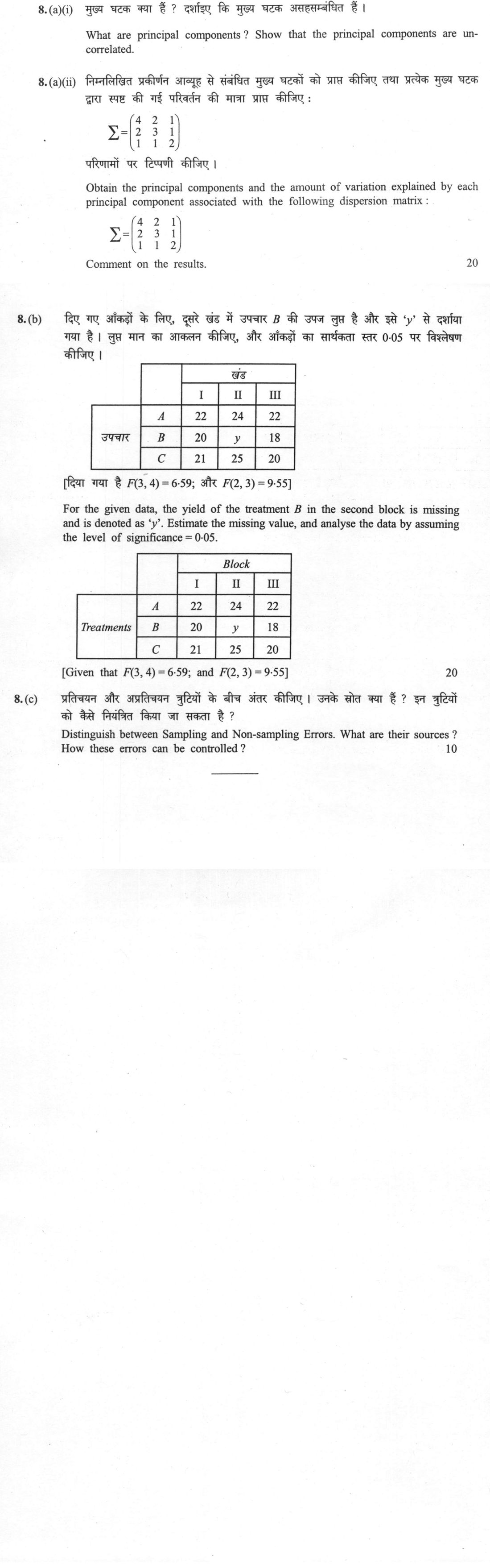
Obtain the principal components and the amount of variation explained by each principal component associated with the following dispersion matrix : Σ = 4 & 2 & 1 2 & 3 & 1 1 & 1 & 2 Comment on the results. 10 marks
For the given data, the yield of the treatment B in the second block is missing and is denoted as 'y'. Estimate the missing value, and analyse the data by assuming the level of significance = 0·05. [Given that F(3, 4) = 6·59; and F(2, 3) = 9·55] 20 marks
Distinguish between Sampling and Non-sampling Errors. What are their sources ? How these errors can be controlled ? 10 marks
हिंदी में प्रश्न पढ़ें
मुख्य घटक क्या हैं ? दर्शाइए कि मुख्य घटक असहसंबंधित हैं। (10 अंक)
निम्नलिखित प्रकीर्णन आव्यूह से संबंधित मुख्य घटकों को प्राप्त कीजिए तथा प्रत्येक मुख्य घटक द्वारा स्पष्ट की गई परिवर्तन की मात्रा प्राप्त कीजिए : Σ = 4 & 2 & 1 2 & 3 & 1 1 & 1 & 2 परिणामों पर टिप्पणी कीजिए। (10 अंक)
दिए गए आंकड़ों के लिए, दूसरे खंड में उपचार B की उपज लुप्त है और इसे 'y' से दर्शाया गया है। लुप्त मान का आकलन कीजिए, और आंकड़ों का सार्थकता स्तर 0·05 पर विश्लेषण कीजिए। [दिया गया है F(3, 4) = 6·59; और F(2, 3) = 9·55] (20 अंक)
प्रतिचयन और अप्रतिचयन त्रुटियों के बीच अंतर कीजिए। उनके स्रोत क्या हैं ? इन त्रुटियों को कैसे नियंत्रित किया जा सकता है ? (10 अंक)
The figure this question refers to, in words
The question paper is a scan and the diagram did not survive as text. This is the figure as read from the original page — every component, value and label — so the question can be worked from the text below.
(a) A 3x3 matrix labeled Sigma (dispersion matrix) with the following values: Row 1: 4, 2, 1 Row 2: 2, 3, 1 Row 3: 1, 1, 2
(b) Table with header 'Block' spanning three columns labeled I, II, III. The rows are labeled by 'Treatments' on the left. The data is as follows: Row A: 22, 24, 22 Row B: 20, y, 18 Row C: 21, 25, 20 Below the table, the text reads: [Given that F(3, 4) = 6.59; and F(2, 3) = 9.55]
What "Solve" is asking you to do
Choose the method, then carry it through to a final answer. Identifying what kind of problem this is and why that method applies is the first thing marked; a correct figure arrived at invisibly earns almost nothing.
Structure that answers it
Given data and what is required → method chosen, with the reason it applies → set-up (equation, circuit, free body, trial balance) → working, step by step → answer with units and any condition of validity
Where marks are lost
Doing the middle steps mentally and writing only the result. In mathematics papers, a further loss comes from giving a decimal where the exact value in surds or fractions was wanted, or from skipping the justification a part explicitly asks for.
How this answer will be evaluated
Approach
Framework: UPSC Statistics Paper 1. (a(i)) define: precise definition > the distinguishing feature > one example | (a(ii)) calculate: given > formula > substitution > result with units > interpretation | (b) calculate: given > formula > substitution > result with units > interpretation | (c) compare: paired headings or table > key differences > significance > conclusion Full marks: Rigorous derivation in (a), precise ANOVA in (b), clear distinction in (c).
Key points expected
- Define PC as linear combinations of variables
- State objective: maximize variance
- Show Cov(PC_i, PC_j) = 0 for i ≠ j
- Use eigenvalue properties of dispersion matrix
- Find eigenvalues of the 3x3 matrix
- Find corresponding eigenvectors
- Calculate proportion of variance for each PC
- Comment on the results (e.g., cumulative variance)
Evaluation rubric
Each sub-part is marked on its own, against the marks and word limit printed on the paper.
- (a(i)) Definition of principal components and proof of their uncorrelated nature.
define— precise definition → the distinguishing feature → one example
Must cover
- Define PC as linear combinations of variables
- State objective: maximize variance
- Show Cov(PC_i, PC_j) = 0 for i ≠ j
- Use eigenvalue properties of dispersion matrix
Loses marks
- Defining PC without variance maximization
- Failing to show covariance is zero
Earns more
- Mention orthogonality of eigenvectors
- Reference to spectral decomposition
Extra mark
- Geometric interpretation of rotation
- (a(ii)) Compute principal components and variance explained for the given matrix.
calculate— given → formula → substitution → result with units → interpretation
Must cover
- Find eigenvalues of the 3x3 matrix
- Find corresponding eigenvectors
- Calculate proportion of variance for each PC
- Comment on the results (e.g., cumulative variance)
Loses marks
- Arithmetic errors in eigenvalues
- Missing the 'comment' section
Earns more
- Correct characteristic equation setup
- Normalized eigenvectors
Extra mark
- Scree plot description
- (b) Estimate missing value 'y' and perform ANOVA for the data. 20 marks
calculate— given → formula → substitution → result with units → interpretation
Must cover
- Use formula to estimate missing value y
- Construct ANOVA table (Treatments, Blocks, Error)
- Calculate F-statistic for treatments and blocks
- Compare F-calculated with F-table (0.05 level)
Loses marks
- Using wrong formula for missing value
- Incorrect degrees of freedom in ANOVA
Earns more
- Correct degrees of freedom adjustment for missing value
- Clear hypothesis statement
Extra mark
- Mentioning loss of 1 degree of freedom
- (c) Distinguish between sampling and non-sampling errors with sources and control. 10 marks
compare— paired headings or table → key differences → significance → conclusion
Must cover
- Define Sampling Error
- Define Non-sampling Error
- List sources for both types
- Explain control measures for both
Loses marks
- Confusing the two types
- Failing to mention control measures
Earns more
- Table format for distinction
- Specific examples of non-sampling errors (e.g., non-response)
Extra mark
- Mentioning that sampling error can be quantified
Model answer coming soon
Every evaluation on this site is marked against a verified model answer. This question's answer is still being written; evaluation opens the moment it lands.
More from Statistics 2025 Paper I
- Q5 (a) For a two variable linear regression model Yᵢ = a + bXᵢ + eᵢ, where E(eᵢ) = 0, Var(eᵢ…
- Q6 (a)(i) If (X, Y) follows bivariate normal BN(μ₁, μ₂, σ₁², σ₂², ρ), then obtain (A) E(e^X)…
- Q7 (a) Analyse and interpret the following data concerning output of wheat per field obtaine…
- Q8 (a)(i) What are principal components ? Show that the principal components are uncorrelate…