Paper I — Q4
(a) Let X₁, X₂, ... be a sequence of random variables from Bernoulli distribution with mean θ, 0<θ<1. Derive SPRT for testing H₀…
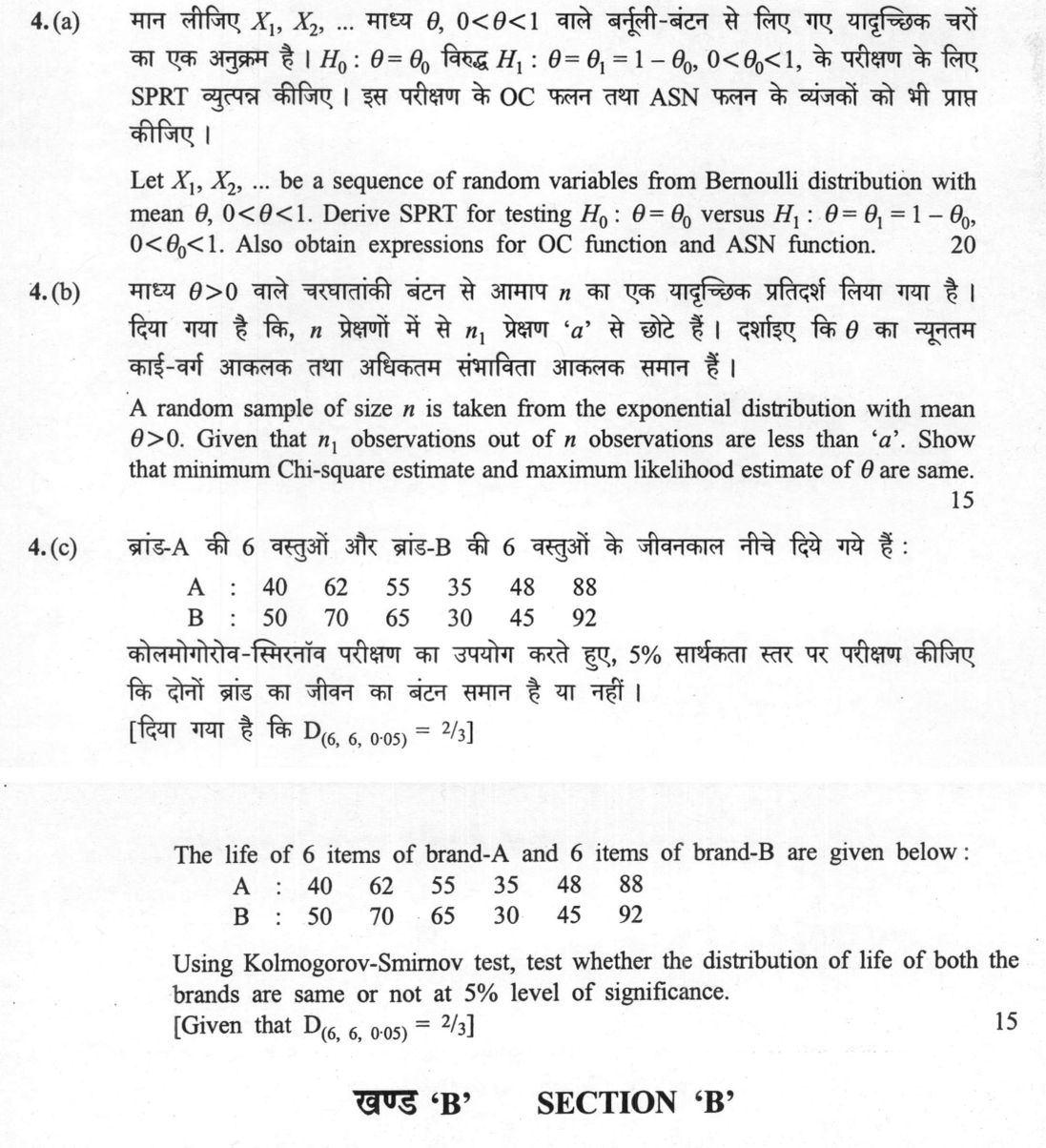
Let X₁, X₂, ... be a sequence of random variables from Bernoulli distribution with mean θ, 0<θ<1. Derive SPRT for testing H₀ : θ = θ₀ versus H₁ : θ = θ₁ = 1 – θ₀, 0<θ₀<1. Also obtain expressions for OC function and ASN function. 20 marks
A random sample of size n is taken from the exponential distribution with mean θ>0. Given that n₁ observations out of n observations are less than 'a'. Show that minimum Chi-square estimate and maximum likelihood estimate of θ are same. 15 marks
The life of 6 items of brand-A and 6 items of brand-B are given below: A : 40 62 55 35 48 88 B : 50 70 65 30 45 92
Using Kolmogorov-Smirnov test, test whether the distribution of life of both the brands are same or not at 5% level of significance. [Given that D₍₆, ₆, ₀.₀₅₎ = 2/3] 15 marks
हिंदी में प्रश्न पढ़ें
मान लीजिए X₁, X₂, ... माध्य θ, 0<θ<1 वाले बर्नौली-बंटन से लिए गए यादृच्छिक चरों का एक अनुक्रम है । H₀ : θ = θ₀ विरुद्ध H₁ : θ = θ₁ = 1 – θ₀, 0<θ₀<1, के परीक्षण के लिए SPRT व्युत्पन्न कीजिए । इस परीक्षण के OC फलन तथा ASN फलन के व्यंजकों को भी प्राप्त कीजिए । (20 अंक)
माध्य θ>0 वाले चरघातांकी बंटन से आमाप n का एक यादृच्छिक प्रतिदर्श लिया गया है । दिया गया है कि, n प्रेक्षणों में से n₁ प्रेक्षण 'a' से छोटे हैं । दर्शाइए कि θ का न्यूनतम काई-वर्ग आकलक तथा अधिकतम संभाविता आकलक समान है । (15 अंक)
ब्रांड-A की 6 वस्तुओं और ब्रांड-B की 6 वस्तुओं के जीवनकाल नीचे दिये गये हैं : A : 40 62 55 35 48 88 B : 50 70 65 30 45 92
कोलमोगोरोव-स्मिरनोव परीक्षण का उपयोग करते हुए, 5% सार्थकता स्तर पर परीक्षण कीजिए कि दोनों ब्रांड का जीवन का बंटन समान है या नहीं । [दिया गया है कि D₍₆, ₆, ₀.₀₅₎ = ²/₃] (15 अंक)
Model answer
Written by UPSC Answer Check against this question's marking rubric, to the expected length. UPSC does not publish answers for Mains — this is one way to score well, not an official key.
(a) Let Xᵢ ∈ {0,1}, Sₙ = Σᵢ₌₁ⁿ Xᵢ. Under H₀: θ = θ₀ and H₁: θ = θ₁ = 1 − θ₀.
L₀ = θ₀^(Sₙ)(1 − θ₀)^(n − Sₙ), L₁ = (1 − θ₀)^(Sₙ) θ₀^(n − Sₙ).
The likelihood ratio is Λₙ = L₁/L₀ = ((1 − θ₀)/θ₀)^(2Sₙ − n).
Let c = ln((1 − θ₀)/θ₀). If θ₀ = 1/2, then θ₁ = θ₀, so H₀ and H₁ coincide; there is no nontrivial SPRT. Assume θ₀ ≠ 1/2.
Choose boundaries A > 1, B < 1; for example A = (1 − β)/α, B = β/(1 − α), with α + β < 1. Wald’s SPRT is:
- accept H₁ if Λₙ ≥ A,
- accept H₀ if Λₙ ≤ B,
- continue sampling if B < Λₙ < A.
Equivalently, if c > 0, accept H₁ when 2Sₙ − n ≥ ln A/c and accept H₀ when 2Sₙ − n ≤ ln B/c; if c < 0 the inequalities reverse.
For the OC function, define h(θ) = ln((1 − θ)/θ) / ln((1 − θ₀)/θ₀), θ ≠ 1/2.
By Wald’s OC identity, L(θ) = Pθ(accept H₀) = (A^(h(θ)) − 1)/(A^(h(θ)) − B^(h(θ))).
At θ = 1/2, h = 0, so by limit L(1/2) = ln A/(ln A − ln B).
For ASN, let z = ln[f(x;θ₁)/f(x;θ₀)]. Then z = c if X = 1 and z = −c if X = 0, so Eθ(z) = (2θ − 1)c.
By Wald’s ASN identity, Eθ(N) = [L(θ) ln B + (1 − L(θ)) ln A]/[(2θ − 1)c], θ ≠ 1/2.
At θ = 1/2, E(N) = −(ln A)(ln B)/c².
These are Wald approximations, exact up to overshoot error.
(b) Let the exponential density be f(x;θ) = (1/θ)exp(−x/θ), x > 0. Only the two grouped frequencies are used: n₁ below a and n − n₁ at least a. Assume 0 < n₁ < n.
Let p(θ) = P(X < a) = 1 − exp(−a/θ), q(θ) = P(X ≥ a) = exp(−a/θ).
The grouped likelihood is L(θ) = p^(n₁) q^(n − n₁).
So ℓ(θ) = n₁ ln p + (n − n₁) ln q.
Since dp/dθ = −(a/θ²)exp(−a/θ) and dq/dθ = (a/θ²)exp(−a/θ), dℓ/dθ = (a/θ²)[(n − n₁) − n₁ q/p].
Set dℓ/dθ = 0: (n − n₁) = n₁ q/p ⇒ n₁ q = (n − n₁)(1 − q) ⇒ n q = n − n₁ ⇒ q = (n − n₁)/n.
Hence θ̂_MLE = −a/ln((n − n₁)/n) = a/ln(n/(n − n₁)).
Now use minimum Chi-square. Let y = n₁/n and p = P(X < a). The Pearson statistic for two classes is χ² = (n₁ − np)²/(np) + ((n − n₁) − n(1 − p))²/[n(1 − p)] = n(y − p)²/[p(1 − p)].
Differentiating with respect to p: dχ²/dp = −n(y − p)[y + p(1 − 2y)]/[p²(1 − p)²].
For 0 < y < 1, the only stationary point in (0,1) is p = y = n₁/n. Thus p̂ = n₁/n, so q̂ = (n − n₁)/n.
Therefore θ̂_Chi = −a/ln((n − n₁)/n) = a/ln(n/(n − n₁)), which is the same as θ̂_MLE. This holds for 0 < n₁ < n.
(c) Let the null hypothesis be H₀: the life distributions of brands A and B are the same. The two-sample Kolmogorov–Smirnov statistic is D = max|F_A(x) − F_B(x)|.
Sorted samples: A: 35, 40, 48, 55, 62, 88 B: 30, 45, 50, 65, 70, 92.
At the combined ordered points, the absolute differences are: 30: 1/6, 35: 0, 40: 1/6, 45: 0, 48: 1/6, 50: 0, 55: 1/6, 62: 1/3, 65: 1/6, 70: 0, 88: 1/6, 92: 0.
Thus D = 1/3.
Given D₍₆,₆,₀.₀₅₎ = 2/3, and since 1/3 < 2/3, we do not reject H₀ at the 5% level of significance. Hence there is no significant evidence that the life distributions of brand-A and brand-B differ.
What "Derive" is asking you to do
Reach the stated expression from a starting relation, justifying every step. The destination is printed in the question, so only the route earns marks, and the assumptions you work under are part of that route.
Structure that answers it
Assumptions and notation defined → starting relation or governing equation → each step with its justification → the required expression → limiting case or boundary check
Where marks are lost
Writing the standard result first and fitting three lines to it, which an examiner reads at a glance. Marks also go on assumptions left unstated — lossless medium, small amplitude, errors independent with zero mean — and on symbols used before they are defined, even when the question says usual notations.
How this answer will be evaluated
Approach
Framework: UPSC Statistics Paper 1. (a) derive: given > assumptions > stepwise derivation > result > check | (b) justify: claim > 3-4 reasons > evidence > conclusion | (c) calculate: given > formula > substitution > result with units > interpretation Full marks: Rigorous derivations with correct notation and clear interpretation of all results.
Key points expected
- State likelihood ratio for Bernoulli distribution
- Derive stopping boundaries A and B
- Derive OC function expression
- Derive ASN function expression
- State likelihood function for exponential distribution
- Derive MLE of θ
- Formulate Chi-square statistic using n₁
- Show both estimates yield same value
Evaluation rubric
Each sub-part is marked on its own, against the marks and word limit printed on the paper.
- (a) Derive SPRT for Bernoulli mean and obtain OC and ASN functions. 20 marks
derive— given → assumptions → stepwise derivation → result → check
Must cover
- State likelihood ratio for Bernoulli distribution
- Derive stopping boundaries A and B
- Derive OC function expression
- Derive ASN function expression
Loses marks
- Missing derivation of stopping boundaries
- Confusing OC and ASN function definitions
Earns more
- Correct substitution of θ₁ = 1 - θ₀
- Clear step-by-step algebraic derivation
Extra mark
- Mention of Wald's approximation for OC/ASN
- (b) Show MLE and minimum Chi-square estimate of θ are identical. 15 marks
justify— claim → 3-4 reasons → evidence → conclusion
Must cover
- State likelihood function for exponential distribution
- Derive MLE of θ
- Formulate Chi-square statistic using n₁
- Show both estimates yield same value
Loses marks
- Incorrect likelihood function for exponential
- Failing to link n₁ to the probability P(X<a)
Earns more
- Explicit use of n₁/n as estimator for P(X<a)
Extra mark
- Comparison of asymptotic properties
- (c) Perform two-sample Kolmogorov-Smirnov test at 5% significance. 15 marks
calculate— given → formula → substitution → result with units → interpretation
Must cover
- Calculate empirical CDFs for both brands
- Compute maximum difference D statistic
- Compare D with critical value 2/3
- State conclusion regarding distribution equality
Loses marks
- Incorrect calculation of D statistic
- Failing to state the final hypothesis decision
Earns more
- Clean table of CDF values
- Correct interpretation of p-value context
Extra mark
- Graphical representation of CDFs
Practice this exact question
Write your answer and it is marked point by point against the model answer above — what you covered, what you missed, what you got wrong.
Evaluate my answer →More from Statistics 2025 Paper I
- Q1 (a) Let E, F and G be three pairwise independent events such that P(E∩F) = 0·1 and P(F∩G)…
- Q2 (a) Let X be a continuous random variable having probability density function f(x) = (2/2…
- Q3 (a) Let probability of obtaining Head on a biased coin be 4/5 and X be the number of head…
- Q4 (a) Let X₁, X₂, ... be a sequence of random variables from Bernoulli distribution with me…
- Q5 (a) For a two variable linear regression model Yᵢ = a + bXᵢ + eᵢ, where E(eᵢ) = 0, Var(eᵢ…
- Q6 (a)(i) If (X, Y) follows bivariate normal BN(μ₁, μ₂, σ₁², σ₂², ρ), then obtain (A) E(e^X)…
- Q7 (a) Analyse and interpret the following data concerning output of wheat per field obtaine…