Paper I — Q2
(a) Let X be a continuous random variable having probability density function f(x) = (2/25)(x+2), -2 ≤ x ≤ 3; 0, otherwise. Find…
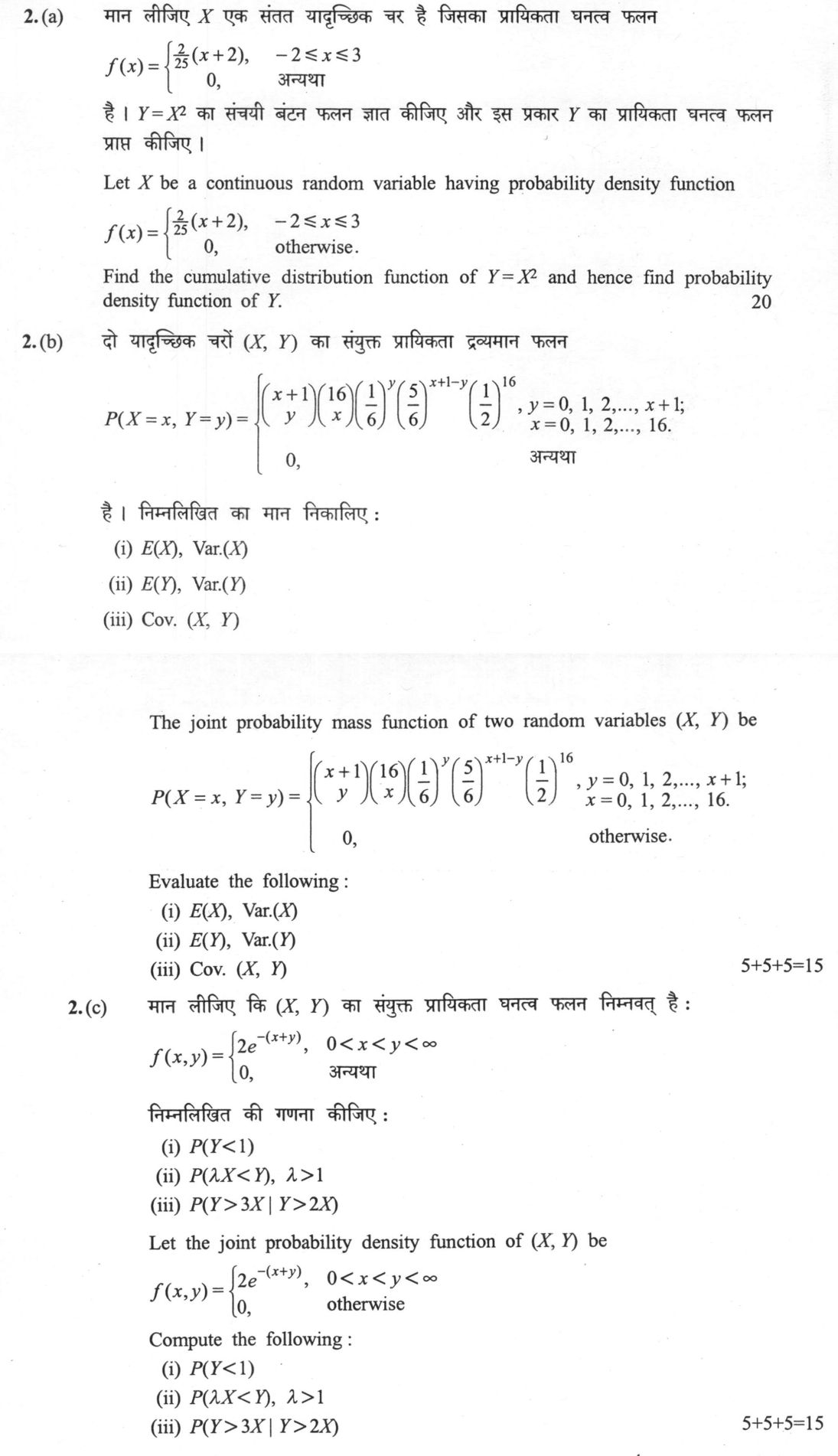
Let X be a continuous random variable having probability density function f(x) = (2/25)(x+2), -2 ≤ x ≤ 3; 0, otherwise. Find the cumulative distribution function of Y = X² and hence find probability density function of Y. 20 marks
The joint probability mass function of two random variables (X, Y) be P(X = x, Y = y) = (x+1)Cᵧ · ¹⁶Cₓ · (1/6)ʸ · (5/6)ˣ⁺¹⁻ʸ · (1/2)¹⁶, y = 0, 1, 2,..., x+1; x = 0, 1, 2,..., 16; 0, otherwise. Evaluate the following: (i) E(X), Var.(X); (ii) E(Y), Var.(Y); (iii) Cov. (X, Y). 5+5+5=15 marks
Let the joint probability density function of (X, Y) be f(x,y) = 2e⁻(x+y), 0 < x < y < ∞; 0, otherwise. Compute the following: (i) P(Y<1); (ii) P(λX<Y), λ>1; (iii) P(Y>3X | Y>2X). 5+5+5=15 marks
हिंदी में प्रश्न पढ़ें
मान लीजिए X एक संतत यादृच्छिक चर है जिसका प्रायिकता घनत्व फलन f(x) = (2/25)(x+2), -2 ≤ x ≤ 3; 0, अन्यथा है। Y = X² का संचयी बंटन फलन ज्ञात कीजिए और इस प्रकार Y का प्रायिकता घनत्व फलन प्राप्त कीजिए। 20
दो यादृच्छिक चरों (X, Y) का संयुक्त प्रायिकता द्रव्यमान फलन P(X = x, Y = y) = (x+1)Cᵧ · ¹⁶Cₓ · (1/6)ʸ · (5/6)ˣ⁺¹⁻ʸ · (1/2)¹⁶, y = 0, 1, 2,..., x+1; x = 0, 1, 2,..., 16; 0, अन्यथा है। निम्नलिखित का मान निकालिए : (i) E(X), Var.(X); (ii) E(Y), Var.(Y); (iii) Cov. (X, Y). 5+5+5=15
मान लीजिए कि (X, Y) का संयुक्त प्रायिकता घनत्व फलन निम्नवत है : f(x,y) = 2e⁻(x+y), 0 < x < y < ∞; 0, अन्यथा. निम्नलिखित की गणना कीजिए : (i) P(Y<1); (ii) P(λX<Y), λ>1; (iii) P(Y>3X | Y>2X). 5+5+5=15
Model answer
Written by UPSC Answer Check against this question's marking rubric, to the expected length. UPSC does not publish answers for Mains — this is one way to score well, not an official key.
(a) For −2 ≤ x ≤ 3, the CDF of X is obtained by integrating the given density. Using the method of distribution functions: F_X(x) = ∫ from −2 to x of (2/25)(t+2) dt = ((x+2)²)/25.
Now Y = X². Since X lies in [−2, 3], Y lies in [0, 9]. For 0 ≤ y ≤ 4, the event X² ≤ y means −√y ≤ X ≤ √y. Hence F_Y(y) = P(−√y ≤ X ≤ √y) = F_X(√y) − F_X(−√y) = ((√y+2)² − (−√y+2)²)/25 = 8√y/25.
For 4 < y ≤ 9, the lower limit is −2, so F_Y(y) = P(−2 ≤ X ≤ √y) = F_X(√y) − F_X(−2) = ((√y+2)²)/25 = (y + 4√y + 4)/25.
Thus F_Y(y) = 0 for y < 0; 8√y/25 for 0 ≤ y ≤ 4; (y + 4√y + 4)/25 for 4 < y ≤ 9; and 1 for y > 9.
Differentiating piecewise gives the pdf of Y: f_Y(y) = 4/(25√y) for 0 < y < 4; f_Y(y) = (1 + 2/√y)/25 = (√y + 2)/(25√y) for 4 < y < 9; f_Y(y) = 0 otherwise. At y = 0 the density is unbounded but integrable; y = 4 and y = 9 carry no probability mass.
(b) First sum the joint pmf over y for fixed x. Since Σ from y=0 to x+1 of (x+1)C_y (1/6)^y (5/6)^(x+1−y) = 1, we get P(X = x) = 16C_x (1/2)^16, x = 0, 1, ..., 16. Thus X ~ Binomial(16, 1/2).
Also, conditional on X = x, Y | X = x ~ Binomial(x+1, 1/6).
(i) For X ~ Binomial(16, 1/2): E(X) = np = 16 × 1/2 = 8. Var(X) = np(1−p) = 16 × 1/2 × 1/2 = 4.
(ii) Using the law of total expectation: E(Y) = E[E(Y|X)] = E[(X+1)/6] = (8+1)/6 = 3/2.
Using the law of total variance: Var(Y) = E[Var(Y|X)] + Var[E(Y|X)]. Now Var(Y|X) = (X+1)(1/6)(5/6) = 5(X+1)/36 and E(Y|X) = (X+1)/6. Therefore E[Var(Y|X)] = 5(8+1)/36 = 45/36 = 5/4, Var[E(Y|X)] = Var[(X+1)/6] = Var(X)/36 = 4/36 = 1/9. Hence Var(Y) = 5/4 + 1/9 = 45/36 + 4/36 = 49/36.
(iii) Using the conditional covariance method, Cov(X, Y) = Cov(X, E[Y|X]) = Cov(X, (X+1)/6) = (1/6)Var(X) = 4/6 = 2/3.
(c) The joint density is f(x,y) = 2e^(−x−y) on 0 < x < y < ∞.
(i) P(Y < 1) = ∫ from 0 to 1 ∫ from 0 to y of 2e^(−x−y) dx dy. Inner integral: ∫ from 0 to y of 2e^(−x−y) dx = 2e^(−y)(1 − e^(−y)). Thus P(Y < 1) = 2∫ from 0 to 1 e^(−y)(1 − e^(−y)) dy = 2(1 − e^(−1)) − (1 − e^(−2)) = 1 − 2e^(−1) + e^(−2) = (1 − e^(−1))².
(ii) For λ > 1, since y > λx implies y > x, the region is 0 < x < ∞, λx < y < ∞. P(λX < Y) = ∫ from 0 to ∞ ∫ from λx to ∞ of 2e^(−x−y) dy dx. Inner integral: ∫ from λx to ∞ of 2e^(−x−y) dy = 2e^(−x)e^(−λx) = 2e^(−(λ+1)x). Therefore P(λX < Y) = ∫ from 0 to ∞ 2e^(−(λ+1)x) dx = 2/(λ+1).
(iii) Since {Y > 3X} is contained in {Y > 2X}, P(Y > 3X | Y > 2X) = P(Y > 3X)/P(Y > 2X). Using the result of (ii): P(Y > 3X) = 2/(3+1) = 1/2, P(Y > 2X) = 2/(2+1) = 2/3. Hence P(Y > 3X | Y > 2X) = (1/2)/(2/3) = 3/4.
What "Solve" is asking you to do
Choose the method, then carry it through to a final answer. Identifying what kind of problem this is and why that method applies is the first thing marked; a correct figure arrived at invisibly earns almost nothing.
Structure that answers it
Given data and what is required → method chosen, with the reason it applies → set-up (equation, circuit, free body, trial balance) → working, step by step → answer with units and any condition of validity
Where marks are lost
Doing the middle steps mentally and writing only the result. In mathematics papers, a further loss comes from giving a decimal where the exact value in surds or fractions was wanted, or from skipping the justification a part explicitly asks for.
How this answer will be evaluated
Approach
(a) derive: given > assumptions > stepwise derivation > result > check | (b(i)) calculate: given > formula > substitution > result with units > interpretation | (b(ii)) calculate: given > formula > substitution > result with units > interpretation | (b(iii)) calculate: given > formula > substitution > result with units > interpretation | (c(i)) calculate: given > formula > substitution > result with units > interpretation | (c(ii)) calculate: given > formula > substitution > result with units > interpretation | (c(iii)) calculate: given > formula > substitution > result with units > interpretation Full marks: All parts with complete derivations, correct calculations, and clear interpretation
Key points expected
- Define Y = X² and identify range of Y
- Split integration at x=0 for CDF
- Differentiate CDF to find PDF of Y
- Verify PDF integrates to 1
- Derive marginal PMF of X
- Calculate E(X) using marginal
- Calculate E(X²) for variance
- Compute Var(X) = E(X²) - [E(X)]²
Evaluation rubric
Each sub-part is marked on its own, against the marks and word limit printed on the paper.
- (a) CDF and PDF of Y = X² from the given PDF of X. 20 marks
derive— given → assumptions → stepwise derivation → result → check
Must cover
- Define Y = X² and identify range of Y
- Split integration at x=0 for CDF
- Differentiate CDF to find PDF of Y
- Verify PDF integrates to 1
Loses marks
- Ignoring negative x values in transformation
- Incorrect differentiation of CDF
Earns more
- Correct handling of negative x range
- Clear step-by-step integration
Extra mark
- Graphical representation of transformation
- (b(i)) E(X) and Var(X) from the joint PMF. 5 marks
calculate— given → formula → substitution → result with units → interpretation
Must cover
- Derive marginal PMF of X
- Calculate E(X) using marginal
- Calculate E(X²) for variance
- Compute Var(X) = E(X²) - [E(X)]²
Loses marks
- Using joint PMF directly for E(X)
- Arithmetic errors in summation
Earns more
- Correct summation limits for X
Extra mark
- Verification of marginal PMF sums to 1
- (b(ii)) E(Y) and Var(Y) from the joint PMF. 5 marks
calculate— given → formula → substitution → result with units → interpretation
Must cover
- Derive marginal PMF of Y
- Calculate E(Y) using marginal
- Calculate E(Y²) for variance
- Compute Var(Y) = E(Y²) - [E(Y)]²
Loses marks
- Using joint PMF directly for E(Y)
- Incorrect variance formula
Earns more
- Correct summation limits for Y
Extra mark
- Verification of marginal PMF sums to 1
- (b(iii)) Cov(X, Y) using the joint PMF. 5 marks
calculate— given → formula → substitution → result with units → interpretation
Must cover
- Calculate E(XY) from joint PMF
- Use Cov(X,Y) = E(XY) - E(X)E(Y)
- Substitute previously found E(X), E(Y)
Loses marks
- Forgetting to subtract E(X)E(Y)
- Incorrect double summation limits
Earns more
- Correct double summation for E(XY)
Extra mark
- Interpretation of covariance sign
- (c(i)) P(Y < 1) from the joint PDF. 5 marks
calculate— given → formula → substitution → result with units → interpretation
Must cover
- Set up double integral with correct limits
- Integrate over 0 < x < y < 1
- Evaluate inner integral first
- Compute final probability value
Loses marks
- Incorrect integration limits
- Order of integration error
Earns more
- Correct region identification
Extra mark
- Sketch of integration region
- (c(ii)) P(λX < Y) for λ > 1. 5 marks
calculate— given → formula → substitution → result with units → interpretation
Must cover
- Set up integral with region λx < y
- Integrate over 0 < x < ∞, λx < y < ∞
- Evaluate exponential integrals
- Express result in terms of λ
Loses marks
- Incorrect region for λx < y
- Integration error with exponential
Earns more
- Correct handling of λ parameter
Extra mark
- Limiting behavior as λ → 1
- (c(iii)) Conditional probability P(Y > 3X | Y > 2X). 5 marks
calculate— given → formula → substitution → result with units → interpretation
Must cover
- Calculate P(Y > 3X) as numerator
- Calculate P(Y > 2X) as denominator
- Apply conditional probability formula
- Simplify the ratio
Loses marks
- Confusing conditional probability formula
- Incorrect region for Y > 2X
Earns more
- Correct region identification for both
Extra mark
- Geometric interpretation of regions
Practice this exact question
Write your answer and it is marked point by point against the model answer above — what you covered, what you missed, what you got wrong.
Evaluate my answer →More from Statistics 2025 Paper I
- Q1 (a) Let E, F and G be three pairwise independent events such that P(E∩F) = 0·1 and P(F∩G)…
- Q2 (a) Let X be a continuous random variable having probability density function f(x) = (2/2…
- Q3 (a) Let probability of obtaining Head on a biased coin be 4/5 and X be the number of head…
- Q4 (a) Let X₁, X₂, ... be a sequence of random variables from Bernoulli distribution with me…
- Q5 (a) For a two variable linear regression model Yᵢ = a + bXᵢ + eᵢ, where E(eᵢ) = 0, Var(eᵢ…