Paper I — Q3
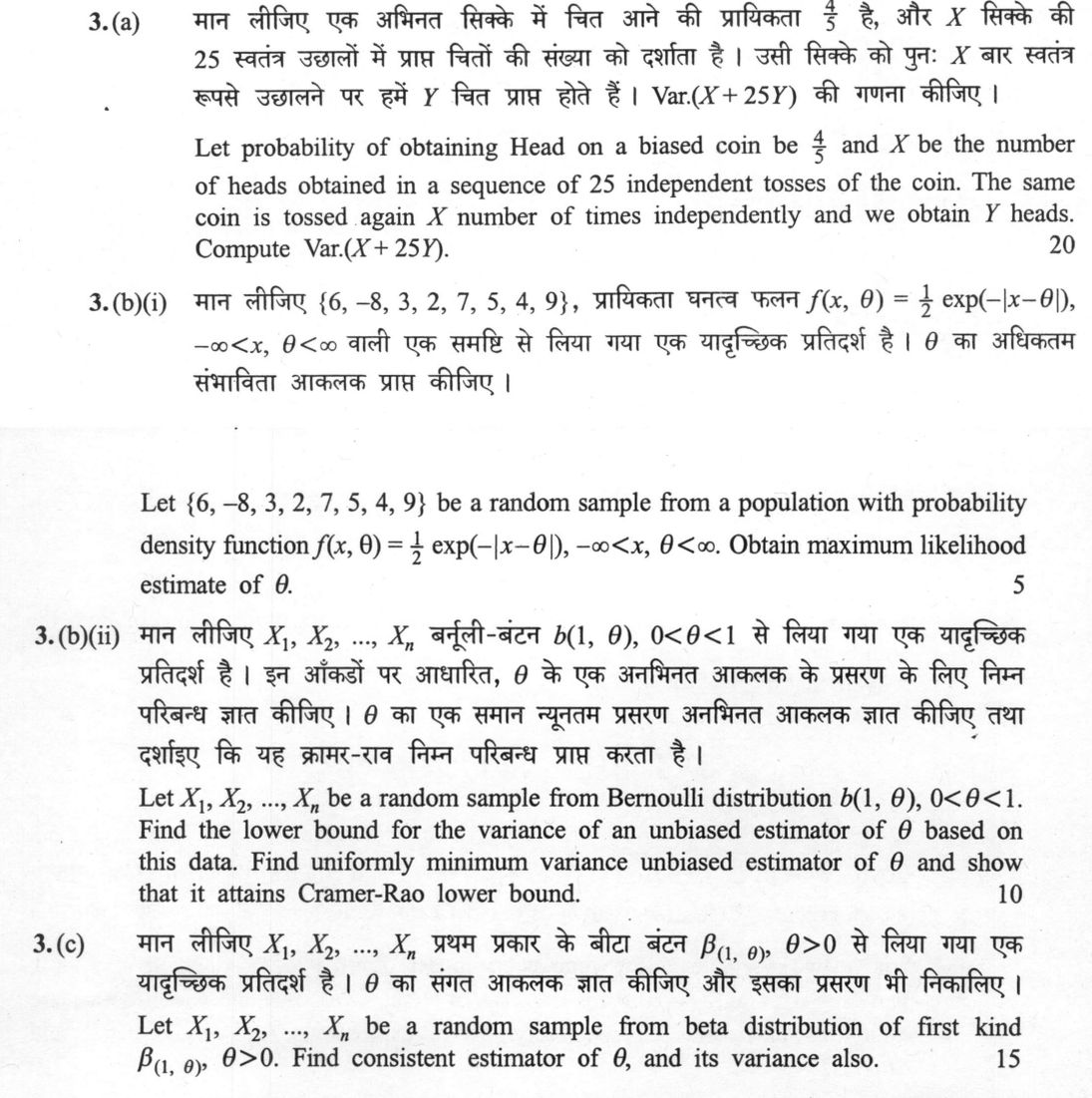
(a) Let probability of obtaining Head on a biased coin be 4/5 and X be the number of heads obtained in a sequence of 25…
Let probability of obtaining Head on a biased coin be 4/5 and X be the number of heads obtained in a sequence of 25 independent tosses of the coin. The same coin is tossed again X number of times independently and we obtain Y heads. Compute Var.(X+25Y). 20 marks
Let {6, –8, 3, 2, 7, 5, 4, 9} be a random sample from a population with probability density function f(x, θ) = ½ exp(–|x–θ|), –∞<x, θ<∞. Obtain maximum likelihood estimate of θ. 5 marks
Let X₁, X₂, ..., Xₙ be a random sample from Bernoulli distribution b(1, θ), 0<θ<1. Find the lower bound for the variance of an unbiased estimator of θ based on this data. Find uniformly minimum variance unbiased estimator of θ and show that it attains Cramer-Rao lower bound. 10 marks
Let X₁, X₂, ..., Xₙ be a random sample from beta distribution of first kind β₍₁, θ₎, θ>0. Find consistent estimator of θ, and its variance also. 15 marks
हिंदी में प्रश्न पढ़ें
मान लीजिए एक अभिनत सिक्के में चित आने की प्रायिकता 4/5 है, और X सिक्के की 25 स्वतंत्र उछालों में प्राप्त चितों की संख्या को दर्शाता है। उसी सिक्के को पुनः X बार स्वतंत्र रूप से उछालने पर हमें Y चित प्राप्त होते हैं। Var.(X+25Y) की गणना कीजिए। (20 अंक)
मान लीजिए {6, −8, 3, 2, 7, 5, 4, 9}, प्रायिकता घनत्व फलन f(x, θ) = 1/2 exp(-|x-θ|), -∞ < x, θ < ∞ वाली एक समष्टि से लिया गया एक यादृच्छिक प्रतिदर्श है। θ का अधिकतम संभाविता आकलक प्राप्त कीजिए। (5 अंक)
मान लीजिए X₁, X₂, ..., Xₙ बर्नौली-बंटन b(1, θ), 0<θ<1 से लिया गया एक यादृच्छिक प्रतिदर्श है । इन आँकड़ों पर आधारित, θ के एक अनभिनत आकलक के प्रसरण के लिए निम्न परिबंध ज्ञात कीजिए । θ का एक समान न्यूनतम प्रसरण अनभिनत आकलक ज्ञात कीजिए तथा दर्शाइए कि यह क्रामर-राव निम्न परिबंध प्राप्त करता है । (10 अंक)
मान लीजिए X₁, X₂, ..., Xₙ प्रथम प्रकार के बीटा बंटन β₍₁, θ₎, θ>0 से लिया गया एक यादृच्छिक प्रतिदर्श है । θ का संगत आकलक ज्ञात कीजिए और इसका प्रसरण भी निकालिए । (15 अंक)
Model answer
Written by UPSC Answer Check against this question's marking rubric, to the expected length. UPSC does not publish answers for Mains — this is one way to score well, not an official key.
(a) Let p = P(Head) = 4/5, q = 1/5. Then X ~ Bin(25, p), so E[X] = 25p = 20, Var(X) = 25pq = 25(4/5)(1/5) = 4.
Given X, Y | X ~ Bin(X, p). Hence E[Y | X] = pX, Var(Y | X) = Xpq.
By the law of total variance, Var(Y) = E[Var(Y | X)] + Var(E[Y | X]) = E[Xpq] + Var(pX) = pqE[X] + p²Var(X) = (4/25)(20) + (16/25)(4) = 16/5 + 64/25 = 144/25.
Also, Cov(X, Y) = E[XY] – E[X]E[Y] = E[X E(Y | X)] – E[X]·pE[X] = pE[X²] – p(E[X])² = p Var(X) = (4/5)(4) = 16/5.
Therefore, Var(X + 25Y) = Var(X) + 25²Var(Y) + 2·25·Cov(X, Y) = 4 + 625(144/25) + 50(16/5) = 4 + 3600 + 160 = 3764.
(b)(i) The likelihood is L(θ) = (1/2)ⁿ exp(–Σ |xᵢ – θ|).
Maximizing L is equivalent to minimizing S(θ) = Σ |xᵢ – θ|.
It is a standard result that S(θ) is minimized at a sample median. The ordered sample is –8, 2, 3, 4, 5, 6, 7, 9.
Since n = 8 is even, any value between the 4th and 5th order statistics minimizes S(θ). Thus the complete set of maximum likelihood estimates is θhat ∈ [4, 5].
If a single value is conventionally reported, take the sample median θhat = (4 + 5)/2 = 4.5.
(b)(ii) Let X₁, X₂, ..., Xₙ be iid Bernoulli(θ). The log-likelihood is log L = Σ [xᵢ log θ + (1 – xᵢ) log(1 – θ)].
The score function is ∂ log L/∂θ = Σ (xᵢ – θ)/[θ(1 – θ)].
For one observation, I(θ) = E[(X – θ)²]/[θ²(1 – θ)²] = θ(1 – θ)/[θ²(1 – θ)²] = 1/[θ(1 – θ)].
For n independent observations, Iₙ(θ) = n/[θ(1 – θ)].
Hence the Cramér-Rao lower bound for any unbiased estimator of θ is 1/Iₙ(θ) = θ(1 – θ)/n.
Let T = Σ Xᵢ. Then T ~ Bin(n, θ). The estimator θhat = T/n is unbiased, since E[θhat] = θ.
Also T is a complete sufficient statistic, so by the Lehmann-Scheffé theorem θhat is the uniformly minimum variance unbiased estimator of θ.
Its variance is Var(θhat) = Var(T)/n² = nθ(1 – θ)/n² = θ(1 – θ)/n.
Thus θhat attains the Cramér-Rao lower bound.
(c) For beta distribution of first kind β(1, θ), the density is f(x; θ) = θ(1 – x)^(θ – 1), 0 < x < 1, θ > 0.
The likelihood is L(θ) = θⁿ ∏ᵢ₌₁ⁿ (1 – xᵢ)^(θ – 1).
Hence log L = n log θ + (θ – 1)Σ log(1 – xᵢ).
The score equation is n/θ + Σ log(1 – xᵢ) = 0.
Therefore the maximum likelihood estimator, and hence a consistent estimator, is θhat = –n / Σᵢ₌₁ⁿ log(1 – Xᵢ).
To find its variance, define Yᵢ = –log(1 – Xᵢ).
Since the CDF of X is F_X(x) = 1 – (1 – x)^θ, we get P(Yᵢ > y) = P(Xᵢ > 1 – e^(–y)) = e^(–θy).
Thus Yᵢ ~ Exponential(rate θ). Therefore T = Σ Yᵢ ~ Gamma(shape n, rate θ).
So θhat = n/T. For T ~ Gamma(n, rate θ), E(1/T) = θ/(n – 1), E(1/T²) = θ²/[(n – 1)(n – 2)], n > 2.
Hence Var(1/T) = E(1/T²) – [E(1/T)]² = θ²/[(n – 1)(n – 2)] – θ²/(n – 1)² = θ²/[(n – 1)²(n – 2)].
Therefore Var(θhat) = n²θ²/[(n – 1)²(n – 2)], n > 2.
Also, by the weak law of large numbers, T/n → 1/θ in probability, so θhat = n/T → θ in probability. Hence θhat is consistent.
What "Calculate" is asking you to do
Apply the standard formula or schedule to data the question has already supplied — a table of readings, cost records, a balance sheet — and produce the number. The method is rarely in doubt; the marks sit in the named intermediate quantities, each of which has to appear as a labelled line.
Structure that answers it
Data as given → formula or standard treatment, named → substitution → each intermediate, labelled → result with units
Where marks are lost
Omitting an intermediate the marking scheme pays for separately, or rounding at an intermediate line so the final figure drifts. In commerce and accountancy, any figure in a statement that no numbered working note supports is treated as unearned.
How this answer will be evaluated
Approach
Framework: UPSC Statistics Paper 1. (a) calculate: given > formula > substitution > result with units > interpretation | (b(i)) calculate: given > formula > substitution > result with units > interpretation | (b(ii)) calculate: given > formula > substitution > result with units > interpretation | (c) calculate: given > formula > substitution > result with units > interpretation Full marks: Rigorous derivation with all steps shown and correct final values.
Key points expected
- Identify X ~ Binomial(25, 4/5)
- Identify Y | X ~ Binomial(X, 4/5)
- Apply Law of Total Variance: Var(X+25Y) = E[Var(...|X)] + Var(E[...|X])
- Calculate final numerical value
- Write the likelihood function L(θ)
- Differentiate log-likelihood with respect to θ
- Identify the median of the sample as the MLE
- Calculate Fisher Information I(θ)
Evaluation rubric
Each sub-part is marked on its own, against the marks and word limit printed on the paper.
- (a) Compute Var(X + 25Y) using conditional variance properties. 20 marks
calculate— given → formula → substitution → result with units → interpretation
Must cover
- Identify X ~ Binomial(25, 4/5)
- Identify Y | X ~ Binomial(X, 4/5)
- Apply Law of Total Variance: Var(X+25Y) = E[Var(...|X)] + Var(E[...|X])
- Calculate final numerical value
Loses marks
- Treating X and Y as independent
- Incorrect application of linearity of variance
Earns more
- Correct calculation of E[X] and Var(X)
- Correct calculation of E[Y] and Var(Y) via conditioning
Extra mark
- Alternative derivation using covariance formula
- (b(i)) Obtain the maximum likelihood estimate of θ for the given sample. 5 marks
calculate— given → formula → substitution → result with units → interpretation
Must cover
- Write the likelihood function L(θ)
- Differentiate log-likelihood with respect to θ
- Identify the median of the sample as the MLE
Loses marks
- Confusing MLE with mean
- Incorrect differentiation of absolute value
Earns more
- Correct sorting of the data points
- Explicit statement that MLE is the median
Extra mark
- General proof that MLE for Laplace is the median
- (b(ii)) Find the Cramer-Rao lower bound and the UMVUE for θ. 10 marks
calculate— given → formula → substitution → result with units → interpretation
Must cover
- Calculate Fisher Information I(θ)
- State Cramer-Rao Lower Bound (CRLB)
- Identify sample mean as UMVUE
- Show UMVUE variance equals CRLB
Loses marks
- Incorrect Fisher Information calculation
- Failing to show the bound is attained
Earns more
- Correct derivation of Fisher Information
- Explicit verification of unbiasedness
Extra mark
- Mention of Lehmann-Scheffe theorem
- (c) Find a consistent estimator for θ and its variance. 15 marks
calculate— given → formula → substitution → result with units → interpretation
Must cover
- Use Method of Moments or MLE
- Derive estimator in terms of sample mean
- Calculate variance of the estimator
- Demonstrate consistency (convergence in probability)
Loses marks
- Incorrect moment calculation for Beta(1, θ)
- Failing to prove consistency
Earns more
- Correct use of Beta distribution moments
- Clear algebraic manipulation for variance
Extra mark
- Comparison of MLE and MOM estimators
Practice this exact question
Write your answer and it is marked point by point against the model answer above — what you covered, what you missed, what you got wrong.
Evaluate my answer →More from Statistics 2025 Paper I
- Q1 (a) Let E, F and G be three pairwise independent events such that P(E∩F) = 0·1 and P(F∩G)…
- Q2 (a) Let X be a continuous random variable having probability density function f(x) = (2/2…
- Q3 (a) Let probability of obtaining Head on a biased coin be 4/5 and X be the number of head…
- Q4 (a) Let X₁, X₂, ... be a sequence of random variables from Bernoulli distribution with me…
- Q5 (a) For a two variable linear regression model Yᵢ = a + bXᵢ + eᵢ, where E(eᵢ) = 0, Var(eᵢ…
- Q6 (a)(i) If (X, Y) follows bivariate normal BN(μ₁, μ₂, σ₁², σ₂², ρ), then obtain (A) E(e^X)…