Paper I — Q1
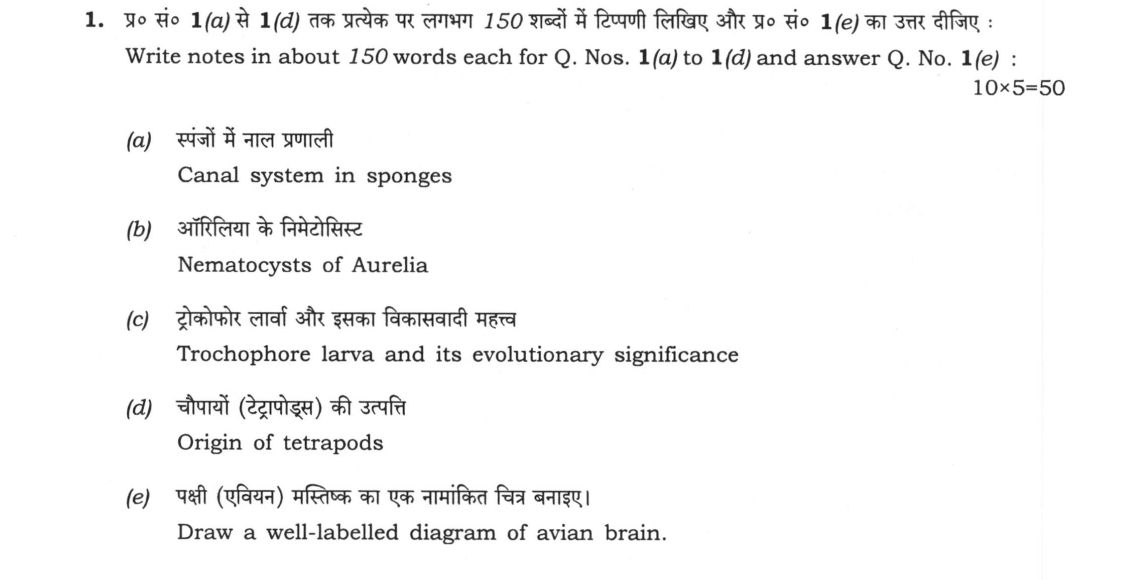
Write notes in about 150 words each for Q. Nos. 1(a) to 1(d) and answer Q. No. 1(e) : (a) Canal system in sponges (10 marks) (b)…
Write notes in about 150 words each for Q. Nos. 1(a) to 1(d) and answer Q. No. 1(e) :
Canal system in sponges 10 marks
Nematocysts of Aurelia 10 marks
Trochophore larva and its evolutionary significance 10 marks
Origin of tetrapods 10 marks
Draw a well-labelled diagram of avian brain. 10 marks
हिंदी में प्रश्न पढ़ें
प्र० सं० 1(a) से 1(d) तक प्रत्येक पर लगभग 150 शब्दों में टिप्पणी लिखिए और प्र० सं० 1(e) का उत्तर दीजिए :
स्पंजों में नाल प्रणाली (10 अंक)
ऑरेलिया के निमेटोसिस्ट (10 अंक)
ट्रोकोफोर लार्वा और इसका विकासवादी महत्व (10 अंक)
चौपायों (टेट्रापोड्स) की उत्पत्ति (10 अंक)
पक्षी (एवियन) मस्तिष्क का एक नामांकित चित्र बनाइए। (10 अंक)
Model answer
Written by UPSC Answer Check against this question's marking rubric, to the 150-word length. UPSC does not publish answers for Mains — this is one way to score well, not an official key.
1(a) Canal system in sponges. The canal system is the water-circulation network of sponges, formed by pores, canals and flagellated choanocytes that draw in water, filter food, and expel waste. In the ascon type, incurrent pores open directly into a central spongocoel lined by choanocytes, with a single osculum; Leucosolenia is a simple example. In the sycon type, pores lead into incurrent canals, then radial canals lined by choanocytes, and finally into a spongocoel and osculum; Sycon shows this arrangement. In the leucon type, the spongocoel is reduced or absent, choanocytes occupy numerous chambers, and incurrent and excurrent canals form a complex network; Spongilla represents this most efficient form. The flagellar current of choanocytes creates unidirectional flow, increasing contact with water and making filter-feeding more efficient as body size and complexity increase. This graded series shows how sponge body plans become more canalised and efficient, with choanocytes remaining the functional centre.
1(b) Nematocysts of Aurelia. Nematocysts are the thread-bearing cnidocysts of Aurelia, borne by cnidocytes on tentacles and oral arms for prey capture. They are classified as atrichous isorhiza, holotrichous isorhiza and heterotrichous microbasic euryteles. The atrichous isorhiza has a smooth, straight thread and a simple penetrating role in capture; the holotrichous isorhiza has barbs or spines along the thread, helping to entangle small prey; the heterotrichous microbasic euryteles has a coiled, often barbed thread with a small base, useful for gripping or immobilising captured organisms. Discharge is triggered when the cnidocil, a mechanosensitive hair, is stimulated by prey contact. This causes rapid osmotic swelling of the capsule, rupture of the operculum, and eversion of the thread, sometimes with barbs or coiled portions. The result is a fast harpoon-like strike that attaches to prey, enabling the jellyfish to bring it to the mouth. These nematocysts are thus central to Aurelia’s predatory feeding.
1(c) Trochophore larva and its evolutionary significance. The trochophore is a free-swimming, ciliated larva of many lophotrochozoan groups, especially polychaete annelids and molluscs. It has a bilaterally symmetrical body, an apical tuft, and three ciliary bands: the prototroch, a principal band around the middle of the body; the metatroch, a posterior ciliary band; and the telotroch, an apical or terminal band. In Nereis, the trochophore is a planktonic larva of a polychaete, while in Pila it appears as a molluscan trochophore-like ciliated larva. The ciliary bands provide locomotion and help in feeding by creating currents that bring particles to the mouth. It is a key larval character. Evolutionarily, the trochophore is important because it supports the trochaea theory, which proposes a common larval ancestor for lophophorates and trochophore-bearing groups. Its repeated occurrence in annelids, molluscs and related phyla is evidence for the monophyly of Lophotrochozoa, although it is a larval homology rather than proof of a direct adult ancestor.
1(d) Origin of tetrapods. Tetrapods originated from lobe-finned sarcopterygian fishes during the Devonian, when fins with internal bones, joints and weight-bearing structures changed into limbs. Tiktaalik shows a transitional skull, neck, ribs and fin with wrist-like elements; Acanthostega and Ichthyostega are early tetrapods with polydactylous limbs, having eight and seven digits respectively, not the later pentadactyl condition. The later pentadactyl limb is homologous to the sarcopterygian fin skeleton, showing continuity from fin to limb. The Devonian record includes Romer's gap, a period of low tetrapod fossil diversity, not a radiation; after this gap, tetrapods diversified. Fossil evidence from Greenland and Pennsylvania, together with Ellesmere Island material, helps bracket the transition: Greenland preserves Acanthostega and Ichthyostega, while North American Devonian sites preserve stem-tetrapod and early tetrapod forms. These fossils show the stepwise fin-to-limb transition in the fossil record.
1(e) Avian brain. In a dorsal view, the avian brain is drawn with the rostral telencephalon (cerebrum) smooth, predominantly pallial, and lacking a corpus callosum. Behind it, the diencephalon is present, with the optic nerve (CN II) arising at this level. The midbrain shows large optic lobes (tectum opticum), reflecting visual dependence; the optic lobe is a midbrain structure, not CN II. The cerebellum is well developed, with prominent lobes for flight coordination. The medulla oblongata is elongated and posterior, bearing cranial nerve roots for IX and X, while V and VII are shown at the pons. The labelled dorsal view shows cerebrum, optic lobes, cerebellum, medulla oblongata, and cranial nerve roots II, V, VII, IX and X at their correct levels. Thus, the smooth cerebrum, large optic lobes and expanded cerebellum are the key diagnostic features of the avian brain in the dorsal view.
What "Write short notes" is asking you to do
Five or six self-contained answers, marked separately, typically 10 marks and about 150 words each. Each note must carry its own definition, its two or three defining features and a line on why it matters; a common introduction or conclusion across the notes earns nothing.
Structure that answers it
Per note: one-line definition or identification → two or three features, mechanisms or named examples → one line of significance or Indian application
Where marks are lost
Writing the first two notes at essay length and rationing the rest. Each note is marked on its own, so marks surrendered on a compressed or unattempted note cannot be won back by the long ones.
How this answer will be evaluated
Approach
Framework: Zoology Paper 1: Define > Structure/Mechanism > Diagram > Example. (a) write short notes: define > 3-4 key features > one example > one-line significance | (b) write short notes: define > 3-4 key features > one example > one-line significance | (c) write short notes: define > 3-4 key features > one example > one-line significance | (d) write short notes: define > 3-4 key features > one example > one-line significance | (e) map: locate accurately > label > one line on why it matters Full marks: All parts answered with precise definitions, detailed mechanisms, and accurate diagrams.
Key points expected
- Define canal system and water flow
- Describe Asconoid, Syconoid, Leuconoid types
- Mention specific cell types (choanocytes, pinacocytes)
- Provide one example taxon for each type
- Define nematocysts and cnidocytes
- Describe types (penetrant, volvent, etc.)
- Explain mechanism of discharge
- Mention function in Aurelia (prey capture)
Evaluation rubric
Each sub-part is marked on its own, against the marks and word limit printed on the paper.
- (a) Define canal system and describe the three types of water flow. 10 marks · 150 words
write short notes— define → 3-4 key features → one example → one-line significance
Must cover
- Define canal system and water flow
- Describe Asconoid, Syconoid, Leuconoid types
- Mention specific cell types (choanocytes, pinacocytes)
- Provide one example taxon for each type
Loses marks
- Confusing canal types
- Missing cell types
- No examples provided
Earns more
- Mention osculum and ostium
- Note on metabolic efficiency
- Reference to specific sponge species
Extra mark
- Mention specific species like Spongia
- Note on evolutionary trend
- (b) Define nematocysts and describe their types and function in Aurelia. 10 marks · 150 words
write short notes— define → 3-4 key features → one example → one-line significance
Must cover
- Define nematocysts and cnidocytes
- Describe types (penetrant, volvent, etc.)
- Explain mechanism of discharge
- Mention function in Aurelia (prey capture)
Loses marks
- Confusing nematocyst types
- Missing mechanism of discharge
- No mention of Aurelia
Earns more
- Mention nematocyst structure
- Note on venom composition
- Reference to specific tentacle location
Extra mark
- Mention specific species like Aurelia aurita
- Note on defensive role
- (c) Define trochophore larva and explain its evolutionary significance. 10 marks · 150 words
write short notes— define → 3-4 key features → one example → one-line significance
Must cover
- Define trochophore larva
- Describe its structure (apical tuft, bands of cilia)
- Explain evolutionary significance (link to annelids, molluscs)
- Mention specific phyla that have trochophore stage
Loses marks
- Confusing trochophore with other larvae
- Missing evolutionary significance
- No mention of specific phyla
Earns more
- Mention trochophore in specific species
- Note on larval development
- Reference to evolutionary relationships
Extra mark
- Mention specific species like Nereis
- Note on larval dispersal
- (d) Describe the origin of tetrapods and key evolutionary changes. 10 marks · 150 words
write short notes— define → 3-4 key features → one example → one-line significance
Must cover
- Define tetrapods and their origin
- Describe key evolutionary changes (limbs, lungs)
- Mention specific transitional fossils (Tiktaalik, Acanthostega)
- Explain significance of tetrapod evolution
Loses marks
- Confusing tetrapod with other vertebrates
- Missing key evolutionary changes
- No mention of transitional fossils
Earns more
- Mention specific time period (Devonian)
- Note on environmental changes
- Reference to specific fossil sites
Extra mark
- Mention specific species like Tiktaalik roseae
- Note on ecological impact
- (e) Draw a well-labelled diagram of the avian brain. 10 marks
map— locate accurately → label → one line on why it matters
Must cover
- Draw a clear diagram of avian brain
- Label major regions (cerebrum, cerebellum, etc.)
- Mention specific structures (optic lobes, olfactory lobes)
- Ensure diagram is well-labelled and accurate
Loses marks
- Missing major brain regions
- Poor labelling
- Inaccurate diagram
Earns more
- Mention specific brain regions
- Note on functional significance
- Reference to specific bird species
Extra mark
- Mention specific species like Corvus
- Note on brain size relative to body
Practice this exact question
Write your answer and it is marked point by point against the model answer above — what you covered, what you missed, what you got wrong.
Evaluate my answer →More from Zoology 2021 Paper I
- Q1 Write notes in about 150 words each for Q. Nos. 1(a) to 1(d) and answer Q. No. 1(e) : (a)…
- Q2 (a) What is metamorphosis? Describe the hormonal regulation of metamorphosis in insects.…
- Q3 (a) What is hypothalamo-pituitary axis? Draw a well-labelled diagram of pituitary gland a…
- Q4 (a) Define double circulation. Give a comparative account of heart in reptiles, birds and…