Paper I — Q6
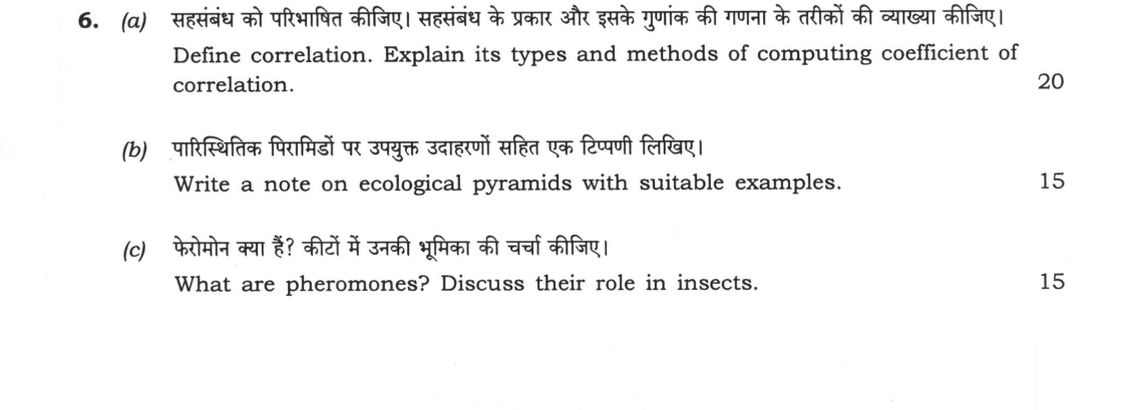
(a) Define correlation. Explain its types and methods of computing coefficient of correlation. (20 marks) (b) Write a note on…
Define correlation. Explain its types and methods of computing coefficient of correlation. 20 marks
Write a note on ecological pyramids with suitable examples. 15 marks
What are pheromones? Discuss their role in insects. 15 marks
हिंदी में प्रश्न पढ़ें
सहसंबंध को परिभाषित कीजिए। सहसंबंध के प्रकार और इसके गुणांक की गणना के तरीकों की व्याख्या कीजिए। (20 अंक)
पारिस्थितिक पिरामिडों पर उपयुक्त उदाहरणों सहित एक टिप्पणी लिखिए। (15 अंक)
फेरोमोन क्या हैं? कीटों में उनकी भूमिका की चर्चा कीजिए। (15 अंक)
Model answer
Written by UPSC Answer Check against this question's marking rubric, to the expected length. UPSC does not publish answers for Mains — this is one way to score well, not an official key.
Correlation and its computation. Correlation is a statistical measure indicating the direction and degree of association between two variables. If both variables tend to rise or fall together, correlation is positive; if one rises while the other falls, it is negative; if no systematic association exists, it is zero. It may be linear, where points lie near a straight line, or non-linear, where association follows a curve. It is also classified as simple, involving two variables; partial, measuring the effect of one variable while holding another constant; and multiple, where one variable is related to several others simultaneously.
The scatter diagram is the first method: plotting paired values shows whether the relation is positive, negative, linear or curved, though it does not give an exact coefficient. Pearson’s product-moment coefficient, r, is used for interval or ratio data and is computed as r = [nΣxy − ΣxΣy]/√{[nΣx²−(Σx)²][nΣy²−(Σy)²]}. In practice, one calculates means, deviations, products of deviations and sums of squares, or uses covariance divided by the product of standard deviations. The coefficient ranges from −1 to +1 inclusive; +1 and −1 denote perfect linear association, while 0 denotes no linear association. The magnitude indicates strength, and the sign indicates direction. It can be computed without assuming bivariate normality; normality is mainly relevant for significance tests and confidence intervals. Spearman’s rank correlation, ρ, is used for ordinal data or when Pearson’s assumptions are unsuitable. Ranks are assigned to each variable, differences are squared and summed; for no tied ranks, ρ = 1 − 6Σd²/[n(n²−1)]. With tied ranks a tie correction is applied, for example ρ = 1 − [6Σd² + Σ(t³−t)/12]/[n(n²−1)]. If n=5 and Σd²=10, ρ=1−60/120=0.5. The coefficient of concurrent deviations gives a rough estimate: r=(c−d)/(c+d), where c and d are the numbers of concordant and discordant deviations from the means; it is less precise and is affected by zero deviations.
Ecological pyramids. An ecological pyramid graphically represents trophic levels and energy flow, based on Lindeman’s trophic-dynamic theory, which emphasises unidirectional energy flow and heat loss. The pyramid of numbers shows the count of organisms at each level; in Terai grassland it is usually upright, with many grasses, fewer grazers and fewer predators, but it can be inverted in a parasitic chain where one host supports many parasites. The pyramid of biomass shows standing crop; in grassland it is upright, while in many aquatic ecosystems it may be inverted because phytoplankton have low standing biomass but high turnover. The pyramid of energy is always upright because energy transfer is inefficient, typically about 10% from one trophic level to the next; a pond ecosystem illustrates this, with phytoplankton fixing solar energy, zooplankton using less, small fish less still, and large carnivores least. Thus, pyramids summarise trophic structure, but their shape depends on the unit used and the time of sampling.
Pheromones. Pheromones are species-specific semiochemicals released by insects that modify the behaviour of conspecifics, often detected by antennae at very low concentrations. Sex pheromones attract mates, as in Bombyx mori where bombykol guides male moths to females. Aggregation pheromones gather individuals, as in Tribolium beetles. Alarm pheromones warn and mobilise defence, and trail pheromones mark routes, as in Lasius niger ants. In Apis mellifera, queen substance maintains colony organisation and suppresses worker ovary development. In applied entomology, pheromones are used in IPM through mass trapping, monitoring and mating disruption, for example against fruit flies and bollworm, reducing pesticide dependence and improving pest control. Their specificity makes them valuable for monitoring pest populations without broad-spectrum chemicals.
Thus, correlation provides the statistical basis for quantifying ecological relationships, while pyramids and pheromones explain the structure and behavioural regulation of insect populations.
What "Explain" is asking you to do
Make the working of something clear — what sets it off, what follows from what, and what it produces. Explain is the Commission's mechanism word: it dominates the technical papers and the “explain why” stems, where the marks sit in the causal chain and not in the label.
Structure that answers it
State what it is → the initiating condition → the chain of cause, step by step → an instance where it plays out → what the chain produces
Where marks are lost
Describing what something looks like instead of why it works that way. Naming the stages without linking them reads as description too.
How this answer will be evaluated
Approach
Framework: UPSC Zoology Paper 1. (a) explain: definition/context > points in order > small example > short close | (b) write short notes: define > 3-4 key features > one example > one-line significance | (c) discuss: intro > 3-4 dimensions > example > balanced close Full marks: Comprehensive, accurate, with examples and diagrams
Key points expected
- Precise definition of correlation
- Types: positive, negative, zero
- Pearson's method with formula
- Spearman's rank correlation method
- Pyramid of numbers
- Pyramid of biomass
- Pyramid of energy
- Suitable examples for each type
Evaluation rubric
Each sub-part is marked on its own, against the marks and word limit printed on the paper.
- (a) Definition, types, and methods of computing correlation coefficient. 20 marks
explain— definition/context → points in order → small example → short close
Must cover
- Precise definition of correlation
- Types: positive, negative, zero
- Pearson's method with formula
- Spearman's rank correlation method
Loses marks
- Confusing correlation with regression
- Missing formula for Pearson's r
- No distinction between types
Earns more
- Kendall's rank correlation
- Interpretation of r values
- Distinction between correlation and causation
Extra mark
- Scatter plot diagram
- Biological example (e.g., height vs weight)
- (b) Note on ecological pyramids with suitable examples. 15 marks
write short notes— define → 3-4 key features → one example → one-line significance
Must cover
- Pyramid of numbers
- Pyramid of biomass
- Pyramid of energy
- Suitable examples for each type
Loses marks
- Missing one type of pyramid
- No examples provided
- Confusing biomass with energy
Earns more
- Inverted pyramid examples
- Diagram of pyramids
- Limitations of each pyramid type
Extra mark
- Specific ecosystem examples (e.g., pond, forest)
- Comparison of pyramid types
- (c) Definition of pheromones and their role in insects. 15 marks
discuss— intro → 3-4 dimensions → example → balanced close
Must cover
- Definition of pheromones
- Types: sex, trail, alarm, aggregation
- Role in insect communication
- Specific examples (e.g., ant trail, moth sex pheromone)
Loses marks
- No types of pheromones mentioned
- No specific insect examples
- Confusing pheromones with hormones
Earns more
- Mechanism of pheromone detection
- Application in pest control
- Chemical structure examples
Extra mark
- Specific species examples (e.g., Bombyx mori)
- Diagram of pheromone pathway
Practice this exact question
Write your answer and it is marked point by point against the model answer above — what you covered, what you missed, what you got wrong.
Evaluate my answer →More from Zoology 2021 Paper I
- Q3 (a) What is hypothalamo-pituitary axis? Draw a well-labelled diagram of pituitary gland a…
- Q4 (a) Define double circulation. Give a comparative account of heart in reptiles, birds and…
- Q5 Write notes on the following in about 150 words each : (a) Vermiculture (10 marks) (b) FI…
- Q6 (a) Define correlation. Explain its types and methods of computing coefficient of correla…
- Q7 (a) What is transgenesis? Describe the methods and applications of transgenesis in animal…
- Q8 (a) Define ecosystem. Discuss the structure and functions of ecosystem. (20 marks) (b) Wh…