Paper I — Q7
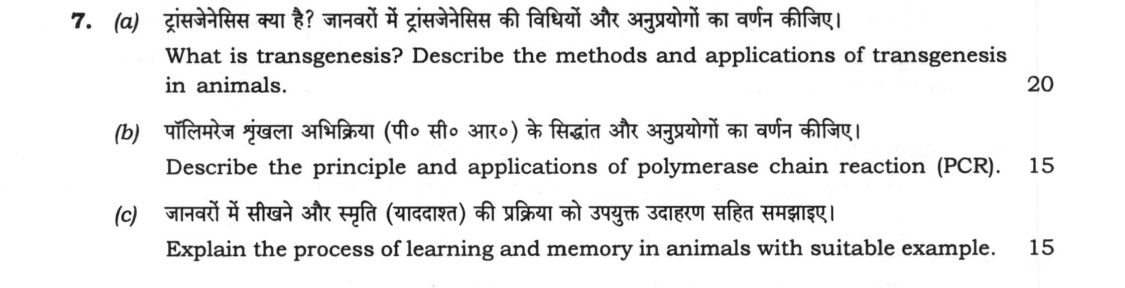
(a) What is transgenesis? Describe the methods and applications of transgenesis in animals. (20 marks) (b) Describe the principle…
What is transgenesis? Describe the methods and applications of transgenesis in animals. 20 marks
Describe the principle and applications of polymerase chain reaction (PCR). 15 marks
Explain the process of learning and memory in animals with suitable example. 15 marks
हिंदी में प्रश्न पढ़ें
ट्रांसजेनेसिस क्या है? जानवरों में ट्रांसजेनेसिस की विधियों और अनुप्रयोगों का वर्णन कीजिए। (20 अंक)
पॉलिमरेज मुंबला अभिक्रिया (पी० सी० आर०) के सिद्धांत और अनुप्रयोगों का वर्णन कीजिए। (15 अंक)
जानवरों में सीखने और स्मृति (याददाश्त) की प्रक्रिया को उपयुक्त उदाहरण सहित समझाइए। (15 अंक)
Model answer
Written by UPSC Answer Check against this question's marking rubric, to the expected length. UPSC does not publish answers for Mains — this is one way to score well, not an official key.
Transgenesis. Transgenesis is the stable introduction and inheritance of a foreign DNA sequence into the germline of an animal, so that the transgene is expressed in offspring and can be used to alter physiology, disease susceptibility, or product formation. The classical method is pronuclear microinjection, in which linear DNA is injected into the male pronucleus of a fertilised egg; it is simple and widely used for mice, but random integration and low efficiency limit precise control. Viral vector-mediated transfer uses retroviruses, lentiviruses or adenoviral vectors to carry the transgene into embryos or cells; it can improve delivery and expression, though vector size and immune or insertional risks matter. Embryonic stem cell-mediated gene transfer introduces the construct into ES cells, selects clones, and injects them into blastocysts, giving a more controlled route, especially in mice, but it is labour-intensive and not universal. CRISPR-Cas9 genome editing adds a comparative advantage by allowing targeted insertion, deletion or knock-in at a chosen locus, improving reproducibility and reducing random insertions, while still requiring careful delivery and off-target assessment. Applications include transgenic livestock such as GloFish and EnviroPig, bioreactors producing pharmaceutical proteins like ATryn from transgenic goats, disease models such as Alzheimer’s mice carrying human amyloid or tau genes, and Indian vector-control initiatives exploring GM mosquitoes to reduce malaria or dengue transmission.
PCR. Polymerase chain reaction is an in vitro method for amplifying a defined DNA segment through repeated cycles of denaturation, annealing and extension. A short target sequence is flanked by two synthetic primers; in each cycle, high temperature separates strands, primers anneal to complementary sequences, and a thermostable DNA polymerase, usually Taq polymerase, extends from the primers using dNTPs in a buffered Mg2+ solution. The product doubles each cycle, giving exponential amplification, conventionally 2^n after n cycles, so a few copies become detectable. Variants include quantitative PCR, which measures amplification in real time for copy-number or gene-expression estimates, and reverse transcription PCR, which converts RNA into cDNA before amplification and is used for mRNA studies. Applications span forensic DNA profiling, including Indian CODIS database work, disease diagnosis such as TB and COVID-19, paternity testing, ancient DNA studies such as Rakhigarhi samples, and wildlife conservation genetics such as tiger DNA barcoding.
Learning and memory. Learning in animals is a relatively permanent change in behaviour produced by experience, while memory is the storage and retrieval of that information. Simple forms include habituation, where repeated harmless stimuli reduce response; sensitization, where a strong stimulus heightens response; imprinting, as in Konrad Lorenz’s geese following the first moving object; classical conditioning, where a neutral cue predicts an unconditioned stimulus; and operant conditioning, where behaviour is shaped by reward or punishment. The neural basis rests on synaptic plasticity, especially long-term potentiation (LTP) in hippocampal circuits for spatial and episodic-like memory and amygdala circuits for emotional memory. CREB protein is a key transcription factor that converts short-term synaptic changes into long-term memory by promoting new protein synthesis and structural changes. Aplysia gill-withdrawal reflex studies, central to Kandel’s Nobel work, showed how repeated stimulation changes synaptic transmission in habituation and sensitization. Spatial memory in rats is tested in the Morris water maze, where hippocampal damage impairs platform learning. Indian examples include elephant mahout training, where operant and social learning shape complex tasks, and corvid tool-use studies that reveal problem-solving and memory. Together, transgenesis, PCR and learning-memory research show how biotechnology and neurobiology allow animal systems to be modelled, diagnosed, conserved and understood at molecular and behavioural levels.
What "Describe" is asking you to do
Give a full, ordered account of the thing named — its parts, stages or mechanism — in the sequence in which it actually exists or occurs. Most describe questions come from the science optionals, where the marks sit in correct technical detail and, where the stem says so, a labelled diagram.
Structure that answers it
One-line identification of the subject → the parts or stages in their real order, each with its defining detail → labelled diagram where the subject is structural → closing line on function or significance
Where marks are lost
Loose general prose where the examiner is ticking named parts, correct terminology and their sequence; and in the General Studies papers, turning to evaluation before the description is finished.
How this answer will be evaluated
Approach
Framework: Zoology Paper 1: Define > Structure/Mechanism > Diagram > Example. (a) describe: define > structure or process in order > labelled diagram > significance | (b) describe: define > structure or process in order > labelled diagram > significance | (c) explain: definition/context > points in order > small example > short close Full marks: Precise definitions, detailed mechanisms, labelled diagrams, specific examples, and clear applications.
Key points expected
- Precise definition of transgenesis
- Methods: Microinjection, Retroviral, Somatic cell nuclear transfer
- Applications: Bioreactors, disease models, conservation
- Labelled diagram of a transfer method
- Principle: Thermal cycling (Denaturation, Annealing, Extension)
- Components: Template, Primers, dNTPs, Taq polymerase
- Applications: Forensics, Diagnostics, Cloning
- Labelled diagram of the PCR cycle
Evaluation rubric
Each sub-part is marked on its own, against the marks and word limit printed on the paper.
- (a) Definition of transgenesis, methods of gene transfer, and applications in animals. 20 marks
describe— define → structure or process in order → labelled diagram → significance
Must cover
- Precise definition of transgenesis
- Methods: Microinjection, Retroviral, Somatic cell nuclear transfer
- Applications: Bioreactors, disease models, conservation
- Labelled diagram of a transfer method
Loses marks
- Confusing transgenesis with general genetic engineering
- Listing methods without explaining the mechanism
- Diagrams without labels
Earns more
- Mention of specific transgenic species (e.g., Rosy Periwinkle)
- Discussion of ethical considerations
- Comparison of efficiency of methods
Extra mark
- Reference to specific landmark transgenic animal (e.g., Transgenic goat)
- Mention of CRISPR/Cas9 as a modern tool
- (b) Principle of PCR (denaturation, annealing, extension) and its applications. 15 marks
describe— define → structure or process in order → labelled diagram → significance
Must cover
- Principle: Thermal cycling (Denaturation, Annealing, Extension)
- Components: Template, Primers, dNTPs, Taq polymerase
- Applications: Forensics, Diagnostics, Cloning
- Labelled diagram of the PCR cycle
Loses marks
- Omitting the role of Taq polymerase
- Confusing PCR with DNA sequencing
- Diagrams without labels
Earns more
- Mention of specific temperatures for each step
- Distinction between PCR and RT-PCR
- Mention of qPCR for quantification
Extra mark
- Reference to Kary Mullis (inventor)
- Mention of specific diagnostic test (e.g., SARS-CoV-2 PCR)
- (c) Process of learning and memory in animals with a suitable example. 15 marks
explain— definition/context → points in order → small example → short close
Must cover
- Definition of learning (classical/operant) and memory
- Mechanism: Neural pathways, synaptic plasticity
- Suitable example: Pavlov's dog or Skinner's box
- Link to survival/adaptive behavior
Loses marks
- Confusing instinct with learning
- Vague examples without specific experimental setup
- Ignoring the biological basis of memory
Earns more
- Distinction between short-term and long-term memory
- Mention of specific brain regions (e.g., hippocampus)
- Comparison of learning in invertebrates vs vertebrates
Extra mark
- Reference to specific researcher (e.g., Pavlov, Skinner)
- Mention of specific neural mechanism (e.g., LTP)
Practice this exact question
Write your answer and it is marked point by point against the model answer above — what you covered, what you missed, what you got wrong.
Evaluate my answer →More from Zoology 2021 Paper I
- Q4 (a) Define double circulation. Give a comparative account of heart in reptiles, birds and…
- Q5 Write notes on the following in about 150 words each : (a) Vermiculture (10 marks) (b) FI…
- Q6 (a) Define correlation. Explain its types and methods of computing coefficient of correla…
- Q7 (a) What is transgenesis? Describe the methods and applications of transgenesis in animal…
- Q8 (a) Define ecosystem. Discuss the structure and functions of ecosystem. (20 marks) (b) Wh…