Paper I — Q2
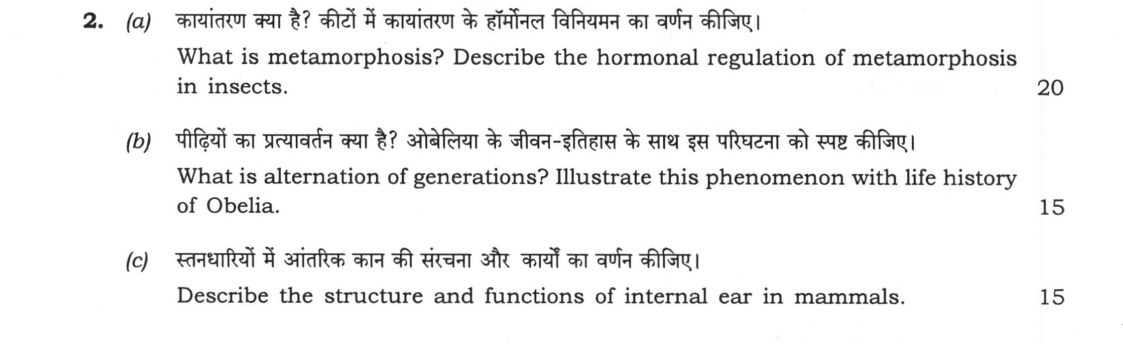
(a) What is metamorphosis? Describe the hormonal regulation of metamorphosis in insects. (20 marks) (b) What is alternation of…
What is metamorphosis? Describe the hormonal regulation of metamorphosis in insects. 20 marks
What is alternation of generations? Illustrate this phenomenon with life history of Obelia. 15 marks
Describe the structure and functions of internal ear in mammals. 15 marks
हिंदी में प्रश्न पढ़ें
कायांतरण क्या है? कीटों में कायांतरण के हार्मोनल विनियमन का वर्णन कीजिए। (20 अंक)
पीढ़ियों का प्रत्यावर्तन क्या है? ओबेलिया के जीवन-इतिहास के साथ इस परिघटना को स्पष्ट कीजिए। (15 अंक)
स्तनधारियों में आंतरिक कान की संरचना और कार्यों का वर्णन कीजिए। (15 अंक)
Model answer
Written by UPSC Answer Check against this question's marking rubric, to the expected length. UPSC does not publish answers for Mains — this is one way to score well, not an official key.
Metamorphosis and Hormonal Regulation in Insects
Metamorphosis is the post-embryonic developmental process involving abrupt morphological, anatomical, and physiological transformation from a juvenile form to an adult. It occurs as incomplete metamorphosis (hemimetaboly, characterized by gradual nymphal stages lacking a pupa) or complete metamorphosis (holometaboly, proceeding through egg, feeding larva, quiescent pupa, and winged adult).
The process is strictly regulated by a tripartite neuroendocrine axis comprising neurosecretory cells of the brain, the corpora allata, and the prothoracic glands. Environmental or developmental cues stimulate the median neurosecretory cells of the protocerebrum to synthesize Prothoracicotropic Hormone (PTTH), which is transported to and released from the corpora cardiaca into the hemolymph. PTTH acts on the thoracic prothoracic glands, stimulating the secretion of the steroid prohormone ecdysone. Peripheral target tissues convert ecdysone into the active hormone 20-hydroxyecdysone (20E), which triggers apolysis and ecdysis (moulting).
The nature of the moult is determined by Juvenile Hormone (JH, a sesquiterpenoid) secreted by the corpora allata. Functioning as a "status quo" hormone, high titers of JH in the hemolymph ensure that 20E pulses induce a larva-to-larva moult, preserving juvenile characteristics and repressing adult gene expression. In holometabolous insects, a critical drop in JH levels during the final larval instar allows 20E to trigger pupation. In the subsequent pupal stage, the complete absence of JH permits 20E to direct imaginal disc differentiation and histolysis of larval tissues, culminating in adult emergence (imago).
**Alternation of Generations in *Obelia***
Alternation of generations in cnidarians, termed metagenesis, describes the cyclic alternation between a sessile, asexually reproducing polypoid generation and a free-swimming, sexually reproducing medusoid generation. Because both the polyp and medusa phases are diploid, this differs from the true alternation of generations (haplodiplontic cycle) in plants; only the gametes are haploid.
Obelia exhibits a polymorphic colonial hydroid stage anchored to the substratum by a horizontal, root-like hydrorhiza, which gives rise to erect, branching hydrocauli. The colony displays two main types of zooids: feeding hydranths (gastrozooids) possessing tentacles and a hypostome for nutrient capture, and reproductive blastostyles (gonozooids) enclosed within a gonotheca, forming a gonangium.
The blastostyle asexually produces miniature, bell-shaped, dioecious medusae by lateral budding. The medusae detach, become free-swimming, and produce haploid gametes (sperm and ova) from four gonads situated on the radial canals. External fertilization in seawater yields a diploid zygote that undergoes holoblastic cleavage to form a ciliated, free-swimming planula larva. The planula settles onto a suitable substratum, loses its cilia, attaches at its anterior end, and undergoes morphogenesis into a simple hydrula polyp, which subsequently buds to establish a new branched colonial hydroid.
Structure and Functions of the Internal Ear in Mammals
The mammalian internal ear (labyrinth) is embedded within the petrous temporal bone and comprises two concentric systems: an outer bony labyrinth filled with perilymph and an inner membranous labyrinth filled with endolymph. It is anatomically differentiated into the cochlea for auditory perception and the vestibular apparatus for balance.
The cochlea is a coiled, snail-like structure partitioned into three longitudinal fluid-filled canals: the upper scala vestibuli and lower scala tympani (containing perilymph), and the intermediate scala media (containing endolymph). Resting on the basilar membrane within the scala media is the organ of Corti, composed of rows of inner and outer sensory hair cells whose stereocilia project beneath the acellular tectorial membrane. Sound waves striking the tympanum vibrate the stapes against the oval window, initiating fluid waves in the perilymph. These waves displace the basilar membrane, shearing the hair cell stereocilia against the tectorial membrane. This mechanical deformation triggers mechanotransduction via the opening of mechanically-gated potassium channels, depolarizing the hair cells and firing action potentials along the cochlear nerve. Frequency discrimination is achieved via tonotopy: high frequencies resonate with the stiff, narrow base of the basilar membrane, whereas low frequencies displace the wide, flexible apex near the helicotrema.
The vestibular apparatus comprises the utricle, saccule, and three orthogonal semicircular canals. The maculae of the utricle and saccule contain sensory hair cells covered by a gelatinous otolithic membrane embedded with calcium carbonate otoconia, detecting gravity, linear acceleration, and static equilibrium. The dilated ampulla of each semicircular canal contains a crista ampullaris with hair cells embedded in a gelatinous cupula; rotational head movements deflect the cupula via endolymph inertia, detecting angular acceleration and maintaining dynamic equilibrium.
Together, endocrine titration in insect metamorphosis, life-cycle alternation in hydrozoans, and mechanoreceptive specialization in the mammalian labyrinth represent evolutionary solutions across animal phyla for growth transitions, reproductive dispersal, and precise physiological homeostasis.
What "Describe" is asking you to do
Give a full, ordered account of the thing named — its parts, stages or mechanism — in the sequence in which it actually exists or occurs. Most describe questions come from the science optionals, where the marks sit in correct technical detail and, where the stem says so, a labelled diagram.
Structure that answers it
One-line identification of the subject → the parts or stages in their real order, each with its defining detail → labelled diagram where the subject is structural → closing line on function or significance
Where marks are lost
Loose general prose where the examiner is ticking named parts, correct terminology and their sequence; and in the General Studies papers, turning to evaluation before the description is finished.
How this answer will be evaluated
Approach
Framework: Zoology Paper 1: Define > Structure/Mechanism > Diagram > Example. (a) describe: define > structure or process in order > labelled diagram > significance | (b) explain: definition/context > points in order > small example > short close | (c) describe: define > structure or process in order > labelled diagram > significance Full marks: Precise definitions, detailed mechanisms, labelled diagrams, named examples, and clear hormonal/structural explanations.
Key points expected
- Define complete vs incomplete metamorphosis
- Role of Prothoracicotropic hormone (PTTH)
- Mechanism of Ecdysone and Juvenile Hormone (JH)
- Labelled diagram of hormonal pathway
- Define alternation of generations (metagenesis)
- Identify Obelia as hydrozoan
- Describe polyp (asexual) stage
- Describe medusa (sexual) stage
Evaluation rubric
Each sub-part is marked on its own, against the marks and word limit printed on the paper.
- (a) Definition of metamorphosis and detailed hormonal regulation in insects. 20 marks
describe— define → structure or process in order → labelled diagram → significance
Must cover
- Define complete vs incomplete metamorphosis
- Role of Prothoracicotropic hormone (PTTH)
- Mechanism of Ecdysone and Juvenile Hormone (JH)
- Labelled diagram of hormonal pathway
Loses marks
- Confusing JH and Ecdysone functions
- Diagram without labels
- Describing only the physical changes, not hormonal
Earns more
- Mention of specific insect example (e.g., Bombyx)
- Explanation of JH titration effect
- Mention of ecdysis (moulting) process
Extra mark
- Mention of specific receptor names (EcR/MRX)
- Reference to recent research on metamorphosis
- (b) Definition of alternation of generations and life history of Obelia. 15 marks
explain— definition/context → points in order → small example → short close
Must cover
- Define alternation of generations (metagenesis)
- Identify Obelia as hydrozoan
- Describe polyp (asexual) stage
- Describe medusa (sexual) stage
Loses marks
- Confusing polyp and medusa functions
- Missing the asexual/sexual distinction
- Diagram without labels
Earns more
- Labelled life cycle diagram of Obelia
- Mention of gonangia and gonophores
- Explanation of parthenogenesis in Obelia
Extra mark
- Mention of specific species (Obelia hydrostatica)
- Comparison with other hydrozoans
- (c) Structure and functions of the internal ear in mammals. 15 marks
describe— define → structure or process in order → labelled diagram → significance
Must cover
- Identify cochlea, semicircular canals, vestibule
- Explain cochlea's role in hearing
- Explain semicircular canals' role in balance
- Labelled diagram of internal ear
Loses marks
- Confusing external/middle ear with internal ear
- Diagram without labels
- Describing only structure, not function
Earns more
- Mention of organ of Corti
- Explanation of hair cells
- Mention of otoliths in vestibule
Extra mark
- Mention of specific mammal example
- Reference to recent research on hearing loss
Practice this exact question
Write your answer and it is marked point by point against the model answer above — what you covered, what you missed, what you got wrong.
Evaluate my answer →More from Zoology 2021 Paper I
- Q1 Write notes in about 150 words each for Q. Nos. 1(a) to 1(d) and answer Q. No. 1(e) : (a)…
- Q2 (a) What is metamorphosis? Describe the hormonal regulation of metamorphosis in insects.…
- Q3 (a) What is hypothalamo-pituitary axis? Draw a well-labelled diagram of pituitary gland a…
- Q4 (a) Define double circulation. Give a comparative account of heart in reptiles, birds and…
- Q5 Write notes on the following in about 150 words each : (a) Vermiculture (10 marks) (b) FI…