Paper I — Q3
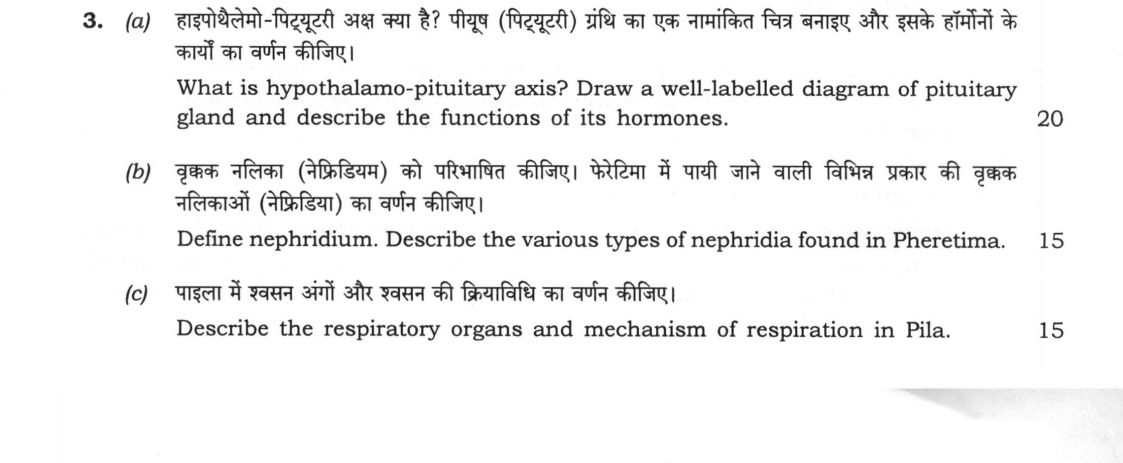
(a) What is hypothalamo-pituitary axis? Draw a well-labelled diagram of pituitary gland and describe the functions of its…
What is hypothalamo-pituitary axis? Draw a well-labelled diagram of pituitary gland and describe the functions of its hormones. 20 marks
Define nephridium. Describe the various types of nephridia found in Pheretima. 15 marks
Describe the respiratory organs and mechanism of respiration in Pila. 15 marks
हिंदी में प्रश्न पढ़ें
हाइपोथैलेमो-पिट्यूटरी अक्ष क्या है? पीयूष (पिट्यूटरी) ग्रंथि का एक नामांकित चित्र बनाइए और इसके हार्मोनों के कार्यों का वर्णन कीजिए। (20 अंक)
वृक्क नलिका (नेफ्रिडियम) को परिभाषित कीजिए। फेरेटिमा में पाई जाने वाली विभिन्न प्रकार की वृक्क नलिकाओं (नेफ्रिडिया) का वर्णन कीजिए। (15 अंक)
पाइला में श्वसन अंगों और श्वसन की क्रियाविधि का वर्णन कीजिए। (15 अंक)
Model answer
Written by UPSC Answer Check against this question's marking rubric, to the expected length. UPSC does not publish answers for Mains — this is one way to score well, not an official key.
Part (a): Hypothalamo-pituitary axis The hypothalamo-pituitary axis is the anatomical and functional link between the hypothalamus and the pituitary gland, through which the brain regulates endocrine activity. It is established by the portal hypophyseal system, a capillary network that carries hypothalamic releasing and inhibiting hormones to the anterior pituitary, and by axons of hypothalamic neurosecretory cells, especially from the supraoptic and paraventricular nuclei, that terminate in the posterior pituitary. The portal system provides a direct route for hypothalamic control, while the neurohypophysis acts as a storage and release site for hypothalamic hormones. The labelled diagram shows the adenohypophysis (anterior lobe) comprising pars distalis, pars intermedia and pars tuberalis, and the neurohypophysis (posterior lobe) comprising pars nervosa and the infundibulum/pituitary stalk. The pars distalis is labelled with GH, TSH, ACTH, FSH, LH and PRL; the pars nervosa with ADH and oxytocin. The anterior hormones act on target organs: GH stimulates growth of bones and muscles and metabolic activity; TSH acts on the thyroid to secrete thyroxine; ACTH acts on the adrenal cortex to release glucocorticoids; FSH and LH act on the gonads to promote gametogenesis, follicle development and steroid secretion; PRL stimulates mammary gland development and milk production. The posterior hormones are stored and released from neurohypophysis: ADH increases water reabsorption in renal collecting ducts and causes vasoconstriction, conserving water; oxytocin contracts myoepithelial cells around mammary alveoli for milk ejection and also stimulates uterine contraction during parturition. Thus the axis integrates neural and endocrine control.
Part (b): Nephridia in Pheretima A nephridium is a coelomic excretory organ that filters coelomic fluid and removes nitrogenous wastes. In Pheretima, three types are present: septal (pharyngeal), integumentary and enteronephric nephridia. The septal nephridia are situated in the septa; their ciliated, funnel-shaped nephrostome opens into the coelom of the segment anterior to their origin, and their ciliated canal leads to a terminal duct that opens to the exterior through a nephridiopore. The integumentary nephridia lie in the body wall; their ciliated nephrostome opens into the coelom of the same segment, and they discharge through a ventral nephridiopore. The enteronephric nephridia differ functionally: they lack a nephrostome and their terminal duct opens into the gut, so excretory fluid is discharged into the intestine. In the first two types, coelomic fluid is collected by the nephrostome, modified in the canal, and discharged externally; the enteronephric nephridia serve the gut rather than the exterior.
Part (c): Respiration in Pila Pila is an amphibious freshwater snail with a mantle cavity that contains two respiratory structures: a ctenidium (gill) used in water and a lung or pulmonary sac used in air. The ctenidium is a single, feathery organ on the right side of the mantle cavity, bearing filaments and leaflets rich in capillaries. In the aquatic phase, water enters the mantle cavity and, by ciliary action, passes over the ctenidial filaments; deoxygenated blood enters the gill through the afferent branchial vessel, oxygen diffuses into the blood in the ctenidial leaflets, and oxygenated blood leaves through the efferent branchial vessel. In the aerial phase, the mantle cavity is filled with air and the vascularized wall of the lung functions as a respiratory surface. The lung is a vascular fold of the mantle cavity. Air enters and leaves through the right-sided pneumostome, whose rhythmic opening and closing by mantle movements regulates gas exchange. The operculum closes the shell aperture, and during estivation Pila may form a calcified epiphragm; metabolism is then greatly reduced and the animal relies on stored air and anaerobic respiration rather than continuous aerial diffusion. These organs reflect adaptation to an amphibious life and illustrate the evolutionary transition from aquatic gill respiration to terrestrial lung respiration.
What "Describe" is asking you to do
Give a full, ordered account of the thing named — its parts, stages or mechanism — in the sequence in which it actually exists or occurs. Most describe questions come from the science optionals, where the marks sit in correct technical detail and, where the stem says so, a labelled diagram.
Structure that answers it
One-line identification of the subject → the parts or stages in their real order, each with its defining detail → labelled diagram where the subject is structural → closing line on function or significance
Where marks are lost
Loose general prose where the examiner is ticking named parts, correct terminology and their sequence; and in the General Studies papers, turning to evaluation before the description is finished.
How this answer will be evaluated
Approach
Framework: Zoology Paper 1: Define > Structure/Mechanism > Diagram > Example. (a) describe: define > structure or process in order > labelled diagram > significance | (b) describe: define > structure or process in order > labelled diagram > significance | (c) describe: define > structure or process in order > labelled diagram > significance Full marks: Precise definitions, fully labelled diagrams, and detailed mechanisms for all parts.
Key points expected
- Define hypothalamo-pituitary axis
- Well-labelled diagram of pituitary gland
- Functions of anterior pituitary hormones
- Functions of posterior pituitary hormones
- Definition of nephridium
- Description of septal nephridia
- Description of intestinal nephridia
- Description of pharyngeal nephridia
Evaluation rubric
Each sub-part is marked on its own, against the marks and word limit printed on the paper.
- (a) Define HPA, draw labelled pituitary diagram, and detail hormone functions. 20 marks
describe— define → structure or process in order → labelled diagram → significance
Must cover
- Define hypothalamo-pituitary axis
- Well-labelled diagram of pituitary gland
- Functions of anterior pituitary hormones
- Functions of posterior pituitary hormones
Loses marks
- Diagram without labels
- Confusing anterior and posterior hormones
Earns more
- Mention of specific releasing/inhibiting factors
- Distinction between adenohypophysis and neurohypophysis
Extra mark
- Mention of specific feedback loops
- (b) Define nephridium and describe types found in Pheretima. 15 marks
describe— define → structure or process in order → labelled diagram → significance
Must cover
- Definition of nephridium
- Description of septal nephridia
- Description of intestinal nephridia
- Description of pharyngeal nephridia
Loses marks
- Omitting any of the three types
- Confusing nephridia with Malpighian tubules
Earns more
- Mention of metanephridial nature
- Location of each type relative to segments
Extra mark
- Mention of specific segment numbers for pharyngeal nephridia
- (c) Describe respiratory organs and mechanism in Pila. 15 marks
describe— define → structure or process in order → labelled diagram → significance
Must cover
- Identification of ctenidium as respiratory organ
- Description of ctenidium structure (filaments/lamellae)
- Mechanism of water flow over ctenidia
- Role of mantle cavity in respiration
Loses marks
- Confusing ctenidium with lungs
- Failing to describe the mechanism of water flow
Earns more
- Mention of gill position (right side)
- Description of blood flow direction
Extra mark
- Mention of aerial respiration capability
Practice this exact question
Write your answer and it is marked point by point against the model answer above — what you covered, what you missed, what you got wrong.
Evaluate my answer →More from Zoology 2021 Paper I
- Q1 Write notes in about 150 words each for Q. Nos. 1(a) to 1(d) and answer Q. No. 1(e) : (a)…
- Q2 (a) What is metamorphosis? Describe the hormonal regulation of metamorphosis in insects.…
- Q3 (a) What is hypothalamo-pituitary axis? Draw a well-labelled diagram of pituitary gland a…
- Q4 (a) Define double circulation. Give a comparative account of heart in reptiles, birds and…
- Q5 Write notes on the following in about 150 words each : (a) Vermiculture (10 marks) (b) FI…
- Q6 (a) Define correlation. Explain its types and methods of computing coefficient of correla…