Paper I — Q8
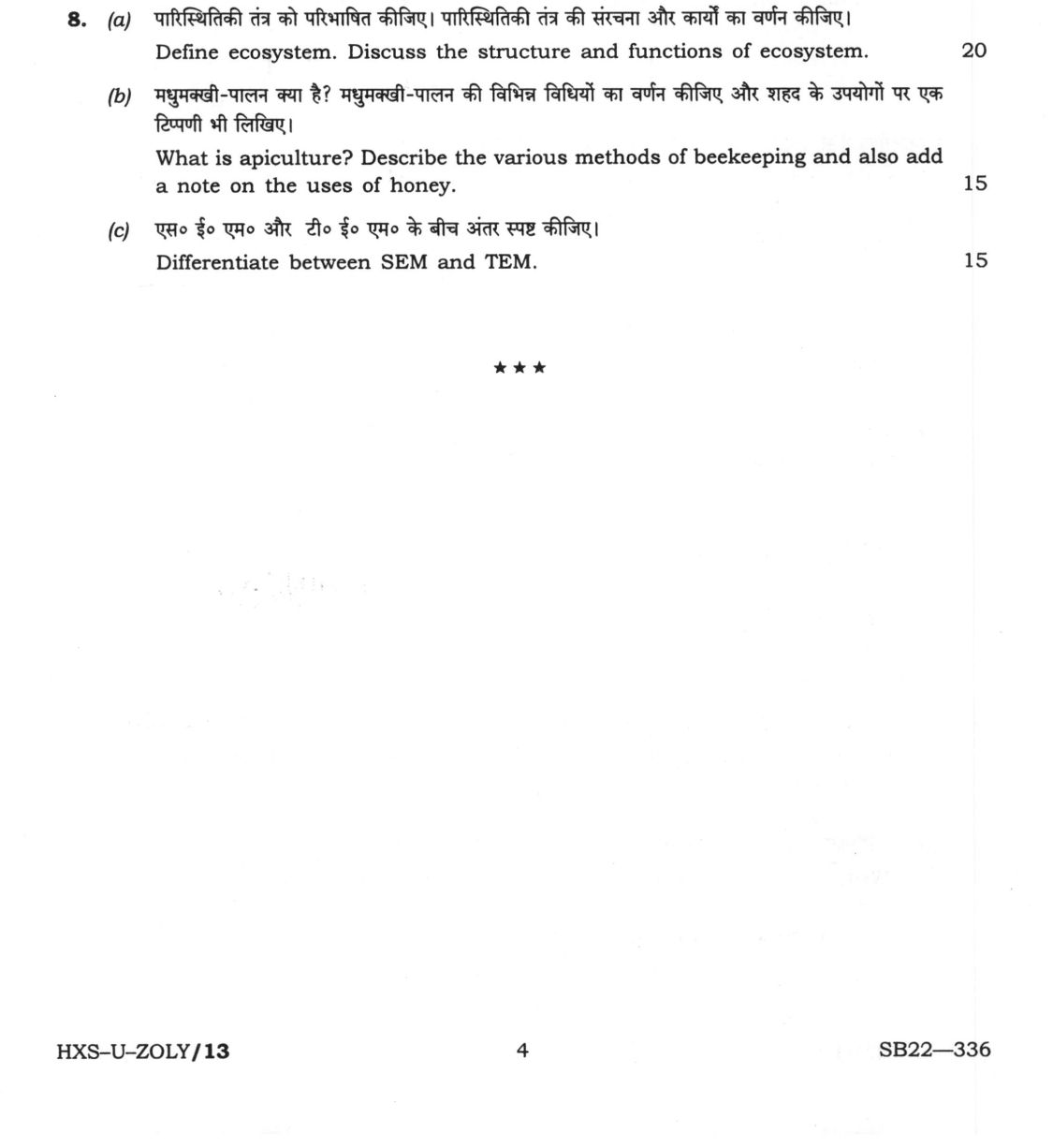
(a) Define ecosystem. Discuss the structure and functions of ecosystem. (20 marks) (b) What is apiculture? Describe the various…
Define ecosystem. Discuss the structure and functions of ecosystem. 20 marks
What is apiculture? Describe the various methods of beekeeping and also add a note on the uses of honey. 15 marks
Differentiate between SEM and TEM. 15 marks
हिंदी में प्रश्न पढ़ें
पारिस्थितिकी तंत्र को परिभाषित कीजिए। पारिस्थितिकी तंत्र की संरचना और कार्यों का वर्णन कीजिए। (20 अंक)
मधुमक्खी-पालन क्या है? मधुमक्खी-पालन की विभिन्न विधियों का वर्णन कीजिए और शहद के उपयोगों पर एक टिप्पणी भी लिखिए। (15 अंक)
एस० ई० एम० और टी० ई० एम० के बीच अंतर स्पष्ट कीजिए। (15 अंक)
Model answer
Written by UPSC Answer Check against this question's marking rubric, to the expected length. UPSC does not publish answers for Mains — this is one way to score well, not an official key.
An ecosystem is a functional unit in which biotic communities interact with their abiotic environment through energy flow and nutrient cycling. The term was coined by A. G. Tansley in 1935 and elaborated by E. P. Odum. Indian examples include Western Ghats forests, Sundarbans mangroves and Thar desert ecosystems.
Structure of ecosystem. Structurally, an ecosystem has biotic and abiotic components. Biotic components are producers (plants, algae, cyanobacteria), consumers (herbivores, carnivores, omnivores) and decomposers (bacteria, fungi). Abiotic components include physical factors such as light, temperature, water, soil and topography, and chemical factors such as pH, salinity, oxygen, carbon dioxide and nutrients. These form trophic levels: producers, primary consumers, secondary consumers and decomposers.
Functions of ecosystem. Functionally, an ecosystem performs energy flow and nutrient cycling. Solar energy enters through producers and passes through trophic levels; Lindeman’s 10% law states that only about 10% of energy is transferred from one trophic level to the next, the rest being lost as heat. Nutrients such as carbon, nitrogen, phosphorus and water are recycled through biogeochemical cycles. Ecological pyramids represent trophic structure. The pyramid of energy is invariably upright, while pyramids of numbers and biomass may be inverted, as in a tree ecosystem (numbers) or a marine phytoplankton ecosystem (biomass). Odum’s systems approach highlighted ecosystem services, homeostasis and stability, central to valuation of services such as pollination, water regulation and carbon sequestration.
Apiculture and beekeeping. Apiculture is the science and practice of managing honeybee colonies for honey, wax, pollen, propolis and pollination. In India, the main managed species are Apis cerana indica and Apis mellifera; wild species such as Apis dorsata and Apis florea are ecologically important and their products may be collected, but they are not normally maintained in hives for systematic apiculture. Beekeeping methods range from traditional fixed-comb hives made of logs, clay pots or bamboo, to transitional top-bar hives, and modern movable-frame hives such as the Langstroth hive and the Newton or Indian hive. Movable frames allow inspection, disease control, swarm management and honey extraction without destroying combs. Institutions such as the National Dairy Development Board and the Khadi and Village Industries Commission have promoted apiculture as a rural livelihood, especially among small farmers and tribal communities.
Uses of honey. Honey is a nutrient-rich source of sugars, vitamins and minerals. Medicinally, it has antimicrobial, anti-inflammatory and wound-healing properties and is used in traditional and modern preparations. It is also used in cosmetics, food processing, pharmaceuticals and industrial applications such as flavouring or preservative. Its pollination value is equally important for crop productivity and ecosystem health.
SEM and TEM. Scanning electron microscopy and transmission electron microscopy differ systematically. In SEM, a focused electron beam scans the surface of a specimen; secondary electrons emitted from the surface form a three-dimensional image of surface ultrastructure. In TEM, the electron beam passes through an ultrathin specimen; transmitted electrons form a two-dimensional image of internal organelles and membranes. Specimen preparation differs: SEM samples are usually dehydrated, critical-point dried and coated with metal, while TEM samples require ultrathin sectioning and heavy-metal staining. Resolution is higher in TEM, about 0.1–0.5 nm, compared with 3–10 nm in SEM; TEM also achieves greater magnification. SEM has greater depth of field and can examine larger, solid, dry or coated samples, whereas TEM requires very thin, conductive or stained sections. In zoology, SEM is used for studying insect cuticles, pollen grains, feather surfaces and parasite morphology, while TEM is used for visualizing mitochondria, nuclei, membranes, viruses and disease-related cellular changes.
Thus, ecosystem understanding, sustainable apiculture and electron microscopy are interconnected in modern zoology: ecological principles guide conservation and livelihoods, beekeeping applies pollinator biology to rural development, and electron microscopy provides the ultrastructural evidence needed for taxonomy, pathology and applied research.
What "Discuss" is asking you to do
Lay the issue out from more than one side — how it arose, what is claimed for it, what is held against it, and where it now stands. UPSC attaches discuss to broad topics with several live dimensions, so coverage of the dimensions earns more than the strength of your opinion.
Structure that answers it
Set the issue up → the case as it is made → the case against → the dimension both sides leave out → where the balance now lies
Where marks are lost
Listing facts with no thread between them, or arguing one side throughout and calling it a discussion.
How this answer will be evaluated
Approach
(a) discuss: intro > 3-4 dimensions > example > balanced close | (b) describe: define > structure or process in order > labelled diagram > significance | (c) compare: paired headings or table > key differences > significance > conclusion Full marks: Comprehensive coverage of all sub-parts with precise terminology, labelled diagrams, and specific examples.
Key points expected
- Precise definition of ecosystem (biotic + abiotic)
- Structure: Biotic (producers, consumers, decomposers) and Abiotic (physical/chemical)
- Function: Energy flow (unidirectional) and nutrient cycling (cyclic)
- Labelled diagram of energy flow or nutrient cycle
- Definition of apiculture (beekeeping for honey/pollination)
- Methods: Traditional (log hives) vs Modern (Langstroth/Frame hives)
- Uses of honey: Nutritional value, medicinal properties, industrial use
- Mention of specific bee species (e.g., Apis mellifera)
Evaluation rubric
Each sub-part is marked on its own, against the marks and word limit printed on the paper.
- (a) Define ecosystem and detail its structural components and functional processes. 20 marks
discuss— intro → 3-4 dimensions → example → balanced close
Must cover
- Precise definition of ecosystem (biotic + abiotic)
- Structure: Biotic (producers, consumers, decomposers) and Abiotic (physical/chemical)
- Function: Energy flow (unidirectional) and nutrient cycling (cyclic)
- Labelled diagram of energy flow or nutrient cycle
Loses marks
- Confusing energy flow with nutrient cycling
- Omitting the abiotic component in structure
- Diagram without labels
Earns more
- Mention of specific trophic levels (T1, T2, T3)
- Distinction between gross and net primary productivity
- Example of specific ecosystem type (e.g., forest, pond)
Extra mark
- Reference to Odum's definition or specific ecological pyramid types
- (b) Define apiculture, outline beekeeping methods, and list uses of honey. 15 marks
describe— define → structure or process in order → labelled diagram → significance
Must cover
- Definition of apiculture (beekeeping for honey/pollination)
- Methods: Traditional (log hives) vs Modern (Langstroth/Frame hives)
- Uses of honey: Nutritional value, medicinal properties, industrial use
- Mention of specific bee species (e.g., Apis mellifera)
Loses marks
- Failing to distinguish between traditional and modern methods
- Vague description of honey uses (e.g., 'good for health' only)
Earns more
- Details on hive management (swarming control, disease)
- Mention of other products (wax, royal jelly, propolis)
- Economic importance of apiculture
Extra mark
- Specific mention of Langstroth hive dimensions or specific honey diseases
- (c) Differentiate between Scanning Electron Microscope (SEM) and Transmission Electron Microscope (TEM). 15 marks
compare— paired headings or table → key differences → significance → conclusion
Must cover
- SEM: Surface imaging, 3D topography, electron beam scans surface
- TEM: Internal structure, 2D projection, electron beam passes through specimen
- Specimen preparation differences (coating vs thin sectioning)
- Resolution and magnification comparison
Loses marks
- Confusing surface vs internal imaging capabilities
- Failing to mention specimen preparation differences
Earns more
- Mention of specific applications (e.g., SEM for pollen, TEM for organelles)
- Details on electron lenses or vacuum requirements
- Comparison of depth of field
Extra mark
- Mention of specific magnification limits (e.g., 1000x vs 1,000,000x)
Practice this exact question
Write your answer and it is marked point by point against the model answer above — what you covered, what you missed, what you got wrong.
Evaluate my answer →More from Zoology 2021 Paper I
- Q5 Write notes on the following in about 150 words each : (a) Vermiculture (10 marks) (b) FI…
- Q6 (a) Define correlation. Explain its types and methods of computing coefficient of correla…
- Q7 (a) What is transgenesis? Describe the methods and applications of transgenesis in animal…
- Q8 (a) Define ecosystem. Discuss the structure and functions of ecosystem. (20 marks) (b) Wh…