Paper I — Q4
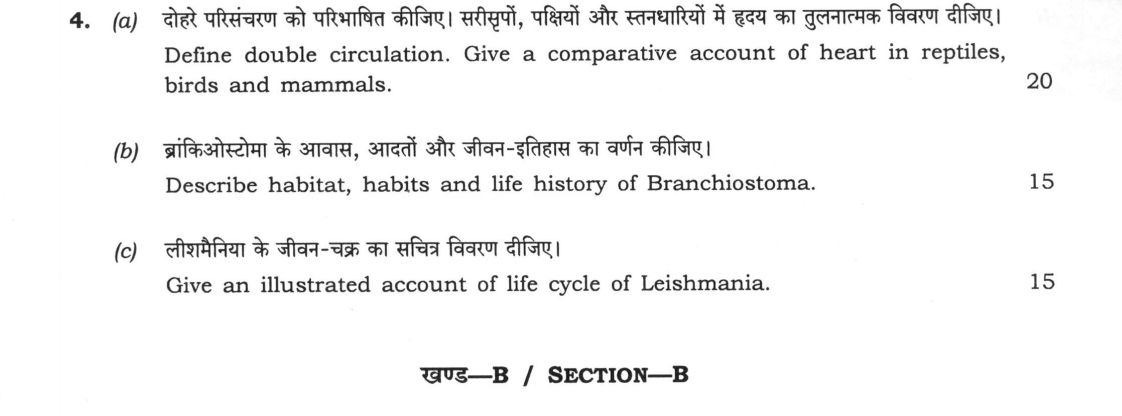
(a) Define double circulation. Give a comparative account of heart in reptiles, birds and mammals. (20 marks) (b) Describe…
Define double circulation. Give a comparative account of heart in reptiles, birds and mammals. 20 marks
Describe habitat, habits and life history of Branchiostoma. 15 marks
Give an illustrated account of life cycle of Leishmania. 15 marks
हिंदी में प्रश्न पढ़ें
दोहरे परिसंचरण को परिभाषित कीजिए। सरीसृपों, पक्षियों और स्तनधारियों में हृदय का तुलनात्मक विवरण दीजिए। (20 अंक)
ब्रांकिओस्टोमा के आवास, आदतों और जीवन-इतिहास का वर्णन कीजिए। (15 अंक)
लीशमैनिया के जीवन-चक्र का सचित्र विवरण दीजिए। (15 अंक)
Model answer
Written by UPSC Answer Check against this question's marking rubric, to the expected length. UPSC does not publish answers for Mains — this is one way to score well, not an official key.
Double Circulation and Comparative Heart Anatomy
Double circulation refers to a vascular mechanism wherein blood passes through the heart twice during a single complete circuit of the body, divided into two distinct pathways: the pulmonary circuit, which transports deoxygenated blood to the respiratory organs for oxygenation, and the systemic circuit, which delivers oxygenated blood to the body tissues. This arrangement ensures complete physical separation of oxygenated and deoxygenated blood, maintaining high systemic pressure and metabolic efficiency in homeotherms.
The vertebrate heart exhibits progressive evolutionary advancement from reptiles to birds and mammals, primarily marked by the gradual completion of the interventricular septum. In typical reptiles, the heart is three-chambered with two completely divided atria (sinus venosus reduced) and a single ventricle partially subdivided by an incomplete muscular interventricular septum into cavum venosum, cavum pulmonale, and cavum arteriosum. While some mixing occurs, separation is functionally maintained during systole. Crocodilians represent an exception, possessing a completely four-chambered heart with two atria and two ventricles, where cross-connection persists via the Foramen of Panizza between the left and right systemic arches.
In birds and mammals, the heart achieves complete structural four-chambered organization with two thin-walled atria and two thick-walled ventricles, entirely abolishing the mixing of blood. Sinus venosus and conus arteriosus are fully incorporated into the right atrium and base of major trunks, respectively. Avian hearts retain only the right systemic (aortic) arch arising from the left ventricle, whereas mammalian hearts retain solely the left systemic arch. In both classes, the evolution of a complete interventricular septum supports endothermy by sustaining high metabolic rates and targeted systemic hydrostatic pressures.
Habitat, Habits and Life History of Branchiostoma
Branchiostoma (Amphioxus or lancelet) is a primitive cephalochordate inhabiting shallow, warm, temperate, and tropical coastal waters with clean, coarse, sandy substrates, prominently recorded along Indian coasts including the Gulf of Mannar and Palk Bay.
It exhibits a sedentary, burrowing habit, remaining buried vertically in sand with only its anterior end bearing oral cirri protruding into water. It is a ciliary, microphagous filter-feeder; the beating of cilia on the wheel organ and gill bars creates a continuous water current entering the mouth, where the endostyle secretes mucus to trap food particles, which are then conveyed to the intestine. Locomotion occurs through fish-like lateral undulations driven by myotomes during nocturnal excursions.
The life history of Branchiostoma is simple and marine. Sexes are separate (dioecious) without sexual dimorphism, featuring about twenty-six pairs of gonads lacking gonoducts. Gametes are shed into the atrium and released via the atriopore for external fertilization. Cleavage is complete, equal, and holoblastic, producing a hollow blastula followed by invagination into a gastrula. Development proceeds through a free-swimming, asymmetric, ciliated larva that feeds for several months. Metamorphosis involves extensive tissue remodeling (metaplasia) rather than severe retrogressive degeneration, culminating in the burrowing adult that clearly retains all diagnostic chordate hallmarks: a persistent notochord extending from rostrum to tail, a dorsal hollow nerve cord, and numerous pharyngeal gill slits throughout life.
Life Cycle of Leishmania donovani
Leishmania donovani, the causative protozoan of Visceral Leishmaniasis (Kala-azar), exhibits a digenetic life cycle alternating between a vertebrate host (humans, canines) and an invertebrate vector, the female sandfly (Phlebotomus argentipes).
The parasite exists in two primary morphological stages: the intracellular, oval, non-flagellated amastigote form (Leishman-Donovan body) measuring two to four micrometres within human macrophages, and the extracellular, elongated, flagellated promastigote form measuring fifteen to twenty micrometres in the insect gut.
In humans, the cycle begins when an infected sandfly introduces metacyclic promastigotes during a blood meal. Host macrophages of the reticuloendothelial system engulf the promastigotes via phagocytosis. Inside the phagolysosome, promastigotes transform into amastigotes, which resist enzymatic lysis, multiply by binary fission, and eventually burst the host cell to invade fresh macrophages in the spleen, liver, and bone marrow.
When a sandfly feeds on an infected individual, it ingests amastigotes. In the insect midgut, amastigotes transform into procyclic promastigotes, multiply by longitudinal binary fission, and migrate to the pharynx and proboscis as infectious metacyclic promastigotes within six to nine days, completing the transmission cycle.
This pathogenic cycle underpins endemic visceral leishmaniasis across the Gangetic plains of India, notably Bihar, Jharkhand, and West Bengal, where targeted sandfly vector control and early antiparasitic therapy remain central to the National Vector Borne Disease Control Programme elimination mandate.
What "Describe" is asking you to do
Give a full, ordered account of the thing named — its parts, stages or mechanism — in the sequence in which it actually exists or occurs. Most describe questions come from the science optionals, where the marks sit in correct technical detail and, where the stem says so, a labelled diagram.
Structure that answers it
One-line identification of the subject → the parts or stages in their real order, each with its defining detail → labelled diagram where the subject is structural → closing line on function or significance
Where marks are lost
Loose general prose where the examiner is ticking named parts, correct terminology and their sequence; and in the General Studies papers, turning to evaluation before the description is finished.
How this answer will be evaluated
Approach
Framework: UPSC Zoology Paper 1. (a) compare: paired headings or table > key differences > significance > conclusion | (b) describe: define > structure or process in order > labelled diagram > significance | (c) describe: define > structure or process in order > labelled diagram > significance Full marks: Precise definitions, comparative tables, labelled diagrams, specific species names, and clear mechanisms.
Key points expected
- Precise definition of double circulation
- Reptile heart: 3-chambered, incomplete septum, mixing
- Bird/Mammal heart: 4-chambered, complete septum, no mixing
- Comparative table or paired headings for the three groups
- Habitat: Intertidal zone, sand, shallow water
- Habits: Burrowing, filter feeding, diurnal activity
- Life history: Direct development, no larval stage
- Mention of specific species (e.g., B. laticollaris)
Evaluation rubric
Each sub-part is marked on its own, against the marks and word limit printed on the paper.
- (a) Definition of double circulation and comparative anatomy of hearts in reptiles, birds, and mammals. 20 marks
compare— paired headings or table → key differences → significance → conclusion
Must cover
- Precise definition of double circulation
- Reptile heart: 3-chambered, incomplete septum, mixing
- Bird/Mammal heart: 4-chambered, complete septum, no mixing
- Comparative table or paired headings for the three groups
Loses marks
- Confusing reptile heart types (anuran vs crocodilian)
- Diagrams without labels
- Descriptive prose without comparative structure
Earns more
- Mention of specific reptile types (crocodilian vs others)
- Explanation of pulmonary vs systemic pressure
- Link to metabolic rate or endothermy
Extra mark
- Labelled comparative diagrams of the three hearts
- Mention of specific species (e.g., Crocodilus, Gallus, Rattus)
- (b) Habitat, habits, and life history of Branchiostoma. 15 marks
describe— define → structure or process in order → labelled diagram → significance
Must cover
- Habitat: Intertidal zone, sand, shallow water
- Habits: Burrowing, filter feeding, diurnal activity
- Life history: Direct development, no larval stage
- Mention of specific species (e.g., B. laticollaris)
Loses marks
- Confusing Branchiostoma with Amphioxus (if distinct)
- Vague habitat description (e.g., 'in water')
- Omitting life history details
Earns more
- Description of burrowing mechanism (ciliary action)
- Details on feeding apparatus (pharyngeal basket)
- Reproductive details (gonads, spawning)
Extra mark
- Labelled diagram of the burrow or feeding apparatus
- Mention of conservation status or specific locality
- (c) Illustrated account of the life cycle of Leishmania. 15 marks
describe— define → structure or process in order → labelled diagram → significance
Must cover
- Vector: Sandfly (Phlebotomus/Papatasi)
- Parasite stages: Promastigote (fly) to Amastigote (host)
- Transmission: Bite of infected female sandfly
- Labelled diagram of the cycle
Loses marks
- Missing the vector (sandfly)
- Confusing promastigote and amastigote stages
- Diagram without labels
Earns more
- Mention of specific disease (Kala-azar/Visceral Leishmaniasis)
- Details on multiplication in macrophages
- Mention of specific species (e.g., L. donovani)
Extra mark
- Diagram showing the sandfly and human host clearly
- Mention of specific geographic distribution
Practice this exact question
Write your answer and it is marked point by point against the model answer above — what you covered, what you missed, what you got wrong.
Evaluate my answer →More from Zoology 2021 Paper I
- Q1 Write notes in about 150 words each for Q. Nos. 1(a) to 1(d) and answer Q. No. 1(e) : (a)…
- Q2 (a) What is metamorphosis? Describe the hormonal regulation of metamorphosis in insects.…
- Q3 (a) What is hypothalamo-pituitary axis? Draw a well-labelled diagram of pituitary gland a…
- Q4 (a) Define double circulation. Give a comparative account of heart in reptiles, birds and…
- Q5 Write notes on the following in about 150 words each : (a) Vermiculture (10 marks) (b) FI…
- Q6 (a) Define correlation. Explain its types and methods of computing coefficient of correla…
- Q7 (a) What is transgenesis? Describe the methods and applications of transgenesis in animal…