Paper I — Q5
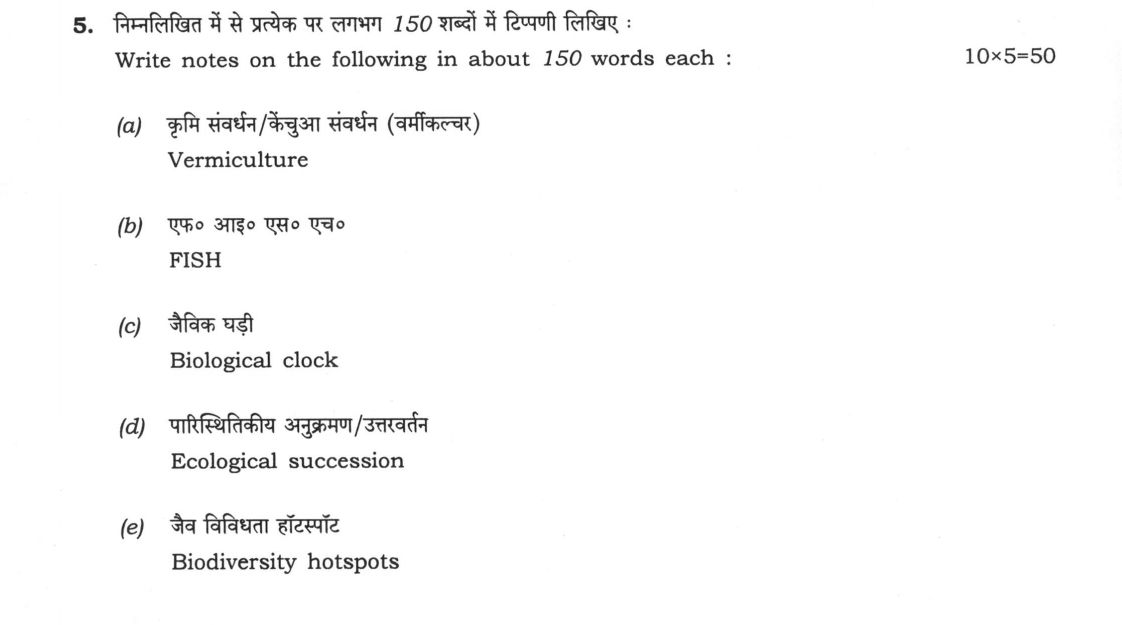
Write notes on the following in about 150 words each : (a) Vermiculture (10 marks) (b) FISH (10 marks) (c) Biological clock (10…
Write notes on the following in about 150 words each :
Vermiculture 10 marks
FISH 10 marks
Biological clock 10 marks
Ecological succession 10 marks
Biodiversity hotspots 10 marks
हिंदी में प्रश्न पढ़ें
निम्नलिखित में से प्रत्येक पर लगभग 150 शब्दों में टिप्पणी लिखिए :
कृमि संवर्धन/केंचुआ संवर्धन (वर्मीकल्चर) (10 अंक)
एफ० आई० एस० एच० (10 अंक)
जैविक घड़ी (10 अंक)
पारिस्थितिकीय अनुक्रमण/उत्तरवर्तन (10 अंक)
जैव विविधता हॉटस्पॉट (10 अंक)
Model answer
Written by UPSC Answer Check against this question's marking rubric, to the 150-word length. UPSC does not publish answers for Mains — this is one way to score well, not an official key.
(a) Vermiculture
Vermiculture refers to the controlled breeding and rearing of earthworms for organic waste management and the production of nutrient-rich vermicompost. The process employs specialized epigeic earthworm species, primarily Eisenia fetida (red wigglers) and Eudrilus eugeniae (African nightcrawler), which reside in the upper organic layer, exhibit voracious feeding habits, and tolerate wide environmental fluctuations.
Mechanistically, earthworms ingest organic solid wastes, grinding them biochemically within their gizzard alongside gut microflora. The resulting casts, termed vermicompost, are characterized by high porosity, water-holding capacity, and bioavailable macro- and micronutrients. A typical nutrient profile yields approximately 1.5–2.5% Nitrogen (N), 1.0–1.8% available Phosphorus (P), and 1.0–2.0% Potassium (K), enriched with plant growth-promoting substances such as auxins and gibberellins. In India, institutions like the Indian Council of Agricultural Research (ICAR) and the National Centre of Organic Farming have standardized low-cost vermicomposting technologies to convert agricultural and rural solid wastes into bio-fertilizers, reducing reliance on synthetic agrochemicals.
(b) FISH (Fluorescence In Situ Hybridization)
Fluorescence In Situ Hybridization (FISH) is a molecular cytogenetic technique used to detect, localize, and quantify specific DNA or RNA sequences directly on intact metaphase chromosomes or interphase nuclei. The mechanism involves denaturing the double-stranded target cellular DNA and hybridizing it with a fluorophore-labeled complementary single-stranded DNA probe. Upon hybridization, the locus-specific fluorescent signals are visualized and mapped using epifluorescence microscopy.
FISH bridges the resolution gap between conventional karyotyping and molecular sequencing. It is extensively applied in clinical diagnostics for identifying numerical aneuploidies, microdeletion syndromes, and prenatal chromosomal screening. In oncology, it detects critical gene amplifications and translocations, such as BCR-ABL1 in chronic myeloid leukemia and HER2/neu in breast cancer. In India, research institutes like the Centre for Cellular and Molecular Biology (CCMB), Hyderabad, routinely deploy FISH protocols for tracking constitutional chromosomal abnormalities, evolutionary genomics, and diagnostic mapping of human genetic disorders.
(c) Biological Clock
The biological clock is an endogenous, cell-autonomous timing mechanism that drives circadian rhythms—physiological, metabolic, and behavioral cycles that recur roughly every 24 hours in the absence of external cues, but remain entrainable by environmental zeitgebers such as light. In mammals, the master pacemaker is localized within the suprachiasmatic nucleus (SCN) of the anterior hypothalamus, receiving photic inputs directly via the retinohypothalamic tract.
At the molecular level, circadian oscillation operates through autoregulatory transcriptional-translational feedback loops (TTFL). The positive arm comprises transcription factors CLOCK and BMAL1, which bind to E-box elements to drive the expression of Period (per) and Cryptochrome (cry) genes. The synthesized PER and CRY proteins heterodimerize and translocate back to the nucleus to inhibit CLOCK:BMAL1 activity, generating self-sustained ~24-hour periodicity. Chronobiological applications include managing circadian disruptions such as jet lag, shift work sleep disorders, and metabolic derangements, frequently using timed exogenous melatonin therapy to facilitate phase-advance or phase-delay of the sleep-wake cycle.
(d) Ecological Succession
Ecological succession is the predictable, directional, and sequential replacement of biological communities in an ecosystem over time until a stable, self-perpetuating climax community is established. Succession is categorized into primary succession, which initiates on barren, sterile substrates previously devoid of life or organic soil, and secondary succession, which occurs on sites where a preexisting community was cleared by disturbances, retaining intact soil and viable seed banks.
The succession begins with pioneer species, proceeds through multiple transient seral stages that progressively modify soil chemistry and microclimate, and concludes at a dynamic climax equilibrium. An Indian example of primary succession is the biological colonization of fresh volcanic basalt on Barren Island in the Andaman Sea, progressing from lichens to ferns and grasses. Conversely, secondary succession is exemplified by the natural regeneration of secondary forest canopies and pioneer woody taxa in abandoned shifting cultivation sites and degraded tracts across the Western Ghats.
(e) Biodiversity Hotspots
Biodiversity hotspots are biogeographical regions characterized by exceptional concentrations of endemic species experiencing severe habitat destruction. As formulated by Norman Myers, a region must fulfill two strict quantitative criteria to qualify as a global hotspot: it must contain at least 1,500 species of vascular plants as endemics (>0.5% of the world’s total), and it must have lost at least 70% of its original primary native vegetation.
Globally, 36 hotspots have been designated, with four overlapping the Indian subcontinent: the Himalaya, Western Ghats–Sri Lanka, Indo-Burma, and Sundaland (including the Nicobar Islands). For instance, the Western Ghats encompass over 3,000 endemic vascular plant species alongside high degrees of amphibian and reptilian endemism. Hotspot demarcation serves as an indispensable conservation framework, enabling international and national agencies to prioritize resource allocation, guide the establishment of Protected Area Networks, and design targeted species recovery plans.
What "Write short notes" is asking you to do
Five or six self-contained answers, marked separately, typically 10 marks and about 150 words each. Each note must carry its own definition, its two or three defining features and a line on why it matters; a common introduction or conclusion across the notes earns nothing.
Structure that answers it
Per note: one-line definition or identification → two or three features, mechanisms or named examples → one line of significance or Indian application
Where marks are lost
Writing the first two notes at essay length and rationing the rest. Each note is marked on its own, so marks surrendered on a compressed or unattempted note cannot be won back by the long ones.
How this answer will be evaluated
Approach
Framework: Zoology Paper 1: Define > Structure/Mechanism > Diagram > Example. (a) write short notes: define > 3-4 key features > one example > one-line significance | (b) write short notes: define > 3-4 key features > one example > one-line significance | (c) write short notes: define > 3-4 key features > one example > one-line significance | (d) write short notes: define > 3-4 key features > one example > one-line significance | (e) write short notes: define > 3-4 key features > one example > one-line significance Full marks: Precise definitions, clear mechanisms, specific examples, and accurate terminology.
Key points expected
- Definition of vermicomposting
- Role of specific earthworm species (e.g., Eudrilus eugeniae)
- Process of vermicast formation
- Agricultural or environmental application
- Full form: Fluorescence In Situ Hybridization
- Principle of DNA probe binding
- Use in detecting chromosomal abnormalities
- One specific application (e.g., Down syndrome)
Evaluation rubric
Each sub-part is marked on its own, against the marks and word limit printed on the paper.
- (a) Define vermicomposting and explain the mechanism of organic waste conversion. · 150 words
write short notes— define → 3-4 key features → one example → one-line significance
Must cover
- Definition of vermicomposting
- Role of specific earthworm species (e.g., Eudrilus eugeniae)
- Process of vermicast formation
- Agricultural or environmental application
Loses marks
- Confusing vermicompost with general composting
- Omitting the role of earthworms
- Vague description of the process
Earns more
- Mention of vermi-jelly or vermi-liquid
- Comparison with traditional composting
- Diagram of vermicompost pit
Extra mark
- Specific scientific name of earthworm used
- Mention of specific nutrient content (NPK)
- (b) Define FISH and explain its use in detecting chromosomal abnormalities. · 150 words
write short notes— define → 3-4 key features → one example → one-line significance
Must cover
- Full form: Fluorescence In Situ Hybridization
- Principle of DNA probe binding
- Use in detecting chromosomal abnormalities
- One specific application (e.g., Down syndrome)
Loses marks
- Confusing FISH with PCR
- Failing to explain the mechanism
- No specific example given
Earns more
- Mention of fluorescent labels
- Comparison with G-banding
- Use in cancer cytogenetics
Extra mark
- Mention of specific probe types (BAC, cosmid)
- Reference to a specific clinical case
- (c) Define biological clock and explain the mechanism of circadian rhythm. · 150 words
write short notes— define → 3-4 key features → one example → one-line significance
Must cover
- Definition of biological clock
- Role of Suprachiasmatic Nucleus (SCN)
- Mechanism of circadian rhythm
- One example of a biological clock
Loses marks
- Confusing biological clock with general timekeeping
- Omitting the role of SCN
- No specific example given
Earns more
- Mention of melatonin
- Explanation of light-dark cycle
- Reference to jet lag
Extra mark
- Mention of specific genes (Period, Clock)
- Reference to a specific study
- (d) Define ecological succession and explain the stages of primary and secondary succession. · 150 words
write short notes— define → 3-4 key features → one example → one-line significance
Must cover
- Definition of ecological succession
- Distinction between primary and secondary succession
- Stages of succession (pioneer to climax)
- One example of succession
Loses marks
- Confusing succession with evolution
- Omitting the stages of succession
- No specific example given
Earns more
- Mention of specific pioneer species
- Explanation of climax community
- Reference to a specific ecosystem
Extra mark
- Mention of specific time scales
- Reference to a specific study
- (e) Define biodiversity hotspots and explain their significance in conservation. · 150 words
write short notes— define → 3-4 key features → one example → one-line significance
Must cover
- Definition of biodiversity hotspots
- Criteria for identifying hotspots
- Significance in conservation
- One specific example of a hotspot
Loses marks
- Confusing hotspots with general biodiversity
- Omitting the criteria for identification
- No specific example given
Earns more
- Mention of specific regions (e.g., Western Ghats)
- Explanation of endemism
- Reference to conservation efforts
Extra mark
- Mention of specific species
- Reference to a specific conservation organization
Practice this exact question
Write your answer and it is marked point by point against the model answer above — what you covered, what you missed, what you got wrong.
Evaluate my answer →More from Zoology 2021 Paper I
- Q2 (a) What is metamorphosis? Describe the hormonal regulation of metamorphosis in insects.…
- Q3 (a) What is hypothalamo-pituitary axis? Draw a well-labelled diagram of pituitary gland a…
- Q4 (a) Define double circulation. Give a comparative account of heart in reptiles, birds and…
- Q5 Write notes on the following in about 150 words each : (a) Vermiculture (10 marks) (b) FI…
- Q6 (a) Define correlation. Explain its types and methods of computing coefficient of correla…
- Q7 (a) What is transgenesis? Describe the methods and applications of transgenesis in animal…
- Q8 (a) Define ecosystem. Discuss the structure and functions of ecosystem. (20 marks) (b) Wh…