Paper II — Q1
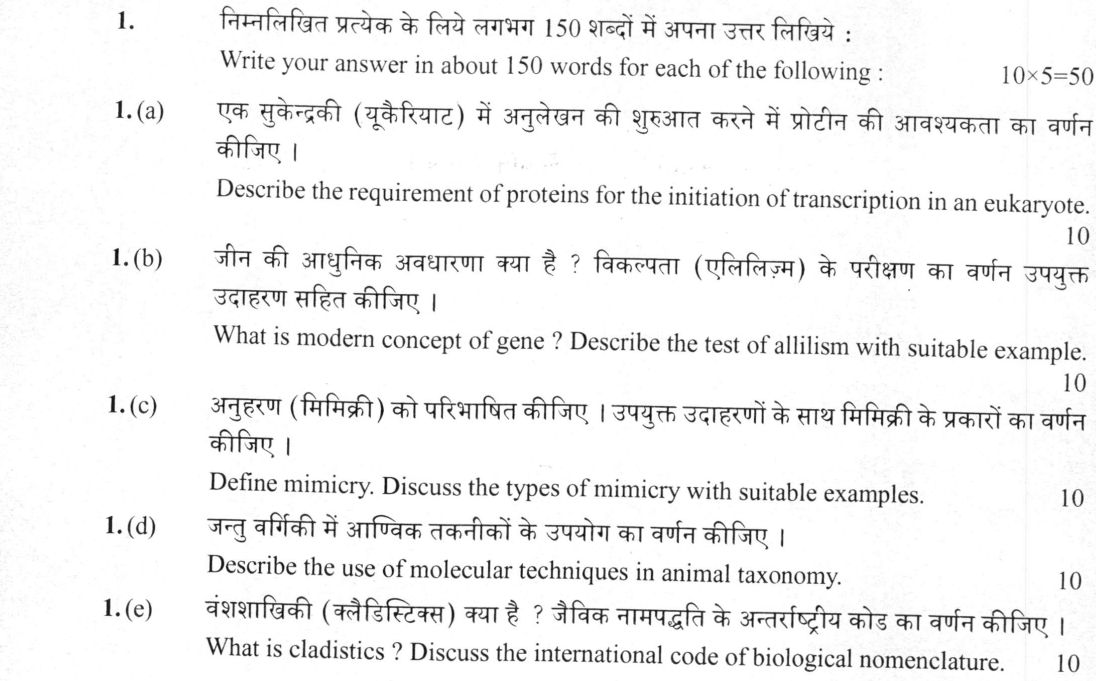
Write your answer in about 150 words for each of the following : 10×5=50 (a) Describe the requirement of proteins for the…
Write your answer in about 150 words for each of the following : 10×5=50
Describe the requirement of proteins for the initiation of transcription in an eukaryote. 10 marks
What is modern concept of gene ? Describe the test of allilism with suitable example. 10 marks
Define mimicry. Discuss the types of mimicry with suitable examples. 10 marks
Describe the use of molecular techniques in animal taxonomy. 10 marks
What is cladistics ? Discuss the international code of biological nomenclature. 10 marks
हिंदी में प्रश्न पढ़ें
निम्नलिखित प्रत्येक के लिये लगभग 150 शब्दों में अपना उत्तर लिखिये : 10×5=50
एक सुकेंद्रकी (यूकेरियाट) में अनुलेखन की शुरुआत करने में प्रोटीन की आवश्यकता का वर्णन कीजिए । 10
जीन की आधुनिक अवधारणा क्या है ? विकल्पता (एलिलिज्म) के परीक्षण का वर्णन उपयुक्त उदाहरण सहित कीजिए । 10
अनुहरण (मिमिक्री) को परिभाषित कीजिए । उपयुक्त उदाहरणों के साथ मिमिक्री के प्रकारों का वर्णन कीजिए । 10
जन्तु वर्गिकी में आणविक तकनीकों के उपयोग का वर्णन कीजिए । 10
वंशशाखिकी (क्लैडिस्टिक्स) क्या है ? जैविक नामपद्धति के अन्तर्राष्ट्रीय कोड का वर्णन कीजिए । 10
Model answer
Written by UPSC Answer Check against this question's marking rubric, to the 150-word length. UPSC does not publish answers for Mains — this is one way to score well, not an official key.
(a) Protein Requirements for Eukaryotic Transcription Initiation
Eukaryotic transcription initiation requires the coordinated assembly of RNA Polymerase II, General Transcription Factors (GTFs), and accessory co-activator complexes onto core promoter elements, including the TATA box, Initiator (Inr), and Downstream Promoter Element (DPE). Initiation begins when transcription factor TFIID, via its TATA-Binding Protein (TBP) subunit and TBP-Associated Factors (TAFs), binds specifically to the TATA box. TFIIA subsequently binds to stabilize the TFIID-DNA complex, while TFIIB recognizes the B recognition element (BRE) and acts as a molecular bridge between TFIID and RNA Polymerase II. TFIIF escorts RNA Polymerase II to the promoter, ensuring its precise positioning over the transcription start site. TFIIE then joins the assembly to recruit TFIIH, completing the Pre-Initiation Complex (PIC). TFIIH exerts ATP-dependent helicase activity to unwind the double helix, forming the open promoter complex, while its cyclin-dependent kinase subunit phosphorylates the C-terminal domain (CTD) of RNA Polymerase II at Serine-5 residues to facilitate promoter clearance. Gene-specific transcriptional activators and the multi-protein Mediator co-activator complex further stimulate PIC assembly and transition to elongation.
(b) Modern Concept of Gene and Test of Allelism
The modern concept of the gene departs from the classical bead-on-a-string hypothesis, defining the gene as a complex transcriptional and operational unit of heredity consisting of coding exons interrupted by non-coding introns (split genes). Genes can overlap to maximize genome economy, generate multiple protein isoforms via alternative splicing, and encode functional non-coding RNAs. Seymour Benzer redefined the gene into functional operational units: the cistron (unit of function), muton (smallest unit of mutation), and recon (smallest unit of recombination).
The test of allelism, or cis-trans complementation test developed by Benzer using the rII locus of bacteriophage T4, determines whether two independent recessive mutations occur within the same cistron or in separate cistrons. When two mutant genomes are introduced into Escherichia coli K12 in the *trans*-configuration (m₁ + / + m₂), complementation occurs if each mutant chromosome supplies a functional product missing in the other, resulting in wild-type lysis. This proves the mutations reside in different cistrons (rIIA and rIIB). If no lysis occurs, both mutations affect the same cistron and are allelic. The *cis*-configuration (m₁ m₂ / + +) always yields a wild-type phenotype, serving as an internal positive control.
(c) Mimicry: Definition and Types
Mimicry is the close morphological, behavioural, or physiological resemblance of one organism (the mimic) to another organism (the model) or an inanimate object, providing an evolutionary survival advantage against predation or foraging constraints.
Batesian mimicry involves an edible, palatable mimic resembling an unpalatable, toxic model to deter shared predators. In India, the palatable female Papilio polytes (Common Mormon butterfly) exhibits polymorphism, mimicking unpalatable models such as Pachliopta aristolochiae (Common Rose).
Müllerian mimicry occurs when two or more distinct unpalatable or defended species evolve convergent warning colouration (aposematism), thereby sharing the mortality cost of predator learning. Classic examples include the co-mimetic warning patterns of Danaine butterflies, such as Danaus chrysippus (Plain Tiger) and Euploea core (Common Indian Crow).
Aggressive mimicry involves predators or parasites mimicking harmless models or alluring cues to facilitate predation or host exploitation, as observed in the anglerfish (Lophius), which utilizes a modified dorsal fin spine (illicium) resembling prey.
Automimicry occurs when an organism mimics parts of its own body, such as false eyespots on the posterior wings of lycaenid butterflies, or when palatable individuals of a species chemically mimic defended conspecifics.
(d) Use of Molecular Techniques in Animal Taxonomy
Molecular techniques provide objective, discrete, and quantifiable characters to delimit taxa, reconstruct evolutionary phylogenies, and uncover cryptic biodiversity. DNA barcoding employs a standardized 648-base-pair region of the mitochondrial Cytochrome c Oxidase subunit I (COI) gene for rapid species-level identification and discrimination of cryptic sibling species, a protocol widely applied in Indian faunal surveys by the Zoological Survey of India. Restriction Fragment Length Polymorphism (RFLP) and DNA-DNA hybridization assess sequence divergence and overall genomic homology across species. Polymerase chain reaction (PCR)-based markers, including Random Amplified Polymorphic DNA (RAPD) and Amplified Fragment Length Polymorphism (AFLP), detect genetic polymorphism across populations. Variable number tandem repeats, such as microsatellites (SSRs) and Single Nucleotide Polymorphism (SNP) genotyping, resolve fine-scale phylogeography and hybridization boundaries. Furthermore, sequencing of nuclear ribosomal genes (18S and 28S rDNA) alongside mitochondrial markers (16S rRNA and Cytochrome b) enables multi-locus phylogenetic reconstruction, resolving deep evolutionary relationships and species complexes where morphological characters exhibit evolutionary homoplasy.
(e) Cladistics and the International Code of Zoological Nomenclature
Cladistics, or phylogenetic systematics, is an evolutionary classification framework based on shared derived character states (synapomorphies) to reconstruct natural monophyletic lineages, comprising an ancestor and all its descendants. Unlike phenetics based on overall similarity or evolutionary systematics that permits paraphyly, cladistics strictly utilizes derived characters to generate hierarchical branching diagrams known as cladograms, while excluding shared ancestral traits (symplesiomorphies).
The International Code of Zoological Nomenclature (ICZN) establishes the formal rules governing the naming of animal taxa: Binomial nomenclature mandates that every species name consists of a Latinized binomen, comprising a capitalized genus name and a lowercase specific epithet (e.g., Panthera tigris). The Principle of Priority dictates that the oldest validly published name applied to a taxon, starting from Linnaeus's Systema Naturae (10th edition, 1758), takes precedence. The Principle of Typification requires that every nominal taxon be permanently anchored to an objective type specimen (such as a holotype or lectotype) deposited in an accessible public museum or scientific repository. Publication criteria mandate distribution in permanent, widely accessible scientific media, complete with Latinized grammatical consistency and diagnostic descriptions. Higher-taxon nomenclature enforces standardized suffixes to define rank, notably -idae for families and -inae for subfamilies.
What "Describe" is asking you to do
Give a full, ordered account of the thing named — its parts, stages or mechanism — in the sequence in which it actually exists or occurs. Most describe questions come from the science optionals, where the marks sit in correct technical detail and, where the stem says so, a labelled diagram.
Structure that answers it
One-line identification of the subject → the parts or stages in their real order, each with its defining detail → labelled diagram where the subject is structural → closing line on function or significance
Where marks are lost
Loose general prose where the examiner is ticking named parts, correct terminology and their sequence; and in the General Studies papers, turning to evaluation before the description is finished.
How this answer will be evaluated
Approach
Framework: Zoology Paper 2: Define > Structure/Mechanism > Diagram > Example. (a) describe: define > structure or process in order > labelled diagram > significance | (b) describe: define > structure or process in order > labelled diagram > significance | (c) define: precise definition > the distinguishing feature > one example | (d) describe: define > structure or process in order > labelled diagram > significance | (e) discuss: intro > 3-4 dimensions > example > balanced close Full marks: Precise mechanisms, named species, and clear logical flow for all parts.
Key points expected
- Role of TATA box and promoter recognition
- Function of TFIID and TBP (TATA-binding protein)
- Assembly of Pre-Initiation Complex (PIC)
- Role of TFIIH in promoter melting
- Definition of gene as functional unit (cistron)
- Explanation of Complementation Test (cis-trans)
- Interpretation of results (complementation vs non-complementation)
- Suitable example (e.g., Drosophila eye color)
Evaluation rubric
Each sub-part is marked on its own, against the marks and word limit printed on the paper.
- (a) Mechanism of eukaryotic transcription initiation involving specific proteins. 10 marks · 150 words
describe— define → structure or process in order → labelled diagram → significance
Must cover
- Role of TATA box and promoter recognition
- Function of TFIID and TBP (TATA-binding protein)
- Assembly of Pre-Initiation Complex (PIC)
- Role of TFIIH in promoter melting
Loses marks
- Confusing prokaryotic sigma factor with eukaryotic TFIID
- Omitting the role of TFIID/TBP
- Vague description without naming specific factors
Earns more
- Mention of specific TFs (TFIIB, TFIIE, TFIIF)
- Distinction between general and specific factors
- Mention of RNA Pol II recruitment
Extra mark
- Labelled diagram of PIC assembly
- Mention of chromatin remodeling
- (b) Modern definition of gene and the test of allilism with example. 10 marks · 150 words
describe— define → structure or process in order → labelled diagram → significance
Must cover
- Definition of gene as functional unit (cistron)
- Explanation of Complementation Test (cis-trans)
- Interpretation of results (complementation vs non-complementation)
- Suitable example (e.g., Drosophila eye color)
Loses marks
- Defining gene only as a segment of DNA
- Failing to explain the logic of the test
- Confusing linkage with allilism
Earns more
- Distinction between gene and cistron
- Mention of introns/exons in modern concept
- Clear logic of the test
Extra mark
- Mention of specific Drosophila genes (e.g., white, brown)
- Reference to Beadle and Tatum
- (c) Definition of mimicry and discussion of its types with examples. 10 marks · 150 words
define— precise definition → the distinguishing feature → one example
Must cover
- Precise definition of mimicry
- Batesian mimicry (harmless mimics harmful)
- Mullerian mimicry (harmless mimics harmless)
- Suitable examples for each type
Loses marks
- Confusing mimicry with camouflage
- Missing one of the main types (Batesian/Mullerian)
- Vague examples without specific taxa
Earns more
- Mention of Brookesian mimicry
- Explanation of evolutionary advantage
- Distinction from camouflage
Extra mark
- Specific species names (e.g., Viceroy/Monarch)
- Mention of predator learning
- (d) Application of molecular techniques in animal taxonomy. 10 marks · 150 words
describe— define → structure or process in order → labelled diagram → significance
Must cover
- Use of DNA barcoding (COI gene)
- Molecular phylogenetics (evolutionary relationships)
- Resolution of cryptic species
- Advantages over morphological taxonomy
Loses marks
- Focusing only on DNA barcoding
- Failing to link to taxonomic classification
- Vague mention of 'DNA testing'
Earns more
- Mention of specific markers (16S rRNA, 18S rRNA)
- Mention of DNA-DNA hybridization
- Link to conservation (identifying protected species)
Extra mark
- Mention of specific software (e.g., MEGA)
- Reference to BOLD database
- (e) Definition of cladistics and discussion of the International Code of Biological Nomenclature. 10 marks · 150 words
discuss— intro → 3-4 dimensions → example → balanced close
Must cover
- Definition of cladistics (monophyletic groups)
- Principle of common ancestry
- Key principles of ICZN (priority, type species)
- Rules of nomenclature (binomial nomenclature)
Loses marks
- Confusing cladistics with phenetics
- Failing to mention the Code of Nomenclature
- Vague description of nomenclature rules
Earns more
- Mention of synapomorphies
- Distinction between ICZN and ICN (plants)
- Mention of holotype
Extra mark
- Mention of specific ICZN articles
- Example of a taxonomic revision
Practice this exact question
Write your answer and it is marked point by point against the model answer above — what you covered, what you missed, what you got wrong.
Evaluate my answer →More from Zoology 2021 Paper II
- Q1 Write your answer in about 150 words for each of the following : 10×5=50 (a) Describe the…
- Q2 (a) What is cell cycle ? Draw an overview of molecular events during cell cycle. Discuss…
- Q3 (a) What is chromosome mutation ? Describe various types of polyploidy with suitable exam…
- Q4 (a) What is isolation ? Describe the major isolating mechanisms which lead to speciation.…