Paper II — Q3
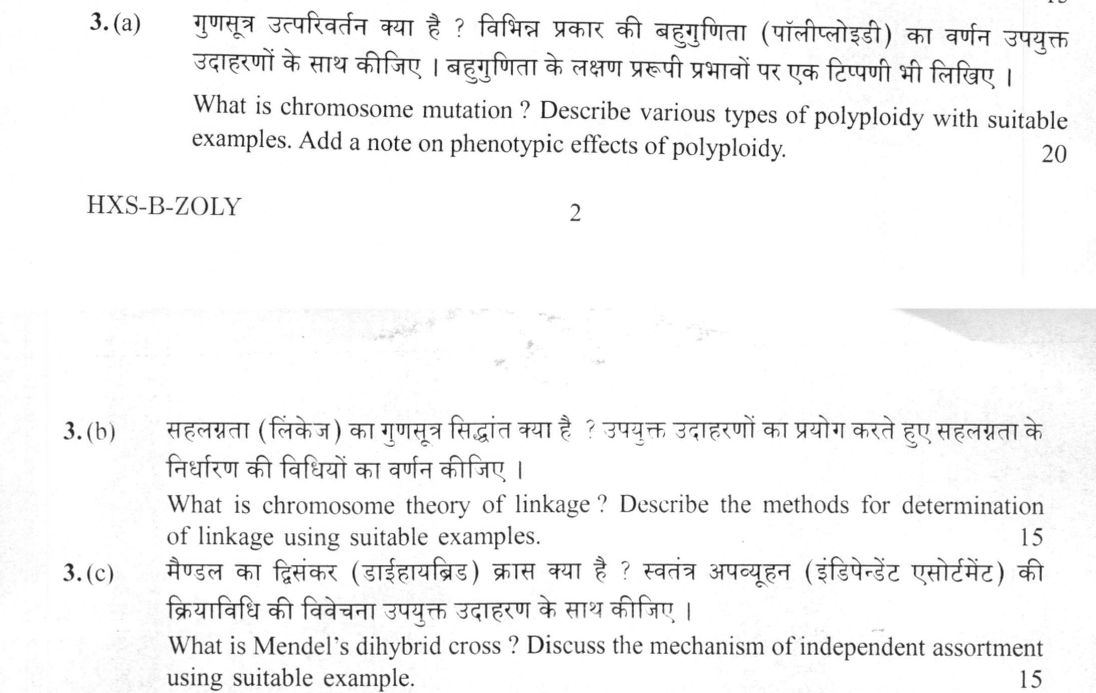
(a) What is chromosome mutation ? Describe various types of polyploidy with suitable examples. Add a note on phenotypic effects…
What is chromosome mutation ? Describe various types of polyploidy with suitable examples. Add a note on phenotypic effects of polyploidy. 20 marks
What is chromosome theory of linkage ? Describe the methods for determination of linkage using suitable examples. 15 marks
What is Mendel's dihybrid cross ? Discuss the mechanism of independent assortment using suitable example. 15 marks
हिंदी में प्रश्न पढ़ें
गुणसूत्र उत्परिवर्तन क्या है ? विभिन्न प्रकार की बहुगुणिता (पॉलीप्लॉइडी) का वर्णन उपयुक्त उदाहरणों के साथ कीजिए । बहुगुणिता के लक्षण प्रकृति प्रभावों पर एक टिप्पणी भी लिखिए । 20
सहलग्नता (लिंकेज) का गुणसूत्र सिद्धांत क्या है ? उपयुक्त उदाहरणों का प्रयोग करते हुए सहलग्नता के निर्धारण की विधियों का वर्णन कीजिए । 15
मैंडल का द्विसंकर (डाइहाइब्रिड) क्रॉस क्या है ? स्वतंत्र अपव्यूहन (इंडिपेंडेंट असॉर्टमेंट) की क्रियाविधि की विवेचना उपयुक्त उदाहरण के साथ कीजिए । 15
Model answer
Written by UPSC Answer Check against this question's marking rubric, to the expected length. UPSC does not publish answers for Mains — this is one way to score well, not an official key.
Chromosome mutation is a heritable change in chromosome number or structure, unlike gene mutation which alters a base pair within a gene. In polyploidy, whole sets of chromosomes are added. Autopolyploidy arises from duplication within one species: autotriploids (3x) and autotetraploids (4x). Potato (Solanum tuberosum) is a naturally occurring autotetraploid, and colchicine can experimentally induce tetraploidy in other plants. Allopolyploidy arises by hybridisation between related species followed by chromosome doubling, giving a new fertile species. Bread wheat (Triticum aestivum) is an allohexaploid with 2n = 6x = 42, genome AABBDD. Raphanobrassica (2n = 36) is an amphidiploid from Raphanus and Brassica. Modern commercial sugarcane, based on Saccharum officinarum, is a high polyploid, often octoploid with 2n = 80, and is best treated as a complex allopolyploid/aneuploid hybrid rather than a simple autotetraploid. Phenotypically, polyploids show gigantism, larger cells, thicker leaves, delayed flowering, and sometimes reduced fertility in odd ploids. Their evolutionary significance is high in plants, because reproductive isolation after chromosome doubling can produce instant speciation. Applied significance includes crop improvement in Indian wheat and cotton breeding, where polyploidy increases vigour, yield potential and stress tolerance.
Chromosome theory of linkage. Sutton and Boveri postulated that chromosomes are the physical carriers of genes, that homologues segregate during meiosis, and that linked genes remain together because they occupy the same chromosome. Complete linkage occurs when two loci are so close that no crossing over is detected between them; incomplete linkage occurs when crossing over produces recombinant gametes. The strength of linkage depends on distance along the chromosome. Methods of determination begin with a two-point test cross: a heterozygote for two markers is crossed to a homozygous recessive tester, and recombinants are counted. Recombination frequency equals recombinants divided by total progeny, multiplied by 100; one per cent recombination is one map unit or centimorgan. In maize, shrunken (sh) and waxy (wx) are close on the same chromosome and give a small map distance, about 2.8 map units. In Drosophila, singed (sn) and lumpy (lp) on chromosome IV can be scored similarly. Three-point test crosses use three markers to detect double crossovers, determine gene order, and construct a genetic map. If the order is A-B-C, the map distance is the sum of adjacent intervals corrected for double crossovers. This distinguishes linkage from independent assortment: linked genes travel together unless separated by crossing over, while unlinked genes on different chromosomes assort independently.
Mendel's dihybrid cross and independent assortment. Mendel crossed true-breeding yellow round (YYRR) with green wrinkled (yyrr) peas. The F1 was yellow round (YyRr). Selfing F1 gave the 9:3:3:1 phenotypic ratio: 9 yellow round, 3 yellow wrinkled, 3 green round, 1 green wrinkled. The parental phenotypes are yellow round and green wrinkled; the recombinant phenotypes are yellow wrinkled and green round. The ratio is derived from four equally probable gametes, YR, Yr, yR and yr, produced by independent segregation of the two gene pairs. Cytologically, independent assortment occurs at metaphase I of meiosis: each homologous pair aligns randomly at the equator, and at anaphase I homologues separate. For two pairs, the orientation of one pair is independent of the other, giving four gamete types in equal numbers. A simple annotated diagram would show two bivalent pairs, one vertical and one horizontal, with four possible orientations and resulting gametes. Statistical validation uses chi-square tests to compare observed and expected 9:3:3:1 counts. The mechanism explains why unlinked traits show Mendelian ratios, whereas linked traits deviate. Its applied significance is in breeding programmes, where independent assortment generates new combinations and contributes to hybrid vigour, while linkage mapping helps breeders select marker-trait associations.
What "Describe" is asking you to do
Give a full, ordered account of the thing named — its parts, stages or mechanism — in the sequence in which it actually exists or occurs. Most describe questions come from the science optionals, where the marks sit in correct technical detail and, where the stem says so, a labelled diagram.
Structure that answers it
One-line identification of the subject → the parts or stages in their real order, each with its defining detail → labelled diagram where the subject is structural → closing line on function or significance
Where marks are lost
Loose general prose where the examiner is ticking named parts, correct terminology and their sequence; and in the General Studies papers, turning to evaluation before the description is finished.
How this answer will be evaluated
Approach
Framework: Zoology Paper 2: Define > Structure/Mechanism > Diagram > Example. (a) describe: define > structure or process in order > labelled diagram > significance | (b) describe: define > structure or process in order > labelled diagram > significance | (c) discuss: intro > 3-4 dimensions > example > balanced close Full marks: Precise definitions, clear mechanisms, specific examples, and correct ratios/calculations.
Key points expected
- Define chromosome mutation as structural/numerical change
- Distinguish autopolyploidy from allopolyploidy
- Provide specific examples (e.g., Triticum, Gossypium)
- Detail phenotypic effects (gigas effect, sterility)
- Define linkage (Morgan's theory)
- Explain recombination frequency calculation
- Describe mapping function (Haldane/Kosambi)
- Provide a worked example of linkage
Evaluation rubric
Each sub-part is marked on its own, against the marks and word limit printed on the paper.
- (a) Define chromosome mutation and classify polyploidy types with examples and phenotypic effects. 20 marks
describe— define → structure or process in order → labelled diagram → significance
Must cover
- Define chromosome mutation as structural/numerical change
- Distinguish autopolyploidy from allopolyploidy
- Provide specific examples (e.g., Triticum, Gossypium)
- Detail phenotypic effects (gigas effect, sterility)
Loses marks
- Confusing polyploidy with aneuploidy
- Missing phenotypic effects section
- No specific examples provided
Earns more
- Mention triploidy or aneuploidy
- Reference colchicine induction
- Mention specific plant species names
- Diagram of polyploid formation
Extra mark
- Mention specific commercial crops (e.g., banana)
- Reference specific researcher (e.g., Dujardin)
- (b) State chromosome theory of linkage and methods for its determination. 15 marks
describe— define → structure or process in order → labelled diagram → significance
Must cover
- Define linkage (Morgan's theory)
- Explain recombination frequency calculation
- Describe mapping function (Haldane/Kosambi)
- Provide a worked example of linkage
Loses marks
- Confusing linkage with independent assortment
- No calculation of recombination frequency
- Vague description of mapping
Earns more
- Mention crossing over mechanism
- Reference Drosophila experiments
- Mention interference and coincidence
- Diagram of linkage map
Extra mark
- Mention specific gene loci (e.g., white, yellow)
- Reference specific mapping function formula
- (c) Explain Mendel's dihybrid cross and the mechanism of independent assortment. 15 marks
discuss— intro → 3-4 dimensions → example → balanced close
Must cover
- Define dihybrid cross (two traits)
- Show 9:3:3:1 phenotypic ratio
- Explain independent assortment mechanism (meiosis)
- Provide a specific example (e.g., pea plant)
Loses marks
- Confusing dihybrid with monohybrid
- Missing 9:3:3:1 ratio
- No explanation of meiotic mechanism
Earns more
- Punnett square diagram
- Mention gamete formation
- Reference Mendel's original experiments
- Mention test cross
Extra mark
- Mention specific gene symbols (e.g., YyRr)
- Reference specific pea traits (e.g., seed color)
Practice this exact question
Write your answer and it is marked point by point against the model answer above — what you covered, what you missed, what you got wrong.
Evaluate my answer →More from Zoology 2021 Paper II
- Q1 Write your answer in about 150 words for each of the following : 10×5=50 (a) Describe the…
- Q2 (a) What is cell cycle ? Draw an overview of molecular events during cell cycle. Discuss…
- Q3 (a) What is chromosome mutation ? Describe various types of polyploidy with suitable exam…
- Q4 (a) What is isolation ? Describe the major isolating mechanisms which lead to speciation.…
- Q5 Write your answer in about 150 words for each of the following : 10×5=50 (a) Fatty acids…
- Q6 (a) What are peptide hormones ? With the help of schematic diagram, discuss the epinephri…