Paper II — Q4
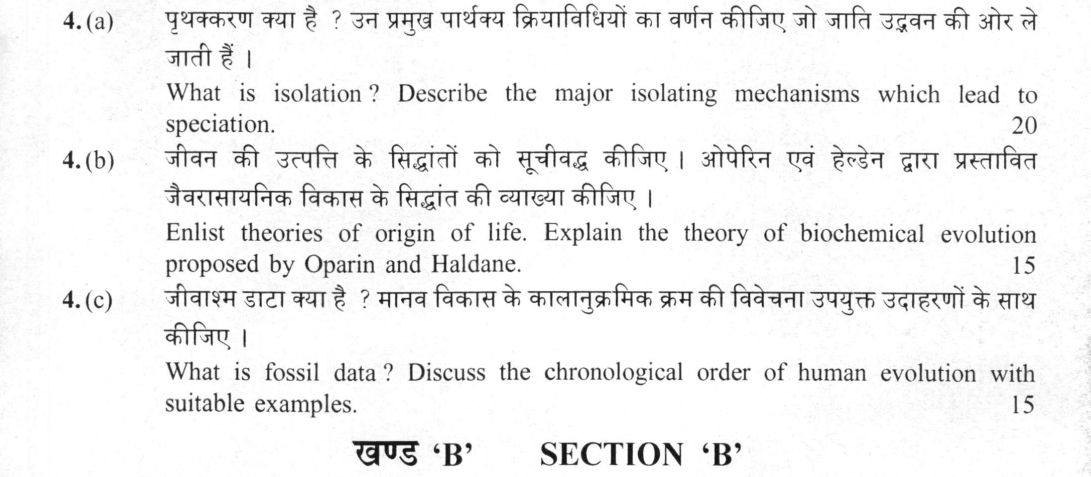
(a) What is isolation ? Describe the major isolating mechanisms which lead to speciation. 20 (b) Enlist theories of origin of…
What is isolation ? Describe the major isolating mechanisms which lead to speciation. 20 marks
Enlist theories of origin of life. Explain the theory of biochemical evolution proposed by Oparin and Haldane. 15 marks
What is fossil data ? Discuss the chronological order of human evolution with suitable examples. 15 marks
हिंदी में प्रश्न पढ़ें
पृथक्करण क्या है ? उन प्रमुख पार्थक्य क्रियाविधियों का वर्णन कीजिए जो जाति उद्भवन की ओर ले जाती हैं । 20
जीवन की उत्पत्ति के सिद्धांतों को सूचीबद्ध कीजिए । ओपेरिन एवं हेल्डेन द्वारा प्रस्तावित जैवरासायनिक विकास के सिद्धांत की व्याख्या कीजिए । 15
जीवाश्म डाटा क्या है ? मानव विकास के कालानुक्रमिक क्रम की विवेचना उपयुक्त उदाहरणों के साथ कीजिए । 15
Model answer
Written by UPSC Answer Check against this question's marking rubric, to the expected length. UPSC does not publish answers for Mains — this is one way to score well, not an official key.
Isolation and Isolating Mechanisms in Speciation
Isolation refers to any biological, ecological, or physical barrier that prevents interbreeding and gene flow between populations of the same or closely related species. It allows populations to follow independent evolutionary trajectories, accumulating mutations, genetic drift, and selective adaptations, which ultimately leads to reproductive isolation and cladogenesis (speciation). Isolating mechanisms are categorized into pre-zygotic and post-zygotic mechanisms.
Pre-zygotic mechanisms prevent mating or fertilization. Ecological or habitat isolation occurs when populations occupy different niches in the same geographic region, such as Bufo fowleri (breeding in still water) and Bufo americanus (breeding in temporary rain puddles). Temporal or seasonal isolation arises when species breed at different times of day or seasons, as seen in Rana aurora (breeding earlier in spring) and Rana boylii (breeding later). Ethological or behavioral isolation relies on species-specific courtship signals, such as distinctive flashing patterns in fireflies or mating songs in sympatric warblers. Mechanical isolation results from anatomical incompatibility of genitalia (the "lock-and-key" model), common in insects like Drosophila species and specialized orchids. Gametic isolation involves biochemical or immunological incompatibility between sperm and egg, preventing fertilization, as seen among sympatric sea urchins of the genus Strongylocentrotus.
Post-zygotic mechanisms act after fertilization, reducing hybrid fitness. Zygotic mortality and hybrid inviability occur when hybrid embryos fail to develop normally due to incompatible developmental gene complexes, observed in crosses between Rana pipiens and Rana sylvatica. Hybrid sterility produces sterile adults with defective gametogenesis due to chromosomal non-homology, famously exemplified by the mule (female horse × male donkey). Hybrid breakdown allows F1 hybrids to be viable and fertile, but subsequent F2 generations exhibit inviability or sterility, as seen in interspecific cotton hybrids (Gossypium).
Theories of Origin of Life and the Oparin-Haldane Biochemical Evolution
The origin of life has been explained by several paradigms: the Theory of Special Creation, the Theory of Spontaneous Generation (Abiogenesis, disproved by Pasteur), the Theory of Biogenesis, the Cosmozoic/Panspermia Theory (Arrhenius), and the Modern Biochemical or Chemical Evolution Theory.
The Oparin-Haldane hypothesis posited that life arose through gradual chemical evolution under the reducing conditions of the primitive Earth, which possessed methane, ammonia, free hydrogen, and water vapour, but lacked free molecular oxygen (O₂). Energy from ultraviolet radiation, volcanic heat, and lightning drove the synthesis of simple organic monomers (amino acids, purines, pyrimidines, simple sugars) in the oceans, forming a prebiotic "hot dilute soup." Subsequent polymerisation produced complex macromolecules like polypeptides and polynucleotides. These polymers aggregated into colloidal, self-organizing droplet systems termed coacervates (by Oparin) or protobionts, possessing a rudimentary boundary layer and localized catalytic metabolic reactions. The incorporation of self-replicating nucleic acids marked the origin of the first living entities: primitive, anaerobic, heterotrophic cells. These ancestral heterotrophs subsequently diversified into chemoautotrophs and photoautotrophs, releasing oxygen and converting the primitive reducing atmosphere into an oxidising one.
Fossil Data and Chronological Sequence of Human Evolution
Fossil data encompasses the preserved physical remains (body fossils such as bones and teeth), preserved activity markers (trace fossils like footprints and stone tools), and ancient biomolecules (chemical fossils) extracted from sedimentary strata. These are chronologically dated using absolute radiometric techniques (¹⁴C dating, Potassium-Argon, and Argon-Argon dating) and relative stratigraphic correlation.
The fossil-documented lineage of human evolution reveals a clear chronological sequence:
Dryopithecus (Late Miocene, ~20–15 Ma) represents an arboreal, common hominoid ancestor with generalized dentition.
Ramapithecus and Sivapithecus (Late Miocene, ~14–8 Ma), recovered extensively from the Siwalik Hills of India, showed reduced canines, thicker molar enamel, and a semi-erect posture.
Australopithecus (Pliocene, ~4–2 Ma), exemplified by A. afarensis ("Lucy") and A. africanus, exhibited obligate bipedalism, a bowl-shaped pelvis, and a small cranial capacity of 400–500 cc.
Homo habilis (Early Pleistocene, ~2.4–1.4 Ma, cranial capacity ~650–800 cc) marked the emergence of the genus Homo, associated with the first manufactured Oldowan stone tools ("Handy Man").
Homo erectus (~1.8 Ma–200 ka, cranial capacity ~900–1100 cc) displayed fully modern upright posture, controlled use of fire, and Acheulean handaxes (e.g., Java Man, Peking Man). In the Indian subcontinent, the Narmada hominid fossil discovered at Hathnora (Madhya Pradesh) represents this mid-Pleistocene evolutionary phase.
Homo sapiens neanderthalensis (~300–30 ka, cranial capacity ~1400–1450 cc) possessed heavy supraorbital ridges, Mousterian tool technology, and intentional burial rituals.
Homo sapiens sapiens (Late Pleistocene to present, ~300 ka onward, represented fossil-wise by Cro-Magnon, cranial capacity ~1350–1400 cc) is characterized by a prominent chin, high orthognathous cranium, refined blade-tool industries, and abstract cave art.
Throughout this lineage, the major evolutionary trends include the progressive reduction of facial prognathism and brow ridges, acquisition of an erect posture with a lumbar curvature and an opposable thumb, and profound encephalization tightly correlated with cultural complexity and tool use. Thus, microevolutionary isolating mechanisms and macroevolutionary chemical-to-biological transitions together explain the diversification of life culminant in hominid phylogeny.
What "Describe" is asking you to do
Give a full, ordered account of the thing named — its parts, stages or mechanism — in the sequence in which it actually exists or occurs. Most describe questions come from the science optionals, where the marks sit in correct technical detail and, where the stem says so, a labelled diagram.
Structure that answers it
One-line identification of the subject → the parts or stages in their real order, each with its defining detail → labelled diagram where the subject is structural → closing line on function or significance
Where marks are lost
Loose general prose where the examiner is ticking named parts, correct terminology and their sequence; and in the General Studies papers, turning to evaluation before the description is finished.
How this answer will be evaluated
Approach
(a) describe: define > structure or process in order > labelled diagram > significance | (b) explain: definition/context > points in order > small example > short close | (c) discuss: intro > 3-4 dimensions > example > balanced close Full marks: Comprehensive coverage of all parts with precise terminology, clear mechanisms, and specific examples.
Key points expected
- Precise definition of reproductive isolation
- Pre-zygotic mechanisms (e.g., temporal, behavioral)
- Post-zygotic mechanisms (e.g., hybrid sterility)
- Linkage of mechanisms to speciation
- List of major origin theories
- Oparin-Haldane theory of primordial soup
- Stages of chemical evolution (monomers to polymers)
- Role of reducing atmosphere/energy sources
Evaluation rubric
Each sub-part is marked on its own, against the marks and word limit printed on the paper.
- (a) Define isolation and detail the specific mechanisms preventing gene flow. 20 marks
describe— define → structure or process in order → labelled diagram → significance
Must cover
- Precise definition of reproductive isolation
- Pre-zygotic mechanisms (e.g., temporal, behavioral)
- Post-zygotic mechanisms (e.g., hybrid sterility)
- Linkage of mechanisms to speciation
Loses marks
- Confusing isolation with migration
- Listing mechanisms without explaining function
- Vague generalities without specific examples
Earns more
- Distinction between allopatric and sympatric
- Specific examples of isolating barriers
- Mention of genetic drift or selection
Extra mark
- Diagram of reproductive isolation types
- Reference to specific speciation models
- (b) List origin theories and detail the Oparin-Haldane biochemical evolution model. 15 marks
explain— definition/context → points in order → small example → short close
Must cover
- List of major origin theories
- Oparin-Haldane theory of primordial soup
- Stages of chemical evolution (monomers to polymers)
- Role of reducing atmosphere/energy sources
Loses marks
- Confusing origin of life with evolution
- Omitting the specific Oparin-Haldane mechanism
- Vague description of 'primordial soup'
Earns more
- Mention of Miller-Urey experiment
- Explanation of coacervates or microspheres
- Comparison with other theories
Extra mark
- Diagram of chemical evolution stages
- Reference to RNA world hypothesis
- (c) Define fossil data and outline the chronological sequence of human evolution. 15 marks
discuss— intro → 3-4 dimensions → example → balanced close
Must cover
- Definition of fossil data and its utility
- Chronological order of hominid evolution
- Key species (e.g., Australopithecus, H. erectus)
- Suitable examples of fossil evidence
Loses marks
- Skipping key evolutionary stages
- Confusing fossil data with genetic data
- Lack of chronological sequence
Earns more
- Mention of specific fossil sites (e.g., Laetoli)
- Discussion of brain size changes
- Reference to bipedalism development
Extra mark
- Timeline diagram of human evolution
- Mention of specific fossil names (e.g., Lucy)
Practice this exact question
Write your answer and it is marked point by point against the model answer above — what you covered, what you missed, what you got wrong.
Evaluate my answer →More from Zoology 2021 Paper II
- Q1 Write your answer in about 150 words for each of the following : 10×5=50 (a) Describe the…
- Q2 (a) What is cell cycle ? Draw an overview of molecular events during cell cycle. Discuss…
- Q3 (a) What is chromosome mutation ? Describe various types of polyploidy with suitable exam…
- Q4 (a) What is isolation ? Describe the major isolating mechanisms which lead to speciation.…
- Q5 Write your answer in about 150 words for each of the following : 10×5=50 (a) Fatty acids…
- Q6 (a) What are peptide hormones ? With the help of schematic diagram, discuss the epinephri…
- Q7 (a) Explain the basic stimuli causing pancreatic secretion. Discuss the role of pancreas…