Paper II — Q5
Write your answer in about 150 words for each of the following : 10×5=50 (a) Fatty acids regulate the nature of lipids, justify…
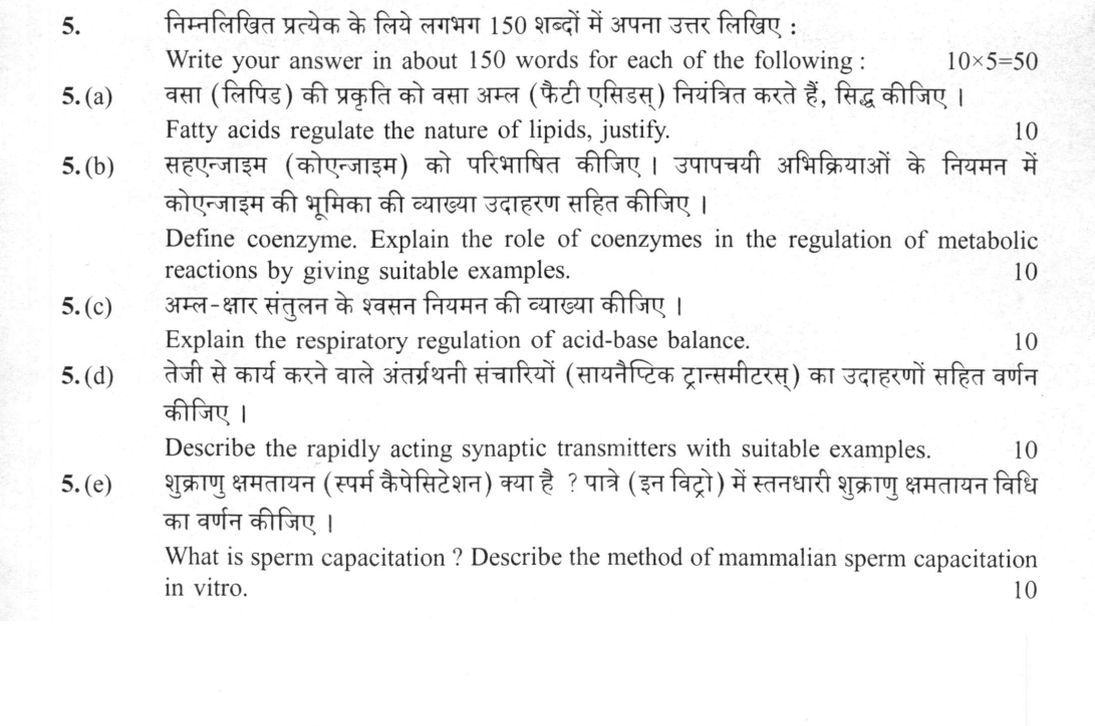
Write your answer in about 150 words for each of the following : 10×5=50
Fatty acids regulate the nature of lipids, justify. 10 marks
Define coenzyme. Explain the role of coenzymes in the regulation of metabolic reactions by giving suitable examples. 10 marks
Explain the respiratory regulation of acid-base balance. 10 marks
Describe the rapidly acting synaptic transmitters with suitable examples. 10 marks
What is sperm capacitation ? Describe the method of mammalian sperm capacitation in vitro. 10 marks
हिंदी में प्रश्न पढ़ें
निम्नलिखित प्रत्येक के लिए लगभग 150 शब्दों में अपना उत्तर लिखिए : 10×5=50
वसा (लिपिड) की प्रकृति को वसा अम्ल (फैटी एसिड्स) नियंत्रित करते हैं, सिद्ध कीजिए । 10
सहएंजाइम (कोएंजाइम) को परिभाषित कीजिए । उपापचयी अभिक्रियाओं के नियमन में कोएंजाइम की भूमिका की व्याख्या उदाहरण सहित कीजिए । 10
अम्ल-क्षार संतुलन के श्वसन नियमन की व्याख्या कीजिए । 10
तेजी से कार्य करने वाले अंतःप्रदर्शी संचारियों (सायनैप्टिक ट्रांसमिटर्स) का उदाहरणों सहित वर्णन कीजिए । 10
शुक्राणु क्षमतायन (स्पर्म कैपेसिटेशन) क्या है ? पात्रे (इन विट्रो) में स्तनधारी शुक्राणु क्षमतायन विधि का वर्णन कीजिए । 10
Model answer
Written by UPSC Answer Check against this question's marking rubric, to the 150-word length. UPSC does not publish answers for Mains — this is one way to score well, not an official key.
(a) Fatty acids are determinants of lipid behaviour because their saturation and chain length set packing, melting point and phase state. Although head groups and sterols modify membranes, acyl chain composition sets the baseline physical state. Saturated chains are straight and pack tightly, raising melting temperature and making lipids more solid; stearic acid, a saturated 18-carbon acid, contributes to rigid, high-melting membranes. Unsaturated chains contain cis double bonds that introduce kinks, reduce van der Waals contacts, lower melting point and increase fluidity; oleic acid, a monounsaturated 18-carbon acid, keeps phospholipid bilayers more mobile. Longer chains increase hydrophobic interactions and raise melting point, while shorter chains lower it. In membranes, the saturated to unsaturated ratio controls fluidity, domain formation, enzyme activity and transport. Thus, when an organism changes diet or temperature, it alters fatty acid composition to maintain membrane function, which justifies the statement that fatty acids regulate the nature of lipids.
(b) A coenzyme is a small non-protein organic cofactor that binds transiently to an enzyme and participates directly in electron, atom or group transfer, becoming regenerated in the reaction. Many coenzymes are vitamins or their derivatives. NAD+ and NADH are central mitochondrial dehydrogenase coenzymes: NAD+ accepts hydride from substrates such as lactate, isocitrate and alpha-ketoglutarate, and NADH donates electrons to respiratory chain complexes. The NADH/NAD+ ratio therefore signals the cellular redox state and directly controls the rate of dehydrogenases; high NADH slows oxidative decarboxylation, while high NAD+ favours it. FAD is tightly bound to succinate dehydrogenase, where it accepts electrons from succinate to form fumarate and passes them to ubiquinone, linking the citric acid cycle to the electron transport chain. Coenzyme availability thus regulates metabolic flux. For example, high NADH and acetyl-CoA favour pyruvate dehydrogenase kinase activity, which phosphorylates and inhibits pyruvate dehydrogenase, preventing unnecessary entry of pyruvate into the cycle.
(c) The respiratory system regulates acid-base balance mainly by controlling excretion of carbon dioxide, a volatile acid. Carbon dioxide and water form carbonic acid, which dissociates to hydrogen ion and bicarbonate, so changing ventilation changes hydrogen ion concentration. The Henderson-Hasselbalch relation is pH = 6.1 + log10([HCO3-] mmol/L / (0.03 x PaCO2 mm Hg)), where PaCO2 is measured in mm Hg. Normal arterial pH is 7.35 to 7.45. When PaCO2 rises, as in hypoventilation or airway obstruction, carbon dioxide retention lowers pH; central and peripheral chemoreceptors stimulate ventilation, increasing CO2 elimination and restoring pH. Hypoxia also stimulates peripheral chemoreceptors, while hypercapnia is the dominant respiratory acid-base stimulus. Renal compensation follows over hours to days by retaining bicarbonate or excreting acid. In veterinary practice, respiratory acidosis may occur in obstructed animals, while metabolic acidosis in ruminant acidosis is managed by correcting the cause and, only when severe, by bicarbonate therapy.
(d) Rapidly acting synaptic transmitters at chemical synapses are small molecules that bind ionotropic receptors, opening ion channels directly and producing millisecond changes in postsynaptic membrane potential. Acetylcholine is a classic example: at the neuromuscular junction it binds nicotinic receptors, opens sodium channels, and causes fast excitatory postsynaptic potentials and muscle contraction. Glutamate is the main excitatory transmitter in most central nervous system neurons; binding AMPA receptors opens sodium and sometimes calcium channels, producing fast excitation. GABA is the main inhibitory transmitter; GABA-A receptors are chloride channels, so GABA-A activation typically hyperpolarises or shunts the postsynaptic cell, producing fast inhibition. These ionotropic actions are brief because the transmitter is rapidly removed by reuptake, diffusion or enzymatic breakdown, as with acetylcholinesterase. They differ from slow neuromodulators such as dopamine, serotonin or neuropeptides, which usually act through metabotropic receptors, second messengers and longer-lasting changes in excitability, synaptic strength or gene expression.
(e) Sperm capacitation is the post-ejaculatory maturation of mammalian sperm in the female reproductive tract, involving membrane cholesterol loss, protein tyrosine phosphorylation, calcium changes and motility changes, which enable the acrosome reaction and fertilisation. In vitro capacitation mimics this by first removing seminal plasma and immotile sperm. Swim-up allows progressively motile sperm to migrate into a fresh medium, while Percoll or density gradient centrifugation separates motile sperm from debris and leukocytes. The selected sperm are then incubated in capacitating media such as TALP or HTF, usually with bovine serum albumin, at 37 degrees C in 5 percent CO2, for several hours. After capacitation, the acrosome reaction is assessed or induced using calcium ionophore A23187 or heparin; these agents trigger the acrosome reaction and are not themselves capacitating agents. Applied in assisted reproduction and cryopreservation of Indian Murrah buffalo semen, it shows capacitation is a controlled maturation step essential for fertilisation.
What "Justify" is asking you to do
Defend a position with reasons that carry evidence, and show why the contrary view does not hold. Where the stem runs as a question and asks you to justify your answer, the position is yours to choose and the marks lie wholly in the defence.
Structure that answers it
Position stated plainly → reason 1 with evidence → reason 2 with evidence → strongest objection, met → position restated as qualified
Where marks are lost
Reasons stated and none of them evidenced. The other standard loss is fence-sitting — an answer that finds merit on both sides and commits to neither has justified nothing.
How this answer will be evaluated
Approach
Framework: Zoology Paper 2: Define > Structure/Mechanism > Diagram > Example. (a) justify: claim > 3-4 reasons > evidence > conclusion | (b) explain: definition/context > points in order > small example > short close | (c) explain: definition/context > points in order > small example > short close | (d) describe: define > structure or process in order > labelled diagram > significance | (e) describe: define > structure or process in order > labelled diagram > significance Full marks: Precise definitions, specific examples, clear mechanisms, and correct terminology throughout.
Key points expected
- Mention saturation state (saturated vs unsaturated)
- Link chain length to melting point
- Explain effect on membrane fluidity
- Reference specific lipid classes (e.g., phospholipids)
- Precise definition of coenzyme
- Distinguish from prosthetic groups
- Explain role in electron/group transfer
- Provide specific examples (e.g., NAD+, FAD, CoA)
Evaluation rubric
Each sub-part is marked on its own, against the marks and word limit printed on the paper.
- (a) Claim that fatty acids regulate lipid nature with 3-4 reasons and evidence. 10 marks · 150 words
justify— claim → 3-4 reasons → evidence → conclusion
Must cover
- Mention saturation state (saturated vs unsaturated)
- Link chain length to melting point
- Explain effect on membrane fluidity
- Reference specific lipid classes (e.g., phospholipids)
Loses marks
- General description without specific mechanism
- Confusing fatty acids with proteins
Earns more
- Mention cis/trans isomerism effects
- Reference specific fatty acids (e.g., oleic, palmitic)
Extra mark
- Diagram of lipid bilayer fluidity
- (b) Define coenzyme and explain role in metabolic regulation with examples. 10 marks · 150 words
explain— definition/context → points in order → small example → short close
Must cover
- Precise definition of coenzyme
- Distinguish from prosthetic groups
- Explain role in electron/group transfer
- Provide specific examples (e.g., NAD+, FAD, CoA)
Loses marks
- Confusing coenzymes with vitamins
- Lack of specific examples
Earns more
- Mention specific metabolic pathways (e.g., TCA cycle)
- Explain regeneration of coenzymes
Extra mark
- Diagram of coenzyme structure
- (c) Explain respiratory regulation of acid-base balance. 10 marks · 150 words
explain— definition/context → points in order → small example → short close
Must cover
- Link CO2 levels to blood pH
- Explain role of chemoreceptors
- Describe respiratory center response
- Mention hyperventilation/hypoventilation mechanisms
Loses marks
- Focusing only on renal regulation
- Ignoring the role of CO2
Earns more
- Reference bicarbonate buffer system
- Mention central vs peripheral chemoreceptors
Extra mark
- Diagram of respiratory control center
- (d) Describe rapidly acting synaptic transmitters with examples. 10 marks · 150 words
describe— define → structure or process in order → labelled diagram → significance
Must cover
- Define rapidly acting transmitters
- Distinguish from slow-acting (neurohormones)
- Name specific examples (e.g., ACh, GABA, Glutamate)
- Explain mechanism of action (ionotropic receptors)
Loses marks
- Including slow-acting transmitters as primary examples
- Lack of specific examples
Earns more
- Mention specific synapses (e.g., neuromuscular junction)
- Explain reuptake/degradation mechanisms
Extra mark
- Diagram of synaptic cleft
- (e) Define sperm capacitation and describe in vitro method. 10 marks · 150 words
describe— define → structure or process in order → labelled diagram → significance
Must cover
- Define sperm capacitation
- Explain physiological changes (e.g., hyperactivation)
- Describe in vitro method (e.g., incubation in medium)
- Mention specific media (e.g., TLR, HTF)
Loses marks
- Confusing capacitation with acrosome reaction
- Lack of specific in vitro details
Earns more
- Mention role of cholesterol efflux
- Explain acrosome reaction readiness
Extra mark
- Diagram of capacitated vs non-capacitated sperm
Practice this exact question
Write your answer and it is marked point by point against the model answer above — what you covered, what you missed, what you got wrong.
Evaluate my answer →More from Zoology 2021 Paper II
- Q2 (a) What is cell cycle ? Draw an overview of molecular events during cell cycle. Discuss…
- Q3 (a) What is chromosome mutation ? Describe various types of polyploidy with suitable exam…
- Q4 (a) What is isolation ? Describe the major isolating mechanisms which lead to speciation.…
- Q5 Write your answer in about 150 words for each of the following : 10×5=50 (a) Fatty acids…
- Q6 (a) What are peptide hormones ? With the help of schematic diagram, discuss the epinephri…
- Q7 (a) Explain the basic stimuli causing pancreatic secretion. Discuss the role of pancreas…
- Q8 (a) What are morphogens ? Describe the cellular differentiation during morphogenesis. 20…