Paper II — Q8
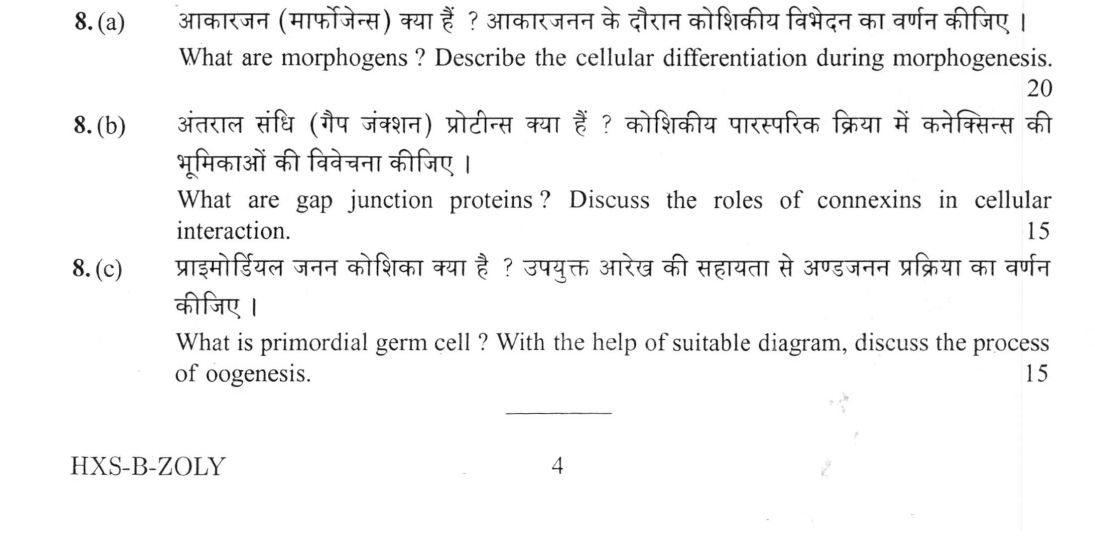
(a) What are morphogens ? Describe the cellular differentiation during morphogenesis. 20 (b) What are gap junction proteins ?…
What are morphogens ? Describe the cellular differentiation during morphogenesis. 20 marks
What are gap junction proteins ? Discuss the roles of connexins in cellular interaction. 15 marks
What is primordial germ cell ? With the help of suitable diagram, discuss the process of oogenesis. 15 marks
हिंदी में प्रश्न पढ़ें
आकारजन (मॉर्फोजेनेसिस) क्या है ? आकारजनन के दौरान कोशिकीय विभेदन का वर्णन कीजिए । 20
अन्तराल संधि (गैप जंक्शन) प्रोटीन्स क्या हैं ? कोशिकीय पारस्परिक क्रिया में कनेक्सिन्स की भूमिकाओं की विवेचना कीजिए । 15
प्राइमोर्डियल जनन कोशिका क्या है ? उपयुक्त आरेख की सहायता से अंडजनन प्रक्रिया का वर्णन कीजिए । 15
Model answer
Written by UPSC Answer Check against this question's marking rubric, to the expected length. UPSC does not publish answers for Mains — this is one way to score well, not an official key.
Morphogens are developmental signalling molecules whose concentration determines cell fate. They are not merely inducers; they supply graded positional information. They provide positional information along embryonic axes: in Drosophila, Bicoid forms an anterior gradient and acts as a transcription factor, while in vertebrates Sonic hedgehog, Wnt and FGF form gradients that pattern the neural tube, limb and body axes. The gradient is read by cells through graded transcriptional responses, so identical cells at different positions adopt different fates. Morphogenesis is the ordered conversion of a blastula into shaped tissues and organs, and cellular differentiation within it proceeds through specification, determination and terminal differentiation. First, cells acquire competence: a group of cells becomes able to respond to a particular signal because of its lineage and gene-regulatory state. Second, exposure to a morphogen gradient at a threshold concentration activates or represses specific transcription factors, producing determination; for example, high Shh induces ventral neural tube fates, intermediate levels intermediate fates, low levels dorsal fates. This is not simply receptor binding for all morphogens: secreted morphogens such as Shh signal through membrane receptors, whereas Bicoid enters the nucleus and directly controls target genes. Third, determined cells execute differential gene expression, changing cytoskeletal organisation, adhesion, migration, proliferation and apoptosis, so that epithelia, mesenchyme, muscle and nerve acquire distinct shapes and functions. Morphogenesis also requires coordinated cell shape changes, adhesion and extracellular matrix remodelling. Thus morphogen gradients convert a homogeneous field into patterned, differentiated tissues.
Gap junction proteins are integral membrane proteins that form intercellular channels permitting direct cytoplasmic communication. In vertebrates, connexins assemble into hexameric connexons, or hemichannels; two connexons from adjacent cells dock to form a continuous channel. In invertebrates, innexins form analogous channels, but their hemichannels are not called connexons. Pannexins are vertebrate large-pore channels and are generally not treated as gap junction proteins. Connexin channels pass ions, metabolites, ATP, cAMP and Ca2+, allowing metabolic coupling, electrical synchronisation and regulation of signalling. In embryonic patterning, they coordinate proliferation, differentiation and morphogenetic movements by synchronising intracellular signals across cell groups, as in lens, neural tube and somite development. In adult tissues, connexin 43 couples cardiac myocytes for coordinated contraction, and connexin 36 synchronises neuronal firing. By sharing second messengers and metabolites, connexins also modulate growth factor and morphogen signalling, ensuring that neighbouring cells behave as a functional unit.
Primordial germ cells are the embryonic precursors of sperm and ova. In humans they are specified in the epiblast near the hindgut, largely through BMP signalling, and then migrate along the dorsal mesentery to the developing gonadal ridges. Oogenesis begins when oogonia proliferate mitotically in the fetal ovary. Some oogonia enter meiosis I and become primary oocytes, which arrest in prophase I, the dictyate stage, surrounded by a zona pellucida and follicle cells. A suitable diagram would show a central oocyte with surrounding follicular layers: primordial follicle, primary follicle, secondary follicle with antrum, mature Graafian follicle, ovulation, and post-ovulatory corpus luteum. The diagram should also show the first polar body extruded after meiosis I and the second polar body after fertilisation. From puberty, each month a primary oocyte resumes meiosis I, completes it to form a large secondary oocyte and a small first polar body, then arrests at metaphase II. The secondary oocyte is ovulated while still arrested at metaphase II; meiosis II is completed only if sperm entry occurs, producing an ovum and a second polar body. If fertilisation does not occur, the secondary oocyte degenerates.
Together, these processes show how development is coordinated: morphogens establish positional identity, gap junctions synchronise neighbouring cells, and PGCs preserve the germline, ensuring that differentiated somatic tissues and reproductive continuity are both produced from the embryo.
What "Describe" is asking you to do
Give a full, ordered account of the thing named — its parts, stages or mechanism — in the sequence in which it actually exists or occurs. Most describe questions come from the science optionals, where the marks sit in correct technical detail and, where the stem says so, a labelled diagram.
Structure that answers it
One-line identification of the subject → the parts or stages in their real order, each with its defining detail → labelled diagram where the subject is structural → closing line on function or significance
Where marks are lost
Loose general prose where the examiner is ticking named parts, correct terminology and their sequence; and in the General Studies papers, turning to evaluation before the description is finished.
How this answer will be evaluated
Approach
Framework: UPSC Zoology Paper 2. (a) describe: define > structure or process in order > labelled diagram > significance | (b) discuss: intro > 3-4 dimensions > example > balanced close | (c) discuss: intro > 3-4 dimensions > example > balanced close Full marks: Precise definitions, detailed mechanisms, and clear, labelled diagrams.
Key points expected
- Define morphogens as concentration-dependent signaling molecules
- Explain the concept of the morphogen gradient
- Describe the process of cellular differentiation (e.g., induction)
- Provide a specific example (e.g., Bicoid in Drosophila)
- Define gap junctions as intercellular channels
- Identify connexins as the protein subunits
- Explain the formation of the connexon hexamer
- Describe the role in intercellular communication (electrical/chemical)
Evaluation rubric
Each sub-part is marked on its own, against the marks and word limit printed on the paper.
- (a) Define morphogens and explain the mechanism of cellular differentiation during morphogenesis. 20 marks
describe— define → structure or process in order → labelled diagram → significance
Must cover
- Define morphogens as concentration-dependent signaling molecules
- Explain the concept of the morphogen gradient
- Describe the process of cellular differentiation (e.g., induction)
- Provide a specific example (e.g., Bicoid in Drosophila)
Loses marks
- Confusing morphogens with general growth factors
- Describing differentiation without linking to morphogen concentration
- Vague description of 'cell changes' without mechanism
Earns more
- Mention specific signaling pathways (e.g., Wnt, Hedgehog)
- Discuss the role of transcription factors
- Reference the French Flag model
Extra mark
- Draw a labelled diagram of a morphogen gradient
- Mention specific gene names (e.g., Hox genes)
- (b) Define gap junction proteins and discuss the specific roles of connexins in cellular interaction. 15 marks
discuss— intro → 3-4 dimensions → example → balanced close
Must cover
- Define gap junctions as intercellular channels
- Identify connexins as the protein subunits
- Explain the formation of the connexon hexamer
- Describe the role in intercellular communication (electrical/chemical)
Loses marks
- Confusing gap junctions with tight junctions
- Failing to mention the connexon structure
- Describing only electrical coupling without chemical signaling
Earns more
- Mention the role in tissue homeostasis
- Discuss the selectivity of the channel (size/charge)
- Reference specific connexin types (e.g., Cx43)
Extra mark
- Draw a labelled diagram of a gap junction channel
- Mention the role in cardiac muscle synchronization
- (c) Define primordial germ cells and discuss the process of oogenesis with a suitable diagram. 15 marks
discuss— intro → 3-4 dimensions → example → balanced close
Must cover
- Define primordial germ cells (PGCs) as precursors to gametes
- Describe the stages of oogenesis (oogonia to oocyte)
- Include a suitable, labelled diagram of the process
- Mention the role of follicular cells
Loses marks
- Diagram without labels
- Confusing oogenesis with spermatogenesis
- Failing to mention the role of follicular cells
Earns more
- Describe the meiotic stages (Meiosis I and II)
- Mention the formation of polar bodies
- Discuss the hormonal regulation (FSH, LH)
Extra mark
- Mention the specific timing of meiotic arrest
- Reference the corpus luteum formation
Practice this exact question
Write your answer and it is marked point by point against the model answer above — what you covered, what you missed, what you got wrong.
Evaluate my answer →More from Zoology 2021 Paper II
- Q5 Write your answer in about 150 words for each of the following : 10×5=50 (a) Fatty acids…
- Q6 (a) What are peptide hormones ? With the help of schematic diagram, discuss the epinephri…
- Q7 (a) Explain the basic stimuli causing pancreatic secretion. Discuss the role of pancreas…
- Q8 (a) What are morphogens ? Describe the cellular differentiation during morphogenesis. 20…