Paper II — Q6
(a) What are peptide hormones ? With the help of schematic diagram, discuss the epinephrine cascade for the glucose release from…
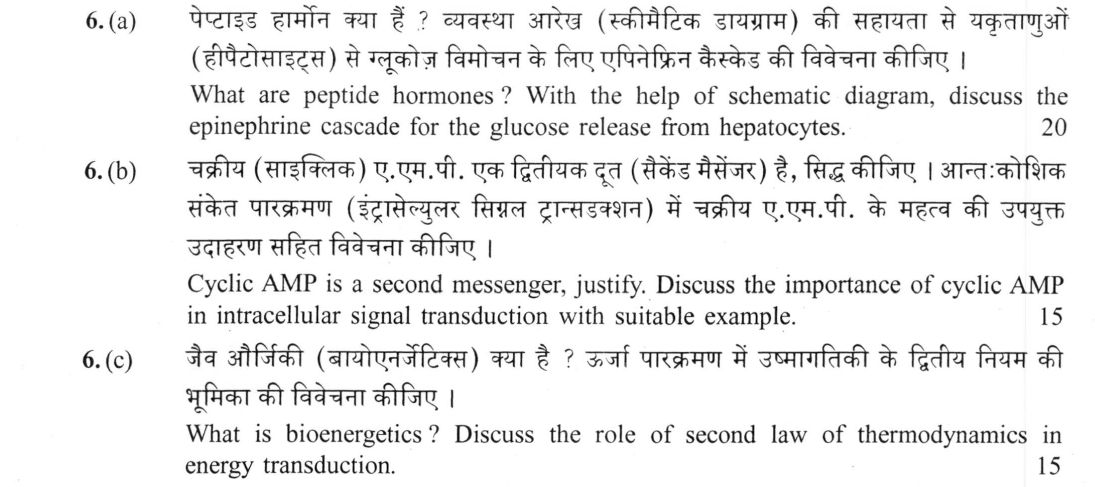
What are peptide hormones ? With the help of schematic diagram, discuss the epinephrine cascade for the glucose release from hepatocytes. 20 marks
Cyclic AMP is a second messenger, justify. Discuss the importance of cyclic AMP in intracellular signal transduction with suitable example. 15 marks
What is bioenergetics ? Discuss the role of second law of thermodynamics in energy transduction. 15 marks
हिंदी में प्रश्न पढ़ें
पेप्टाइड हार्मोन क्या हैं ? व्यवस्था आरेख (स्कीमेटिक डायग्राम) की सहायता से यकृताणुओं (हैपेटोसाइट्स) से ग्लूकोज विमोचन के लिए एपिनेफ्रिन कैस्केड की विवेचना कीजिए । 20
चक्रीय (साइक्लिक) ए.एम.पी. एक द्वितीयक दूत (सेकेंड मैसेंजर) है, सिद्ध कीजिए । अन्तःकोशिक संकेत पारक्रमण (इंट्रासेल्युलर सिग्नल ट्रांसडक्शन) में चक्रीय ए.एम.पी. के महत्व की उपयुक्त उदाहरण सहित विवेचना कीजिए । 15
जैव ऊर्जिकी (बायोएनर्जेटिक्स) क्या है ? ऊर्जा पारक्रमण में उष्मागतिकी के द्वितीय नियम की भूमिका की विवेचना कीजिए । 15
Model answer
Written by UPSC Answer Check against this question's marking rubric, to the expected length. UPSC does not publish answers for Mains — this is one way to score well, not an official key.
Peptide hormones are water-soluble, amino acid polymers ranging from oligopeptides to large glycoproteins that cannot cross the hydrophobic lipid bilayer of target cells. Consequently, they initiate physiological responses by binding specifically to extracellular domains of transmembrane cell-surface receptors, triggering intracellular signaling cascades.
Epinephrine Cascade for Hepatic Glucose Release
Although epinephrine is a catecholamine derivative, it exemplifies the classical G-protein coupled receptor (GPCR) paradigm shared with peptide hormones like glucagon. In hepatocytes, epinephrine binds to the cell-surface β₂-adrenergic receptor, altering its conformation and catalyzing the exchange of GDP for GTP on the associated heterotrimeric G_α s subunit.
The activated G_α s-GTP dissociates from the G_βγ complex and activates the membrane-bound enzyme adenylyl cyclase. Adenylyl cyclase hydrolyzes cytosolic ATP into cyclic AMP (cAMP). Cyclic AMP acts allosterically on Protein Kinase A (PKA), binding its two regulatory subunits and releasing two active catalytic subunits. PKA phosphorylates and activates phosphorylase kinase (b → a), which subsequently phosphorylates inactive glycogen phosphorylase b into its active a form. Glycogen phosphorylase a catalyzes the phosphorolytic breakdown of glycogen into glucose-1-phosphate, which is converted to glucose-6-phosphate by phosphoglucomutase. Finally, hepatic glucose-6-phosphatase hydrolyzes the phosphate group, and free D-glucose is released into the bloodstream via GLUT2 transporters.
`` Epinephrine + β₂-Adrenergic Receptor │ ▼ Active Gαs-GTP complex │ ▼ Adenylyl Cyclase │ (ATP ➔ cAMP) ▼ Protein Kinase A (PKA) │ ▼ Phosphorylase Kinase (b ➔ a) │ ▼ Glycogen Phosphorylase (b ➔ a) │ (Glycogen ➔ G-1-P) ▼ Glucose-6-Phosphate │ (Glucose-6-Phosphatase) ▼ Free Glucose Release (GLUT2) ``
Justification of cAMP as a Second Messenger
Cyclic adenosine 3',5'-monophosphate (cAMP) qualifies as a classic second messenger because it fulfills essential physiological criteria:
- Intracellular relay: It is synthesized inside the cell in response to an extracellular first messenger (hormone) binding to the plasma membrane.
- Rapid diffusion: Being small, hydrophilic, and stable, it diffuses rapidly through the cytosol.
- Geometric signal amplification: A single ligand-receptor interaction generates thousands of cAMP molecules, amplifying low-concentration endocrine signals.
- Regulated termination: It undergoes rapid hydrolysis to inactive 5'-AMP by phosphodiesterases (PDEs), ensuring tight temporal regulation.
- Effector versatility: It orchestrates coordinated downstream cellular changes through specific targets like PKA and Epac (exchange protein activated by cAMP).
In adrenocortical steroidogenesis, Adrenocorticotropic Hormone (ACTH) binds melanocortin-2 receptors (MC_2R), activating the Gₛ-adenylyl cyclase pathway. The resulting cAMP surge activates PKA, which phosphorylates steroidogenic acute regulatory (StAR) protein and hormone-sensitive lipase, facilitating cholesterol import into the inner mitochondrial membrane for cortisol biosynthesis.
Bioenergetics and the Second Law of Thermodynamics
Bioenergetics is the quantitative study of energy flow, conservation, and transformations in biological systems. Living systems obey the laws of thermodynamics, governed by the Gibbs free energy relationship:
Δ G = Δ H - TΔ S
The Second Law of Thermodynamics dictates that every natural, spontaneous process increases the total entropy of the universe (Δ Sᵤₙᵢᵥ > 0). Living cells are open, non-equilibrium systems that maintain local structural and metabolic order (Δ S_system < 0) by dissipating heat and exporting entropic waste (Δ S_surroundings > 0) into their environment.
In biological energy transduction, non-spontaneous endergonic reactions (Δ G > 0) are driven by coupling to exergonic processes (Δ G < 0). In mitochondrial oxidative phosphorylation, the exergonic transfer of electrons down the respiratory chain drives proton translocation, generating an electrochemical proton gradient (Δ μ_H⁺). The dissipation of this non-equilibrium proton gradient through ATP synthase provides the negative free energy change required to synthesize ATP from ADP and Pᵢ. However, energy transduction is inherently subject to thermodynamic inefficiencies, as a fraction of free energy is lost as metabolic heat (TΔ S).
Signal transduction cascades, such as the epinephrine-mediated pathway, illustrate how biological systems optimize thermodynamic efficiency. By coupling high-energy nucleotide hydrolysis at successive enzymatic steps, cells convert infinitesimal chemical stimuli into massive metabolic outputs, representing an evolutionarily conserved mechanism of non-equilibrium control across eukaryotic phyla.
What "Discuss" is asking you to do
Lay the issue out from more than one side — how it arose, what is claimed for it, what is held against it, and where it now stands. UPSC attaches discuss to broad topics with several live dimensions, so coverage of the dimensions earns more than the strength of your opinion.
Structure that answers it
Set the issue up → the case as it is made → the case against → the dimension both sides leave out → where the balance now lies
Where marks are lost
Listing facts with no thread between them, or arguing one side throughout and calling it a discussion.
How this answer will be evaluated
Approach
Framework: Zoology, Paper 2. (a) discuss: intro > 3-4 dimensions > example > balanced close | (b) justify: claim > 3-4 reasons > evidence > conclusion | (c) discuss: intro > 3-4 dimensions > example > balanced close Full marks: Comprehensive, accurate, and well-structured answers with clear diagrams and examples.
Key points expected
- Define peptide hormones as water-soluble, non-lipid soluble
- Schematic diagram of epinephrine binding to G-protein coupled receptor
- Activation of Adenylyl cyclase and conversion of ATP to cAMP
- Activation of Protein Kinase A (PKA) and phosphorylase kinase
- Define second messenger as intracellular signal relay
- Explain cAMP production from ATP by Adenylyl cyclase
- Describe cAMP activation of Protein Kinase A (PKA)
- Provide a suitable example of signal transduction
Evaluation rubric
Each sub-part is marked on its own, against the marks and word limit printed on the paper.
- (a) Define peptide hormones and explain the epinephrine cascade for glucose release in hepatocytes. 20 marks
discuss— intro → 3-4 dimensions → example → balanced close
Must cover
- Define peptide hormones as water-soluble, non-lipid soluble
- Schematic diagram of epinephrine binding to G-protein coupled receptor
- Activation of Adenylyl cyclase and conversion of ATP to cAMP
- Activation of Protein Kinase A (PKA) and phosphorylase kinase
Loses marks
- Confusing peptide hormones with steroid hormones
- Diagram missing the G-protein or Adenylyl cyclase step
- Failing to link the cascade to glucose release
Earns more
- Mention of Gs protein alpha subunit activation
- Inhibition of glycogen synthase by PKA
- Final step: Glycogen phosphorylase converting glycogen to glucose-1-phosphate
Extra mark
- Mention of cAMP breakdown by Phosphodiesterase
- Specific mention of liver-specific Glucose-6-phosphatase
- (b) Justify cAMP as a second messenger and discuss its role in intracellular signal transduction. 15 marks
justify— claim → 3-4 reasons → evidence → conclusion
Must cover
- Define second messenger as intracellular signal relay
- Explain cAMP production from ATP by Adenylyl cyclase
- Describe cAMP activation of Protein Kinase A (PKA)
- Provide a suitable example of signal transduction
Loses marks
- Confusing cAMP with a first messenger
- Failing to explain the mechanism of cAMP action
- No example provided
Earns more
- Mention of cAMP as a universal second messenger
- Explanation of signal amplification by cAMP
- Example of cAMP in muscle or liver cells
Extra mark
- Mention of cAMP in other signaling pathways
- Specific example of cAMP in a named organism
- (c) Define bioenergetics and discuss the role of the second law of thermodynamics in energy transduction. 15 marks
discuss— intro → 3-4 dimensions → example → balanced close
Must cover
- Define bioenergetics as study of energy flow in living systems
- State the second law of thermodynamics (entropy increases)
- Explain how energy transduction increases entropy
- Link to biological processes like respiration or photosynthesis
Loses marks
- Confusing bioenergetics with general thermodynamics
- Failing to explain the second law's role in energy transduction
- No link to biological processes
Earns more
- Mention of Gibbs free energy (ΔG) in energy transduction
- Explanation of energy loss as heat in biological systems
- Example of energy transduction in a specific organism
Extra mark
- Mention of ATP as energy currency
- Specific example of energy transduction in a named organism
Practice this exact question
Write your answer and it is marked point by point against the model answer above — what you covered, what you missed, what you got wrong.
Evaluate my answer →More from Zoology 2021 Paper II
- Q3 (a) What is chromosome mutation ? Describe various types of polyploidy with suitable exam…
- Q4 (a) What is isolation ? Describe the major isolating mechanisms which lead to speciation.…
- Q5 Write your answer in about 150 words for each of the following : 10×5=50 (a) Fatty acids…
- Q6 (a) What are peptide hormones ? With the help of schematic diagram, discuss the epinephri…
- Q7 (a) Explain the basic stimuli causing pancreatic secretion. Discuss the role of pancreas…
- Q8 (a) What are morphogens ? Describe the cellular differentiation during morphogenesis. 20…