Paper I — Q1
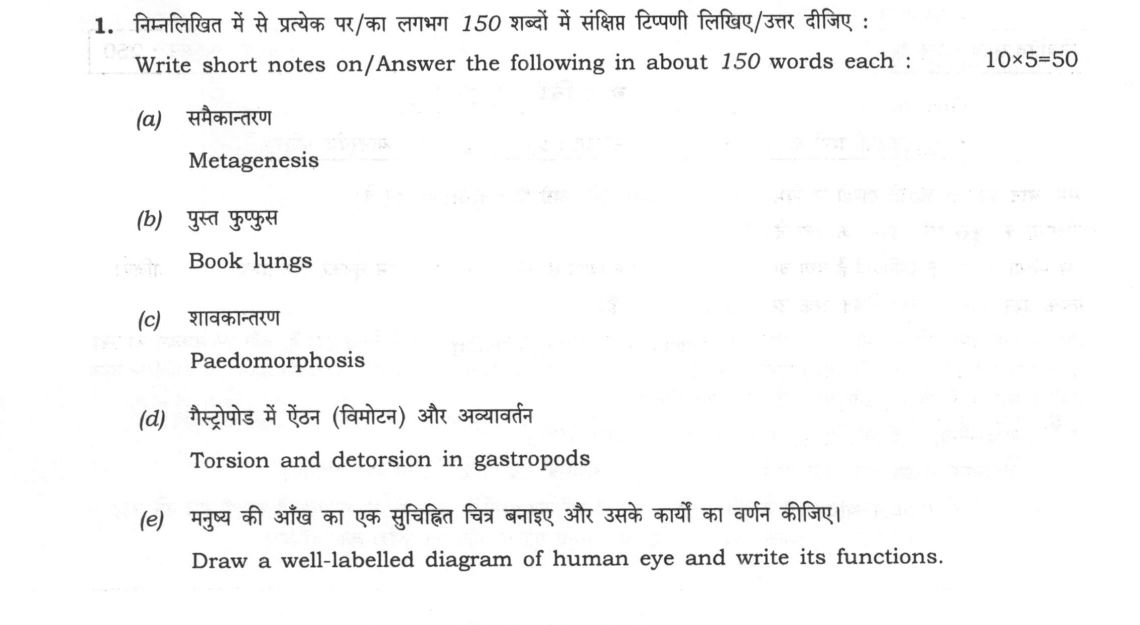
Write short notes on/Answer the following in about 150 words each: 10×5=50 (a) Metagenesis (b) Book lungs (c)…
Write short notes on/Answer the following in about 150 words each: 10×5=50
Metagenesis
Book lungs
Paedomorphosis
Torsion and detorsion in gastropods
Draw a well-labelled diagram of human eye and write its functions.
हिंदी में प्रश्न पढ़ें
निम्नलिखित में से प्रत्येक पर/का लगभग 150 शब्दों में संक्षिप्त टिप्पणी लिखिए/उत्तर दीजिए : 10×5=50
संमेकांतरण
पुस्त फुप्फुस
शावकांतरण
गैस्ट्रोपोड में ऐटन (विमोटन) और अव्यावर्तन
मनुष्य की आँख का एक सुचिहित चित्र बनाइए और उसके कार्यों का वर्णन कीजिए।
Model answer
Written by UPSC Answer Check against this question's marking rubric, to the 150-word length. UPSC does not publish answers for Mains — this is one way to score well, not an official key.
(a) Metagenesis. Metagenesis is the alternation of two multicellular generations in Cnidaria: an asexual polyp generation and a sexual medusa generation. In Obelia, the polyp colony reproduces asexually by budding, producing free-swimming medusae; medusae produce gametes, and fertilisation gives a planula larva that settles and develops into a new polyp. The term is used because the two phases differ in form and mode of reproduction, and the cycle is completed only when both generations are present. It is not identical with true alternation of generations in plants or some algae, where a spore phase is produced by meiosis and both generations are independent. In cnidarian metagenesis, meiosis occurs in the medusa during gamete formation, not in spore formation, and the polyp is not a spore phase. Thus metagenesis is a cnidarian-specific form of alternation, important for understanding life cycles, reproduction, and complex diploblastic life histories.
(b) Book lungs. Book lungs are respiratory organs of many arachnids, especially spiders and scorpions. They consist of a chamber filled with hemolymph in which numerous thin, leaf-like lamellae are stacked like pages of a book. Air enters through spiracles and diffuses across the thin epithelial surfaces of the lamellae, where oxygen passes into hemolymph and carbon dioxide is released. Unlike simple cutaneous diffusion, book lungs are actively ventilated by body movements: sternite movements in scorpions and abdominal muscle contractions in spiders compress the chambers and renew air. This active ventilation improves gas exchange but limits the rate of oxygen supply compared with tracheal systems of insects, so book-lunged arachnids are less suited to sustained high metabolic activity. Book lungs should be contrasted with book gills of horseshoe crabs such as Limulus, which are external, feathery, and adapted to aquatic respiration. Their structure shows how arachnids modified respiratory surfaces for terrestrial life.
(c) Paedomorphosis. Paedomorphosis is a heterochronic evolutionary pattern in which adults retain juvenile or larval characters. It arises when the timing of developmental events changes. Two mechanisms are recognised. In neoteny, somatic development is delayed, so the organism reaches sexual maturity while possessing juvenile body forms; the axolotl, Ambystoma mexicanum, is an example, retaining external gills, aquatic habits, and larval skull proportions while reproducing. In progenesis, sexual maturation is advanced while somatic growth continues later, so adults may be small but reproductively mature. Paedomorphosis is not simply arrested development; it can be adaptive, allowing retention of useful larval traits such as aquatic respiration. In humans, evolutionary biologists sometimes refer to fetalization or neotenous retention of juvenile features, such as a relatively flat face, large brain relative to body, and prolonged growth period, though this is debated. Paedomorphosis is significant because changes in developmental timing, not only new structures, can produce major evolutionary novelties.
(d) Torsion and detorsion in gastropods. Torsion is a developmental event in prosobranch gastropod larvae, in which the visceral mass, mantle cavity, and associated organs rotate 180° counter-clockwise relative to the head and foot. As a result, the originally posterior mantle cavity, gill, and anus are brought anteriorly above the head. Torsion also twists the visceral nerve cords into a figure-of-eight, producing a ligation. Functionally, it may help orient the mantle cavity for chemoreception and protection, but it destroys original bilateral symmetry, creates body-plan asymmetry, and can lead to loss or reduction of the gill and auricle in some groups. Detorsion is the partial or complete reversal of this rotation in some opisthobranchs and pulmonates. It does not restore external bilateral symmetry, because the coiled shell, asymmetric visceral mass, and other modifications remain. Detorsion is partial and is evolutionarily important as a reversal of an early gastropod innovation, allowing repositioning of the mantle cavity in lineages.
(e) Human eye diagram. A well-labelled sagittal section of the human eye should show the cornea, sclera, choroid, and retina. The cornea and sclera form the outer fibrous tunic; the choroid is vascular; the retina is neural. The iris, with its pupil, controls light entry. Behind the iris, the lens is suspended by suspensory ligaments from the ciliary body; ciliary muscle contraction relaxes the ligaments, allowing the lens to thicken for near vision. The retina contains photoreceptors, rods for dim light and cones for colour and acuity, with a fovea for sharp vision. The optic disc is the blind spot where ganglion cell axons leave as the optic nerve. In the retina, photoreceptors synapse with bipolar cells, which relay signals to ganglion cells; horizontal cells modulate the outer plexiform layer. The eye forms an inverted image on the retina, and the brain reverses it for upright vision. Its functions are refraction, accommodation, photoreception, and image formation.
What "Write short notes" is asking you to do
Five or six self-contained answers, marked separately, typically 10 marks and about 150 words each. Each note must carry its own definition, its two or three defining features and a line on why it matters; a common introduction or conclusion across the notes earns nothing.
Structure that answers it
Per note: one-line definition or identification → two or three features, mechanisms or named examples → one line of significance or Indian application
Where marks are lost
Writing the first two notes at essay length and rationing the rest. Each note is marked on its own, so marks surrendered on a compressed or unattempted note cannot be won back by the long ones.
How this answer will be evaluated
Approach
Framework: Zoology Paper 1: Define > Structure/Mechanism > Diagram > Example. (a) write short notes: define > 3-4 key features > one example > one-line significance | (b) write short notes: define > 3-4 key features > one example > one-line significance | (c) write short notes: define > 3-4 key features > one example > one-line significance | (d) write short notes: define > 3-4 key features > one example > one-line significance | (e) describe: define > structure or process in order > labelled diagram > significance Full marks: Precise definitions, named taxa, clear diagrams, and functional explanations.
Key points expected
- Define metagenesis as alternation of generations
- Distinguish asexual (sporic) and sexual (gametic) phases
- Name a specific taxon (e.g., Obelia, Fasciola)
- Describe the life cycle stages in order
- Define book lungs as respiratory organs
- Describe the lamellae (pages) structure
- Name the taxon (e.g., Arachnida, Scorpiones)
- Explain the mechanism of gas exchange
Evaluation rubric
Each sub-part is marked on its own, against the marks and word limit printed on the paper.
- (a) Define metagenesis and describe the alternation of generations. · 150 words
write short notes— define → 3-4 key features → one example → one-line significance
Must cover
- Define metagenesis as alternation of generations
- Distinguish asexual (sporic) and sexual (gametic) phases
- Name a specific taxon (e.g., Obelia, Fasciola)
- Describe the life cycle stages in order
Loses marks
- Confusing metagenesis with simple regeneration
- Omitting the specific taxon example
Earns more
- Mention specific larval stages (e.g., planula, miracidium)
- Note ecological significance of the two phases
Extra mark
- Reference a specific recent study on life cycle plasticity
- (b) Describe the structure and function of book lungs. · 150 words
write short notes— define → 3-4 key features → one example → one-line significance
Must cover
- Define book lungs as respiratory organs
- Describe the lamellae (pages) structure
- Name the taxon (e.g., Arachnida, Scorpiones)
- Explain the mechanism of gas exchange
Loses marks
- Describing lungs of mammals instead
- Failing to name the specific arachnid group
Earns more
- Mention the role of the spiracles
- Note the counter-current flow if applicable
Extra mark
- Comparison with tracheal systems in other arthropods
- (c) Define paedomorphosis and explain its evolutionary significance. · 150 words
write short notes— define → 3-4 key features → one example → one-line significance
Must cover
- Define paedomorphosis (neoteny/peramorphosis)
- Explain the mechanism (developmental timing)
- Name a classic example (e.g., Axolotl, Lamprey)
- Link to evolutionary adaptation
Loses marks
- Confusing with simple larval survival
- Failing to provide a named taxon example
Earns more
- Distinguish between neoteny and peramorphosis
- Mention the role of hormones (e.g., T3 in axolotl)
Extra mark
- Reference a specific molecular mechanism (e.g., Hox genes)
- (d) Explain torsion and detorsion in gastropods. · 150 words
write short notes— define → 3-4 key features → one example → one-line significance
Must cover
- Define torsion (180-degree rotation)
- Explain the function (protection of siphon/foot)
- Define detorsion (reversal of torsion)
- Name a taxon showing detorsion (e.g., Cephalaspidea)
Loses marks
- Confusing torsion with simple coiling
- Failing to explain the functional advantage
Earns more
- Mention the kinesis of the visceral mass
- Note the impact on the nervous system (strobilation)
Extra mark
- Reference a specific study on the evolutionary origin of torsion
- (e) Draw a labelled diagram of the human eye and describe its functions. · 150 words
describe— define → structure or process in order → labelled diagram → significance
Must cover
- Draw a clear, labelled diagram of the human eye
- Label key structures (cornea, lens, retina, etc.)
- Describe the function of the eye (vision)
- Explain the mechanism of image formation
Loses marks
- Diagram without labels
- Failing to describe the function of the eye
Earns more
- Mention the role of the ciliary muscles in accommodation
- Note the function of the optic nerve
Extra mark
- Reference a specific visual pathway (e.g., optic chiasm)
Practice this exact question
Write your answer and it is marked point by point against the model answer above — what you covered, what you missed, what you got wrong.
Evaluate my answer →More from Zoology 2025 Paper I
- Q1 Write short notes on/Answer the following in about 150 words each: 10×5=50 (a) Metagenesi…
- Q2 (a) Describe the comparative anatomy of digestive system in vertebrates. 20 (b) Give an i…
- Q3 (a) Describe the mechanism of parental care in amphibians with suitable examples. 20 (b)…
- Q4 (a) Draw a well-labelled diagram of testis and ovary in mammals, and discuss the function…